Daily insights for city builders, delivered every morning at 6 AM ET. I’m Brandon Donnelly — a Toronto-based real estate developer and founder of Globizen. I’ve been writing here since 2013.

Month: September 2024

  • An Ethereum story

    We’ve spoken about Vitalik Buterin before.

    He is the inventor of the Ethereum blockchain, and its most prominent figure. He also happens to have grown up in Toronto. He went to the University of Waterloo. So when I wrote this post back in 2021, I asked: Why the hell is nobody talking about this? Why are we not celebrating the fact that our great city helped birth one of the most important technologies of our time? You couldn’t ask for a better economic development story. Well, I guess the answer is twofold. Crypto isn’t mainstream. Even back in 2021 when things were frothy it wasn’t. And, we’re awful at promoting and driving a global brand for our city. Both of these things need to change. So if you’re interested in learning more about Vitalik and Ethereum, you should check out this new movie (trailer) called Vitalik: An Ethereum Story. To watch it, go to ethereumfilm.xyz and mint the NFT for $20. You’ll then be able to stream it. I haven’t done this yet, but I’ll be doing it very soon. All of the proceeds from the NFT sales will go toward getting a more mainstream distribution deal.

    So by watching, you’re helping.

    Update: I watched it. It’s great.

  • Vancouver’s social housing initiative

    Vancouver just put forward a bold proposal to encourage more social, or non-market housing, across the city. As drafted, new social housing projects up to 6 storeys would be permitted as-of-right in “villages” and social housing between 15-18 storeys would be permitted as-of-right in “neighborhood centers.” This is a big deal. I mean, look at the above map. Between these two area designations, big chunks of the city would receive these new permissions. For more information on the proposal, check out this short video.

  • Kids in Europe

    I don’t have any kids, so I’m probably unqualified to opine on this topic. But every time I’m in Europe, I notice that children seem to have a different relationship with cities and that parents seem to socialize them a little differently. Here’s an example of what I mean by that. Last month, when Neat B and I were in Biarritz, we had a wonderful evening hanging out at this restaurant/bar:

    We had just finished our first surf lesson, we were on an endorphin high, and we wanted to be outside to see the sunset. So we sat on the above steps, and we had some food and drink off of a small wooden stool. It was simple and unglamorous; it was perfect.

    The place also stayed busy all night and, looking around, there were lots of young kids out. The parents were socializing and doing their thing — including across the street next to the water — and the kids were just playing quietly on their own. It’s as if the city was their own backyard and everyone was just doing what they felt like.

    It is something that always strikes me as being different compared to North America. Here, we’ve, in many cases, convinced ourselves that you need a garage and a backyard to properly raise a child. But maybe all that is needed is a concrete step, a small wooden stool, and a more laid-back approach to enjoying what cities have to offer.

  • Toronto is looking to remove garden suite zoning permissions from this street

    Toronto has been making great progress when it comes to allowing more housing in its low-rise neighborhoods. We now allow laneway suites, garden suites, multiplexes, and soon we’ll allow 6-storey apartments. But interestingly enough, there is one small part of the city that is looking to regress. This past summer, council asked planning staff to bring forward a zoning by-law amendment to remove garden suite permissions for some of the properties backing onto Craven Road, near Danforth and Coxwell.

    Here’s a community consultation flyer that went out to residents and that shows the affected properties:

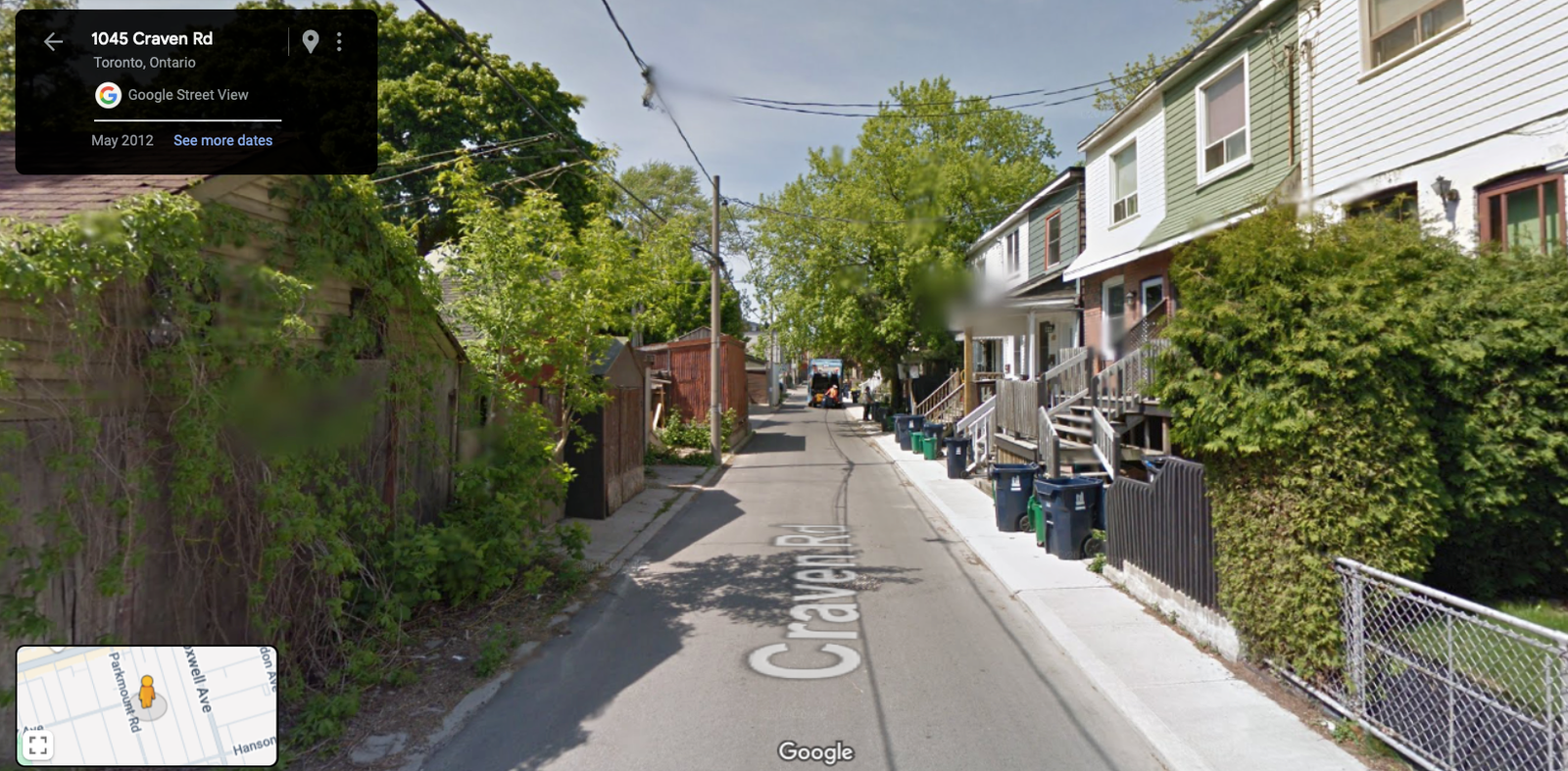
    We’ve spoken about Craven Road before. It’s a relatively odd street with a unique history. Its most obvious characteristic is that it’s a kind of single-sided street. For the most part, there are homes on the east side of the street, but no homes on the west side. On the non-home side there is typically a garage, or the longest municipally-owned fence in the city. Here’s some of the backstory on Craven Road’s infamous fence (which occurs on a stretch further south), and below is what the study area in question looks like today:

    So why remove the garden suite permissions here? The answer is to block housing. The people who live on Craven Road like it the way it is and don’t want anyone to build new housing on the other side of the street. What’s interesting about this is that it roughly mirrors what happened over a century ago. We couldn’t figure out how to broker a deal between two adjacent streets and so we just said “screw it, let’s build a really really long fence and call it a day.”

    Today we’re saying, “yeah, we really need more housing in the city, but I dunno, somebody might get upset here.” There is nothing sacrosanct about the old garages, or the fence, that line the west side of Craven. It is a street, proximate to a major subway station, that is missing homes on one entire side. It’s low hanging fruit for infill housing. In fact, there’s an easy argument to be made that garden suites aren’t nearly enough density for a location like this. We should be encouraging a lot more.

    But this is just my opinion. If you’d like to share yours, the City of Toronto is hosting a community meeting this week on September 19, 2024 from 7 – 830 PM. To participate, register here.

  • Uber and Waymo announce exclusive partnership in Austin and Atlanta

    Waymo and Uber just announced a partnership that will bring Waymo’s autonomous vehicles to the Uber app in Austin and Atlanta. Notably, this is an exclusive partnership, meaning the only way you’ll be able to summon a Waymo vehicle in these cities will be through Uber.

    The people who follow this space closely, people like Reilly Brennan of Trucks (VC) and Harry Campbell (The Rideshare Guy), think this is a really big deal for a number of reasons.

    One, it signals a bifurcation in the industry where there will be companies, like Waymo, that supply autonomous vehicles, and companies, like Uber, that operate them and manage the overall ride hailing marketplace. As part of this deal, Uber is going to handle all of the maintenance and cleaning of the vehicles. This split is similar to the airline industry.

    Two, it suggests, and this is Harry’s argument, that Waymo needs Uber more than Uber needs Waymo. One of the reasons for this is that a 100% AV fleet is simply too expensive to operate if you’re solving for peak demand loads. Because during off-peak times, you then need to pay for downtime.

    Uber, on the other hand, doesn’t pay for downtime with its human drivers. Most of its drivers are part-time and only plug in when they want to or when the surge pricing becomes too attractive to pass up. So they’re the perfect compliment to an AV fleet. Harry argues that this is part of Uber’s competitive moat.

    And three, it signals that AVs are really starting to arrive, if not already here. The hype cycle certainly hit its trough of disillusionment and everyone switched to thinking that AVs weren’t going to happen for many years, if not decades. But now it’s happening. City by city.

  • I finally tried Apple Vision Pro

    I know I’m late to the party on this, but I finally tried Apple Vision Pro this weekend. I was in the Apple Store at the Toronto Eaton Center getting the battery replaced in my phone, so I decided to do a demo. And let me tell you — I was totally blown away. I messaged everyone I knew (after I got my phone back) and told them that they need to try it.

    To be clear, though, very few people right now want to actually buy this computing device. Initially, Apple was thinking that it would sell upwards of 800,000 units this year. But now it expects to sell somewhere closer to 400,000. Maybe. The device is too expensive, too bulky, and the use cases just aren’t there for someone to feel they need to buy it.

    I also found that, when I was looking at the world around me, I could tell I was looking at a video. It wasn’t exactly perfect. (Vision Pro creates a mixed-reality experience by recording the world around you and then playing it back to you.) But that’s okay. The hardware will get better. The price will come down. And the developer community will build a bunch of killer apps that nobody has even thought of yet.

    None of this changes the fact that the device is still an astonishing technical achievement. The eye tracking works perfectly. All of my hand gestures were flawlessly picked up. And the overall experience was entirely immersive — from 3D videos (recorded on regular iPhones) to a butterfly landing on my hand and a velociraptor flaring its nostrils right in front of me.

    What was most impactful to me is that I could easily imagine a future where all of this works. Is this a more exciting way to watch sports? Yes. I sat courtside and Lebron dunked in my face. Is this a better way to watch movies on a plane? By far. Will this be used to help build buildings and coordinate design & engineering disciplines? Yes, absolutely, among many other things.

    It is also easy to imagine how spatial computing is likely to dovetail with other innovations such as AI and blockchains. Mixed-reality or extended reality blurs the line between physical and digital. And in my mind, AI becomes the way in which we will want to interact with this new computing world. (It’s not easy to type on a virtual keyboard.)

    At the same time, digital artifacts will come to be viewed much differently when they’re all blended in. An NFT sitting in a cold wallet is going to feel a lot different than an NFT hanging in a fully immersive 3D gallery that is viewed by millions of people. This strengthens the case for blockchains, and the ownership of digital objects, products, and services.

    Maybe this is really far into the future. I don’t know. But regardless, if you haven’t already, I would encourage you to book a demo at your local Apple Store. However cool and great you think it will be, it will be better. I’m not suggesting you should buy one, but I am suggesting that you need to try it out and see a glimpse into the future.

    And if any of you are working on Apple Vision Pro software that is somehow connected to the design and construction industry, I would love to hear from you and learn more about what you’re up to. I have complete conviction that this will form the future of our industry. The best place to reach out is here.

  • Density vs. infrastructure in Liberty Village

    A beautiful new 43-storey rental building was just approved in Toronto’s Liberty Village neighborhood. More info about the project can be found, here. Not surprisingly, some people in the community were against it. Here is a recent article that blogTO published talking about people who live in high-rises not wanting a new high-rise next to them.

    One argument that is being made is that the neighborhood is already full. It has reached its density limit. We also hear this about the City of Toronto as a whole. But we know this isn’t true. Architect Naama Blonder recently did a study that found we could fit another 12 million people within our boundaries with more efficient land use policies.

    This particular site in Liberty Village is also about 400 meters from a future subway stop on the Ontario Line. So it is exactly where we should be putting more density. The problem today is that the area is suffering from a massive infrastructure deficit. The road network is inadequate and the King streetcar hasn’t been prioritized.

    It’s no wonder the area feels full. But the reality is that there are lots of examples of highly livable neighborhoods from around the world with much higher population densities. The difference is that they have the right infrastructure, the right public realms, and the right modal splits.

    Liberty Village will get there as well and it’s already underway. For a preview of the future, check out the City of Toronto’s Public Realm Strategy for the area. It was published in April 2024 and it includes things like new streets, new mid-block connections, and new parks. It is what the area needs and it’s exciting to see it happening.

  • Developers are optimists

    I started a new French class his week. Most of my classmates are regulars, but since we have a new teacher, we were all asked to introduce ourselves. And to spice things up, we were asked to talk about whether we’re glass half full or half empty kind of people.

    When it came to my turn, and before I could answer, one of my classmates jumped in and said “Brandon est un optimiste.” And you know what, this made me happy. I took it as a great compliment.

    Because to be a real estate developer, I think you need to be an optimist. I have argued this before on the blog.

    This is not to say that you don’t need to carefully manage risk, and think about all of the things that can and probably will go wrong. It is say that the inertia working against you is so great, that you really need to believe in the future you are trying to create. If not, you’re liable to not make it.

    So this morning, when my partner Lucas showed me the below quote from Nobel Prize winner Daniel Kahneman, I immediately thought, “yeah, this is going on the blog.”

    “If you are allowed one wish for your child, seriously consider wishing him or her optimism. Optimists are normally cheerful and happy, and therefore popular; they are resilient in adapting to failures and hardships, their chances of clinical depression are reduced, their immune system is stronger, they take better care of their health, they feel healthier than others and are in fact likely to live longer.

    Optimistic individuals play a disproportionate role in shaping our lives. Their decisions make a difference; they are the inventors, the entrepreneurs, the political and military leaders – not average people. They got to where they are by seeking challenges and taking risks. They are talented and they have been lucky, almost certainly luckier than they acknowledge… the people who have the greatest influence on the lives of others are likely to be optimistic and overconfident, and to take more risks than they realize.”

    This excerpt is from Kahneman’s book, Thinking, Fast and Slow. I haven’t read it. But now I want to.

  • Development charges are an insidious problem

    Here is a recent chart from Mike Moffat showing how much development charges have increased in the City of Toronto from 2009 to today:

    We’ve, of course, seen this before. Back in 2020, I shared an article that developer Urban Capital published where they did a cost comparison between a project they had done in 2005 and a project they were doing in 2020. What they uncovered was that development charges alone had increased by 3,244%! The most of any line item in their pro forma.

    Development charges over the last real estate cycle have been an insidious problem. Meaning, the industry knew they were crazy high, and we were all trying to be vocal about it, but let’s face it — the general public doesn’t have a lot of sympathy for developers complaining about high fees. They are also largely hidden from purchasers and renters. The charges just get lumped in.

    If our industry could figure out how to be more transparent and separate out these charges, much like a sales tax, I think it would go a long way to showing consumers what they’re actually paying when it comes to new housing. And then maybe something positive would happen. Because this is a major reason why new housing has gotten so expensive in this region.

    Can you imagine if property taxes had increased by 3,244% over the last 15 years? I can’t. Because no one would have ever allowed that to happen.

    For better and for worse, the current market is going to serve as a rude awakening for municipalities. We’ve reached the breaking point. The housing market is, as we’ve talked about, in a “state of economic lockdown.” And when people don’t buy new homes, it means developers no longer have the money to pay development charges.

  • Autonomous vehicles are already safer than human-driven ones

    Waymo has started releasing statistics for its autonomous vehicles. Here’s the link.

    There are a number of important considerations when comparing human-driven and autonomous vehicles. For instance, the two have different definitions of a crash. AV operators have to report any kind of physical contact (property damage, injury, or fatality). Human-driven cars, on the other hand, don’t typically report accidents unless it was bad enough to necessitate a police report. So there are nuances to keep in mind.

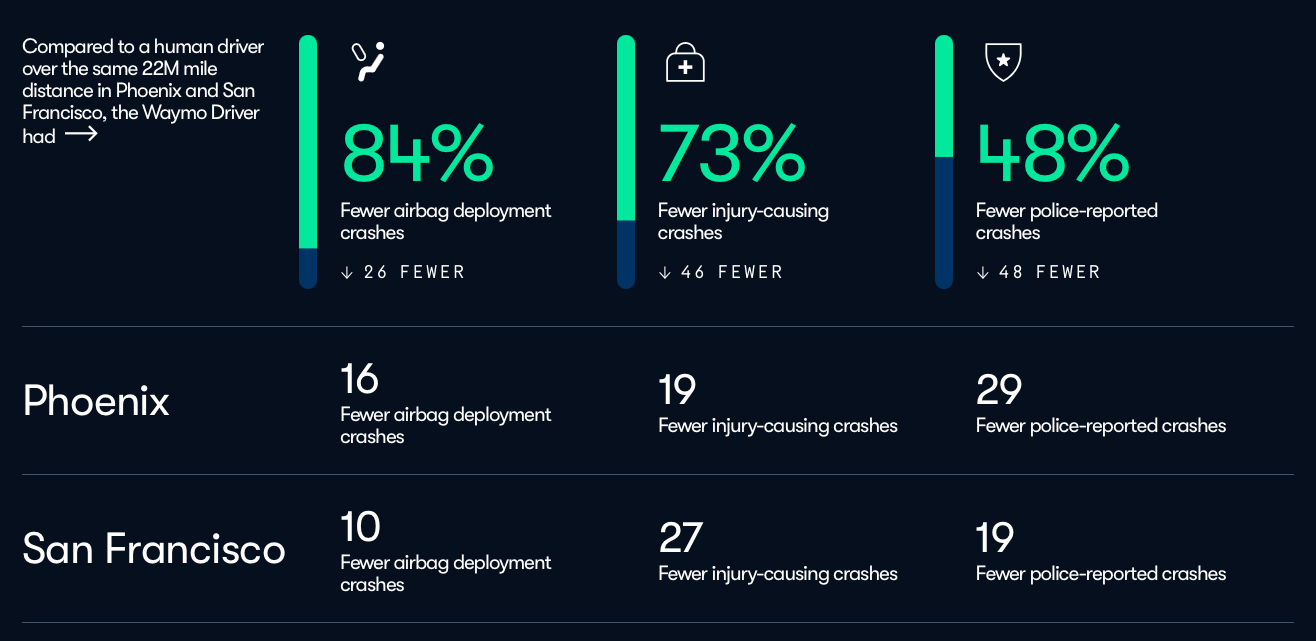
    That said, there is an argument to be made that AVs are already safer than human-driven ones. Through to June 2024, Waymo had already logged over 22 million rider-only miles. And here is what it is now reporting in terms of airbag deployments, injury-causing crashes, and police-reported crashes:

    All of them are lower than their respective benchmark crash rates.