Daily insights for city builders, delivered every morning at 6 AM ET. I’m Brandon Donnelly — a Toronto-based real estate developer and founder of Globizen. I’ve been writing here since 2013.
I was a little surprised by some of the numbers here, namely municipal fees. But that is not the point here. The point is that this is a great idea and that, judging from the comments on Twitter, many people seem to want this.
The obvious benefit is that it allows consumers to better understand where their money is going. But I also think that by showing people all of the costs that get levied on new housing, it could benefit the overall development industry.
What do you think? Should developers in Toronto adopt a similar approach? Let me know in the comments below.
We have spoken before about buildings, such as this 6-storey one in Paris, that were allowed to be built with only a single exit stair. This is noteworthy because, here in Canada, if you were to try and build an equivalent 6-storey building on an equivalent 100 square meter site, you would be required to have two exit stairs. And that would create more non-leasable space and make it even more challenging to develop such a small building.
It is for this reason that single-stair buildings have been getting an increasing amount of attention as of late. They are seen as a way of encouraging more missing middle housing.
So where are single-stair buildings currently allowed? Below is a map from Seattle-based Larch Lab showing the maximum number of storeys for point access blocks (what they call single-stair buildings) around the world. Based on this, Canada is one of the most conservative countries on the planet when it comes to required exiting (I don’t want to speak for any of the grayed-out countries). It also shows that much of the world allows 6 or more storeys.
Larch Lab is a major advocate for point access blocks and they have this policy brief outlining the problem and the opportunities. One of their most interesting statistics has to do with minimum project size inflation. As recent as 2000, only about 13% of all multifamily completions in the US had more than 50 units. Today, this number has jumped to more than 55% of all new multifamily buildings, meaning we are quickly losing our ability to build small and intimate.
Point access blocks can help with this.
Of course, the reason we have exiting requirements in our building codes is because of life safety. But there’s research to suggest that this level of redundancy may not be needed in certain buildings. According to the above policy brief, the average death rate (caused by a building) in point access block countries like Switzerland, France, Italy and Germany, is significantly lower than that of the US. On top of this, almost no countries in the EU require buildings less than 28m tall to be sprinklered. The US does.
All of this said, I don’t think that single-stair buildings are a silver bullet for missing middle housing. It is just one important ingredient in a complicated recipe. And as evidence of this, we can look to Seattle. The 2018 Seattle Building Code allows point access blocks up to 6 storeys, which is a rare occurrence in the US. However, the city appears to be still working on missing middle reform. Presumably other ingredients are still — missing.
Approving new housing is one thing. And it is an important one thing. But you also need to sell/lease and finance the project. And that is a lot more challenging in today’s environment compared to a few years ago. I think a lot of people look at our cities, see a shortage of housing, and wonder why developers don’t just build more of it. But it’s not that simple:
“Our industry is now taking a second look at our [calculations] and saying it’s costing more to build, it’s costing more to lend,” he said. “And there is a threshold in regards to what a purchase price or sale price can be. So there’s a bit of a pause in the market right now in regards to starting construction.”
Throughout this last development cycle and, in particular, during the pandemic, development costs increased dramatically. But the revenue side was also increasing — meaning you could sell and/or lease space for more. That kept development going. You could still successfully underwrite new projects.
But now the cost of debt has increased and the revenue side has expectedly slowed both in terms of pricing and velocity. This dramatically changes the feasibility of new projects, which means the market is going to need time to adjust to this new environment. This, of course, will happen. But in the interim (i.e. right now), it is going to mean a lot less new housing.
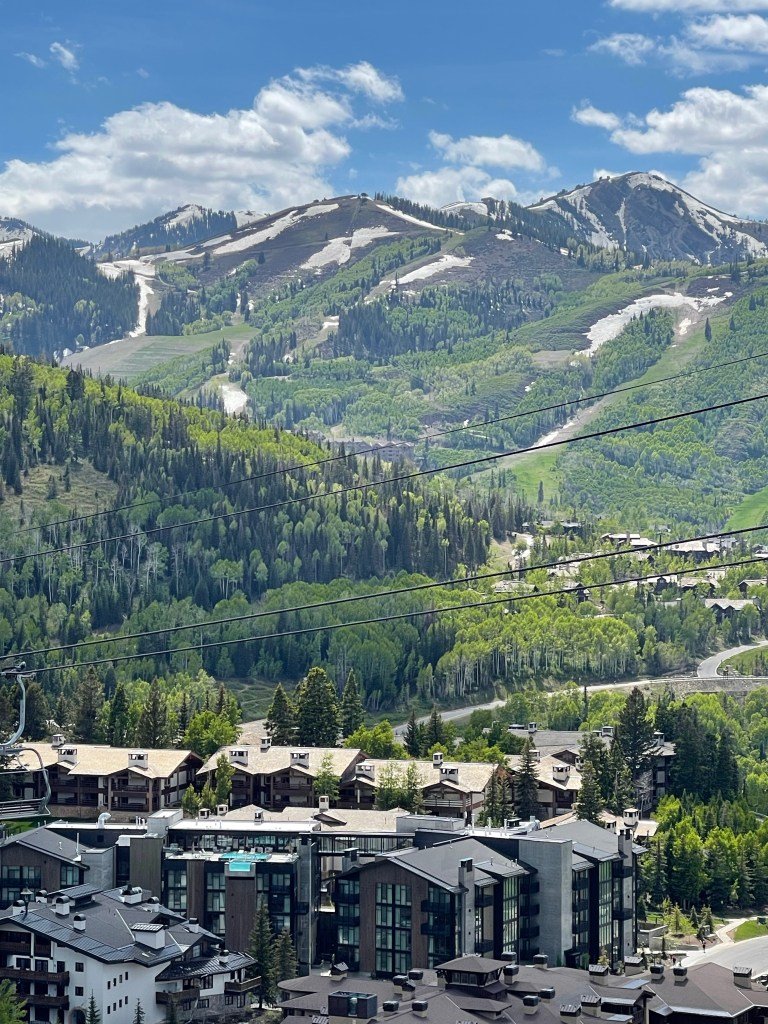
We spent his morning meeting with prospective property managers for Parkview Mountain House. Here’s what we learned about the short-term rental market in Park City, Utah:
Property management fees generally range from 20-35% of revenue (these are turnkey solutions)
Airbnb is somewhere around 80% of the market here; though it does tend to skew toward slightly smaller rentals, whereas VRBO skews larger
Sundance Film Festival and New Year’s Eve are the two busiest times in Park City (demand greatly exceeds the available vacation rentals — 120%?)
Many Sundance guests tends to be people on expenses accounts: not price sensitive, but apparently very demanding
Winter is obviously peak demand because of snowboarding and skiing, but demand is still strong in the summer because of cycling, hiking, golfing, fishing, etc.
The two slowest times are spring (mud season) and fall
Many PMs will track booking lead times, which is the period of time between booking and check-in
This past winter season, demand was strong but average lead times were way down — meaning people were booking last minute and responding to snowstorms
During heavy snowfall seasons, like the one Utah had this past winter, you’ll likely need to budget for roof snow clearing (a few thousand for the season)
Heated driveways are a very good idea in the mountains
The most popular / most searched amenity is by far a hot tub; servicing one will run you about $125 per month
I always find it fascinating to dig in and learn about a new industry and/or market. And that’s exactly what we did this morning.
I am in Park City for the weekend because we just started site works for Parkview Mountain House (PMH).
When you’re building in the mountains, there are generally two types of sites: sites that are uphill from the road and sites that are downhill from the road.
The latter is significantly harder to build on because you have to first create access to the lot, which means bringing in soil and creating a ramp. You may also end up craning in materials.
Thankfully, our site is on the uphill side. You bring in an excavator, dig into the mountain, and then you have a flat workable site.
That’s what we’re doing on site right now and it’s what you’re seeing above — a big hole in the side of a mountain. And it’s pretty exciting.
I learned this morning that Statistics Canada publishes a real-time population counter and that it is currently hovering at just below 40 million people:
So by the time that many of you read this post, Canada will likely be over the 40 million mark. If you’d like to see for yourself, you can do that here.
It’s 158m tall and about 40 storeys (which makes it comparable in height to One Delisle). It’s extremely narrow in one direction (see above), and so from central Paris it is intended to be read as a kind of thin pencil tower. But when viewed in the east-west direction, you get the full width of its trapezoidal shape (see above, again).
Not surprisingly, this has been a highly contentious development — which is why it was 15 years in the making. It is now under construction, though, and it is expected to be completed sometime in 2026. But this is likely to be the last tower in Paris for quite some time.
Partially because of this Triangle Tower, Paris has just decided to ban tall buildings in the city. The new height limit is now back to 37 meters (or 12 storeys), which is essentially the same height cap that was put in place in 1977 following completion of the Tour Montparnasse.
So this is seemingly how things work in Paris. Somebody builds a tall tower. People mostly hate it. And then the city bans tall buildings for a number of decades. The previous height cap was relaxed in 2010. (Also, for those of you who are wondering, La Défense, which is generally where Paris puts its tall buildings, is outside of the city limits.)
Regardless, I think there’s no question that this new Triangle Tower is destined to become an iconic punctuation in the city’s skyline. Which means that we’re probably going to have to update our thinking. If Paris, today, is sometimes thought of as a city with two principal towers — the Eiffel Tower and the “awful tower” — it will soon be a city with three principal towers.
Perhaps the only question that remains is: Will people learn to love it like the Eiffel Tower or will it end up as another Tour Montparnasse?
And it retracts/opens up like this (the glass panels stack neatly to one side when you want to create a traditional balcony and guard condition):
Obviously the idea here is to create outdoor spaces that can be enjoyed for more months of the year. In the summer it opens up so you get a typical balcony condition. And then in the cooler months or on a windy or rainy day, you get a solarium. Maybe it even works in the winter with the right sun exposure.
But obviously there is a cost to adding something like this to new projects. So my development question to all of you today is: Would you be willing to pay a premium for a balcony glazing system like the one shown here? And if so, how important would you rank a feature like this for multifamily buildings?
If you have a few minutes, please let me know in the comment section below.
Decentralization, in the crypto/blockchain/web3 sense of the word, is a crucial thing. Here is an excellent article talking about why it is the key innovation of blockchain technology and why it is a central feature in this new emerging web3 world.
But of course, it can all get very complicated. So I thought this — and in particular the sentence in bold below — was a good way of describing the benefits:
“…decentralization enables web3 systems to be credibly neutral (they cannot discriminate against any individual stakeholder or any group of stakeholders, which is critical to incentivize developers to build within ecosystems) and composable (to mix and match software components like Lego bricks). As a result, web3 systems function more like public infrastructure than proprietary technology platforms. In contrast to the gated software of Web2, web3 protocols provide decentralized internet infrastructure on which anybody can build and create an internet business. Crucially, in web3, this can be done without the permission of the original deployer of the protocol or the need to use a centrally controlled interface.“
This resonated with me because think about how important public infrastructure is to our cities. Most of us take it for granted that, when we need it, we can just plug in and access electricity, water, sewer, and other public infrastructure.
But throughout history, these services have been fundamental to the growth of our cities. They empowered scale and better health outcomes, among other things. So it’s exciting to think that we are now living through the creation of something kind of similar in tech.
Cities are complicated. And we have spoken before about how it can sometimes feel like they never really reach homeostasis. In extreme cases, it might seem like they’re either decaying and losing people, or they’re too successful.
I was reminded of this again this morning while reading an article about how Rome’s historic city center is being overrun with Airbnbs and tourists, and how it is pushing out the locals. It has, arguably, become too successful as a tourist destination.
But the question I have is: What’s the right amount of tourism? If 25,000 listings is too many for Rome, what’s the right number? And do cities ever really achieve homeostasis, where, you know, things feel just right? Here’s an excerpt from the above article that describes what parts of Rome were like before the tourism boom:
Ms. Rapaccini remembers when Monti was a quiet, authentic haven for arty types and locals. She and her late partner, the film director Mario Monicelli, who received six Oscar nominations, moved to Monti in 1988. The area wasunfashionable, dirty and full of prostitutes, but beautiful in its gritty way, “like a little village” even though it was in the heart of a big, bustling city, she recalls. The apartments were cheap and the area began to attract film types, journalists and artisans – none of them rich – who mixed easily with local workers and shop owners.
It’s a romantic description of what sounds like a pretty gritty area. Unfashionable, dirty, and full of prostitutes is apparently better than full of annoying American tourists. And perhaps it is. But then what was the area like before it was unfashionable, dirty, and full of prostitutes? Was that also better?
I have no idea. But cities are constantly changing and evolving, and they were doing it long before any of us arrived, especially in the case of an ancient city like Rome. Maybe that’s what makes it so difficult to hang onto that exact moment in time when everything was just right.