Daily insights for city builders, delivered every morning at 6 AM ET. I’m Brandon Donnelly — a Toronto-based real estate developer and founder of Globizen. I’ve been writing here since 2013.

Month: April 2018

  • Branding is part of city building

    Below is a good discussion with Aaron Renn about how to brand a city. I fully agree with two of the points he makes: (1) Not enough cities are thinking holistically about this topic and (2) tech startups, bicycle lanes, and craft breweries aren’t going to cut it as a strategy. Every city is focusing on that sort of stuff these days. Zero differentiation. Find something germane to your city and start building on it. If you can’t see the embedded podcast below, click here.

    [soundcloud url=”https://api.soundcloud.com/tracks/436104924″ params=”color=#ff5500&auto_play=false&hide_related=false&show_comments=true&show_user=true&show_reposts=false&show_teaser=true&visual=true” width=”100%” height=”300″ iframe=”true” /]

  • A unique taste in buildings

    image

    A condo developer friend of mine once told me something along the lines of this: “Brandon, I have generally learned over the years that if I like something, it probably means the general public [our purchasers] isn’t going to like it. And that’s because if I like it, there’s probably something unique or quirky about it.”

    When he told me this it made perfect sense to me, because there’s a well documented taste divide that seems to exist between architects and design-types and non-architects and non-design-types (whatever this latter categorization means).

    A few years ago The Architects’ Journal published an article referencing a 1987 study that took a group of students – some architecture students and some non-architecture students – and asked them to rate the attractiveness of a series of photos containing both unfamiliar people and buildings.

    What they discovered was that most people had similar views on the attractiveness of the people. I guess hotness is somewhat universal. But when it came to the buildings, the viewpoints were completely opposite. The architecture students’ favorite buildings were what everyone else disliked the most.

    The conclusion in the article: “Professionals are, empirically, the very worst judges available of what people want or like in the built environment.”

    Photo by Simon Goetz on Unsplash

  • More than a real estate company — a state of consciousness

    Matt Levine’s most recent Money Stuff article is classic Matt Levine. It is both entertaining and informative. This one is on WeWork – the coworking startup that has committed to 14 million square feet of office space around the world and will have $18 billion in rent payments due over the next decade.

    Here is an excerpt:

    WeWork Cos. is a real-estate company with a couple of innovative twists on the model. First, rather than owning its buildings, it rents them: It leases office space from regular real-estate companies, adds … beer? … or whatever, and then subleases the space to tenants at higher rates. And second, rather than being valued like a real-estate company, it gets valued like a hot tech startup — “the sharing economy,” ping-pong tables, etc. — so it can raise gobs of money from SoftBank Group Corp. at a $20 billion valuation without ever getting particularly close to profitability. And look at all these words:

    “Indeed, to assess WeWork by conventional metrics is to miss the point, according to [Chief Executive Officer Adam] Neumann. WeWork isn’t really a real estate company. It’s a state of consciousness, he argues, a generation of interconnected emotionally intelligent entrepreneurs.”

    Really, what sort of multiple would you put on a state of consciousness?

  • Hotel room as shop

    Vipp is a 3rd generation family-owned Danish company that makes everything from kitchens and lighting to prefab homes. But it all started with a pedal-controlled waste bin that Holger Nielsen – a metalworker – crafted for his wife Marie’s salon in 1939.

    I love their design philosophy. It is centered around “fewer but better products” and around lasting function over ephemeral trends.

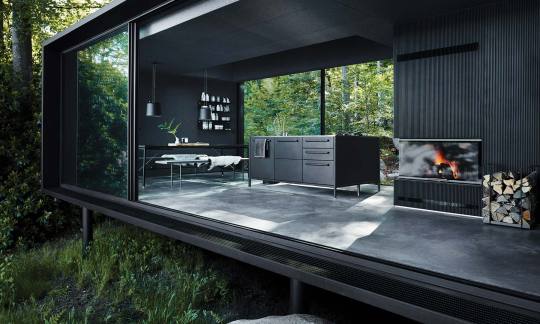
    But equally interesting is what they are doing with their Vipp Hotels. Instead of large hotels, they offer individual rooms in unique locations, such as this 55 square meter design object in the Swedish wilderness (pictured above).

    The rooms they have crafted are, not surprisingly, stunning. And that’s because they are deliberately designed as a tool to showcase their kitchens, bathrooms, bins, and other products. 

    Here is a quote from their CEO taken from a recent Surface article:

    “Traditional retail seems to be losing its power, but what is not losing power is our desire to see or do something interesting. I see our hotels as the experience economy coming alive,” says Kasper Egelund, CEO of Denmark-based Vipp.

    Clever.

    Image: Vipp

  • Assortative mating at elite colleges

    When demographers talk about how educated a city or place is, they often refer to the percentage of the population with a 4-year college degree. This may seem crude, but so far it has been found to be one of the best predictors of higher income levels and overall urban prosperity.

    When you add in the fact that people tend to marry people that are similar to themselves – often called assortative mating – you get a driver for income inequality. People with high incomes are marrying other people with high incomes.

    In this recent New York Times article they dive into the sorting that can happen even within colleges, including elite colleges. 

    According to data from the Equality of Opportunity Project, if you were born between 1980 and 1984, went to Princeton, and came from a family with a household income in the top 20%, you had a 56% chance of being married by the time you hit 32-34 years old.

    However, if you came from a family with a household income in the bottom 20%, you only had a 34% of being married by the time you hit the same age bracket. One possible explanation is that if you’re from a lower income family, you simply aren’t privy to the same “clubs”, where people mate, even though you still got into Princeton.

    To reinforce this point even further, the above data suggests that only about 1.3% of Princeton students that come from a poor family will ultimately end up a rich adult. About 72% of Princeton students come from a household in the top 20 percent.

    When I look at the numbers for Penn, my alma mater, the marriage spread isn’t quite as dramatic. The marriage rates are 55% and 48%, respectively, for the top and bottom 20%. Maybe that makes it more egalitarian. Or maybe not.

  • A demand-driven apparel world

    Here is an interesting article from Loose Threads that talks about the profound impact that data and fast fashion are having on apparel brands, transforming them from supply-driven businesses to demand-driven ones. It adds a bit more nuance to the trope that tech is disrupting retail simply because people are choosing to buy online.

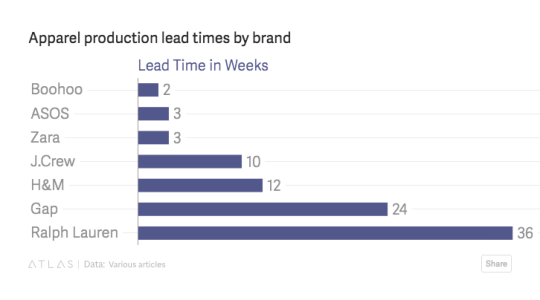
    The argument, here, is about a more fundamental shift in commerce. Brands are now forced to move faster than ever before. Product lead times are dropping (see below via LT). Customer feedback loops are almost instantaneous because of social. And the result is that customers are now the driver: Figure out what people want right now and then create that supply as quickly as possible.

    image

    Fast fashion certainly isn’t a new concept, but the data, algorithms and demand planning systems are only becoming more robust. Merchandise buying – historically the work intuitionists trying to predict what customers will want seasons into the future – is now an automated process that optimizes itself following every click, abandoned shopping cart, and social media like. 

  • Toronto is finally ready to permit laneway suites

    Some of you might remember that last summer the city refused my laneway house/suite here in Toronto.

    Well that was last summer and this is this summer.

    On May 2, 2018 – which just so happens to be my birthday – Toronto and East York Community Council will consider a staff report for a City-initiated Official Plan Amendment and Zoning By-law Amendment that would permit laneway suites in the Toronto & East York District.

    Here are a couple of excerpts from the summary section (full report, here):

    This report recommends establishing a planning framework to permit laneway suites on lands within the Toronto and East York District that are designated as Neighbourhoods by amending both the Official Plan and City-wide Zoning By-law.

    A second unit can take many forms but is generally considered to be subordinate to the primary dwelling unit on a lot. Second units are an important part of the City’s rental housing stock. Laneway suites are one form of second unit.

    This report contains a detailed planning rationale for the introduction and regulation of laneway suites within the Toronto and East York area and discusses the policy implications and intent of proposed performance standards and criteria. 

    These performance standards and criteria intend that laneway suites will provide a new form of ground-related, rental and extended family housing that will fit appropriately within the scale of established Neighbourhoods, and limit their impact on the existing physical character, while contributing to the growth of the City’s rental housing stock.

    What a thoughtful birthday gift. Thank you.

  • Writing is thinking

    Steven Sinofsky recently tweeted out this thread where he talks about the virtues of writing in business. His argument: writing is thinking.

    Writing is difficult. It takes a lot of time. I’ve been writing posts – albeit short ones – on this blog every day for almost 5 years and I can tell you that somedays it is downright painful. Somedays I ask myself: Would I be better served spending this time elsewhere?

    It’s much easier to talk, throw down bullet points on a slide, or send out pithy emails. And because, today, we’re all so focused on “agility” and “execution”, it is easy to dismiss writing as being slow and cumbersome. 

    But the act of writing is indeed thinking. To write about something you have to wade into the details and actually understand what you’re talking about. It’s far more nuanced.

    One of Sinofsky’s arguments is that “execution is in a constant state of diverging as more expertise deals with more details that fewer people understand.” Business becomes “I just know.” Writing can fill in those missing parts.

    He goes on to argue that agility is also not mutually exclusive with writing. In fact, when you write, clarify, and collaborate early on, overall execution speeds up because now people get the details and better understand the context.

    I’ve mentioned this before on the blog, but my Grade 4 English teacher used to make us write a daily journal. He would tell us that it didn’t matter what we wrote or how long it was, but we had to write something every day.

    I did it and I enjoyed keeping those journals, but at the time I didn’t really appreciate was he was trying to get us to do. I do now.


  • Studio Gang’s first project in Los Angeles

    This past week Studio Gang unveiled its first project in Los Angeles, a curvaceous apartment (300 rental units) and hotel (149 rooms) tower in Chinatown.

    The developer is Paris-based Compagnie de Phalsbourg and the hotel component is expected to be operated by the European brand, MOB Hotel.

    Above is the only rendering I could find. If you would like to read a bit more about the project, check out Curbed LA.

    Image: Studio Gang

  • New, mini, electric skateboard

    image

    Boosted — which is a California-based company that makes electric skateboards — has just released a new smaller and more affordable version called the Mini S.

    Casey Neistat — who helped popularize the original models through his wildly successful YouTube channel — recently vlogged about it and it ended up crashing their website. That’s how things work these days.

    Now, this new version is still USD 750 (so CAD 1,000), but it is significantly less than their other, bigger, models.

    The Mini S goes up to 18 mph and lasts for about 7 miles (optional extended range battery available). So it’s perfect for short jaunts around the city and as a solution to that pesky last mile problem. 

    I am seriously considering getting one for my short commute to the office. That way I’m not breaking a sweat in my suit. But $1,000 remains an awful lot for a skateboard.

    What do you think?

    Image: Casey Neistat via Boosted