Daily insights for city builders, delivered every morning at 6 AM ET. I’m Brandon Donnelly — a Toronto-based real estate developer and founder of Globizen. I’ve been writing here since 2013.

Month: June 2017

  • What land-use restrictions are doing to our cities

    I have Richard Florida’s recent book, The New Urban Crisis, sitting on my bedside table. I’m only about ¼ of the way through it, but I’m really enjoying it. I’ll write more once I’m done.

    What I instead want to talk about today is a recent (and related) article that Florida published in CityLab called: Did Land-Use Restrictions Save the Rust Belt? 

    In it, he leans on the research of two economists – Chang-Tai Hsieh of the University of Chicago and Enrico Moretti of the University of California at Berkeley – and makes 3 valuable points.

    They are:

    It is estimated that land-use restrictions (which limit development / supply) have reduced overall GDP in the U.S. by about 9% or approximately $1.5 trillion per year. It is also estimated that housing supply constraints alone lowered overall growth by more than half between 1964 and 2009.

    At the same time, these land-use restrictions may have benefited other regions – such as the Rust Belt – that would have otherwise lost more people and jobs to places like New York and San Francisco. The research found that without these land-use restrictions, employment growth between 1964 and 2009 would have been more than 1,000% higher in New York and almost 700% higher in San Francisco.

    The final takeaway is one that we’ve talked about before on this blog. One of the most effective things we can do to counteract geographic inequality is to build great transit; transit that connects both people and land to the most desirable areas of our city.

    And with that, Happy Canada Day weekend all.

    Photo by João Silas on Unsplash

  • Lease vs. Life

    image

    When I was in graduate school in the U.S., I remember it being a pain having to always sign a 1 year lease. I only wanted 8 months so that I could take off during the summers. Too bad Flip wasn’t around back then.

    Flip is a startup that I just discovered, which is positioning itself as the “easiest way to sublet or get out of your lease.” It’s all about reconciling the conflict between lease and life, which don’t always match up.

    The platform is free to listers. So you don’t get charged to post a lease or to flip a lease. Renters get charged a service fee equal to 5% of one month’s rent.

    It’s interesting to think about the surge in short-term rentals and platforms such as Flip that are effectively helping to reduce lease terms by way of streamlining the “flipping” process. 

    Are millennials ushering in a new era of mobility and transience?

    One feature that I think is neat and that I would like to point out is “Bounties.” The platform allows listers to attach a bounty ($) to any listing. Users are then able to grab a unique URL that can be shared around online. If someone takes over a lease via one of your links, you get paid the bounty. Smart.

    In case you’re curious – I certainly was – here’s a ranking of all 50 U.S. states according to how friendly they are to subletters. It also summarizes how to legally sublet. On the friendly side is New York and on the less friendly side is Wyoming.

    Photo by Dan Gold on Unsplash

  • 76 thumbs down

    A few weeks ago Seth Godin wrote a post on his blog called: What 99% looks like. He used the example of a Turkish vlogger who had posted an interview with him to YouTube that received the following view count, up votes and down votes:

    image

    The point he wanted to make was that many of us will instinctively focus on that one number: 76. We will say to ourselves that 76 people hated our video, our work, so much so that they felt compelled to give it a decisive thumbs down.

    His message was clear: “Ignore it. Shun the non-believers and ship your work.” 76 people out of 108,605 views is not even 1%. And 76 out of (10,827 + 76) interactions is still not even 1%. You could easily say that this video has a greater than 99% approval rating.

    I love this message, because there will always be naysayers, especially if you’re doing something interesting and unique. In fact, having naysayers is probably a good litmus test to make sure that you are indeed doing something interesting and unique.

    But here’s the thing. 

    The YouTube metrics above make for a rather transparent platform. You can see that the video received 108,605 views and that 10,827 + 76 people felt so strongly about it that they wanted to leave a mark by way of a thumbs up or thumbs down. But most importantly, you can see that way more liked the video than hated it.

    But what if it wasn’t clear that over 10,000 people were fans of your work? What if all you saw was how many people hated it? And what if those voices were amplified? That would be pretty discouraging, considering that many of us are already focusing on that number to begin with.

    I can think of many instances where the fog is thick and we don’t have full visibility. That’s where it gets even tougher, but more critical, to “shun the non-believers.” There may be people out there who truly love your work and what you’re trying to do. You just may not know it, yet.

  • Digitizing fast food workers

    I think I am 1 of only 7 people in the world who actually likes the Filet-O-Fish sandwich from McDonald’s. That said, I rarely go, maybe only after a fancy small plate dinner. You know, the kind where you leave starving and you’re desperately searching for a burger on the way home just so you can go to sleep full.

    I have, however, been noticing the introduction of their digital ordering kiosks, which are part of the McDonald’s Experience of the Future strategy. The plan is to replace human cashiers in at least 2,500 U.S. locations by the end of this year and in another 3,000 locations by the end of 2018. By 2020, the majority of U.S. locations should have “EOTF” in place.

    Because of this, analysts are raising their price targets for McDonald’s. They are also attributing its surging stock price to these new operational efficiencies. MCD is up about 26% YTD. And you can bet the ROI math on these kiosks only looks better if/when minimum wages increase.

    This isn’t necessarily groundbreaking news, but if you’d like to dig into some of the math behind why customer-facing fast food workers are clearly going to become a thing of the past, you can do that here.

    I did want to single out one stat that I came across when researching how I will be experiencing Filet-O-Fish sandwiches in the future. 

    More than 70% of all McDonald’s sales in the U.S. happens via drive-thru. This stood out to me as being an extraordinary number, not because I don’t believe it, but because it very clearly speaks to urban-suburban form. It is saying that more than 70% of sales are happening in geographies where it’s actually feasible to have a drive-thru window.

    That’s not possible at the corner of Queen and Spadina.

  • The “R” word

    Albert Wenger recently penned an interesting post about the “R” word.

    It’s about health insurance and why redistribution is a toxic word in U.S. politics, but also why much of what we do as a society – from public roads to insurance – is actually about redistribution. What I like about the post is that he cuts through a lot of the noise and gets right at the crux of things.

    Here’s part of his conclusion:

    So what should you take away from this? There always is some element of redistribution to insurance – at a minimum ex post and generally also ex ante. The “why should I (usually some healthy person) pay for x (usually some payment for someone from a different demographic)” objection to health insurance is about redistribution. We should acknowledge this openly and not pretend that it is otherwise, because then we can move forward and say “you should, because that is your contribution to how our society works.”

    The point of his post, which he reiterates in the comment section, is that “insurance is a commons more than it is a market.” Too much individual choice – for instance, rich people opting out because they don’t need it – actually weakens the system.

    But you should really read his entire post. It’s good.

    Photo by Jamie Street on Unsplash

  • Should Uber be shut down?

    image

    Last week Travis Kalanick – the cofounder who built Uber into the most highly valued privately held startup in the world – stepped down as chief executive at the request of his investors. This was the culmination of months of controversy related to the company’s toxic corporate culture.

    So what’s next? 

    Benjamin Edelman, associate professor at Harvard Business School, recently argued that this is it for the company: Uber Can’t be Fixed – It’s Time for Regulators to Shut It Down. I discovered the article through a good friend of mine who has felt similarly since the beginning. Uber’s business model is predicated on illegality and that should not be misconstrued as “innovation”.

    I have a few thoughts on this.

    But let me start by saying that this post is not a comment on the company’s corporate culture or its internal practices related to lobbying governments. I have not really been following what’s going on internally and I’ll leave other, more informed, people to comment on those matters.

    With that said, here are 3 thoughts.

    One, shutting down the company feels like an extreme case of throwing out the baby with the bathwater. Lots of companies go through restructuring, assuming that’s needed, without completely capitulating.

    Two, before Uber came along it was still challenging to pay for a taxi in Toronto with a credit card. More often than not the driver would tell you that the machine was broken or ask that you instead pay with cash. At that point, I would have accepted a clunky payment machine mounted to the rear of the front seats as an innovation.

    To say that Uber’s technological innovations were all banal things that its competitors were already about to introduce is downplaying so much of what the company has done outside of its beneficial cost structure. 

    We got perfect information: Where is my car right now? We got full pricing transparency before even accepting a ride: Should I take an Uber or transit or should I drive? We got the ability to get in and out of a taxi without pulling out our wallets: I’ll quickly jump out at this red light. We got dynamic ride pooling and cost sharing: Let’s split this ride 3 ways to bring the fare down. And we got clean cars that didn’t smell.

    Why weren’t any of the incumbent taxi companies do this?

    Three, I fully agree that Uber (unfairly?) benefited from a meaningful cost advantage by operating in the unregulated side of the market. This was a huge boon for the company because, as the data suggests, the demand for taxis is highly elastic.

    But I also believe that the incumbent taxi companies were perpetuating a marketplace that was anything but free enterprise. It ensured that the status quo was maintained and that those who historically benefited from the system continued to benefit from the system.

    Because of this, I’m not sure that we would have seen the innovation that we saw without a company like Uber deciding to operate within a gray area and not ask for permission. Protectionism may have stomped it out. This may be why Hailo – which operated in the regulated side of the taxi marketplace here in Toronto – ultimately wasn’t able to survive.

    Though I suppose you could argue that Hailo’s failure (at least here in Toronto) strengthens the argument that Uber was only able to thrive because of its illegal cost structure. 

    However, it’s important to remember that Uber got its start by actually charging more than traditional taxis. At the outset it didn’t have enough liquidity in its marketplace to compete based on speed and/or price, and so it decided to offer a premium experience. 

    UberX didn’t introduce steep discounts until later on and even today many people will gladly accept surge pricing at multiples of a regular taxi fare. Clearly customers are deriving some other benefits from the app.

    Edelman ends his piece by referencing Napster as an example of another startup that defied legality and was ultimately forced to shut down. Again, shutting Uber down seems extreme to me, but I do agree with his conclusion. Regardless of what happens, the lawful innovations that Uber introduced are here to stay.

    Photo by Carl Joseph on Unsplash

  • Why you should sometimes ignore your customers

    In business we are told to listen to our customers. Be customer-centric. In city building we are told to listen to the community. Be community-focused. And there’s no question that these mantras exist for a reason. They are paramount.

    But when should you not listen?

    I watched a Chef’s Table documentary last night on Massimo Bottura (pictured above), who is the owner and operator of Osteria Francescana in Modena, Italy. Osteria Francescana is a 3 star Michelin restaurant and widely ranked as one of the best restaurants in the world.

    But it wasn’t easy for Massimo at the beginning. His goal was to bring the Italian kitchen into the 21st century and so his plates are often creative takes on classic Italian dishes. His restaurant blends the old and new; food and contemporary art.

    This approach upset a lot of people at the outset. Massimo was seen almost as a traitor who was turning his back on traditional Italian cooking within provincial Modena. Don’t mess with centuries of tradition they would say. Grandma knew best, son.

    Because of this, his restaurant sat empty in the early years, to that point that he was ready to close its doors. The only reason he kept it open was because his wife encouraged him to give it one more year. She said: This is the kind of food you want to make. If you don’t try, you’ll regret it.

    So he gave it another year and luckily he got a few breaks, including a glowing review by a well known food critic from out of town. Once this hit, the Modenese started to quickly rethink their distaste for Massimo’s idiosyncratic dishes. Before long, his restaurant was full.

    So what changed? It wasn’t the dishes. It was perception. The out of town critics and positive reviews gave people permission to like the dishes. This is critical because nobody needs permission to like tradition. It’s tradition, after all. There’s little risk in that.

    But there’s risk in liking something new that hasn’t been done before. Change creates uncertainty. And if Massimo’s wife hadn’t encouraged him to stick with it just a bit longer and ignore the naysayers, the world may not have one of its top restaurants.

    Sometimes we don’t know what we like and want until we are shown.

    Image: Osteria Francescana 

  • Laneway housing represents 19% of all new single family and two family dwellings in Vancouver

    One of the criticisms surrounding laneway housing is that – while great – there is no way for this housing typology to have a meaningful impact on the overall housing supply equation.

    I’ve previously written about the impact of laneway housing in Vancouver. But I wanted to revisit some of the data following this tweet by GRIDS Vancouver, where they link to a spreadsheet they prepared using the City of Vancouver’s building permit data.

    Laneway housing was first allowed in Vancouver in 2009. In that first year, only 18 building permits were issued. But since then the number has grown steadily. In 2014, they hit 377. And in 2015 (up to September), they hit 360. So for the full year, it is highly likely they will show yet another year-over-year increase.

    Since laneway houses became permissible (and up to September 2015), a total of 1,885 building permits have been issued. During this same time period, 8,239 permits were issued for other low-rise housing, up to and including duplexes. This includes single family dwellings, single family dwellings with a secondary suite, and two family dwellings.

    So for a period of almost 8 years, laneway houses have represented on average 19% of all new single family and two family dwellings in Vancouver. If you include low-rise multifamily product into this equation (more than 2 units, but 3 storeys or less ), the percentage is still slightly above 17%. This is something. It’s not everything, but it is certainly something. 

    More conventional low-rise housing still represents a greater number and, of course, most of the new supply is coming in the form of condos, apartments and other higher density housing. But 17-19% are still meaningful numbers when part of the affordability problem is clearly a lack of supply.

    It is for reasons such as these that I, along with many others, want to bring laneway housing Toronto. If you feel similarly, please consider supporting my prototype project by signing your name here.

    Update: A previous version of this post stated that 19% of all new low-rise housing in Vancouver had become laneway housing. This number was calculated on all low-rise housing up to and including duplexes, but excluded low-rise multifamily product. The above post has been updated to lend more precision to my understanding of the data.

  • Screw Toronto

    Hamilton, Ontario is on the rise. It’s no secret. 

    In fact, Toronto Life just ran a piece called The New Hamiltonians, where it profiled ex-Torontonians who have made the move west for more affordable housing and a higher quality of life.

    What stands out for me about the article is how there’s already growing resentment toward both developers and the local business owners who are helping to revitalize the city. Here is an excerpt:

    As builders encroach on Hamilton’s old neighbourhoods, a simmering resentment is building toward the upstart businesses that make rundown areas attractive to developers in the first place. Dave Kuruc, who owns Mixed Media, says that last year, the front door of his and neighbouring shops got slapped with a sticker that read “FUCK YOUR BOUTIQUE. DEFEND HAMILTON.” Last June, a bus tour for ­developers—branded “Try Hamilton!”—was interrupted by masked activists spraying sour milk out of water pistols and wielding signs that read “Developers + Investors = Predators.”

    So it’s not just developers. It’s also those damn boutiques. But the City of Hamilton eliminated development charges and put in place many other incentives for a reason. It wants to see more new construction. 

    Some people clearly aren’t happy about that.

  • The roots of the tree

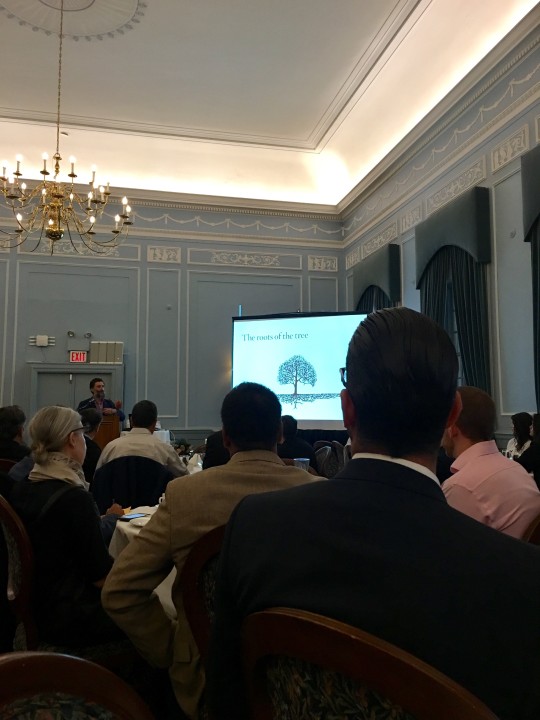
    Yesterday morning I attended a CTBUH (Council on Tall Buildings and Urban Habitat) breakfast event called The Story of Marketing Tall Buildings.

    It consisted of a talk by William Murray, who is Group Director of the UK-based creative agency Wordsearch, and then a panel discussion with some of Toronto’s leading developers. (David Wex of Urban Capital was one of the panelists. Many of you will probably remember him from this BARED post.)

    Shown above is one of William’s slides. The title is: The roots of the tree. And I thought it was a great metaphor for what tall buildings, well really all buildings, should aspire to do.

    The tendency is to think of buildings as objects. Here, look at how beautiful this thing is. That’s obviously important, but what about its roots? What about the way in which it interfaces with its context and hopefully gives back? Is it a catalyst for positive change?

    I thought it was a good slide.