Daily insights for city builders, delivered every morning at 6 AM ET. I’m Brandon Donnelly — a Toronto-based real estate developer and founder of Globizen. I’ve been writing here since 2013.

Month: May 2017

  • Zaha Hadid’s Miami condo is on the market for $4,350 psf

    Today, Google is celebrating the famed Iraqi-born British architect Zaha Hadid, who died last March (2016) in Miami of a sudden heart attack.

    She was the first woman ever to receive the Pritzker Architecture Prize, which is the prize of all prizes for architects.

    Here is Google’s front page:

    The building that is featured is the Heydar Aliyev Center in Baku, Azerbaijan. It’s an extraordinary piece of architecture. And in case you aren’t familiar with it, below is a Red Bull video of Maksim Kruglov skateboarding the building and its grounds. The building is just screaming to be skated. (Click here if you can’t see it below.)

    [youtube https://www.youtube.com/watch?v=J7lEGbAIU6M&w=560&h=315]

    I’m not exactly sure why Google chose today to feature Hadid. Initially I thought it might be the anniversary of her death, but she died in March. Whatever the case may be, a quick search revealed that her Miami condo was just listed for $10,000,000. That’s probably not what they are celebrating.

    It’s located at 2201 Collins Avenue (Unit 730) in the W Hotel Miami Beach. It’s 2,299 sf and features a totally separate guest apartment, which itself has one bedroom. The main suite was initially 2 units, but Zaha had them combined into a generous one bedroom.

    Only $4,350 per square foot.

    Below is a quick video prepared by the broker. You don’t need the sound on for this one. (Click here if you can’t see it below.)

    [youtube https://www.youtube.com/watch?v=9CD_xwYPbf8&w=560&h=315]
  • Neon rooftops of LA

    I am absolutely obsessed with the below video by Drew Ganyer called Neon Rooftops of LA. If you can’t see the embedded video, click here.

    [vimeo 158929583 w=640 h=360]

    The story is that Gayner was playing around with his new drone at a friend’s apartment next to “The Embassy” sign. This peaked his interest and so he went searching for more of these signs. This brought him to PublicArtInLA.com, which provides a comprehensive list of “buildings with historic neon signs” in the Los Angeles area.

    And so a movie was born.

    I’ll end with the below snippet from the opening paragraph of Public Art In LA. I don’t know about you, but I love these signs. I think they really do give rise to the magic of the night.

    “Sometimes, urban renewal can be as simple as the relighting of a neon sign on Wilshire, Hollywood or Sunset boulevard, lights that recover the past and point to an equally bright urban future. Remnants of a lost Los Angeles, city of the mind, remembered and yearned for, the neon lights of L.A.–celestial fires of another sort, green, gold, ruby red, electric blue–guide us down the Wilshire corridor, up through Hollywood and out along Sunset Boulevard west. If Paris is the City of Lights, L.A. is the City of Neon, possessed of a comparable (yet antithetical) beauty and capable as well, like all great cities, of giving rise in the magic of the night to hungers of body, mind and spirit.” (Kevin Starr, “Landscape Electric; A program that renews the city’s urban spirit by relighting Philip Marlowe’s neon L.A.” Los Angeles Times, July 4, 1999. 

  • So is this Brutalism or not?

    image

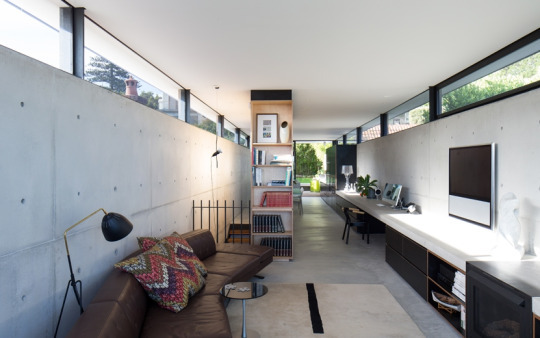
    The Spaces just featured 21 Scott Street in Bronte (a suburb of Sydney) as its property of the week. (The home is currently listed.)

    Designed by MCK Architects, the home is also called the “Upsilon House” and was supposedly designed for a fashion-industry couple.

    Two things should immediately stand out to you about the house. One is how long and narrow the site and house are.

    Here is a lengthwise view of the main living floor:

    image

    Based on the plans provided by The Agency (listing agency), the house is about ~3.9m wide. That’s because of its tight site. However, the clerestory windows that run the length of the house would provide ample light.

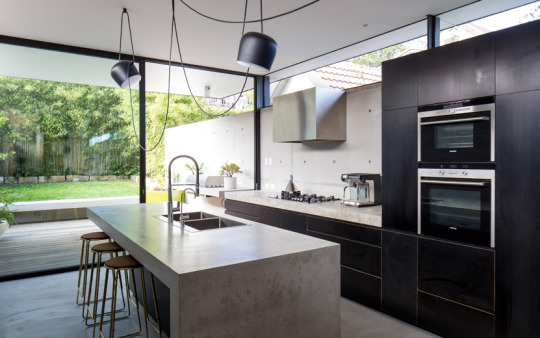
    The other thing that should stand out is all of the exposed concrete. The Spaces calls it “soft brutalism.” I personally love it, but I recognize that it’s not for everyone.

    In any event, it reminded me of a recent blog post by Witold Rybczynski in which he responded to the New York Times calling Habitat in Montreal a brutalist building. His rebuttal: that’s a gross over-simplification. Brutalism, in its truest sense, is about dramatizing the “rough character of concrete.”

    But I particularly enjoyed how he ended the post:

    “There is another litmus test of Brutalism. Buildings like Habitat remain popular with their users. If people don’t hate it, it can’t be Brutalist.”

    If that’s the case, then 21 Scott is certainly not Brutalism in my book.

    Images via MCK Architects

  • Follow the sun and sprawl

    image

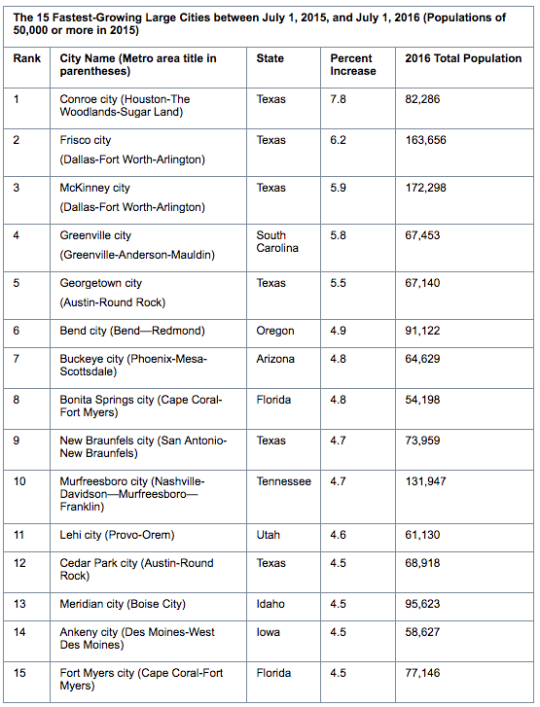
    The U.S. Census Bureau recently released it’s 2016 city and town population estimates. The press release can be found here.

    The headline isn’t a new one. Southern cities continue to grow quickly. This is not a new trend. Humans seem to like warm weather and the housing supply in southern cities tends to be more elastic. This keeps home prices relatively in check and allows the cities to more easily accommodate growth.

    From July 2015 to July 2016, 10 of the 15 fastest growing large U.S. cities were in the south (based on % growth). 4 of the top 5 were in Texas. 

    From 2010 to 2016, the population in large southern cities grew an average of 9.4%. Cities in the west clocked in at 7.3%. And cities in the northeast and midwest were at 1.8% and 3.0%, respectively.

    Two outliers near the top are Seattle and Denver. Since 2010, the population of these two cities grew 15.39% and 14.87%, respectively. I’m going to say it’s because of the skiing and snowboarding. Half-joking. For the top 25 large cities ranked by 2010-2016 growth rate, click here.

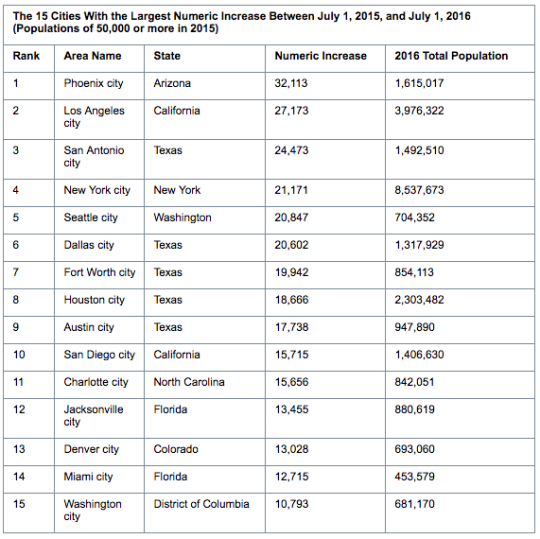
    In terms of absolute humans, Phoenix had the largest numeric increase between 2015 and 2016: 32,113 or about 88 people per day. After Phoenix it’s Los Angeles (27,173), San Antonio (24,473), New York (21,171), and Seattle (20,847). These are all city proper figures.

    It’s also worth noting which large cities aren’t growing. From 2015 to 2016, Chicago fell -0.32% and Detroit fell -0.52%. Philadelphia was only slightly positive at 0.19%. Going back to 2010, Chicago is still flat at 0.27% and Detroit is even more negative at -5.39%. Philadelphia is 2.5%.

    Follow the sun and the sprawl.

    The below charts are from the United States Census Bureau.

    imageimage

  • Is radical rezoning the solution to gentrification and displacement?

    image

    “If I meet one more anti-gentrification activist who moved to Seattle ten minutes ago, I shall scream.” –Dan Savage

    So it’s not just developers who are frustrated by the many paradoxical desires that we have of cities. We are concerned about housing affordability and we want to minimize displacement, but we do things that restrict new supply and put increasing pressure on our existing housing stock. 

    Below is another excerpt from Dan Savage. It’s from an article called: Doing Something Real About Gentrification and Displacement. Dan writes a sex-advice column, but clearly also feels passionate about urban issues. When he talks about “this city” he’s talking about Seattle.

    “Housing scarcity—exacerbated by the ridiculous amount of this city zoned for single-family housing—deserves as much blame for the displacement crisis as gentrification. More. And unlike gentrification (“a once in a lifetime tectonic shift in consumer preferences”), scarcity and single-family zoning are two things we can actually do something about. Rezone huge swaths of the city. Build more units of affordable housing, borrow the social housing model discussed in the Rick Jacobus’ piece I quote from above (“Why We Must Build”), do away with parking requirements, and—yes—let developers develop. (This is the point where someone jumps into comments to point out that I live in a big house on Capitol Hill. It’s true! And my house is worth a lot of money—a lot more than what we paid for it a dozen years ago. But the value of my house is tied to its scarcity. Want to cut the value of my property in half? Great! Join me in calling for a radical rezone of all of Capitol Hill—every single block—for multi-family housing, apartment blocks and towers. That’ll show me!)”

    His overarching point is that lots of highly-educated people with money are choosing, today, to live in urban centers. And whether we like it or not, that is going to cause gentrification. We can’t stop that. But what we can do is try and alleviate housing scarcity. 

    His other solution involves building lots of transit to address geographic isolation. I agree with him on this point and I’ve argued it before on the blog. If we can all agree that one of the issues is land/housing scarcity, then transit is certainly another way to “pull in” new supply. Though I think we need to be realistic about the level of service required to make areas desirable.

    If you have a few minutes, check out Dan Savage’s article. It’s a good and entertaining read.

  • What’s happening in Melbourne?

    image

    I’ve never been to Australia, so take everything I’m about to say in this post for what it’s worth. I also don’t know much about Sydney and Melbourne, other than the fact that I’ve studied the latter’s laneways and the tremendous impact they’ve had on revitalizing the CBD.

    However, recently I’ve had a few close friends visit these cities for the first time and, since then, I have started noticing a trend. All of them come back and tell me the same thing, that they prefer Melbourne to Sydney. They say: “Yeah, Sydney is nice and beautiful and all, but it’s not all that exciting. Melbourne feels way more dynamic. Oh, and have you seen their laneways? You would love them.” That’s what they tell me.

    So that’s what I have in my head when I read that Melbourne is now the fastest growing city in Australia; that it’s one of the most liveable cities in the world; and that by as early as 2031 it could take Sydney’s place as the biggest city in the country. Below is a chart from The Australian. If you can’t see it, click here.

    //platform.twitter.com/widgets.js

    Some argue that this is happening because housing is cheaper in Melbourne (median dwelling price of ~$700,000 versus ~$1 million). And some argue it’s because the jobs are there and the city has become a cultural and sporting destination. Whatever the case may be, net migration is estimated to be somewhere around 100,000 people per year.

    My own view – and I’ve made this argument before on the blog – is that we shouldn’t underestimate the importance of cool shit when it comes to cities. People vote with their feet more than ever today. And for a growing segment of the population, cities are a consumer good.

    Indeed, in 2001, Edward Glaeser, Jed Kolko, and Albert Saiz penned a research paper called the Consumer city, where they argued precisely that. The premise was that historically we have tended to think of cities as being centers of production, but we should also be thinking about them as places of consumption.

    Here’s an excerpt:

    “But we believe that too little attention has been paid to the role of cities as centers of consumption. In the next century, as human beings continue to get richer, quality of life will become increasingly critical in determining the attractiveness of particular areas. After all, choosing a pleasant place to live is among the most natural ways to spend one’s money.”

    This is why those coffee shops and cool laneways matter. Some cities have unfair natural advantages. Los Angeles has weather. Vancouver has mountains. Montreal has poutine. But for the rest of us, the amenities typically form part of the built environment. They are a product of our choices.

  • 150 noteworthy Toronto buildings are opening up their doors this weekend

    This weekend – May 27 and 28, 2017 – is the 18th annual Doors Open Toronto. The event provides free and open access to “architecturally, historically, culturally and socially significant buildings across the city.” And in honor of Canada’s 150th birthday, 150 noteworthy spaces will be opening up their doors. The list of participating buildings can be found here.

    I’m going through the list right now and curating my weekend itinerary. I’ve never been inside the Don Jail or the R.C. Harris Water Treatment Plant, so I’d like to check those off. I plan to be on my bike and have my Fujifilm around my shoulder. If you’re also getting out this weekend, drop me a line on Twitter and let’s connect. What buildings are on your list?

  • Opendoor is now selling ~300 homes per month

    Farhad Manjoo of the New York Times published an article this morning about Opendoor – a startup that I have written about multiple times on this blog – called, The Rise of the Fat Start-Up. (His definition of “fat” is that the startup owns lots of hard assets, which considered atypical in tech.)

    Below are a couple of interesting tidbits from the article:

    • Opendoor has raised over $300 million in equity and over $500 million in debt since inception.
    • Opendoor plans to be in 10 cities by the end of this year.
    • Average commission charged on Opendoor is 7.5%, which is higher than a traditional real estate agent and higher than what was quoted before in the press. The higher % is because of certainty and convenience.
    • Opendoor offers a leaseback option if you’d like to stay in your house for a period of time after you’ve sold it.
    • Their conversion rate (offers made to closings) is about 30%.
    • Other startups are now in the market with similar models, including Offerpad and Knock. Zillow is working with Offerpad on a pilot. Someone is starting to feel threatened.

    The article also quotes a blogger and real estate analyst named Mike Delprete. Heads-up: His blog is called “Adventures in Real Estate Tech.” I’m sure this will appeal to many of you. I obviously just subscribed.

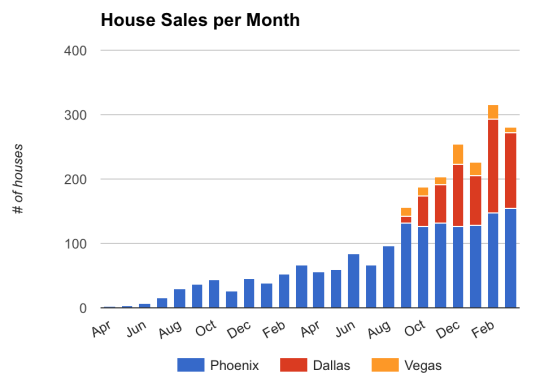
    Mike dug into MLS records in order to figure out Opendoor’s transaction volumes, since the company is not releasing this information. Here’s what he found (the chart is up to March 2017):

    The trend line is certainly moving in the right direction. But Mike also believes that Opendoor is only netting around $8,320 in profit per home and that much of it is driven by appreciation. There’s also substantial risk in owning so many homes – each one is usually held for a few months.

    But you can be sure they’re thinking well beyond where they are at today. Expect many more updates on this blog.

  • We are all biased against creativity

    image

    I would like to do a follow-up to yesterday’s post about innovators and creators, because I recently stumbled up the following quote:

    “We think of creative people in a heroic manner, and we celebrate them, but the thing we celebrate is the after-effect,” says Barry Staw, a researcher at the University of California–Berkeley business school who specializes in creativity.

    It is taken from a Slate article called: Inside the Box – People don’t actually like creativity. And it’s supported by a bunch of research, including a 2010 study conducted by professors at Cornell University, the University of Pennsylvania, and the University of North Carolina.

    The key finding was that people generally hold a bias against creativity, and it’s activated when we become motivated to reduce uncertainty. This might be because we fear rejection or because we’ve come to learn that reducing uncertainty and promoting the status quo is often better for career advancement. 

    There’s less perceived risk.

    But here’s the thing: celebrating creativity after the fact is meaningless. There’s no genius in that. Everyone now knows this truth. The heroics come into play when you’re both willing to be misunderstood and willing to be dead wrong.

    Of course, talk is cheap. 

    Here are 5 suggestions for promoting greater creativity at your company taken from Tom Tunguz’s blog, who himself is borrowing from Barry Staw (author quoted above):

    1. Hire people who’s skills aren’t precise matches for the needs of the company.
    2. Encourage employees not to listen blindly to corporate policy and conventional wisdom; not all to speak with the same voice.
    3. Those in power should go as far as possible to encourage active opposition to ideas. (Similar to Drucker’s obligation to dissent).
    4. Optimize for adaptiveness. Have extra labor capacity and explore side projects. (How many creative companies started or were reinvigorated by side projects? Twitter and Slack are two that immediately come to mind).
    5. Lead rather than follow. Take risks.

  • How I built this

    My friend Dan just introduced me to a terrific podcast called, How I Built This. It’s all about “innovators, entrepreneurs, and idealists, and the stories behind the movements they built.” As soon as he told me about it I immediately pulled out my phone and hit subscribe.

    You will recognize many of the brands and entrepreneurs featured on this podcast. The companies span everything from Whole Foods and the Corcoran Group (real estate) to Kate Spade and Instagram.

    I’m not that up on podcasts. I think it’s because I don’t really drive that often and I don’t have much of a commute. Podcasts are great when you’re sitting in traffic, which is something people here in LA obviously do a lot of.

    But I’m going to make time to listen to this one. I have so much respect for anyone who has built something from nothing. Building and creating is what moves us forward.