Daily insights for city builders, delivered every morning at 6 AM ET. I’m Brandon Donnelly — a Toronto-based real estate developer and founder of Globizen. I’ve been writing here since 2013.

Month: March 2017

  • Studio Gang joins effort to re-imagine Yonge + St. Clair

    Today I am excited to announce that we (Slate) have retained Studio Gang Architects to design a new mixed-use residential tower at Yonge + St. Clair in midtown Toronto. 

    Alex Bozikovic was first to break the news in the Globe and Mail, but you can now also read about it at UrbanToronto.ca, in ArchDaily, and likely some other places.

    Here is something I said to Alex that we feel strongly about:

    “We’re considering the whole community,” Donnelly says. “By thinking of city-building rather than individual tower buildings, it opens up new possibilities.”

    This is particularly true because of Slate’s broader position at Yonge + St Clair.

    And here is something that Stefan Novakovic wrote over at UrbanToronto.ca that we were happy to read – thank you:

    With no renderings, no precise indication of height, scale, or programming, and no hint at the building’s aesthetic—yet—it’s already a lock to be one of Toronto’s most anticipated upcoming developments. That’s because Studio Gang is no ordinary firm.

    I’ve also pasted the full press release at the bottom of this post. 

    One thing you may notice is that we’ll be hosting a public consultation later this spring. This will be before we submit anything to the city. It’s part of our research and information gathering phase, and it will be used to inform the ultimate design.

    I’ve been admiring Studio Gang’s work from afar for well over a decade. So it’s personally very exciting to be starting work with them on an actual project. We are thrilled about this announcement and I hope that many of you are as well.

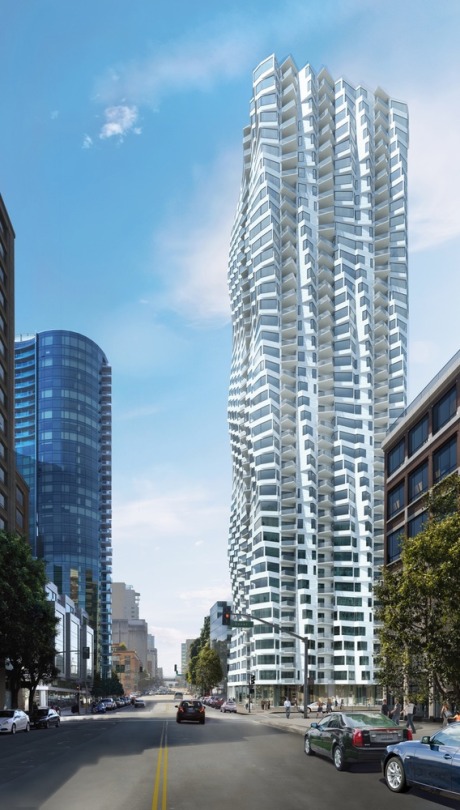
    Image: Folsom Bay Tower, San Francisco

    —————————————————————

    Slate Asset Management commissions acclaimed architecture practice’s first building in Canada

    March 10, 2017 (Toronto)—Slate Asset Management announces it has selected internationally celebrated architecture practice Studio Gang to design a mixed-used tower at the south-west corner of Yonge and Delisle. The announcement is the latest in a series of high-profile commissions by Slate, including an eight-story mural by international street artist Phlegm. The project will be Studio Gang’s first building in Canada, and is part of Slate’s overall effort to reimagine Yonge + St. Clair through the use of public art, world-class design, vibrant streetscapes and open spaces.

    “Yonge + St. Clair is on its way back. Having occasion to bring Studio Gang’s first project in Toronto to the neighbourhood signals to the rest of the city that we would like to create something special here,” says Brandon Donnelly, Vice President of Development at Slate Asset Management.

    The announcement comes just as Studio Gang Founding Principal, Jeanne Gang, is set to receive a 2017 Honorary Fellowship from the Royal Architectural Institute of Canada (RAIC) in May. The Honorary Fellowship is the latest in a series of accolades for Gang including a 2011 MacArthur Fellowship and the Architectural Review’s 2016 Architect of the Year.

    “As our practice’s relationship with Canada grows, we’re excited to explore Toronto and to understand the unique DNA of the Yonge + St. Clair neighbourhood,” says Jeanne Gang. “We hope to design a building that will strengthen relationships within the neighbourhood and the city.”

    Based in Chicago and New York, Studio Gang is widely recognized for elevating the urban environment while building connections between people and their environments. This ethos is visible throughout Studio Gang’s diverse portfolio, which includes Aqua Tower in Chicago, Folsom Tower in San Francisco, and 40 Tenth Avenue along the Highline in New York—each of which emphasizes connections between people, the city, and nature.

    With a practice rooted in research, engagement, sustainability and the innovative use of materials, Studio Gang will work with Slate to host a public consultation later this spring to gather community input prior to a design submission to the city. The final building will be primarily rental, with retail space at grade, in keeping with Slate’s long-term vision for the area. And while the design for the building is not finalized, Donnelly says a couple of decisions have already been made.

    “It’s not going to be a typical all-glass tower,” says Donnelly, citing a need to introduce material variety into Toronto’s ever-booming skyline. “We want to push boundaries in terms of sustainability and building efficiency, which means we are thinking carefully about the building envelope and its materials.”

    The decision to commission Studio Gang was made after an exhaustive selection process emphasizing design methodology, site context, and Slate’s aspirations for world-class architecture and a fresh vision. Yonge + St. Clair is a transit-rich node with a subway and dedicated streetcar tracks. At the same time, the dense urban realm is a short walk from some of the city’s most beloved neighbourhoods and a ravine system, offering direct access to quiet green space. This juxtaposition of natural and built environments will serve as an inspiration for the project.

    “There is a hill that crests at Yonge + St. Clair, which means the build site acts as both a pedestal and a view terminus from way uptown,” says Donnelly, detailing another unique advantage of both the site and the neighbourhood. “The challenge will be to develop a building worthy of being showcased, but we feel confident that we have the right team in place to do just that.”

    Over the last four years, Slate has purchased ten properties in the area, including all four corners of the intersection at Yonge and St. Clair. The Studio Gang commission will be the first ground-up tower in the area by Slate, marking a unique collaboration that combines global experience and high design with a serious investment in the neighbourhood. The area’s transformation kicked-off last summer with the introduction of the eight-story mural by Phlegm.

    Gang is being honoured at the RAIC/OAA Festival of Architecture in Ottawa, May 24–27. She will be named an Honorary Fellow of the College of Fellows of the Royal Architectural Institute of Canada and will deliver the keynote address at the festival.

    -30-

    For more information and images please contact kg&a
    Vakis Boutsalis
    Vakis@kga-inc.com
    416-537-0954

    About Slate Asset Management L.P.

    Slate Asset Management L.P. is a leading real estate investment platform with approximately $4.0 billion in assets under management. Slate is a value-oriented manager and a significant sponsor of all of its private and publicly-traded investment vehicles, which are tailored to the unique goals and objectives of its investors. The firm’s careful and selective investment approach creates long-term value with an emphasis on capital preservation and outsized returns. Slate is supported by exceptional people, flexible capital and a proven ability to originate and execute on a wide range of compelling investment opportunities. Visit slateam.com to learn more.

    About Studio Gang

    Founded by MacArthur Fellow Jeanne Gang, Studio Gang is an architecture and urbanism practice based in Chicago and New York. Known for creating innovative buildings that enhance the public space around them, Studio Gang has completed award-winning projects such as the Aqua Tower and Nature Boardwalk at Lincoln Park Zoo in Chicago, Illinois, USA, and the Arcus Center for Social Justice Leadership in Kalamazoo, Michigan, USA. The Studio is currently designing towers in Chicago, San Francisco, New York, and Amsterdam. In addition, Studio Gang is currently engaged in cultural and educational projects across the Americas, from the new United States Embassy in Brazil to the expansion of the American Museum of Natural History in New York and a consolidated campus for the California College of the Arts in San Francisco. In 2016, Studio Gang was recognized as Firm of the Year at the Architizer A+ Awards and Jeanne Gang was named Architect of the Year by the Architectural Review. Visit www.studiogang.com to learn more.
  • The views are different here

    Tourism Toronto launched a new campaign this week and with it came a great video that has been making the rounds online. It feels authentic. It actually feels like Toronto. Watch it here if you can’t see it embedded below. 

    [youtube https://www.youtube.com/watch?v=eS_tYWIoZzk?rel=0&w=560&h=315]

    But why exactly is it a successful example of place branding?

    Resonance (place branding consultancy) wrote a post about it and also spoke with Tourism Toronto’s EVP and Chief Marketing Officer. Here’s an interesting excerpt about the two things they wanted to achieve in the campaign/video:

    “The campaign—and certainly this video—is trying to achieve two things,” Andrew Weir, Tourism Toronto’s executive vice president and chief marketing officer, tells Resonance. “First, international visitors tend to think of destinations by country, so we had to connect Toronto to the Canadian story.” He says the sprawling, wild country is still generally known for mountains, forests and wilderness, and Toronto wasn’t connecting to that narrative. Enter the “Canada’s Downtown” identity as a way to both incorporate the destination in a national context and differentiate from it. “Toronto is home of the country’s stock exchange, the center of media, the big sports teams are here, we have the long-run theater productions,” Weir rhymes off. “It is the urban center of Canada.”

    The second objective for the campaign (and one held high throughout the commercial) was to be unabashedly proud of the city’s unique alchemy, diversity and inclusivity.

    “We’ve seen the foundation for local pride laid by people and brands like Drake and the Raptors and we wanted to build on that, to separate ourselves from other cities. We tapped into that energy that’s embedded in Toronto’s identity and sense of place.”

    Pride—and a devotion to inclusivity and openness—jumps off the screen. Given the current political direction towards closed borders and suspicion, the goosebumps pop often while viewing.

    At the end of the day though, I think it comes down to the fact that it feels like it captures the zeitgeist of Toronto. As I said at the beginning of this post, it feels authentic. And good place branding doesn’t invent identity. It takes things that are already latent and then exploits them.

    It’s either that or I just like seeing the Chinese food place I go to at 3am featured in a video.

  • Short term, lasting impact

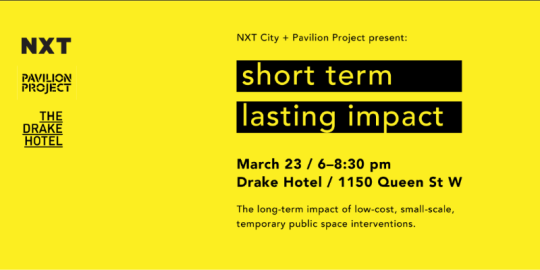
    NXT City and Pavilion Project are hosting an event on March 23, 2017 here in Toronto (at the Drake Hotel) called Short Term, Lasting Impact

    It’s all about how “temporary, low-cost and scalable [urban] interventions” can bring about lasting / meaningful change within our cities.

    Here’s some info on the panelists / topics:

    Matt Rubinoff, Tusk Global // STACKT

    This temporary shipping container market proposes a visionary complex with everything from retail and restaurants to studio spaces and a brewery. What are some of the challenges of bringing an unconventional project to life?

    Rui Pimenta & Layne Hinton, Art Spin // IN/FUTURE ART FESTIVAL

    This art experience reclaimed a beloved Toronto space, transforming it briefly through a multidisciplinary art and music festival. What opportunities can site-specific events bring to celebrate underused spaces?

    Michael McLelland, ERA Architects // PORTLANDS PROJECT

    There are many long-term and competing visions for Toronto’s Portlands. How do we make best use of this prime city site today? How can short-term planning inform a future agenda and create critical cultural space in the near-term?

    I know the folks behind both of these non-profits (NXT City and Pavilion Project), and so I am happy to support this event. Tickets are $10 and can be purchased here.

  • A prototype for low-rise intensification

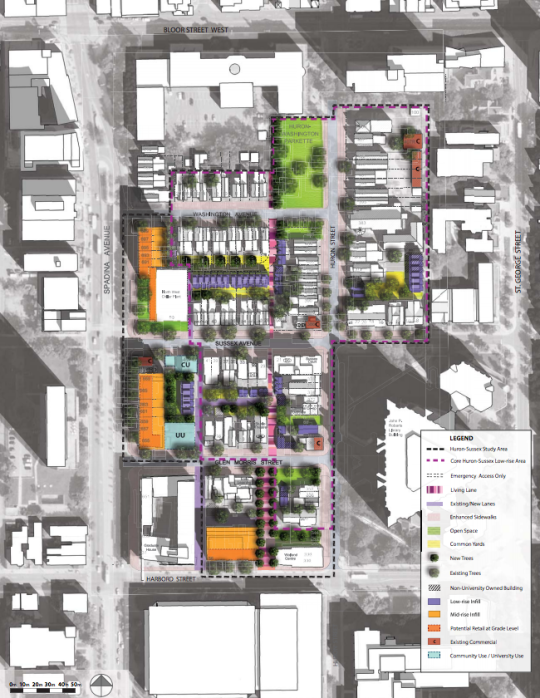
    Laneway housing is back in the news here in Toronto. Last week the University of Toronto reported that they would like to build 50 laneway houses within the Huron-Sussex neighborhood and that they are aiming to start a 2 house pilot project some time in 2018.

    Here is a drawing from their Planning Study:

    image

    What you see is mid-rise infill (orange) along the main streets and low-rise infill (purple) along the secondary streets and laneways. There’s also a “living lane” that runs north-south through the neighborhood. 

    I know we’ve talked a lot about laneway housing and neighborhood intensification on this blog, but I hadn’t seen the above plan before. And I wonder if we aren’t going to look back at this neighborhood plan as a prototype for low-rise intensification.

  • Shareable cities

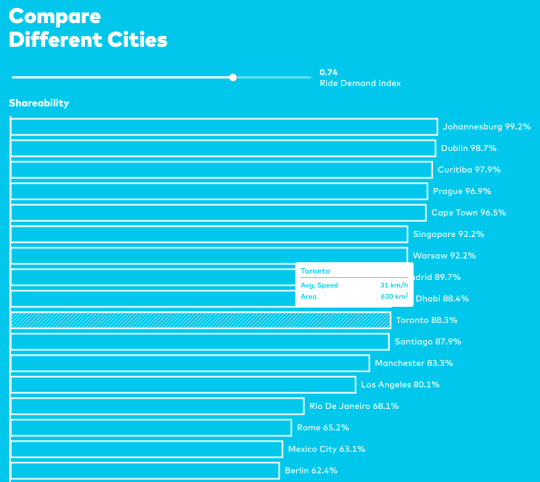
    The MIT Senseable City Lab recently looked at which cities are the most “shareable” when it comes to ride sharing services such as UberPOOL. Their goal was determine what fraction of individual trips (inefficient) could be shared or pooled (more efficient). To do this, they developed a single “shareability curve.” Full research paper, here.

    Not surprisingly, New York City does very well in this analysis. Its shareability is well above 95% for a delta of 5 minutes. That’s because the city has a large population, a small geographic area, enormous density, and lots of taxi traffic. (They used taxi data in their research.)

    But New York City also does very well when it comes to transit ridership. Highest in North America. So it strikes me that the characteristics that make a city “shareable” also apply to transit – which is effectively another form of ride sharing. Might we see the distinction between these 2 forms of mobility blur in the future? I think so.

  • Big bad (software) developers

    “There is no higher God in Silicon Valley than growth. No sacrifice too big for its craving altar. As long as you keep your curve exponential, all your sins will be forgotten at the exit.” –David Heinemeier Hansson

    Snap Inc. went public last week. Offering price was $17. Closing price on the first day was $24.48. Given that the company is not profitable and may never be profitable (their caveat, not mine), many people have been asking: Is a valuation somewhere around $34 billion justifiable?

    This is a common question when it comes to tech companies. And the answer usually comes down to something along the lines of this:

    The Snapchat story “is all about growth,” Mr. Nathanson said. “It’s not about economics.”

    It’s about the future.

    I love Snapchat and I think the company is run by a very creative founder. But now that Snapchat Stories was stolen by Instagram, they need, in my humble opinion, something new and killer to stick.

    How else will they meet their growth targets?

    On a related note, I recommend you read a piece by David Heinemeier Hansson called: Exponential growth devours and corrupts. That’s where the quote at the top of this post is from.

    Here is an excerpt:

    What sucker wants to earn $10 million/year at a 52.5% tax rate when you can get away with hundreds of millions in one take at just 15%? Nobody, that’s who.

    It’s hard to argue that boards, founders, and their financiers aren’t just doing exactly what the incentives are coaxing them to do.

    Which is why growth is now everything and residual value is nothing. In fact, the latter can be outright harmful to the former. When you’re being priced on the hopes and dreams of potential, reality can be a dangerous and undesired competitor. Best just to appeal to the exponential curve and let the imagination roam free. An epic capital gains score awaits!

  • Transit Flow

    This is a map of the Bay Area Rapid Transit network:

    And this is an elegant visualization by Ray Luong of ridership levels over the course of one day: February 4, 2016. If you can’t see the embedded video below, click here.

    [youtube https://www.youtube.com/watch?v=owGgbAS7Wq8?rel=0&w=560&h=315]

    Note how the lines speed up as they go through the Transbay Tube connecting San Francisco and Oakland. That’s actually what happens. Within the 10 km-long tube, the trains reach ~130 km/h, which is more than twice as fast as the average speed throughout the rest of the network.

  • Only $800,000 over asking

    Heads-up: This is going to be a Toronto-specific post.

    This week there was a lot of chatter about escalating house prices in this city (though that seems to be most weeks these days).

    Paul Johnston listed a detached house in Dufferin Grove for $1,285,000 and then turned around and sold it for just over $2.1mm, with 17 potential buyers at the table. I also saw my friend post a note this morning that the average price of a detached house in Toronto has now surpassed $1.5mm.

    What I am curious about – and this is a question for all of you who live here and/or follow the market – is what response does escalating house prices trigger for you? I asked this on Twitter (via a poll), but I would be curious to get your thoughts here in the comments.

    Do you feel rushed out of fear that you may get priced out of the market? Are you now turning your attention to out of the city? Or are you looking at other housing types, such as condos? I am sure the responses will be split.

    My response: condos.

  • Big bad developer

    I just stumbled upon an older (2014) article by Oliver Wainwright in the Guardian called, The truth about property developers: how they are exploiting authorities and ruining our cities. In case the title didn’t give it away, it’s a scathing article about the current state of real estate development and city building.

    Here’s an excerpt:

    “Across the country – and especially in superheated London, where stratospheric land values beget accordingly bloated developments – authorities are allowing planning policies to be continually flouted, affordable housing quotas to be waived, height limits breached, the interests of residents endlessly trampled. Places are becoming ever meaner and more divided, as public assets are relentlessly sold off, entire council estates flattened to make room for silos of luxury safe-deposit boxes in the sky. We are replacing homes with investment units, to be sold overseas and never inhabited, substituting community for vacancy. The more we build, the more our cities are emptied, producing dead swathes of zombie town where the lights might never even be switched on.”

    Now, I’m not that familiar with the London market, so I can’t really comment on the dead swathes of zombie town. But I did enjoy the insights into the UK entitlement process.

    At the same time, my overarching thought as I read through the article was that I don’t believe that making money and doing what’s right need to be mutually exclusively. You can do both in development and in business. Making money as a developer does not mean you have to build shitty buildings.

    Part of the development game is managing an endless number of competing tensions. And profitability and responsible city building is just one of them. Of course, you have to want to do the right thing in the first place.

  • Design Canada

    Canada has a rich graphic design history and that story needs to be told. Here is a Kickstarter project that’s absolutely worth checking out: Design Canada.

    https://www.kickstarter.com/projects/1002969621/design-canada/widget/video.html

    Greg Durrell (a graphic designer from Vancouver) and Jessica Edwards and Gary Hustwit (of Film First in Brooklyn) have partnered up, and they are looking for your support to produce the very first documentary about Canadian graphic design.

    As a proud Canadian, I am thrilled to see this project. Because this is obviously not just a documentary about graphic design (though in the 60′s and 70′s we were the best in the world). It’s a story about Canada, our history, and our evolving identity.

    If you can’t see the embedded video above, click here to make your way over to Kickstarter.