Daily insights for city builders, delivered every morning at 6 AM ET. I’m Brandon Donnelly — a Toronto-based real estate developer and founder of Globizen. I’ve been writing here since 2013.

Month: March 2017

  • Ecodesign for cities and suburbs

    Larry Beasley and Jonathan Barnett are about to start teaching a free online course through the University of British Columbia edX called: Ecodesign for Cities and Suburbs. It starts April 4, 2017 and runs for 6 weeks.

    Here’s what you’ll learn (taken verbatim from edx.org):

    • The principles of ecodesign and why it is important as a response to the current disorganized urban growth model
    • Ways to adapt to a changing climate, and ways to mitigate climate change locally
    • Policies to balance auto and airplane transportation with walking, cycling, transit and high-speed rail
    • Ways of designing urban and suburban regulations to make cities more livable and environmentally compatible
    • Strategies for designing and managing the public realm, plus innovative arrangements and processes for implementing ecodesign

    The course is geared toward urbanists from all over the world and so the case studies will be global in nature. You can also participate as actively or passively as you’d like. Though, if you’d like to get a certificate, then you need to fully participate.

    What immediately stood out for me was the focus on both cities and suburbs. In many ways the suburbs are a more challenging problem to solve. So I hope there’s a good amount of focus on that context.

    Beasley was formerly co-director of planning at the City of Vancouver and Barnett is a professor of city and regional planning at the University of Pennsylvania (my alma mater). It should be an interesting course.

  • Stepping back

    Yesterday the New York Times reported on the fact that Donald Trump has ordered the removal of most of Barack Obama’s policies intended to fight climate change. 

    (Interestingly enough, the Editorial refers to Donald Trump as simply Donald Trump, but it refers to Barack Obama as President Barack Obama.)

    Here’s a sampling of what they had to say:

    It was dismaying also because it repudiated the rock-solid scientific consensus that without swift action the consequences of climate change — rising seas, more devastating droughts, widespread species extinction — are likely to get steadily worse. It was dismaying because it reaffirmed the administration’s support for older, dirtier energy sources when all the economic momentum and new investment lies with newer, cleaner forms of energy. It was dismaying because it flew in the face of widespread public support for environmental protection — including the pleas of the executives of hundreds of major American corporations who fear that without energy innovation their costs will rise and their competitive edge over foreign companies will be lost.

    This is certainly frustrating, but as they mention in the article, it is not unexpected.

  • Formula retail

    San Francisco has something known as the Commission Guide for Formula Retail. Formula retail = chain store. Formula retail uses are regulated by the San Francisco Planning Code. 

    The intent behind the guide is really twofold: It’s to help assess the appropriateness of chain store uses in specific locations and it’s to help counter their homogenizing force on neighborhoods.

    This, of course, is a perennial tension for city builders. The challenge is that formula retailers usually have the ability to pay higher rents compared to smaller independent businesses. And so that’s who landlords will often lease to.

    If you’re the kind of person who enjoys reading esoteric planning documents, then consider incorporating the above SF commission guide into your bedtime reading repertoire.

  • Residential agri-tecture

    Last month Curated Properties and Windmill launched a “residential agri-tecture” project on Toronto’s Queen West called The Plant

    The entire development is oriented around our connection to food. The building will have an interior greenhouse and an industrial style common area kitchen for food prep and events. Each unit will have micro-garden beds for fresh herbs and lattices for growing your own food.

    This is a trend that I hope we see more of going forward. Toronto developers such as TAS have been incorporating urban agricultural elements into their projects for a number of years now and I believe it has the potential to become quite common, particularly for end user buildings. 

    I grew veggies and hot peppers on my terrace one summer and there was something really nice about walking outside to harvest a salad. The hardest part for me, though, was getting enough sun exposure. Some of my crop wasn’t getting enough sun, but for whatever reason my hot peppers really thrived.

    If all of this does really catch on, I could imagine a world where condos and apartments get marketed based on the precise amount of sunshine hours they receive throughout the year. Perhaps some developers are already doing that.

  • Peach skin

    I am fascinated by the way the Japanese think about housing. It is very different than the way we think about housing here in North America. Below is a small house tour that reinforces that. If you can’t see it below, click here.

    [youtube https://www.youtube.com/watch?v=4fEeh-8OFT8?rel=0&w=560&h=315]

  • EDITION

    I took the above photo at The Miami Beach EDITION. I know it’s no longer the newest hotel on the strip, but as far as design is concerned, it’s probably my favorite. I love the interiors. It feels quintessentially Miami Beach to me. The lobby is white and minimal, but at the same time there’s a tropical warmth to it.

    The interiors were done by the Toronto and New York-based Yabu Pushelberg. If you haven’t been, here and here are some photos of the hotel. Before EDITION, the building housed the Seville Beach Hotel. As should be the case, some of that hotel’s original details were preserved in the renovation.

  • Fifth floor retail

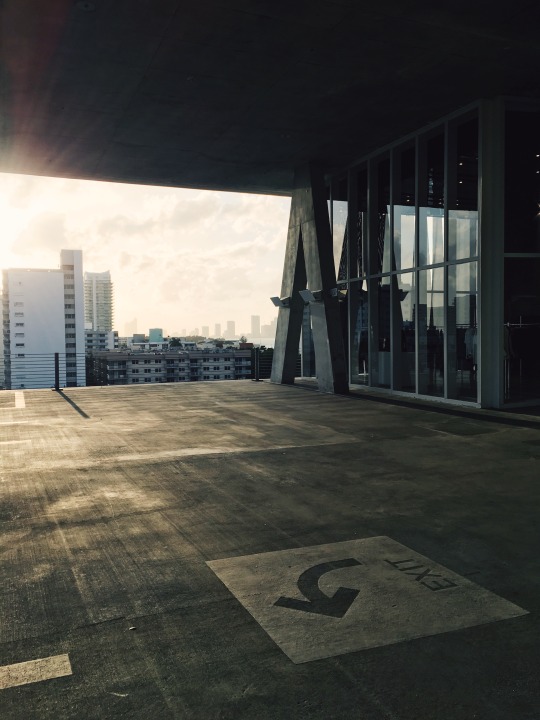
    I spent a bit of time this afternoon photographing 1111 Lincoln Road in Miami Beach. For those of you who aren’t familiar, 1111 is a parking garage that’s so well designed that people throw events – like weddings – in it. It was designed by the Swiss architecture firm Herzog & de Meuron.

    I’ve been through the building before, but one thing I missed the last time around was the 5th floor retail space pictured above. Conventional wisdom would tell you that upper level retail doesn’t really work all that well. But here you have a boutique shop with nothing around it besides parking stalls.

    What makes this case different? Is it the architecture? The desirability of this particular structure? Or is it that the store has enough of a following that it can draw people up and into it?

  • February housing numbers

    The Building Industry and Land Development Association (BILD) announced its February (2017) numbers today for the Greater Toronto Area. Here are some of the highlights:

    – At the end of February, there were 324 detached homes available in developer inventories. Ten years ago, this number was was 12,064 (detached only). 

    – If you consider all low-rise homes (detached, semi-detached, and towns) the above numbers are 1,001 (2017) and 17,304 (2007), respectively.

    – Average price of a new detached house is now $1,469,449. For all ground-related housing – again, including semis and towns – it’s $1,081,013.

    – There were more than twice as many condo apartments sold than low-rise homes in February.

    – Condo inventory is also dropping and reached a low of 10,342 units.

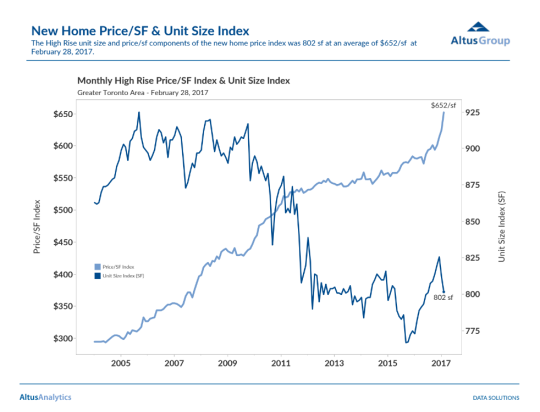
    – Average price of a new condo increased to $652 per square foot and the average unit size decreased to 802 square feet.

    Here’s that information in a chart from Altus Group:

    image

    The overall story here continues to be about decreasing inventory and increasing prices. There’s also the ongoing shift from low-rise to higher density housing, which I don’t view as a bad thing.

  • Collective action problem

    I like this excerpt from City Observatory:

    “More broadly, this paper reminds us of the salience of stigma to neighborhood development. Once a neighborhood acquires a reputation in the collective local consciousness for being a place that is risky, declining, crime-ridden or unattractive, it may be difficult or impossible to get a first-mover to take the necessary investment that could turn things around. The collective action problem is that no one individual will move ahead with investment because they fear (rationally) that others won’t, based on an area’s reputation. A big part of overcoming this is some action that changes a neighborhood’s reputation and people’s expectations, so that they’re willing to undertake investment, which then becomes a self-fulfilling prophecy.”

    It’s taken from an article called: Getting to critical mass in Detroit. The article itself is a response to some of the criticism circulating around that Detroit’s rebound is lopsided toward downtown. But Joe Cortright argues

    (rightly)

    that this is indeed the way to go about it. Concentrate efforts. Establish a critical mass. And then expand from there.

    What I like about the above excerpt is that it’s a reminder that optics, storytelling, and identity all have an important role to play in city building. It’s also a reminder that momentum can develop in either direction and that neighborhood reputation’s can get exaggerated.

  • New lens

    I ordered a new lens for my Fuji X Series camera today. 

    For those of you who are interested in photography, it’s a prime lens: 35mm (53mm equivalent) with a maximum aperture of F2.0. I wanted a fixed focal length because I suspect I’m going to enjoy shooting with it more than my current zoom lens. There’s something pure about it. I also wanted a lens that would be versatile enough for street photography, portraits, and so on. Also helpful is the fact that it’s compact and easy to carry around.

    Since I picked up my Fuji camera last summer I’ve been slowly but surely returning to photography as a hobby. Part of why I did that is because I felt like I needed to challenge myself creatively. I was also inspired by some of my creative friends, namely Akbar and Evgeny. Both of them take great photos and are far more serious about photography than I am. I’m also an avid follower of Bijan Sabet’s blog. He’s a venture capitalist with an amazing passion and talent for photography.

    But the other reason I have been drawn to photography – for my many years now – is that it’s a way to document the built environment. It’s for that reason that I love taking photos when I travel. Everything is new and I’m just trying to soak it all up.

    I am mentioning all of this today for three reasons. First, I’d like to incorporate more of my photos into this blog. I’ve also been feeling like this blog needs a bit of a refresh. It’s been almost 4 years of daily writing and I think it’s important to continually try new things. Second, by being public about all of this, it holds me accountable. And third, I’m going to be in Miami this weekend. So expect some fresh photos on my Instagram.