
Daily insights for city builders, delivered every morning at 6 AM ET. I’m Brandon Donnelly — a Toronto-based real estate developer and founder of Globizen. I’ve been writing here since 2013.

Month: January 2017

  • The Canadian Dream (and 5 things that hurt upward mobility)

    image

    About 7.5% of American children born into the bottom quintile of the income distribution will eventually make it into the top one fifth. In the UK this number is about 9%. And in Canada and Denmark, the numbers are 13% and 13.5%, respectively. (The upper bound for these numbers is 20% since you can’t have more than 20% in the top 20% of the income distribution.)

    Because of stats such as these, Freakeconomics recently asked: Is the American Dream really dead? And if so, should it instead be called the Canadian Dream, seeing how it’s more readily obtained.

    Of course, it’s not necessarily as simple as 7.5% vs. 13%. Upward mobility exhibits a lot of regional variation. In the American southeast, the number is closer to 4%. Whereas in the San Francisco Bay Area, the number is up there with Canada and Denmark. However, this phenomenon is so location-specific that even kids growing up in San Francisco are twice as likely to get to the top 20% compared to kids growing up across the bridge in Oakland.

    There’s also a question of spread. Canada and Denmark have less income inequality, meaning you don’t have to travel as far to get to the top of the income distribution. 

    Still, the reality is that it is becoming harder for Americans to climb the socioeconomic ladder. The number of 30-year old Americans who today earn more than their parents is dropping compared to previous decades. So what needs to be done? What is causing this erosion of the American Dream?

    It turns out that city builders have an important role to play in solving this problem. Because where you live – and in particular where you grow up as a kid – matters.

    The Freakeconomics episode examines a study that was done by Raj Chetty, Nathaniel Hendren, and Lawrence Katz, called: The Effects of Exposure to Better Neighborhoods on Children. And their findings were exactly that. Place matters. The study reexamines the findings of a program that was administered in the mid 1990′s in the US called Moving to Opportunity (MTO). This program randomly offered families living in high-poverty neighborhoods the opportunity to move to neighborhoods with far less poverty. 

    Upon initial review, the program was seen as a failure. There were some positive health outcomes, but no meaningful changes in income. But when Chetty and company took another look at the data – now with more time and IRS data on their side – they discovered that the impact was in fact dramatic. Relocated families raised children that earned 30% more, were 27% more likely to go to college, and 30% less likely to be a single parent. The key, however, was that the children had to relocate when they were young (< 13 year olds). The older they got, the less benefit they received from moving, eventually reaching a plateau where there was basically no benefit at all.

    Here are the 5 things that ended up having significance in their findings:

    1. Residential segregation by income and race is bad. Mixed neighborhoods are good. The southeast is filled with segregated cities and that’s one of the reasons why they underperform in this exercise. San Francisco, on the other hand, was far more mixed in the 80′s and 90′s when the kids belonging to this study were growing up. One could debate whether that’s still the case. I guess we’ll find out in a few decades.
    2. Income inequality negatively impacts upward mobility. See The Great Gatsby Curve.
    3. Single parent households seem to have an impact on upward mobility. However, the data suggests that it’s not just about whether the child in question grew up with married parents. The percentage of single parent households in the neighborhood also matters. Because even children in dual parent households in a neighborhood with lots of single parent households, showed muted upward mobility.
    4. Social fabric. Connections to family and friends matter. It’s about having a support network. (Freakeconomics mentions a book called Bowling Alone that is now on my reading list.)
    5. Not surprisingly, the quality of public schools matters.

    All of the stats for this post were taken from this Freakeconomics Radio episode. For me, it is such an important reminder that the way we plan and build our cities can have meaningful and longstanding impacts on the kinds of children we raise.

  • Move fast and…

    I like this article – called Speed as a Habit – by Dave Girouard, CEO of the personal finance startup Upstart. It’s all about the importance of speed in business. Speed wins.

    “When you think about it, all business activity really comes down to two simple things: Making decisions and executing on decisions. Your success depends on your ability to develop speed as a habit in both.”

    What makes this topic so interesting is that, for a number of reasons, speed has a tendency to get sacrificed. It might be because the plan isn’t yet perfect or because there’s a belief that Y can’t happen until X is complete. 

    Perhaps it’s because the value of speed is harder to measure than the value of “perfection.”

    I particularly like the notion that you know you’re going fast enough when there’s a bit of discomfort and you’re feeling stretched, but not overstretched in an unsustainable way. Here’s another excerpt from Dave’s article:

    “While I was at Google, Larry Page was extremely good at forcing decisions so fast that people were worried the team was about to drive the car off a cliff. He’d push it as far as he could go without people crossing that line of discomfort. It was just his fundamental nature to ask, “Why not? Why can’t we do it faster than this?” and then wait to see if people started screaming. He really rallied everyone around this theory that fast decisions, unless they’re fatal, are always better.”

    A big part of this, I find, is momentum. An object at rest stays at rest. But an object in motion stays in motion. Remember this law? In this context, it is decisions that power motion and help to build and sustain momentum.

    Of course, the ideal outcome is both lightning fast and high quality decisions.

    The title of this post is homage to Facebook’s original corporate motto: “Move fast and break things.” This slogan was later adjusted to “Move fast with stable infrastructure”, which I think demonstrates our constant struggle between speed and quality.

  • What’s in a sign?

    The built environment is the environment that we create around ourselves. Signs are a part of that.

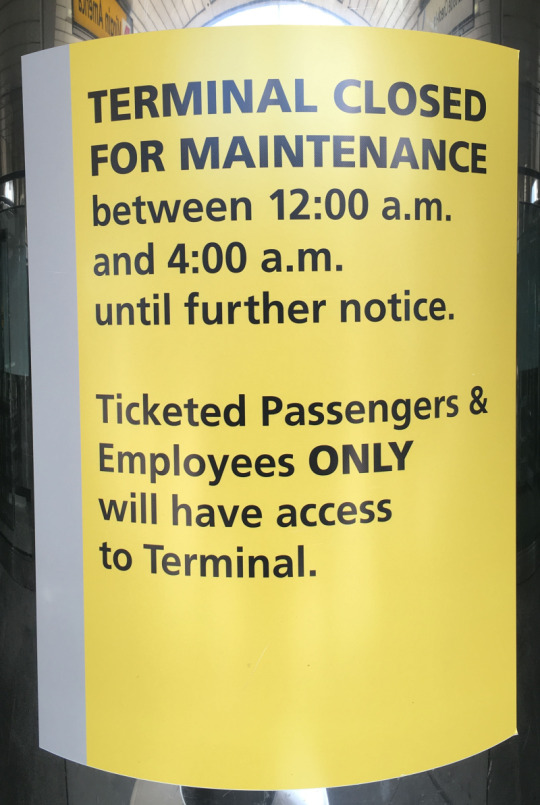
    Seth Godin recently posted this sign on his blog:

    It was seen at LaGuardia Airport.

    He then asked a few pertinent questions, dissecting the signs intent. Finally, he suggested the following reword:

    Hi. To keep this terminal clean, it’s closed to visitors from midnight until 4 a.m. every night. Ticketed passengers are always welcome.

    Which one do you prefer?

    Which one is clearer?

    Which one speaks to you with empathy?

    Dan Pink would call the reword: emotionally intelligent signage.

  • Sixth facade

    A new treehouse at the Treehotel in northern Sweden just opened up this week. (Their website wasn’t working at the time of writing this post.) 

    It was designed by the Oslo and New York-based Snøhetta. All 6 of the cabins at the Treehotel were designed by Scandinavian architects.

    The treehouse is clad in charred-timber (on trend right now) and is raised 10m (~3 storeys) up into the air to provide views out to the landscape. The underside of the treehouse, which is visible as you walk up its stairs, is finished with a black and white image of a forest. According to Dezeen, the architect calls it the sixth facade.

    Below is what that looks like. (Photo by Johan Jansson via designboom.)

    The net you (hopefully) see in the middle of the treehouse is so that you can sleep outside and stare up at the aurora borealis. The treehouse itself is 55 square meters (almost 600 square feet) and is designed to accommodate 5 guests. It has 2 bedrooms. I guess the 5th person has to sleep outside on the net terrace.

    Seeing this project has me excited to be back in the mountains next month.

  • Turning data exhaust into gold

    Last year, social media company Foursquare predicted that Chipotle would see a ~30% drop in its Q1 2016 sales. It knew this because the geo-location data from people using its app (check-ins and passive visits) was also down. They had figured out the relationship between foot traffic and sales. I think I wrote about this in the first half of last of year.

    Not surprisingly, lots of companies – including those on Wall Street – are now starting to pay attention to data sets such as these. Matt Turck wrote a great blog post about it this morning, called: The New Gold Rush? Wall Street Wants your Data. Here’s an excerpt:

    That a social media company could be building a data asset of immense value to Wall Street is part of an accelerating trend known as “alternative data”. As just about everything in our lives is getting sensed and captured by technology, financial services firms have been turning their attention to startups, with the hope of mining their data to extract the type of gold nuggets that will enable them to beat the market.

    The opportunity is open to a wide range of startups.  Many tech companies these days generate an interesting “data exhaust” as a by-product of their core activity.  If your company offers a payment solution, you may have interesting data on what people buy. A mobile app may accumulate geo-location data on where people shop or how often they go to the movies.  A connected health device may know who gets sick when and where.  A commerce company may have data on trends and consumer preferences. A SaaS provider may know what corporations purchase, or how many employees they hire, in which region. And so on and so forth.

    We may be calling this alternative data right now, but it is almost certainly just a matter of time before it simply becomes: the data. 

    I like the term “data exhaust” that Matt uses, because it feels like it accurately captures what is going on right now. The new economy is producing a lot of byproduct. If you clean it up and package it in the right way, then you might be creating additional value. But if you don’t, then it’s probably just exhaust.

  • I love neon

    “As the manufacture of storefront signage becomes increasingly standardized,” says a circular from Berlin’s Buchstabenmuseum, “the tradition of idiosyncratic signs created by skilled craftspeople, reflecting regional differences and a firm’s unique character, is dying out.”

    The above quote is from this Globe and Mail article talking about the lost art of sign making and about an exhibition that starts today (until January 27) in Montreal at the Media Gallery of Concordia University’s Communication Studies and Journalism Building. It is called Tel Quel / As Is and it is by the Montreal Signs Project.

    Cities all around the world are facing a decline in distinctive local signage, which is not all that different than the decline in regional architecture. We are living in a global village.

    Montreal has responded with the above project. Berlin has responded with the Buchstaben Museum (letter museum). And here in Toronto, Mark Garner of the Downtown Yonge BIA has been trying to convert one of our laneways into a haven for restored Toronto neon signs. Great idea.

    It can be challenging to repurpose old signs. There are often issues of appropriateness and scale. Sometimes a new or renovated building looks good with its old signage. But in other cases – and perhaps more often than not – it wouldn’t. So then what do you do with it?

    Still, it behooves us to try. Signs, like buildings, are a snapshot of a moment in time. They are part of the environment that we create for ourselves. They are part of our history.

  • Blaze Laserlights

    This is a great idea:

    It is a bicycle light – by a London-based company called Blaze – that forward projects a bicycle symbol 6m in front of you as you ride. It also has a really bright white light.

    They will be (or have been) installed on London’s entire bike-share fleet and they are currently being piloted in New York City. Here is a video of it in action.

    One of the things I always watch for when I’m cycling is being in a car’s blindspot. Signalling seems to be a dying art, so you never know when someone might turn into you. If this light is able to project in front of the car and signal to the driver that a cyclist is nearby, then I could see this being a big safety improvement. Of course, this is just one scenario where a light like this might be helpful.

    Have any of you tried it?

    Image: Blaze

  • Episode 15: The Master Builder

    My friend Ben Stevens runs a blog called Skyline where he interviews people involved in the built environment (architecture, real estate, planning, and so on). You might remember that I did an episode with him about a year ago where we talked about the overlap between architecture and development.

    His most recent episode is with San Diego-based architect-developer Jonathan Segal. I’ve mentioned Segal before on this blog and that’s because he is well known and admired in certain circles for (re)creating a process that places the architect in the position of “master builder.”

    He is singularly driven by one goal: to have ultimate control over the architecture that he creates. Making money is secondary. It is a byproduct of goal number one.

    To achieve this, he has worked to cut out every conceivable middle person. Design is in-house. Construction management is in-house. Property/asset management is in-house. He even avoids bringing on investors for his projects, out of fear that they will start to dictate what he can and can’t do.

    If this approach resonates with you, I definitely recommend you watch the interview. Click here if you can’t see it below.

    [youtube https://www.youtube.com/watch?v=r7UT–CAS1g?rel=0&w=560&h=315]

  • Toronto is getting an i-team

    Bloomberg Philanthropies runs a program called Innovation Teams (also called i-teams). It is one of their approaches to driving innovation within cities. What they do is provide grant funds to cities in order to help them assemble a local “i-team”, which they will fund for up to 3 years. 

    They, like me, believe that cities are uniquely positioned to solve some of the world’s most challenging problems. So the teams essentially function as in-house (in-city?) innovation consultants, using an approach that relies heavily on research and data.

    Here are some of the successes they’ve had so far (excerpt taken from here):

    “In New Orleans the i-team helped the city reduce its murder rate by 20% in less than two years. In just sixteen months, Memphis’ i-team leveraged the approach to fill 53% of the empty storefronts in key commercial tracts of the city, giving hope to small business owners and reinvigorating the city’s core. Mayors in pioneer cities successfully deployed their i-teams to decrease homelessness, reduce youth violence, and stimulate economic growth, and these i-teams continue to be re-deployed to solve new and pressing problems.”

    Because of these early successes, the program is expanding. Their latest round of funding will bring i-teams to Durham, Baltimore, Austin, Detroit, Anchorage, Be’er Sheva (Israel), and Toronto. This will be the first i-team in Canada. And I am excited to see what they are able to accomplish.

  • Drone fly through of Hamburg’s Elbphilharmonie

    It’s somewhere around 7 years behind schedule, but Hamburg’s Elbphilharmonie concert hall opened its doors this week for its first ever public performance. Designed by Herzog & de Meuron, it was initially scheduled to open in 2010 at a cost of €77m. Instead it cost €789m and its first performance was, well, this week. This is according to The Spaces.

    If by chance you didn’t attend the official opening ceremony (and even if you did), I recommend you check out this interactive drone fly through. It’s a neat (and potentially transformative) way to see the building, experience its architecture, and understand its setting on Hamburg’s harbor. Make sure you turn on your sound. It is a concert hall, after all.

    You can also watch the opening concert (January 11, 2017) here on YouTube.