Daily insights for city builders, delivered every morning at 6 AM ET. I’m Brandon Donnelly — a Toronto-based real estate developer and founder of Globizen. I’ve been writing here since 2013.

Month: January 2017

  • Harry Macklowe, 80

    For those of you interested in real estate development (and architecture), the New York Times recently published an article about New York developer Harry Macklowe

    At 80 years old, he has been in the business for almost 60 years and he has what some might describe as the typical developer story. He has seen ups. And he has seen downs. As a result of the 2008 economic crisis, he was forced to give up seven landmark properties in New York.

    The article doesn’t paint a particularly nice picture about developers. It talks about how he demolished several single room occupancy hotels in midtown Manhattan (hours before a new moratorium was set to go into effect) and how he recently filed a lawsuit against his son, William Macklowe. After their relationship went south, William went off and started his own real estate company and presumably that is causing some problems.

    There’a also mention of a book called The Liar’s Ball, which I am pretty sure would be a good read:

    Real estate “is not an industry full of camaraderie and good will,” said Vicky Ward, the author of “The Liar’s Ball” (Wiley, 2014), a book about Mr. Macklowe and the G.M. building. Developers “are set up to dislike each other, yet occasionally they do come together to partner.”

    If the real estate business has anything, it has characters. Click here for “Harry Macklowe on New York Real Estate.”

  • Driving in the HOT lane

    image

    Joe Cortright of City Observatory recently published an interesting post on HOT lanes (high-occupancy toll lanes) and cited a research paper by Austin Gross (University of Washington) and Daniel Brent (Louisiana State University). The paper looked at the behavioral response of drivers to dynamic HOT lane pricing. 

    They way HOT lanes work is simple: when traffic is light, the price dynamically decreases; when traffic is heavy, the price dynamically increases to ensure a minimum level of service. That is, the price increases until enough cars leave the lane and driving speeds increase to some minimum threshold. In this case, it’s 45 mph.

    The key takeaway from the report is that “value of reliability” appears significantly more important to drivers than “value of time”. Put differently: it’s less about the time I’m wasting in traffic and more about the uncertainty of not knowing when I’m going to arrive at my destination.

    It’s for this reason that HOT lanes are used more frequently in the morning (when you’re running late for that meeting) than in evening (when you’re just on your way home from work). 

    Gross and Brent estimate that the spread is about 7.5x. The typical driver values saving time at about $3 per hour and reliability improvements at about $23 per hour! This is fascinating because we tend to focus a lot on time. But arguably what people really want to buy is greater certainty.

    I can tell you that it’s definitely one of the things that I love about walking to work, or for that matter cycling somewhere. I always know how long it’s going to take.

  • This is not right

    I have largely avoided commenting on politics and Trump on this blog, but at this stage it is almost impossible to do that.

    Donations are starting to pile up for the American Civil Liberties Union (ACLU) as the tech community, and many others, begin to respond to Friday’s executive orders. Lyft announced a $1 million contribution to the non-profit group.

    Today, venture capitalist Fred Wilson wrote: Make America Hate Again. And yesterday, his business partner Albert Wenger wrote: Misleading the World on Immigration.

    At 6 AM this morning, Richard Florida started a tweet storm where he argued that “Trump’s immigration insanity” will fundamentally threaten the core of America’s innovation hegemony. 

    (He also argued that Canada, and more specifically Toronto, serve to “gain substantially”, as there will no doubt be a doubling down on tolerance to attract the best talent from around the world.)

    The Canadian tech community penned an open letter to reinforce the message that, here in Canada, diversity is our strength. This echoes similar messages from Prime Minister Justin Trudeau and Mayor John Tory.

    Mass protests have broken out at US airports (links to photos) spanning San Francisco to New York. 

    And I am seeing folks from Toronto offer up their homes (publicly on Twitter) to anyone who might be stranded at Pearson International Airport as a result of the orders. Many have even tweeted out their phone numbers.

    Everywhere I look this weekend I am seeing these sorts of messages. So while I could remain quiet, that doesn’t feel right. And that’s because what is happening is not right.

  • Province rejects Toronto’s proposed road toll plan

    Earlier this week I was in an Uber heading up to Charles Street and the driver made a comment to me. He said that since he moved to Toronto in the 90′s, traffic has gotten progressively worse every single year. He continued on to say: and yet we continue to build, build, build.

    My response won’t surprise anyone who reads this blog. I said that Toronto has become a far more exciting city since the 90′s because of intensification (though 1992 and 1993 were pretty awesome) and that the problem is our mental model. We haven’t moved beyond the car as the perceived solution to urban mobility.

    A perfect example of this is what just happened with the province vetoing Toronto’s proposed road toll plan. 

    Firstly, I fully agree with Marcus Gee of the Globe and Mail that this is both an act of cowardice (the province gave every indication that they initially supported the plan) and an act of arrogance (we are talking about roads owned by the city, not the province).

    I also find it incredibly frustrating that Toronto cannot control its own destiny. This is a mistake and it needs to change if we – and the rest of the cities in this great country – are to continue competing at a high level in this urban century.

    But to my initial point, the problem with this move is that it signals a status quo mental model. It is a clear reluctance to make any sort of bold moves to move Toronto in a new direction. I guess we are happy with the current trend line. More traffic.

    We shouldn’t be.

  • Where the cranes are

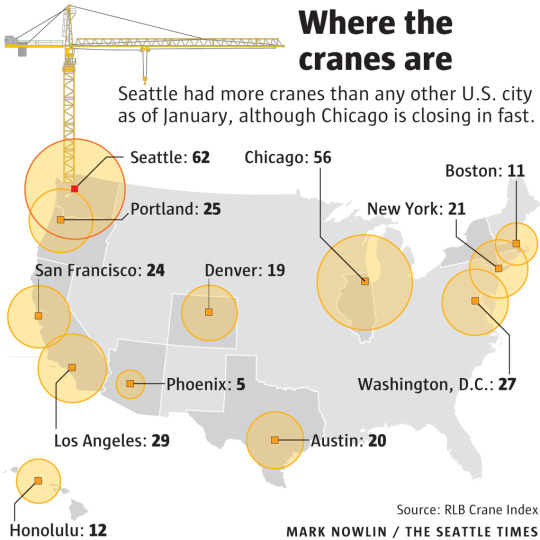
    Earlier this week the Seattle Times published the following graphic showing the US cities with the most (construction) cranes up in the air at the end of 2016:

    At the top of the list is Seattle with 62. And in second place is Chicago with 56. 

    You really need to see these numbers over time to get a better sense of activity. But supposedly, Seattle has been holding pretty steady. Also, these numbers only include cranes within each city proper. The suburbs don’t seem to be counted.

    To put these numbers into perspective, here’s a snippet from the article:

    “Seattle remains behind Toronto, which has 81 cranes, for the North American lead. In Australia, the Middle East, and elsewhere, there are cities where more than 100 cranes are at work.”

    I wonder which city has the global lead. Any guesses?

  • Japan Unlayered

    If you happen to find yourself in Vancouver between January 27th and February 28th, you may want to check out an exhibition being held at the Fairmont Pacific Rim called Japan Unlayered

    It is a celebration of Japanese architecture, design, and culture, curated by the Japanese architect Kengo Kuma and developers Westbank and Peterson.

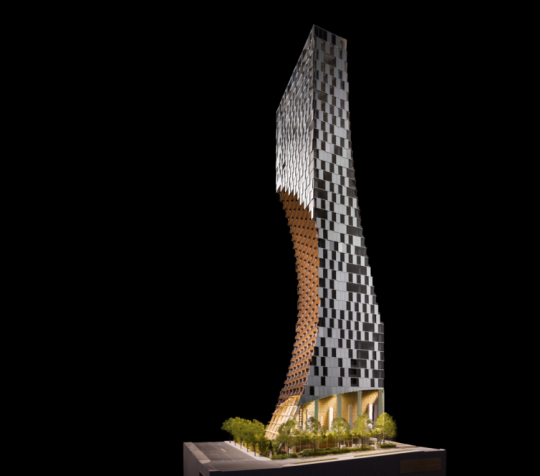
    The exhibition is in support of a new project in Vancouver by Kengo Kuma called 1550 Alberni. Pictured above. It will be his first in North America. 

    The architecture is a 43-storey (residential) tower formed by two “scoops” that carve out the building in response to its urban context. Some of those relationships start to become apparent when you see the building rendered into the skyline (below toward right).

    I’ll be in Vancouver next month and so I’m hoping to stop by.

  • The World in Ten Blocks

    “Toronto is probably the world’s most diverse city.”

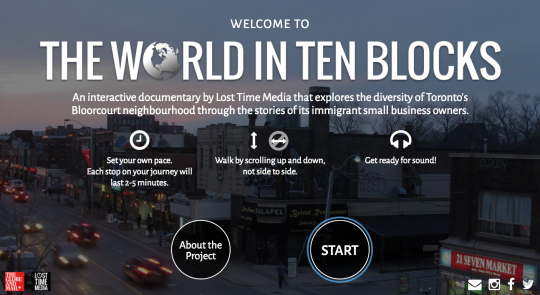
    That is how a new interactive documentary called The World in Ten Blocks starts. Produced by Lost Time Media and hosted at theglobeandmail.com, the documentary examines a ten block stretch of Toronto’s Bloorcourt neighborhood and tells the story of a diverse set of small-business owners who have moved to this city from all around the world. People from Guyana, Mexico, Nicaragua, Saudi Arabia, as well as many other places.

    It’s amazing to be reminded just how diverse ten small blocks of this city can be; especially at a time when immigration has become such a polarizing topic around the world. I sometimes take it for granted just how diverse this city is. I forget and assume that this is just how cities are. But of course that is not always the case. Toronto is an exceptional city.

    Click here for The World in Ten Blocks.

  • Mass timber tower time lapse

    Over the past few years there’s been growing interest in using mass timber for high-rise buildings (now colloquially referred to as “plyscrapers”).

    One project that got a lot of attention last year is Brock Commons (student residence) at the University of British Columbia. It is an 18-storey hybrid mass timber tower.

    The first and second floor (slab) and the two cores are poured-in-place concrete. After that, the other 16 floors of the tower consist of 5-ply cross laminated timber (CLT) panels and glue laminated timber (glulam) columns running every 10 feet. The roof is steel and metal decking.

    Below is a great time lapse video of the building under construction once it had switched over to timber. The wood construction portion started on June 6, 2016 and finished on August 10, 2016. So 2 floors per week.

    The video is well-annotated so that you know what week of construction it is, how many wood installers are on-site, which structural members are going in (along with their dimensions), and so on. The CLT panels are only 169mm thick.

    Click here if you can’t see the video below.

    [youtube https://www.youtube.com/watch?v=GHtdnY_gnmE?rel=0&w=560&h=315]

  • People stay the same

    Andrew Chen recently delivered a keynote at StartCon in Australia called: What’s Next in Growth? You can find his entire talk, here, on his blog. 

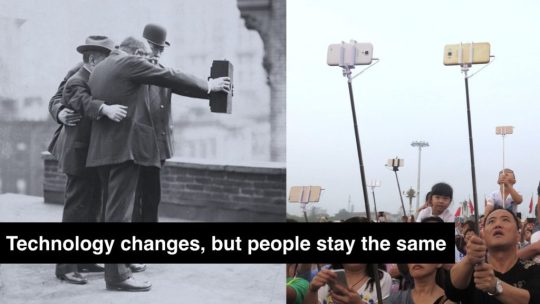
    One of the themes of his talk is that, “technology changes, but people stay the same.” I like that. See above.

    But more specifically, his presentation focuses on 3 techniques for growing businesses and products: customer referrals, viral content, and bootstrapping marketplaces. All of it is interesting, but I’m particularly fascinated by the last one.

    Marketplaces are all around us. Uber is a marketplace that pairs drivers and riders. Bars are a marketplace that try to pair people together. Finding, trading, and transacting (whatever that might mean for the marketplace in question) seems so fundamental to humans. And cities really empower that.

    The challenge with marketplaces is that they’re hard to start. There’s always a chicken-and-egg problem and so one side of the marketplace usually needs to be “hacked” at the beginning.

    Uber is a perfect example of this. At the outset, it didn’t have enough liquidity in its marketplace to compete with incumbent taxis. That is, it took longer to get an Uber than to get a taxi. 

    So instead, the value proposition was not about speed (or cheapness); it was about luxury. Uber was “everyone’s private driver.” That made waiting acceptable. You were getting a different level of service. The first Uber I ever called in Toronto took 20 minutes to get to my place in midtown.

    But obviously as liquidity increased, Uber was able to move downmarket and capture more (most) of the taxi market. Marketplaces are powerful once they get going. Network effects.

    I say all of this because, as many of you know, I have spent a lot of time wondering about the future of real estate marketplaces

    At the same time, I also think that many of these seemingly tech-focused lessons could be applied to cities. Starting an online marketplace is difficult. So is building a new neighborhood from scratch. In the end, it’s always about people.

  • Deep thoughts on apartment layouts

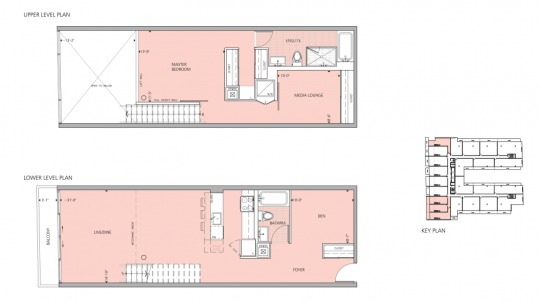
    This morning while I was having a bowl of cereal and fruit, I came across this floor plan from 75 Portland Street, Toronto by CORE Architects:

    It’s a 2-storey unit with a den and double height living room on the main floor and 1 bedroom and 1 media lounge (that could act like a 2nd bedroom, but doesn’t have a window so it can’t be called that) on the second floor.

    This floor plan is a perfect example of what I was getting at with my post: The long and narrow of property affordability

    Rough rough, the overall dimensions look to be about 4.3m wide x 12m deep. It’s a fairly deep plan, which means you have to be careful how much “frontage” you give it. If the apartment gets too wide, then it could quickly become too big and potentially unaffordable.

    With the above dimensions, and if you didn’t go 2 storeys, you’d be forced to do an inset/recessed bedroom. The living room would get all of the windows. And if you made the apartment wider to accommodate that main floor bedroom, then you’d likely end up doing an inset/recessed 2nd bedroom, anyways, because of how big the unit had become. So there are trade-offs to consider.

    I’ve seen this layout first hand and I like it a lot. I think it’s an elegant solution to the challenge of deep floor plates. 

    But what do you think? It may not suit everyone’s needs, so I would be really curious to hear your thoughts in the comment section below or on Twitter.