
April 28, 2026 · View original
One generalized truism is that European cities are walkable and transit-supportive, and North American cities are not. This is not universally true, but it’s often thought to be directionally true. However, a recent paper called “Car Dependency in Urban Accessibility” reveals that this may not be as true as we think.
The study introduces something called a Car Dependency Index (or CDI). What it effectively does is compare accessibility to jobs and services within a city by car versus public transit. They did this for 18 European and North American cities, and here’s what they found:
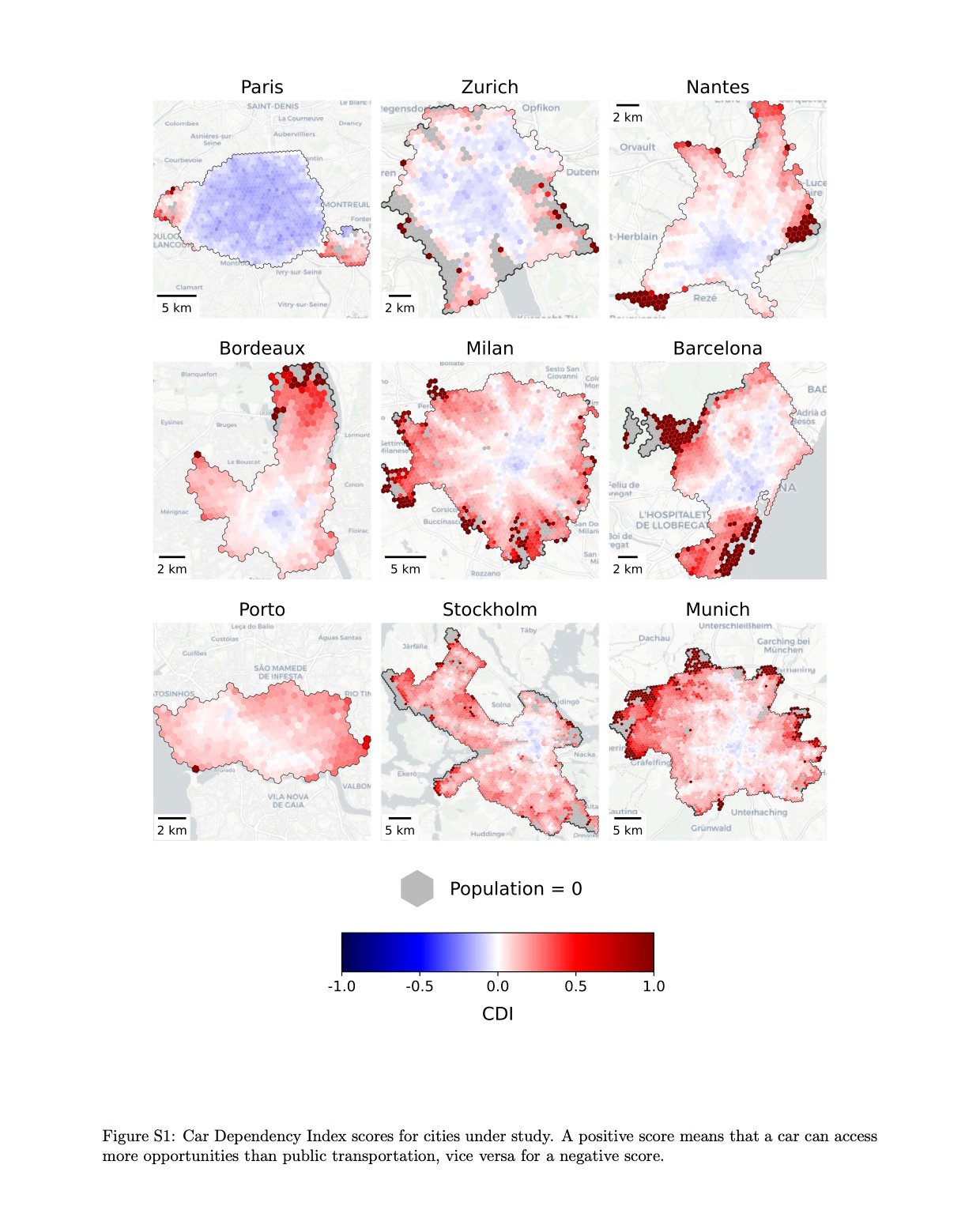
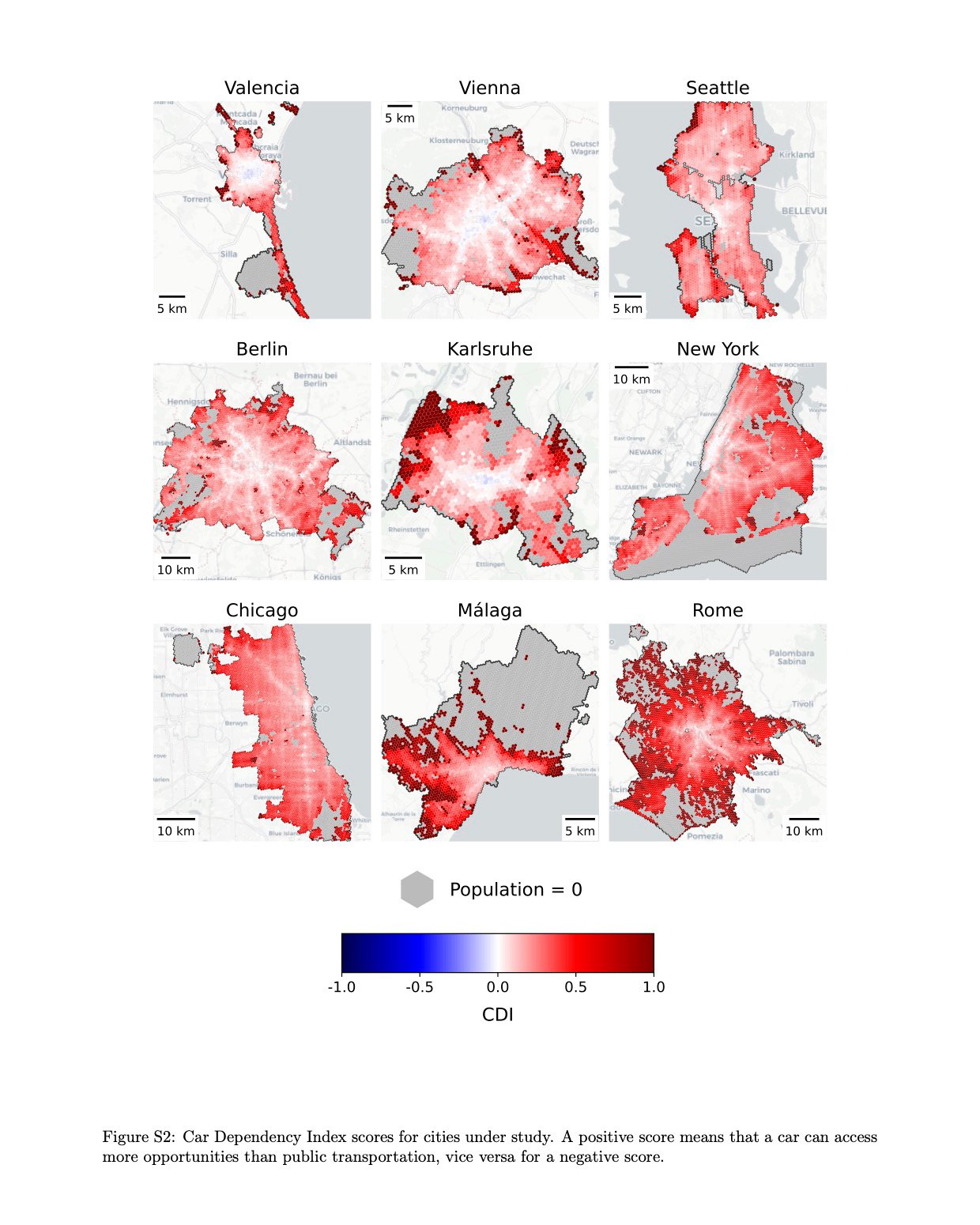
A positive score (red on the map) means that a car can access more opportunities than public transportation, and a negative score (blue on the map) means the opposite. What’s not surprising is how car-dependent the outskirts of most cities are, including European cities. Car dependency was high in over 70% of the urban territories that they analyzed.
What is more surprising to me is that most cities don’t have much, if any, blue. The best-case scenario seems to be a lot of white (which represents accessibility parity between cars and public transit). Hmm. Does Manhattan really not have any blue? The glaring exception is Paris and, to a lesser extent, Zurich, though keep in mind these are only city proper boundaries.
Another finding is that car dependency remains a primary driver of car ownership, even when accounting for income. What this means is that if you took two people with the exact same income, one living in transit-rich Paris and the other living in the suburbs of Rome, the person in Rome is much more likely to own a car.
Once again, this supports the obvious fact that if we design cities so that they’re inconvenient to navigate without a car, well, then more people will get cars. It’s not easy to build a transit network that can compete. Individual lines won’t do it. The key word is “network.” And you need the right land-use policies to support it.
Cover photo by Alessio Ferretti on Unsplash
Charts from “Car Dependency in Urban Accessibility.”
Leave a Reply