Daily insights for city builders, delivered every morning at 6 AM ET. I’m Brandon Donnelly — a Toronto-based real estate developer and founder of Globizen. I’ve been writing here since 2013.

Tag: youtube

  • Transit-oriented vs. single-family

    Michael Beach used to have a YouTube channel where he “looked at Google Maps a lot.” Meaning, he would pan around various cities and comment on their planning and overall built form. Technically the channel still exists, but he stopped making new videos a few years ago. Here is one where he talks about Dubai being “an absolute mess” (3.8 million views) and here is one where he looks at North York (in Toronto) and asks: “why is it here?”

    The most important point from his North York video is that it illustrates the deep divide that exists in Toronto (and other North American cities) between single-family “Neighbourhoods” (a defined planning term) and higher-density transit nodes, where things like tall buildings are allowed to go.

    In the case of North York, this contrast is perhaps at its most stark. Even the street network is designed to stop these two urban forms from commingling with each other too much. There are ring roads that surround the transit-oriented density, and separate, more suburban streets on the other side of it:

    This contrast is why there are so many people talking about the “missing middle.” And I’m sure that if you started asking random people on the street, most would agree that it would be nice if we could build more moderately-scaled housing. You know, like those buildings you see in Paris.

    The problem: Where should it go? Some people would probably suggest the left side of the above ring road. Just don’t build as tall, okay? But this kind of land is already a scarce commodity in a city like Toronto. We need these tall buildings because most of the city is codified to look like the right side of the above ring road.

    So if we have any chance of actually finding the missing middle, it is going to need to happen here, on the right side. Some progress has been made, not just in Toronto but across North America, with accessory dwellings (laneway suites). But it’s not going to be enough.

    This was simply a first step. It was us finding a solution to, “how can we add some more housing here without changing the look and feel and character of these residential streets in any way?” But even this small and incremental change has proven to be exceedingly controversial. People still react to new laneway suites like this:

    https://twitter.com/evboyce/status/1624840523516182528?s=20&t=Q9gCZfTGLz51rVyupxJDPg

    There are complex dynamics at play here.

    If you’re a homeowner that decides to create a new rental home at the rear of your property, you might be viewed as greedy. You are creating something (a home) that someone needs, and you intend to make a small margin on the transaction. It’s like making and selling bread for a small margin, except that selling delicious bread to people is typically viewed in a positive light. On the other hand, ensuring that the value of your house remains as high as possible is generally good practice here. Greed doesn’t factor in this way because, you know, single-family homes.

    There is no surprise why the missing middle is missing. It is missing because we have decided that we want it to be. But hey, $2,145 per month seems like a very reasonable price for a 2-bedroom house.


  • La ville du quart d’heure, but also the value of centralization

    These days, everybody seems to be talking about the 15-minute city — Bloomberg, Treehugger, the Financial Times, as well as countless others. While not a new concept, it is a moniker that is easier for most people to digest. COVID-19 has also created the right backdrop for the moment that it is currently enjoying.

    The 15-minute city is a polycentric and somewhat decentralized approach to urbanism. It is about encouraging and creating multiple centers of urban activity near where people live. The idea being that everybody should have most of their essential services within a 15-minute walk of their home. Put even more simply, it’s about creating an urban environment where people can live locally.

    The benefits to this are numerous. It encourages more compact forms of development, which in turn encourages people to rely more heavily on active modes of transportation such as walking and cycling. The result is less commuting, less carbon emissions, more time, and likely better health outcomes given the reliance on active mobility.

    Indeed, living in a walkable urban community is something that I personally put a huge value on. If I can’t walk out of my home to go grab a coffee and something to eat, it’s probably not the neighborhood for me. But at the same time, I don’t think we can ignore the fact that there are powerful centralizing forces present within our cities.

    As Natalie Whittle points out in this FT article from the summer, new technologies — from the telegraph to the internet — have always elicited predictions that humans would now flee cities and move to the countryside. While it is true that there are other technologies — everything from the streetcar to the automobile — that have allowed us to decentralize to a greater extent, most of us are all still bound to cities.

    In fact, you could argue that the opposite of decentralization has played out. As we have transitioned to a knowledge and information economy, the returns to being embedded within cities and within a particular place have only become greater.

    Take for example the phenomenon of “collab houses” that has been playing out in Los Angeles for some time now, including during this pandemic. Collab houses are typically LA mansions where clusters of young people come and live together in order to create content for platforms like YouTube and TikTok. It’s like a big dorm for creators. And supposedly the biggest one is Hype House.

    What’s fascinating to me about this phenomenon is that it reinforces two things. One, if you want to be rich and famous (emphasis on famous), Los Angeles is seemingly still an important place to be. And two, if you really want to be at the top of your game, it’s apparently not enough to be in the same city as other likeminded individuals; you also need to be under the same roof, bouncing ideas around and pushing one another.

    So what does this all mean? Well, maybe this time is different and we are all currently living through a reorganization of how we will live, work and play. Or, maybe this time isn’t all that different. And the 15-minute city, while an important goal, won’t be the be-all and end-all of modern city building.

    Photo by Lukas Geck on Unsplash

  • Archival street life footage

    Guy Jones is a videographer who specializes in archival footage, or at least that is what his YouTube account suggests. He edits old videos and makes them more watchable by doing things like adding sound and slowing them down to a natural rate. 

    (Older films often appear sped up because they were recorded at less than 24 frames per second and then later played at 24 or more frames per second.)

    I’ve blogged about one of his videos before. This one of New York City in 1911. But he has so many other fascinating films on his channel – including a frozen Ottawa from 1942 – that I figured I would share it in its entirety today

    For the city builders in the room, here are some street life videos of Paris in la Belle Époque (1896-1900), New York City in 1927, and London in 1967. Among other things, it is fascinating to see how quickly the car crept its way into our cities.

    The video of Paris is all horses and moving walkways. The video of New York City (1927) is all cars. And if you look at the other video of New York from 1911, you’ll see a city in the midst of that transition.

  • Leica Store Kyoto

    Yesterday I sent out this tweet about the, relatively new, Apple store in Kyoto

    It is the first in the city and I like what they did with the facade of the building. It is decidedly modern and yet there are hints of a local vernacular.

    Photographer Jonathan Castellino responded and suggested that I check out the new(ish) Leica store, which is also in Kyoto. 

    So here is that store (if you can’t see the video below, click here):

    [youtube https://www.youtube.com/watch?v=ouckkaj3XVc&w=560&h=315]

    I shoot on the Fujifilm X-T3, but Leica certainly makes some exquisite (and expensive) cameras. The Leica Store Kyoto does not deviate from that recipe.

  • Economies of scale in the car and housing industries

    Over the weekend I watched this interview discussion between Elon Musk and Marques Brownlee. If it doesn’t show up below, you can find the video here.

    [youtube https://www.youtube.com/watch?v=MevKTPN4ozw&w=560&h=315]

    Elon figures that if Tesla works really hard they could probably come out with a USD 25,000 car in about three years. The key to that affordability is twofold: (1) design & technology improvements and (2) scale. 

    So part of the answer is just time. As design and engineering iterations continue to take place, the components will become better and cheaper, just as they have for things like cell phones. Elon estimates that we’re in the 30th iteration of the cell phone today.

    But the second factor is simply volume. And that got me thinking about housing production and the similar importance of scale and density. We do a lot to limit volume, despite saying we want more affordable housing.

  • New, mini, electric skateboard

    image

    Boosted — which is a California-based company that makes electric skateboards — has just released a new smaller and more affordable version called the Mini S.

    Casey Neistat — who helped popularize the original models through his wildly successful YouTube channel — recently vlogged about it and it ended up crashing their website. That’s how things work these days.

    Now, this new version is still USD 750 (so CAD 1,000), but it is significantly less than their other, bigger, models.

    The Mini S goes up to 18 mph and lasts for about 7 miles (optional extended range battery available). So it’s perfect for short jaunts around the city and as a solution to that pesky last mile problem. 

    I am seriously considering getting one for my short commute to the office. That way I’m not breaking a sweat in my suit. But $1,000 remains an awful lot for a skateboard.

    What do you think?

    Image: Casey Neistat via Boosted

  • Google and Facebook show

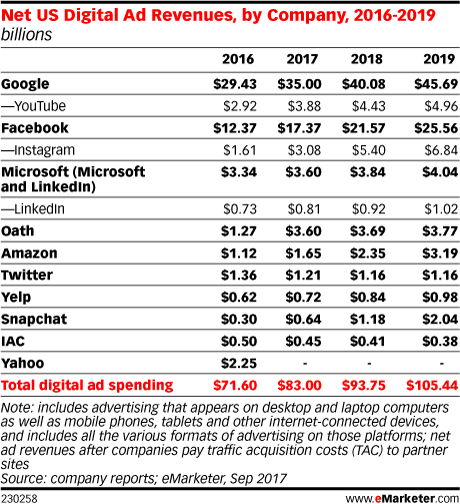
    This morning Fred Wilson posted this chart on his blog:

    image

    What is clear is that when it comes to US digital ad revenue, it’s the Google and Facebook show, followed by everyone else. Microsoft/LinkedIn is a distant third. Fred calls it “the digital advertising duopoly.” And his view is that the tech industry needs to figure out new approaches to monetization that still allow free content to be consumed. 

    I’ve said this before, but Facebook buying Instagram for $1 billion seems like a bargain when you look at a chart like this and you see what they were able to do with the platform. Instagram’s 2018 revenues are projected to be bigger than every other company on the list minus Google but including YouTube.

    Also notable are the flatlining of Twitter and the projected growth of Snapchat. 2017 was a rough year for $SNAP. But it appears that somebody believes they’ll be able to turn things around with their app redesign and reconstituted ad platform. Be that as it may, it’s still the Google and Facebook show – at least for the time being.

  • 4 years

    Today is the 4 year anniversary of this daily blog.

    Sure, I’ve missed a few days over the years (my estimate is 4-5 days), but for the most part I have shown up here every day and written something. 

    Sometimes that something is very short and/or bad. I’ve had a few people say to me: “I can tell when you’re super busy. Your posts are shorter.” I’m okay with that. Part of this exercise for me is simply about the discipline. 80% of success is showing up, right?

    In some ways, what I do here is an anachronism. Here is a good vintage article (2011) that talks about two different schools of thought when it comes to blogging.

    The reality is that it’s painfully slow and difficult to build an online audience via a personal blog using your own domain. It takes years, unless you’re a celebrity, which I am most certainly not. That’s why many people give up.

    Instead, many people/influencers choose to build their audience on top of an existing network, such as YouTube, Instagram, or Medium. Medium is pretty tempting and I’ve seen lots of bloggers port over their personal blogs.

    The idea here is that you simply bring your content to where your/an audience already lives, instead of trying to get them to come to you. 

    Of course, one of the risks of this approach is that you don’t own/control the platform. What if people one day decided to stop using MySpace? I like the idea of owning (at least part of) my online presence.

    So here’s to another year on the blog. Thanks for reading! I really do appreciate it. Regular scheduled programming will resume tomorrow.

  • 76 thumbs down

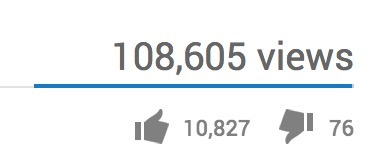
    A few weeks ago Seth Godin wrote a post on his blog called: What 99% looks like. He used the example of a Turkish vlogger who had posted an interview with him to YouTube that received the following view count, up votes and down votes:

    image

    The point he wanted to make was that many of us will instinctively focus on that one number: 76. We will say to ourselves that 76 people hated our video, our work, so much so that they felt compelled to give it a decisive thumbs down.

    His message was clear: “Ignore it. Shun the non-believers and ship your work.” 76 people out of 108,605 views is not even 1%. And 76 out of (10,827 + 76) interactions is still not even 1%. You could easily say that this video has a greater than 99% approval rating.

    I love this message, because there will always be naysayers, especially if you’re doing something interesting and unique. In fact, having naysayers is probably a good litmus test to make sure that you are indeed doing something interesting and unique.

    But here’s the thing. 

    The YouTube metrics above make for a rather transparent platform. You can see that the video received 108,605 views and that 10,827 + 76 people felt so strongly about it that they wanted to leave a mark by way of a thumbs up or thumbs down. But most importantly, you can see that way more liked the video than hated it.

    But what if it wasn’t clear that over 10,000 people were fans of your work? What if all you saw was how many people hated it? And what if those voices were amplified? That would be pretty discouraging, considering that many of us are already focusing on that number to begin with.

    I can think of many instances where the fog is thick and we don’t have full visibility. That’s where it gets even tougher, but more critical, to “shun the non-believers.” There may be people out there who truly love your work and what you’re trying to do. You just may not know it, yet.

  • Kanju (and the future of cities)

    There is so much interest in cities right now and I think that is absolutely wonderful. Earlier today my friend Derek shared a video with me on Twitter called, The Future of Cities. It’s by YouTuber Oscar Boyson, who I recognize from some of Casey Neistat’s videos, but whose own videos I have never watched before.

    I highly recommend you watch this video. It’s just over 18 minutes. If you can’t see the video below, click here.

    [youtube https://www.youtube.com/watch?v=xOOWk5yCMMs?rel=0&w=560&h=315]

    It’s well-executed, a joy to watch, and packed full of information and ideas. There are soundbites from lots of well known urbanists (both living and dead). And I also love how Oscar crowdsourced ideas and content from cities all around the world.

    The title of this blog post will make sense once you’ve watched the video.