Daily insights for city builders, delivered every morning at 6 AM ET. I’m Brandon Donnelly — a Toronto-based real estate developer and founder of Globizen. I’ve been writing here since 2013.
If you’re an architect, you’re sort of expected to have a somewhat eccentric home (or at least a really cool home). And that was certainly the case for architect Paul Rudolph. Paul is perhaps best known — at least in my mind — for being the chair of Yale’s architecture program and for designing its Brutalist building. But he also designed himself a pretty interesting apartment. In 1976, he bought the 19th-century townhouse at 23 Beekman Place in New York. He then constructed himself a now historically-landmarked penthouse on top of it. Now, technically, it is four levels. But spatially, it’s more like a series of connected platforms — 27 of them to be exact. So the penthouse is often described as being 27 levels, and as not having any doors and walls. Because those are totally overrated. I joke, but it’s a beautiful and interesting space. And the two founders of New York’s Gachot (and their two teenage boys) recently got a chance to live in it for three years. If you’d like to hear and see what that was like, click here.
Zoning, as practiced in much of the nation, gravely misallocates resources. Some distortions are micro, such as the mediocre siting of Anton Menlo housing [a project by Facebook], and the lack of walkable neighborhoods in New Haven suburbs. Others are macro. If Silicon Valley were more populous, it would be a world tech center even more attractive to IT workers. The misuse of zoning squanders land, adds to the nation’s carbon footprint, warps interstate migrants’ choices about where to reside, and helps price poor households out of wealthier neighborhoods that would offer better life prospects for their children.
The paper focuses on three metropolitan areas: Austin, Silicon Valley, and New Haven. Of these three, Austin is the most permissive in terms of allowing new and denser housing. Silicon Valley and New Haven, by contrast, have done a great deal to limit intensification by adopting exclusionary policies.
In 1970, home prices in Silicon Valley were only slightly above the national average. Today, they are by far the highest in the United States, which is, of course, partially a result of high demand (tech salaries) and low supply (zoning ordinances). Ellickson’s paper examines the effects of the latter.
Earlier today Richard Florida published a piece in CityLab called: Anatomy of a NIMBY. The article cites a recent paper by Paavo Monkkonen (of UCLA) that focuses on the relationship between NIMBYism and housing affordability – a much talked about subject these days.
More specifically, the paper identifies “four different strains of NIMBYism” and then offers up some possible solutions, which include things like a more inclusive process and better data. I’ve publicly supported these kinds of approaches on this blog many times before.
But in addition to the above, I wanted to point out two other ideas from the paper and Florida’s article.
The first is about shifting land use decisions up to the regional level, and maybe even the state level. This one is particularly timely given that there’s a lot of discussion in Toronto right now about shifting land use decisions in the exact opposite direction – from province (OMB) to city.
The second is a suggestion from Yale professor David Schleicher that he refers to as “tax increment local transfers.” Essentially, the idea is to somehow allow current residents to participate in the future tax revenues generated from new development in their neighborhood.
There’s lots of interesting reading buried in the above links.
In 1960, real estate investment trusts were created in the U.S. with the goal of democratizing real estate ownership. Here’s how Yale professor Robert Schiller described it:
“REITs were created by law in 1960 to democratize the real estate market and make it possible for a broad base of investors to participate in this huge asset class. That was absolutely the right thing to do, because portfolio theory tells us people should diversify across major asset classes, and real estate is one of them.”
But a lot of things have changed since 1960. We now have the internet.
And one of the things that the internet is very good at is creating peer-to-peer networks that connect supply and demand without the same kind of intermediaries. This could be people who have MP3s with people who want MP3s or it could be people who have real estate with people who are looking to invest in real estate.
So with the advent of crowdfunding in both the U.S. and Canada, I think we are at the dawn of another era of real estate democratization. Already we have seen the first crowdfunded real estate development project and it happened at a much smaller and local scale than is usually the case with REITs.
Similarly, we are also seeing companies emerge – such as HomeUnion in the U.S. – that allow people to build their own rental portfolios by directly investing, either fully or partially, in real estate. Again, there are differences here compared to how REITs typically operate.
When I was in grad school at Penn and Sam Zell used to come in and talk to the students, he used always mention how when he started out in real estate (1960s) the industry was disproportionately controlled by a small number of players. That’s been changing ever since and it looks like that trend will only continue.
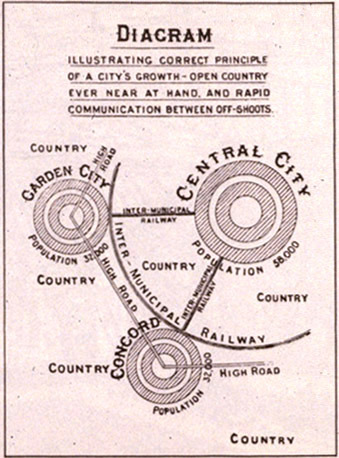
In the book, the authors argue that the solution to our suburban problems is to return to a “tragically interrupted, 150-year-old tradition” known within urban planning and architectural circles as the Garden City movement. Here’s how Arieff describes it:
The garden suburb is — because it still exists in many places — a planned, self-contained village located usually outside a major city. Ideally, it features a variety of housing types, though by variety, we’re talking single-family homes and a few low-rise multifamily buildings.
In contrast to the suburbs we’ve come to be most familiar with, these featured homes are situated in a comfortably dense, highly walkable environment designed around a public center or square.
But in addition to being more dense and walkable, the big difference for me is that the garden city (to use the original terminology) was initially intended to be self sufficient economically–rather than just serve as a bedroom community for the central city.
It was all incredibly rational. As one garden city reached its population and employment projections, the next garden city node would be created and connected to the network via road and rail. And by using land relatively intensely, it meant that more of the countryside could be preserved as undeveloped land.
But while I would agree that the suburbs aren’t going to go away (I’ve said this before) and that we should be making them more dense and walkable, the book (well, the article) got me wondering to what extent the Garden City model applies from an economic standpoint. Should we be trying to create poly-centric cities with tidy little self-sufficient pockets of employment? Or should everything primarily feed a central city?
The irony of the decentralized information economy is that it appears to be encouraging centralization across and within cities. But even before the rise of the internet and other technologies, there have always been real economic benefits to firms clustering in cities. Known as agglomeration economies, it’s one of the reasons cities even exist in the first place.
Certainly, there’s a lot we can learn from the way we used to build and plan our cities and towns (they were designed around people as opposed to cars). But something doesn’t sit right with me in terms of the way the Garden City movement thinks about cities, economically. It seems idealistic.