
Daily insights for city builders, delivered every morning at 6 AM ET. I’m Brandon Donnelly — a Toronto-based real estate developer and founder of Globizen. I’ve been writing here since 2013.

Tag: world health organization

  • 200 km/h on the Autobahn

    We drove on the Autobahn today. Our Ford remained as smooth as ever. They take their cars seriously here and force regular inspections.

    But this got me wondering about safety records and why more countries haven’t adopted similar approaches to highway driving.

    Here is Germany’s 2014 record from Wikipedia:

    It turns out that the injury and fatality rates on the Autobahn — measured per billion vehicle kilometers traveled — are actually relatively low compared to urban and rural road classes.

    It is also relatively low compared to international standards. Here is a 2012 comparison, also via Wikipedia:

    Europe as a whole does very well in this regard (not that this specifically addresses Autobahn safety). Generally, fatalities have declined significantly over the last few decades.

    Here is a chart from the World Health Organization:

    What is clear to me after seeing this data, though, is that the greater problem looks to exist outside of our highways and motorways.
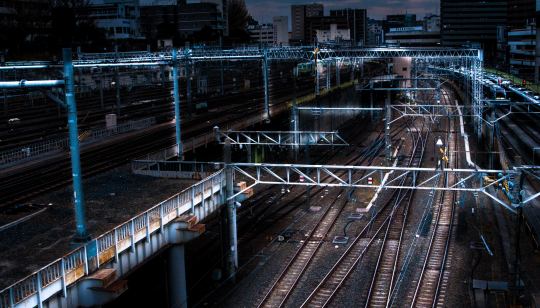
  • Blue lights on train platforms

    Sadly, Japan has one of the higher suicide rates in the world. According to the World Health Organization, the rate from 2000 to 2016 was about 18.5 deaths per 100,000. The only country in Asia with a higher rate is South Korea. They are at 26.9 deaths per 100,000 (an alarming figure). For comparison, Canada and the US are at 12.5 and 15.3, respectively, which also seem rather high to me.

    I was intrigued to learn today that one of the ways that Japan has been trying to combat this high figure is by installing blue LED lamps on some of its railway platforms. Blue lights have been proven to have a calming effect (compared to white light). And since jumping in front of a train is unfortunately a common suicide method, blue lights were thought to maybe be a cost effective alternative to platform screen doors.

    The first blue station lights were installed on Tokyo’s Yamanote line in 2009. And according to this 2013 study – which looked at the possible impact across 71 train stations in Japan – the introduction of blue lights actually resulted in an 84% decrease in the number of suicides. Further studies also showed that there were no corresponding increases at other non-blue light stations. 

    It is an interesting example of “nudge theory”, but does it get at the root of the problem?

    Photo by Athena Lam on Unsplash