Daily insights for city builders, delivered every morning at 6 AM ET. I’m Brandon Donnelly — a Toronto-based real estate developer and founder of Globizen. I’ve been writing here since 2013.

Tag: world economic forum

  • Big global events, small mountain towns

    I was speaking with our lawyer in Park City this week, and he commented to me that he wouldn’t be going into the office next week because Old Town would be too hectic with the Sundance Film Festival going on. His office is right on Main Street.

    When small mountain towns host major international events, there are going to be spillover effects. This is true of Sundance in Park City (population ~8,500) and it is true of the World Economic Forum, which was hosted in Davos (population ~10,000) this past week.

    Perhaps the most obvious impact is that people can rent out their homes for large sums of money. And so lots of people both do that and try to profit maximize while doing it. Here are some anecdotes from Davos (via NZZ):

    Ten days before the WEF, there are still 25 listings on the Airbnb internet platform. The prices here range from 8,000 to 56,000 Swiss francs. The son of an apartment owner says that his family receives 12,000 francs a week for their three-room apartment, which is quite close to the convention center. However, he says he assumes that they could achieve significantly more. The family rents out the apartment through an intermediary.

    Another interesting impact in Davos happens on the retail side (also via NZZ):

    According to expert Robert Weinert, the average rent per square meter of retail space in Davos is 248 Swiss francs. A businessperson renting a storefront of 80 square meters must therefore pay almost 20,000 francs in rent per year. However, if that business vacates the store during the WEF, it can earn 60,000 francs – three times the annual rent for the facilities.

    What this means is that some retail spaces remain vacant all year, just so that they can be available for when the WEF arrives and people need temporary commercial spaces. And why wouldn’t this be the case: 20,000 francs for the year or 60,000 francs for a week. If I’m the landlord, I’ll take the additional 40,000 francs and not think about the property for the rest of the year.

    Of course, if you’re trying to create a vibrant community with things, like, occupied retail spaces, then this isn’t ideal.
  • Five global airlines to start using a digital health pass

    The Commons Project and the World Economic Forum are piloting an initiative right now called the CommonPass framework, and a number of airlines, including Lufthansa and Swiss International Air, are expected to start rolling it out before the end of the year.

    What the CommonPass does is allow people and travelers to verify their health status via a digital certificate on their phone. Right now it can confirm that you’ve tested negative for COVID-19 and eventually it will confirm if you’ve received a valid vaccination.

    The framework also asks countries to publish their travel entry criteria in a standard format, so that it’s easy to update and it can be globally understood.

    Of course, much like all of the exposure alert apps that are out there, this is only really useful if people and companies actually start using it. But the travel industry knows that for customer confidence to return, people are going to need to feel safe again. And a digital health pass is one way to help with that.

    Here is a short video explaining how the CommonPass works. If you can’t see it below, click here.

  • Forum on Future Cities: Urban Intelligence

    MIT Senseable City Lab and the World Economic Forum’s Global Future Council on Cities and Urbanization are hosting a conference next month on the impact that artificial intelligence is having on our cities. Here is a summary of the event:

    As AI (Artificial Intelligence) becomes ubiquitous, it transforms many aspects of the environment we live in. In cities, AI is opening up a new era of an endlessly reconfigurable environment. Empowered by robust computers and elegant algorithms that can handle massive data sets, cities can make more informed decisions and create feedback loops between humans and the urban environment. It is what we call the raise of UI (urban intelligence).

    The 2019 Forum on Future Cities, organized by MIT Senseable City Lab and the World Economic Forum’s Global Future Council on Cities and Urbanization, will focus on four aspects of the UI transformation: autonomous vehicles, ubiquitous data collection, advanced data analytics, and governing innovation. Panelists include mayors, academics, senior industry leaders and members of civil society to explore such topics from different points of view, highlighting the scientific and technological challenges, the critical collective decisions we as a society will have to make, and the exciting possibilities ahead.

    The forum takes place on April 12th in Cambridge, Massachusetts. And since it looks to deal with many of the topics that we talk about on this blog, I figured that some of you might be interested in attending. If so, you can register here.

  • Global mobility index

    Below is a short video that was created by the MIT Senseable City Lab, World Economic Forum and TomTom for a study on how people move in 100 cities around the world. They call it the Global Mobility Index.

    It shows congestion levels (using real-time traffic data from TomTom), commute times, and an estimate for the percentage of trips that could be shared if people were willing to wait up to 5 minutes.

    In the case of Toronto, they estimate that 99% of trips could be shared and that it would increase average speeds by ~7.9 km/h and reduce overall traffic levels by ~44.09%.

    Their solution to solving traffic congestion is a cocktail that involves car-sharing, bike-sharing, and public transit. It’s about developing a “mobility portfolio.” Seems sensible.

    I found myself wanting more information and data after watching the video. Still, it was interesting to see what the authors describe as the “pulse of our cities.”

    If you can’t see it below, click here.

    [youtube https://www.youtube.com/watch?v=ciJEHGMtpWc?rel=0&w=560&h=315]

  • South Korea buys 20% of its groceries online

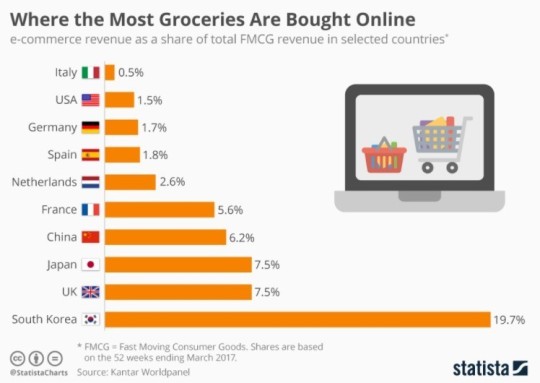
    The World Economic Forum recently posted the below chart showing that 1/5 of all grocery purchases in South Korea are done online. The calculation is e-commerce revenue as a percentage of total fast moving consumer goods revenue in the country.

    image

    The explanation they give for this high percentage is that South Korea has some of the fastest and most ubiquitous internet access in the world. 

    But as soon as I read this I thought to myself: This can’t be the only reason. When was the last time you really wanted to order groceries online but your internet connection was too slow? 

    Also, if you look at all online shopping (not just FMCG), South Korea no longer shows up as such an outlier. So what’s happening with grocery?

    Without actually knowing the market, I would imagine that there are companies in South Korea who have simply figured out how to offer a great online grocery shopping experience.

    South Korea is also one of the denser countries in the world at about 513 people per km2. That would help with distribution. 

    But then again, the Netherlands is also quite dense (414 people per km2). Why are they only at 2.6%? (For comparison, the US is about 33 people per km2.)

    If any of you are familiar with the South Korea market I would love to hear from you in the comments. If they really are at 20%, I am surprised more people aren’t talking about this.

  • The link between ancestry and foreign direct investment

    Below is an interesting example of how international migration – and being open to it – can have positive economic impacts by way of increased foreign direct investment (FDI). The excerpt is from the World Economic Forum.

    “…we document that FDI follows the paths of historical migrants as much as it follows differences in productivity, tax rates, education, and other conventional determinants of economic competitiveness – for the average US county, doubling the number of individuals with ancestry from a given origin country increases by 4 percentage points the probability that at least one firm from this US county engages in FDI with that origin country, and increases by 29% the number of local jobs at subsidiaries of firms headquartered in that origin country.”

    Their study also found that these ties are long lasting. That is, even after a few generations of assimilation, ancestry still has an effect on FDI patterns. 

    There are of course many other benefits to open borders. But our collective tolerance toward immigration has ebbed and flowed greatly over time. And my sense is that if often has a relationship with prosperity.

    As long as times are good and I – the incumbent – am winning, then immigration is accepted, if not welcome. But as soon as times become scarce, then I – the incumbent – need to start protecting my nest.

    This may be one of the reasons why Canada seems to fair so well when it comes to diversity. We optimize for the middle more than countries like the US.

    An example of this phenomenon can be found in the mid-19th century California Gold Rush. By 1876, the United States had approximately 151,000 people of Chinese ancestry and about 116,000 of them were in the state of California.

    In the early days of the rush, when gold was abundant, it has been said that the foreign Chinese laborers were well received. But as gold became more scarce and difficult to find, Californians began to believe that the Chinaman was stealing their wealth.

    In 1882, the US signed the Chinese Exclusion Act, which flat out prohibited the immigration of Chinese laborers. It was not repealed until 1943. However, the Chinese still found other creative ways to enter the country (see Lo Mein Loophole).

    I say all this simply to provide a bit more context. We can talk about how disruptive technologies are squeezing the middle class in new and profound ways. But in many ways, we’ve all heard this story before.

  • The rise of paradiplomacy

    In the words of Mike Bloomberg, then mayor of New York: “We’re the level of government closest to the majority of the world’s people. We’re directly responsible for their well-being and their futures. So while nations talk, but too often drag their heels, cities act”. Whereas diplomacy is carried out for the state, paradiplomacy is executed for the population.

    Rodrigo Tavares has an interesting article up at the World Economic Forum talking about the rise of foreign policy and international relations at the local level. The argument is that as cities rise (and they are certainly rising) paradiplomacy is inevitable.

    He admits that the diplomatic networks tend to be stronger for regions who have “flirted with sovereignty.” Regions such as Quebec, Catalonia, and Scotland are given as examples. However, this shift is by no means exclusive to them. Lots of examples in his article.

    It is also manifesting itself very differently compared to at the national level. And that’s part of the advantage. One example is London & Partners, which is an arm of the City of London that sells consulting services to other cities and nations who want to replicate its successes. Do nations do this?

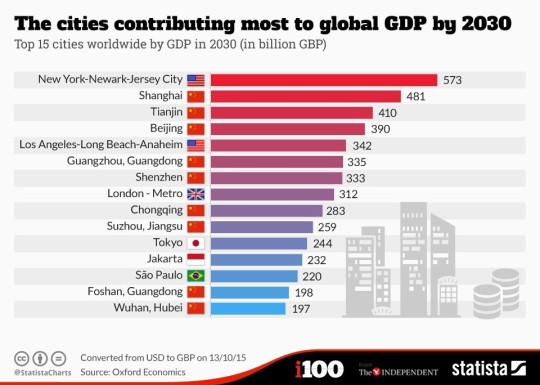
    I have argued before on this blog that our governance structures do not accurately reflect today’s urban reality. Rodrigo’s article is a reminder that we continue to underestimate the role of cities in the global economy.

    I’ll end with this chart from his article:

    image