Daily insights for city builders, delivered every morning at 6 AM ET. I’m Brandon Donnelly — a Toronto-based real estate developer and founder of Globizen. I’ve been writing here since 2013.

Tag: work

  • Uninterrupted flow

    Adam Grant’s recent NY Times article about languishing — the psychological middle state that exists somewhere in between depressed and flourishing — has been making the rounds online. Perhaps it is because COVID sucks and many of us can relate.

    Either way, three points in the article really stood out to me (at least one of which, in my mind, directly ties back to real estate).

    Firstly, I found it helpful to hear him describe what flourishing is. In his words, “flourishing is the peak of well-being: You have a strong sense of meaning, mastery and mattering to others.” This resonates with me. I know that I am at my best when I’m accomplishing things and making progress.

    Secondly, he puts forward a possible solution to languishing — it’s the concept of “flow.” Flow is when we are absorbed in meaningful and challenging work and where, again in his words, “your sense of time, place and self melts away.” This also resonates with me. I am a big fan of a flow (even if I didn’t know what it was called).

    Thirdly — and this one is important as we all think about the future of work/office space — focus is paramount to doing exceptional things! Here’s an excerpt that I immediately paused on as I was reading the article:

    Fragmented attention is an enemy of engagement and excellence. In a group of 100 people, only two or three will even be capable of driving and memorizing information at the same time without their performance suffering on one or both tasks. Computers may be made for parallel processing, but humans are better off serial processing.

    For the rest of Grant’s article, click here.

  • How to achieve peak productivity

    image

    Lately I’ve been finding that I need to divide my time between multitasking and blocks of uninterrupted time. The multitasking phase is doing calls, responding to emails in 3 seconds, going from meeting to meeting, and so on. It’s a mode that many of us probably exist in virtually all of the time.

    But I can’t stay in this mode all of the time. I think of it as short attention span mode. There are times when I need blocks of uninterrupted time so that I can “go deep.” One example would be to review drawings. I really need to focus so that I can think of all of the externalities associated with the decisions being made.

    This is related to my post about managers and makers, but it’s also the focus of a recent book by Cal Newport called, Deep Work: The Secret to Achieving Peak Productivity. You can read more about the book here at Knowledge@Wharton, but I wanted to highlight two concepts. The first is this equation:

    High-Quality Work Produced = (Time Spent) x (Intensity of Focus).

    Obviously the argument here is that if you want to maximize your output, you need to increase the intensity of your focus. Minimize distractions. Ratchet up the intensity. There’s only so much time in the day.

    Newport gives the example of Adam Grant. He is a New York Times bestselling author and the youngest tenured professor at the Wharton School at the University of Pennsylvania. 

    He is so committed to intensity of focus that he batches all of this teaching into the fall semester, allowing him to truly focus on the students. He’s the highest rated teacher at Wharton. At the same time, this lets him focus on research and writing during the spring and summer semesters. He’s also known to regularly use auto-of-office responders when he’s in the office, but needs to focus.

    The second concept is that of “attention residue.” The idea here is that when we switch from some Task A to some other Task B, our attention doesn’t immediately snap over. A portion of our attention remains on the original task and distracts us from fully focusing. There’s residue.

    An example of this would be when you’re working on something and you see an email come in. As soon as you turn your attention to that notification, your attention gets divided. And even if you don’t immediately respond to that email, a portion of your attention now remains with that uncompleted task. It lingers in the mind.

    The above probably makes intuitive sense to a lot of you, but in many ways our work culture today does not encourage intensity of focus.

    Thanks for reading today. There’s lots of evidence to suggest that the best way to learn new things is to not simply read about it, but to share it with others. That’s one of the reasons I blog and hopefully you find that valuable.

  • I’m so busy

    “How are you?”

    “Busy!”

    How many of you say this? I say this all the time, even though I am trying to resist and come up with more creative responses.

    I recently tweeted this idea out and then my friend Brad sent me this article from HBR: Why Americans Are So Impressed by Busyness. It’s a fascinating topic because, historically, not being busy was a sign of status. It meant you had enough money to not have to do anything. 

    But things have changed – at least in this part of the world. (Italy doesn’t seem to feel the same way based on some studies.) Here’s a snippet from the article:

    “What has changed so dramatically in one century? We think that the shift from leisure-as-status to busyness-as-status may be linked to the development of knowledge-intensive economies. In such economies, individuals who possess the human capital characteristics that employers or clients value (e.g., competence and ambition) are expected to be in high demand and short supply on the job market. Thus, by telling others that we are busy and working all the time, we are implicitly suggesting that we are sought after, which enhances our perceived status.”

    So the reality is that there’s actually a good reason for always talking about how busy we are. But as Silvia Bellezza points out in her article, there are also physiological consequences to always being: “busy!” 

    On that note, I think I’ll go snowboarding.

    “How are you?”

    “Just living the dream.”

  • Move fast and…

    I like this article – called Speed as a Habit – by Dave Girouard, CEO of the personal finance startup Upstart. It’s all about the importance of speed in business. Speed wins.

    “When you think about it, all business activity really comes down to two simple things: Making decisions and executing on decisions. Your success depends on your ability to develop speed as a habit in both.”

    What makes this topic so interesting is that, for a number of reasons, speed has a tendency to get sacrificed. It might be because the plan isn’t yet perfect or because there’s a belief that Y can’t happen until X is complete. 

    Perhaps it’s because the value of speed is harder to measure than the value of “perfection.”

    I particularly like the notion that you know you’re going fast enough when there’s a bit of discomfort and you’re feeling stretched, but not overstretched in an unsustainable way. Here’s another excerpt from Dave’s article:

    “While I was at Google, Larry Page was extremely good at forcing decisions so fast that people were worried the team was about to drive the car off a cliff. He’d push it as far as he could go without people crossing that line of discomfort. It was just his fundamental nature to ask, “Why not? Why can’t we do it faster than this?” and then wait to see if people started screaming. He really rallied everyone around this theory that fast decisions, unless they’re fatal, are always better.”

    A big part of this, I find, is momentum. An object at rest stays at rest. But an object in motion stays in motion. Remember this law? In this context, it is decisions that power motion and help to build and sustain momentum.

    Of course, the ideal outcome is both lightning fast and high quality decisions.

    The title of this post is homage to Facebook’s original corporate motto: “Move fast and break things.” This slogan was later adjusted to “Move fast with stable infrastructure”, which I think demonstrates our constant struggle between speed and quality.

  • I love work

    I spent this morning drafting the third post in my BARED blog series. First one, here. Second one, here. If any of you would like to be featured next, or know of someone who you think should be featured next, please send me an email or tweet.

    At this point, I need to move onto other things today. But I did want to mention a post that Ev Williams (Blogger, Twitter, Medium…) recently penned where he talks about keeping technology in check and the drain of being always connected.

    Here are two interesting excerpts:

    “I’ve spent the last 20 years breathing and building the internet. So I have a good sense for the benefits of always-available instant access and all it entails. I also have a strong appreciation for the drain being constantly connected can cause on your health and sense of well-being.”

    “Building companies requires a ton of work — and I love work. But I’ve also found that working 24/7 no longer produces the best work product or the best life experience (not that it ever did).”

    This really resonates with me, as I am sure it does for many of you. I like being always connected. I like waking up every morning and writing a blog post. I like saying yes to things. And I, like Ev, love work. 

    But it can be draining when your ambition seems to exceed your body’s ability to keep on going. And when that happens, you no longer produce your best work, which is the whole point. 

    So in the end, I think we all need these little checks and balances. Exercise is number one for me. It is well worth the time it takes. What do you do for balance?

  • The war on work

    Air Canada bumped me from my flight this morning and so I am spending the day hanging out at Toronto Pearson Airport. I can think of more enjoyable ways to spend Canada Day, but at least there’s a nice seating area in Terminal 1 with free wifi and lots of plugs.

    I just finished watching the below talk by Harvard economist Ed Glaeser at the Manhattan Institute. His overall thesis is that unemployment is a far worse problem than income stagnation and that the US needs to stop creating incentives for people not to work. He refers to it as a war on work.

    He addresses a few topics that we’ve talked about here on this blog, such as guaranteed basic incomes, as well as others that we haven’t talked about, such as raising the minimum wage. To give you one spoiler: He argues that a higher minimum wage has been shown to cause an overall drop in employment, which he, again, believes is a deeper problem.

    Glaeser delivers a passionate performance. So if you have 30 minutes to spare – perhaps you’re stuck in an airport somewhere – I recommend you give it a watch. If you can’t see the video below, click here.

    [youtube https://www.youtube.com/watch?v=8xaNV_6wgak?rel=0&w=560&h=315]

  • Why Google is worried about being welcoming to employees who want to build new businesses

    Here on ATC, we’ve talked a lot about the changing nature of work and what that could mean for cities. 

    We talk (and debate) about the value of density and of being in close proximity to others so that ideas can percolate – whether that means open office floor plans or community coffee shops.

    But alongside all of this, there are some fascinating structural changes taking place within organizations. Below is an excerpt from a recent New York Times article called, How Larry Page’s Obsessions Became Google’s Business

    But corporate success means corporate sprawl, and recently Google has seen a number of engineers and others leave for younger rivals like Facebook and start-ups like Uber. Mr. Page has made personal appeals to some of them, and, at least in a few recent cases, has said he is worried that the company has become a difficult place for entrepreneurs, according to people who have met with him.

    Part of Mr. Page’s pitch included emphasizing how dedicated he was to “moonshots” like interplanetary travel, or offering employees time and money to pursue new projects of their own. By breaking Google into Alphabet, Mr. Page is hoping to make it a more welcoming home for employees to build new businesses, as well as for potential acquisition targets.

    What I find interesting about the statements I’ve bolded is that they represent a radically different approach to business and employment. Of course, it’s not really a new thing. Google has been encouraging its employees to work on personal projects since, I think, the very beginning. 

    But as you read the above article, you really get the sense that Page believes that this kind of organizational culture is fundamental to the long term competitiveness of the company. It’s something he is genuinely worried about.

    As counter intuitive as it might seem to encourage employees to work on other things besides the core business, one could argue that it’s almost essential in a world of rapid and constant innovation. Would you rather an employee or a competitor discover what’s next in your industry? If it’s the former, you have a chance of absorbing it into your current business. If it’s the latter, you’re already too late.

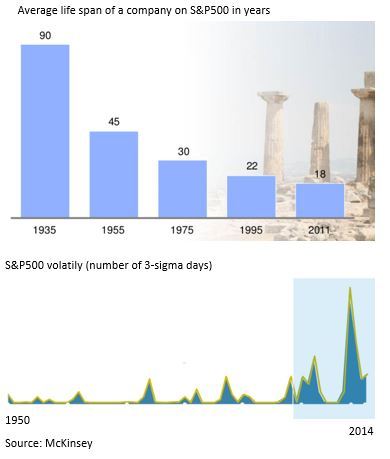
    If you go back to the article I posted earlier this week, you’ll see that creative destruction is happening a lot faster than it did in the past. The average life span of many, or most, companies seems to be decreasing.

    The tech sector seems to be ahead of most other industries with respect to this kind of thinking. But I believe that it will continue to percolate through the economy. And when it does, it will probably have many impacts on the kinds of spaces we design and build in our cities.

  • Coworking, coliving, and an old architecture school project

    Coworking spaces are big business.

    One of the biggest of those companies is WeWork. As of last month (November 2015), the company had raised close to a billion dollars from investors like JPMorgan Chase, Harvard Management, and Benchmark Capital, and was valued at $10 billion. (Remember though, this is in the private not public markets.)

    If you’re unfamiliar with coworking spaces, check out this post from The Spaces. It’s a great demonstration of how beautiful these spaces can be.

    All of this is interesting because it speaks to the changing nature of work. There are a lot of people freelancing, participating in the “online gig economy” and working on new ideas. And in many of these cases, they don’t want or need traditional office space and/or they want the community that many of these coworking spaces afford – both offline and online.

    But it’s not just the office that is changing. It’s also potentially living spaces. Since 2014, WeWork has been talking about their new coliving concept, WeLive. The idea here is to combine smaller living spaces with larger common areas and create an overall live-work community. And they are not the only ones thinking about this.

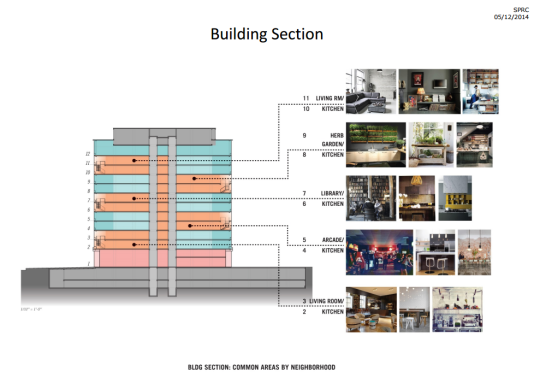
    Below is a building section of what this might look. It’s from a Vornado Realty presentation. They are working with WeWork to deliver their new WeLive concept in Crystal City, Virginia.

    It’s so interesting to see this concept come to fruition. Back in 2008 when I was in architecture school, I worked with a classmate of mine and designed a modular coliving apartment building. It was called the Philly Flex Dwelling and it worked like this:

    The idea here was to start with standard floor plates and use a structural exoskeleton to minimize interior columns. This way you could insert whatever prefabricated modules you wanted and also re-purpose the structure should you want to change the building’s use in the future. 

    This is not that dissimilar from what was originally proposed for One Bloor West here in Toronto. Though the goal there was column-free retail spaces. 

    The yellow spaces are the shared common areas and the remaining spaces are the residential living “pods.” We also designed a “solar skin” that was perfectly tuned to the building’s orientation and location in Philadelphia. The idea here was to maximize winter sun (for heating) and minimize summer sun (to keep the building cool).

    That was a fun project to work on.

  • East Room co-working space

    image

    Amy Bath needs to leave comments here on ATC more often because she has great feedback and insights.

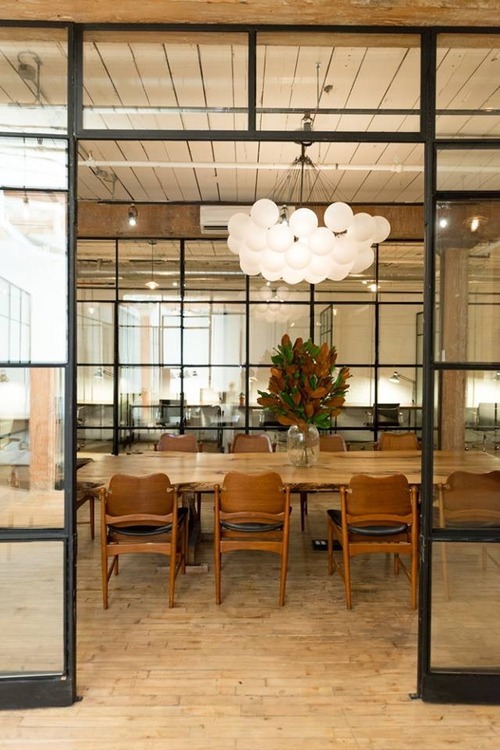
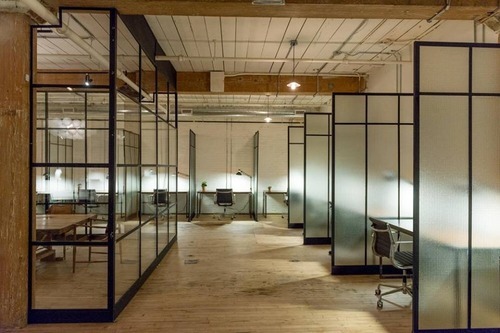
    This morning she tipped me off to a brand new co-working space on the east side of Toronto called East Room. If you haven’t yet heard of it, I would encourage you to check out their website. They’re in a gorgeous heritage building along the Don Valley and they seem to have executed really well. I love their design aesthetic.

    //platform.instagram.com/en_US/embeds.js

    They currently offer two different memberships: a resident membership ($500/month) and a club membership ($250/month).

    image

    This is exciting to me because I have a soft spot for both good design and the east side of Toronto. But probably more importantly, it speaks to the changing nature of work and the workplace, as well as to the shifts in how space is being consumed.

    Co-working spaces are, of course, blowing up all over the world from Philadelphia to Berlin. The internet has empowered new ways to freelance and make money, and these kinds of spaces are really a result of that. Because even though it’s entirely possible for many of us to work remotely at home, we still crave the social interaction that comes from being within an office environment. And that’s a big part of what these spaces are. They’re a social fabric.

    Amy’s hope is that condos will eventually start including amenity spaces that are similar to co-working spaces, and I think that’s a really interesting idea. The challenge, however, is that most developers today (and property managers) aren’t equipped to operate these kinds of environments.

    But maybe it’s only a matter of time before some do become equipped, because I’m sure we’re going to see more, not less, of these kinds of urban spaces.

    Images: @eastroom_

  • How are you attracting and retaining top talent?

    Yesterday I received a comment on my post about service and product companies with a suggestion to check out an interesting Fast Company article talking about the future of work (thank you Amy). The article was based on a research report – commissioned by CBRE and a real estate developer in China (Genesis) – called Fast Forward 2030: The Future of Work and the Workplace.

    This is a topic that’s getting a lot airtime right now because Millennials are starting to impact work in a big way. But what’s interesting about it is how broad these impacts will be. Changes in how we work will affect the way we design our cities; the way architects and developers build and lease space; the type of people and roles companies will need to hire and create; and so on.

    Here’s a snippet from the report:

    “Providers of commercial buildings and places to work will need to develop new, sometimes counter intuitive, business models and work with partners who understand service and experience in order to compete with emerging workplace competitors. Successful providers will work with tenants to unlock ‘win win’ solutions that reduce occupier costs, increase flexibility, and simultaneously provide enhanced levels of community, amenity and user wellbeing. Cities will have a role to lead and nurture changes that will support the changing landscape of work.”

    I plan to go through the report in more detail this weekend, but I did want to point out one thing. When business leaders from around the world were asked what their biggest competitive advantage would be by the year 2030, the top choice was: the ability to attract and retain top talent. This topped organizational vision and even the ability to innovate.

    This might not come as a surprise to some of you, but it’s worth repeating. And in many ways, it’s a chain that begins first with cities. 

    If you’ve ever watched The Startup Kids documentary, you’ll know that when Alexander Ljung (CEO of Soundcloud.com) was about to found his company, he actually started by first traveling around Europe looking for the coolest city in which to base his company. The last city on his trip was Berlin and that just so happened to be the team’s favorite. So that’s where Soundcloud was founded.

    My point with that story is simply that the “workplace” of today – forget the future – means so much more than just your rentable area. Yes, that’s important. But there’s a lot more to consider when trying to get the best people. Cities play a huge role.