Daily insights for city builders, delivered every morning at 6 AM ET. I’m Brandon Donnelly — a Toronto-based real estate developer and founder of Globizen. I’ve been writing here since 2013.

Tag: wework

  • There’s something to be said about hard assets

    Here is a recent post by Scott Galloway comparing Uber and WeWork. In it, he praises the virtues of asset-light business models:

    For most of business history, having assets was good, and having more was even better. However, one of technology’s tectonic unlocks has been elevating information (bits) over objects (atoms). In the information age, owning assets is one business, while operating them is another, and each demands distinct capital structures, management approaches, and operational skills. Businesses offering the greatest return on invested capital don’t have much capital (assets) and can scale up faster, as they don’t bind themselves to cars, apartments, or even inventory.

    We know this. Uber doesn’t own cars. Airbnb doesn’t own rental properties. And most hotels, as Galloway mentions, also don’t own their real estate. Generally speaking, hotels are brands that enter into fee-earning management contracts with people who own real estate.

    However, WeWork is not this. According to Galloway, WeWork had $47 billion of pre-IPO lease obligations. These ran/run through to 2038. In this regard, WeWork is more bank-like: they have a similar mismatch of short-term assets and long-term liabilities.

    Galloway also argues that asset-light businesses offer the greatest ROI because they can scale up faster. And this is certainly one of the virtues of tech businesses. In more asset-heavy businesses like real estate development, each project/asset is largely a discrete effort.

    But there are significant advantages to owning real estate; one of them being that, at the end of the day, you own a hard asset.

    Venture capitalist Fred Wilson once wrote on his blog that one of his big lessons from the dot-com bubble was that he learned to take his tech wealth and funnel portions of it into hard assets — namely real estate in New York City.

    This, of course, comes with its own set of risks. But clearly there is something to be said about owning real estate.

  • A discussion about Adam Neumann’s new residential apartment startup — Flow

    This an interesting discussion about Adam Neumann’s new startup Flow (which I recently wrote about here).

    More specifically though, the discussion is about venture capital firms backing “failed” entrepreneurs, and whether or not Flow can really be that much more valuable than your typical apartment REIT.

    In its simplest form, Flow might just end up being an apartment company with a strong national brand and a consistent resident experience. But maybe that’s all it needs to be.

    If the link doesn’t already do it for you, jump to the 7:19 mark to start with this discussion. After Flow, the podcast moves on to housing policy in the Bay Area, Houston, and Miami. So you may also want to stick around for that.

    Thank you Ocean Jangda for sending this over.

  • Adam Neumann has quietly acquired some 4,000 apartment units

    So it was announced today that Adam Neumann — the cofounder and former CEO of WeWork — has been quietly buying apartment buildings across the United States. According to the Wall Street Journal, he is involved in entities that have acquired more than 4,000 apartment suites valued at least $1 billion.

    The buildings, which seem to be fairly typical and have at least a few hundred doors, are located in cities like Miami, Ft. Lauderdale, Atlanta, Nashville, as well as in many other US cities. It’s not clear what the exact plan is for this real estate but people who claim to know things are saying that it will involve “redefining the future of living”, or something along these lines.

    Presumably this means catering to young professionals with cool design, fun amenities, and beer taps. Whatever ends up happening, it is interesting to see some of the cities that he/they are targeting. They are the cities that we’ve all been talking about for many years. You know, the ones that are growing quickly and have greater housing supply elasticities.

  • More than a real estate company — a state of consciousness

    Matt Levine’s most recent Money Stuff article is classic Matt Levine. It is both entertaining and informative. This one is on WeWork – the coworking startup that has committed to 14 million square feet of office space around the world and will have $18 billion in rent payments due over the next decade.

    Here is an excerpt:

    WeWork Cos. is a real-estate company with a couple of innovative twists on the model. First, rather than owning its buildings, it rents them: It leases office space from regular real-estate companies, adds … beer? … or whatever, and then subleases the space to tenants at higher rates. And second, rather than being valued like a real-estate company, it gets valued like a hot tech startup — “the sharing economy,” ping-pong tables, etc. — so it can raise gobs of money from SoftBank Group Corp. at a $20 billion valuation without ever getting particularly close to profitability. And look at all these words:

    “Indeed, to assess WeWork by conventional metrics is to miss the point, according to [Chief Executive Officer Adam] Neumann. WeWork isn’t really a real estate company. It’s a state of consciousness, he argues, a generation of interconnected emotionally intelligent entrepreneurs.”

    Really, what sort of multiple would you put on a state of consciousness?

  • WeWork launches first co-living space in New York

    I’ve written about co-living spaces before – here and probably elsewhere on this blog.

    Well this morning, WeWork (the co-working startup currently valued at a cool $16 billion) unveiled its inaugural co-living space on New York’s Wall Street. It’s called WeLive and Vanity Fair describes it as “Soho House meets Airbnb meets a tricked-out Restoration Hardware storeroom, but for the Slack Set.” 

    Got it?

    Ultimately, this location at 110 Wall Street will have 600 fully furnished WeLive apartments, but they’re coming online in tranches. This first release includes 200 units. Here’s a bit of information on pricing from Fast Company:

    “There are 200 units available—ranging from $1,375 per person in shared apartments to $2,000 for an individual studio—all with the option of either a month-by-month or yearly lease (a $125 monthly fee covers amenities). The apartments are about 450 square feet on average, with the largest units topping out at 1,000 square feet (one-bedroom apartments in the area, by comparison, range in prices from about $2,850 for 451 square feet to $3,500 for 700 square feet). Each apartment comes fully furnished, minimally decorated, and set up with cable and Internet at move-in.”

    But this is not just about price. The WeLive concept is about creating a strong sense of community within the building. Every floor, for instance, has some sort of common area to foster interaction – a space for yoga classes, a laundry room with a big pool table, and so on.

    I am interested in seeing how this concept pans out because I’ve had discussions before with people in the industry about how condos/apartments might be programmed to feel a bit more like hotels. Years ago, I even spoke to a major European company about trying to pioneer a model like this.

    Because there’s something very social about being in a hotel – something that I really like. You can walk down to the lobby bar by yourself and you never know who you might meet. That’s not really the case in many multi-family buildings.

    Now, part of that might have to do with the fact that people tend to be more open when they travel. But maybe WeLive can help create that kind of social interaction within the apartment building. I think that would be a positive thing.

  • Coworking, coliving, and an old architecture school project

    Coworking spaces are big business.

    One of the biggest of those companies is WeWork. As of last month (November 2015), the company had raised close to a billion dollars from investors like JPMorgan Chase, Harvard Management, and Benchmark Capital, and was valued at $10 billion. (Remember though, this is in the private not public markets.)

    If you’re unfamiliar with coworking spaces, check out this post from The Spaces. It’s a great demonstration of how beautiful these spaces can be.

    All of this is interesting because it speaks to the changing nature of work. There are a lot of people freelancing, participating in the “online gig economy” and working on new ideas. And in many of these cases, they don’t want or need traditional office space and/or they want the community that many of these coworking spaces afford – both offline and online.

    But it’s not just the office that is changing. It’s also potentially living spaces. Since 2014, WeWork has been talking about their new coliving concept, WeLive. The idea here is to combine smaller living spaces with larger common areas and create an overall live-work community. And they are not the only ones thinking about this.

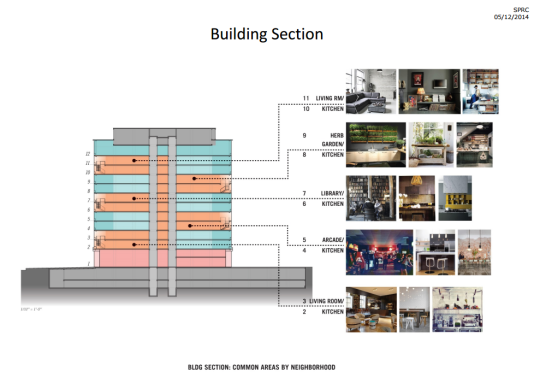
    Below is a building section of what this might look. It’s from a Vornado Realty presentation. They are working with WeWork to deliver their new WeLive concept in Crystal City, Virginia.

    It’s so interesting to see this concept come to fruition. Back in 2008 when I was in architecture school, I worked with a classmate of mine and designed a modular coliving apartment building. It was called the Philly Flex Dwelling and it worked like this:

    The idea here was to start with standard floor plates and use a structural exoskeleton to minimize interior columns. This way you could insert whatever prefabricated modules you wanted and also re-purpose the structure should you want to change the building’s use in the future. 

    This is not that dissimilar from what was originally proposed for One Bloor West here in Toronto. Though the goal there was column-free retail spaces. 

    The yellow spaces are the shared common areas and the remaining spaces are the residential living “pods.” We also designed a “solar skin” that was perfectly tuned to the building’s orientation and location in Philadelphia. The idea here was to maximize winter sun (for heating) and minimize summer sun (to keep the building cool).

    That was a fun project to work on.