Daily insights for city builders, delivered every morning at 6 AM ET. I’m Brandon Donnelly — a Toronto-based real estate developer and founder of Globizen. I’ve been writing here since 2013.

Tag: west queen west

  • The 12 best design districts around the world

    Architectural Digest has just published the perfect article for gratuitous self-promotion. It is a list of “the 12 best design districts around the world”, and it includes The Junction, here in Toronto:

    Located in a tree-lined historic area of the city, The Junction gets its name for its past as the heart of the Canadian Pacific Railway. Mix with locals on the main drag of Dundas West at boutiques including the minimalist homeware store Mjolk and modern stationery shop Take Note. A short 20-minute walk from this charming retail center, the Museum of Contemporary Art is worthy of a stop in too. (Current exhibitions include a site-specific commission by artist Sarah Badr and Seeing the Invisible, an augmented reality experience in the museum’s Jerusalem Botanical Gardens.) Then take a tipple at The Junction Brewery, which serves local craft beers within an Art Deco building that offers a glimpse of the neighborhood’s rich history.

    Early on in high school, I used to come downtown to primarily do two things: skateboard and walk Queen Street. This was the street. It was weird and artsy and we loved it. And so we would start at University Ave and walk west for as long as the street was interesting.

    For a period of time, it felt like things kind of fell off after Spadina Ave. So we would often stop there. But then west of Spadina started getting cool and interesting too.

    Years later in 2004, the Drake Hotel would open up on what felt like a far off location on Queen Street. And then seemingly overnight, all of Queen Street was cool. Parkdale had a taco place with absurdly long lines and loud hip-hop music, and cool started moving up Ossington Ave, presumably because Queen had run out of space.

    Of course, neighborhoods have cycles. Before it was the Drake Hotel, it was Small’s Hotel. And when it opened in 1890, it was located in one of the wealthiest areas of Toronto. Then the area became a lot less wealthy, and eventually the hotel became a flophouse, before once again becoming cool again. These are the cycles.

    There is no doubt that Queen Street remains one of the greatest streets in Toronto. But in my mind, 2018 was a turning point. This is when when the Museum of Contemporary Art (MOCA) left Queen and moved to the Junction Triangle (or the Lower Junction, or just the Junction, depending on what you prefer to call it).

    This to me didn’t signal that Queen had in any way peaked. Far from it. But I think it did solidify the Junction as one of Toronto’s next cool and artsy neighborhoods. And now here we are with Architectural Digest calling it one of the best in the world.

    It would be hard for me to be more biased. But I’m a big fan of the Junction. And I am really looking forward to erecting our placemaking art later this year. It is one of the things that our team is most proud of, and we proposed it simply because we thought it would be cool and interesting. That’s important.

  • Bakery, bar, larder: Drake Commissary opens in the Junction Triangle

    image

    Tonight was the opening party of the new Drake Commissary in the quickly emerging Junction Triangle neighborhood of Toronto. It officially opens on June 12th (2017).

    The concept is a “gastronomic town square.” It’s a bakery. A bar. And a larder. You can get fresh breads, pastas, charcuterie and pantry items, and you can consume them on the spot or take them home.

    The space (see above) was designed by + tongtong. Not surprisingly, it’s beautiful. It also very clearly blurs the boundaries between guests and the bakers and chefs.

    From a city building standpoint, it’s interesting to consider what all of this means for Sterling Road (where the Commissary is located).

    The original Drake Hotel was and continues to be a powerful cultural anchor in the West Queen West neighborhood. In fact, it’s my belief that the Drake was the most important catalyst for what eventually emerged along that strip. 

    So I can’t help but think that we are about to witness a very similar transformation in the Junction.

  • The Shinola Hotel, Detroit

    Hotels play such an interesting role within cities. They are public-facing in a way that many other uses are not and they invite a mixing of different people – everyone from transients to locals. It is therefore no surprise that they can serve a variety of different roles. They can be cultural hubs. But they can also be places in which to misbehave.

    When the Drake Hotel opened up on the west side of downtown Toronto in 2004, I remember it feeling far out. It was on the edge of that which was interesting at the time. But it quickly anchored West Queen West with its cultural and nightlife offerings. And today, we could be about to see the exact same story repeat itself in the east end with the new Broadview Hotel.

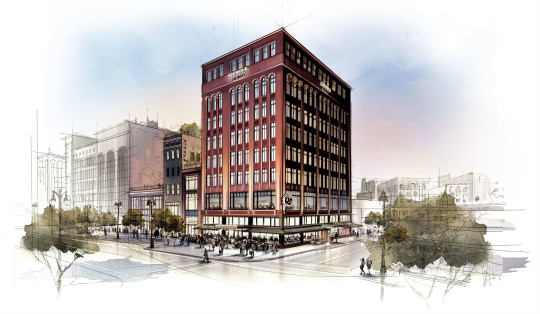
    It’s for these reasons that I was both excited and curious to learn that Bedrock (real estate company) and Shinola are in the midst of launching a new boutique hotel concept in Detroit. It is called The Shinola Hotel. It will be located at 1400 Woodward Avenue. And it will be all about the city of Detroit. They expect it to open sometime in the fall of 2018.

    What I am about to say may be an availability bias talking, but there seems to be a push by many companies into the hotel space. In 2015, Equinox Fitness announced that it would be opening its first hotel in 2018 at Hudson Yards in New York. And just last month furniture retailer West Elm announced that it would be opening a first set of hotels in both Savannah and Detroit. (Go Detroit!)

    West Elm sells furniture. Equinox operates gyms. And Shinola makes and sells watches, bikes, and leather goods. But all of them are now in the hotel space. What other new hotel brands have I missed?

    Image: Shinola

  • Learning from, but not copying, New York’s High Line

    image

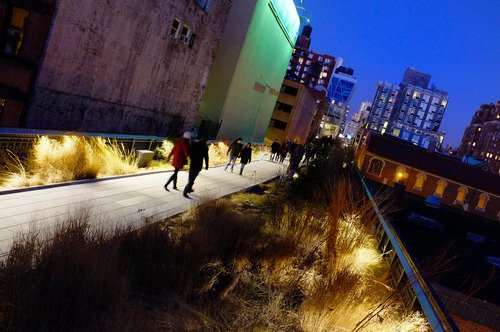
    In 1980, the last train ran on an elevated corridor on the west side of Manhattan known as the High Line. Originally built in the 1930s, the trucking industry had made these trains obsolete and service was halted.

    At this point, neighboring property owners began to lobby for the demolition of the High Line, as they no doubt saw it as an opportunity to increase the value of their land holdings. But thanks to local residents – most notably a man by the name of Peter Obletz – the 1.45 mile-long elevated rail corridor was saved from demolition.

    In 1999, Joshua David and Robert Hammond then decided to form a non-profit with the goal of both preserving and reusing this unused rail corridor. The group was called Friends of the High Line.

    By the early 2000s, Friends of the High Line had successfully made an economic case for transforming the rail line into a public open space and things started moving forward. Initially, it was thought that a public park of this sorts would attract about 400,000 people annually and generate upwards of $286 million in new tax revenues over the following 2 decades (Globe and Mail).

    With these expectations in mind, construction on the new High Line Park began in 2006. The first section opened in 2009 – a decade after Friends of the High Line was formed. And the third, and last section, opened just two weekends ago at the end of September.

    Today the High Line Park attracts 5 million visitors a year and is believed to be directly responsible for about $2.2 billion in new economic activity. The increased tax revenues over the next 2 decades are expected to reach about $980 million. Without a doubt, the High Line has been a huge success. It has become the 2nd most visited cultural attraction in New York (Globe and Mail).

    Which is why every city now wants their own High Line. Philadelphia wants one. Chicago wants one. Mexico City wants one. Seoul wants one. And the list goes on. Here in Toronto, we’ve recently proposed one called the King High Line, which will connect the Liberty Village and West Queen West neighborhoods across a rail corridor.

    While I do believe that this is an important connectivity problem to be solved, I worry about how explicit the references are to the actual High Line. Even the street furniture is the same in their promotional video.

    I worry not only because it means we’re clearly taking on the role of follower, as opposed to leader, but because an elevated park isn’t going to work in all urban contexts the same way that the High Line worked in Chelsea. This is similar to how Frank Gehry can’t magically turn your city into the next Bilbao

    So while I have shown my support by becoming a “Friend of the King High Line” (and I would encourage you to do so as well), it’s important to keep in mind that the problems we’re trying to solve here aren’t necessarily the same ones that New York had to deal with.

    The High Line – from the start – was designed to have an intimate relationship with its surrounding buildings. The tracks rain directly through them so that the trains could easily load and unload their cargo – that was the whole point. So when the High Line was redone, all of a sudden these buildings were able to reconnect themselves to the park in a way that they were already accustomed to doing.

    But in Toronto’s situation, and perhaps in your city, that’s not the case. We’re talking about stitching together two completely disconnected neighborhoods. It’s a noble goal and certainly one that I wholeheartedly believe we should pursue. But I don’t think we should assume that it’s a problem that has already been completely solved for us.

    Image: Flickr

  • Streetcar Developments buys heritage strip club

    image

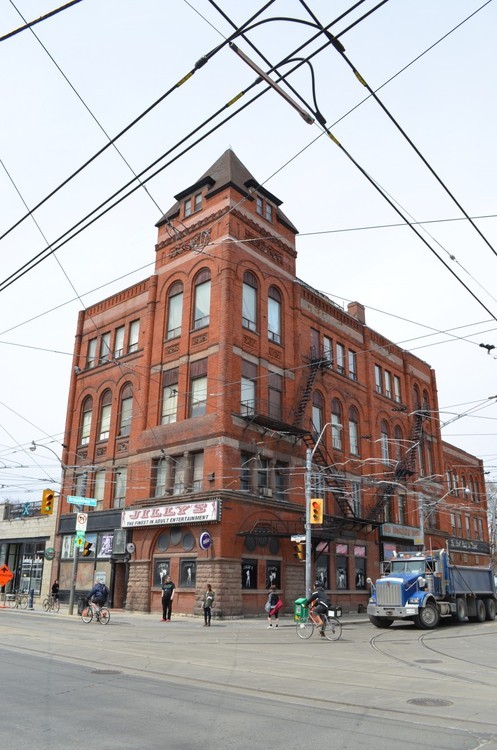
    The big news in Toronto real estate today is that Streetcar Developments has picked up the Broadview Hotel at the northwest corner of Queen Street East and Broadview Avenue in the city’s east end. The building is best known for housing Jilly’sthe finest in adult entertainment.

    I don’t know what it sold for, but the twittersphere seems to think it went for somewhere between $4 and $6 million. My guess is that it’s on the higher end of that range.

    The deal is interesting because there have been rumors circulating for years about its future. At one point there were rumblings that it was going to become a Drake Hotel on the east side–which does seem like a natural fit, and would be exciting for the Riverside area.

    And while we still don’t know what it’s going to be, Streetcar–which is a condo and loft developer–has said the plan isn’t to turn it into residential condos:

    “Although rooted in loft development, Streetcar does not see this building as a residential condominium project. We are in the early stages of planning, but our focus is to revive this building to a landmark everyone in the area can be proud of.”

    That’s interesting. They also don’t deny that it could remain a hotel.

    I don’t want to automatically assume that something along the lines of the Drake Hotel (a hotel, bar, restaurant and cultural community center) is the right recipe for this building, but I do think there’s an opportunity for it to become a significant anchor–even more so than Jilly’s–on the east side of downtown.

    Earlier this week I wrote about the rise of the east end. Maybe this will end up as the establishment that really gives West Queen West a run for its money. But in order to do so, I think Streetcar will need to find the right cultural entrepreneur to partner with. You can’t fake being effortlessly cool.

    Either way, I’m thrilled that this building–built in 1893–will be preserved. If there were any plans to demolish it, I would chain myself to a stripper pole in protest. The Broadview Hotel is a real gem with loads of potential.