Daily insights for city builders, delivered every morning at 6 AM ET. I’m Brandon Donnelly — a Toronto-based real estate developer and founder of Globizen. I’ve been writing here since 2013.
This is an interesting video by Phil Andrews of Maxinomics talking about the economics of Uber and what it could stand to gain from autonomous vehicles.
As part of this, he touches on the exclusive partnership that was announced between Uber and Waymo back in September. That was a big deal.
I find this topic fascinating because it’s hard to imagine it not reshaping the landscape of our cities. And it continues to get more real by the day.
One of the reasons why I’m interested in the autonomous vehicle space is that I know our built environment is sticky. And because we’ve designed so much of it around the car, it’s hard to imagine this dependance going away anytime soon.
In fact, there’s a very real possibility that autonomy leads to further decentralization. That is typically what happens when we make it easier and cheaper for people to travel longer distances. They sprawl. So we ought to start preparing ourselves for the positive and negative externalities.
I’m not a deep expert on autonomous vehicles, but as an interested observer, Waymo appears ahead of Tesla in delivering this future. Waymo has been offering fully driverless rides since 2020 and Tesla is still at L2 autonomy, which means a driver needs to be present in the vehicle.
I hear from lots of people that their Full Self Driving (FSD) software is pretty good, but according to some studies, it can require human intervention as often as every 13 miles. This doesn’t necessarily mean that Tesla won’t be first to “solve autonomy,” but their Cybercab isn’t here yet.
If you’re interested in this topic, here is an article by Timothy Lee summarizing a discussion that he recently had with the co-CEO of Waymo, Dmitri Dolgov. Some of it is a little technical, but it does offer a comparison between Tesla and Waymo.
That is, how their approaches differ and what the future might look like.
I watched Tesla’s We, Robot event last night. As many of you know, Elon and his team showcased a Cybercab, Robovan, and a humanoid robot that dances funny, all of which will be available in the market for purchase at some unknowable date in the future. What was obvious is that Elon himself has no clear idea of when this will be.
What I will say, though, is that the designs look cool. The Cybercab looks like a Porsche and a Cybertruck had a love child, and the Robovan looks like an Art Deco rendition of what the future is supposed to be like. I first wondered why they’d create a robotaxi with only two seats. But thinking about it now, most Uber rides probably only have 1-2 passengers.
Despite these pretty designs, the overwhelming reaction to the event seems to be one of disappointment. We’ve heard what was said before. Public transportation is bad (I disagree). Autonomy will free up your time and remove unnecessary parking spaces from our cities (allowing for more public space). And soon you’ll be able to put your under-utilized car to work and earn extra cash.
Cool, but when?
Waymo and Uber are not, as far as I know, hosting similarly flashy events. But as far as I can tell, they’re making meaningful progress in advancing toward full autonomy. As of June of this year, Waymo had already logged over 22 million rider-only miles. And in September, they announced a partnership that would bring AVs to Austin and Atlanta by way of the Uber app.
At this point in the hype cycle, I don’t think anyone is interested in hearing promises about what the future of autonomy will be like, especially without any firm dates. They want to know: Are we there yet? So I think it’s no surprise that people, including investors, weren’t all that pumped up by the event.
On a more important note, Tesla had bicycles with brightly illuminated wheels circulating around their event set (at Warner Bros.) to presumably demonstrate that their Cybercabs can successfully navigate around moving objects (when brightly illuminated). If you missed them, look at the 29 second mark in the below video:
I can’t be the only one who thought: “What are those? Now, that’s what I want!” So I’ve asked Elon when they’ll be available and when I can buy one. I’ll keep you all posted on his response.
Waymo and Uber just announced a partnership that will bring Waymo’s autonomous vehicles to the Uber app in Austin and Atlanta. Notably, this is an exclusive partnership, meaning the only way you’ll be able to summon a Waymo vehicle in these cities will be through Uber.
The people who follow this space closely, people like Reilly Brennan of Trucks (VC) and Harry Campbell (The Rideshare Guy), think this is a really big deal for a number of reasons.
One, it signals a bifurcation in the industry where there will be companies, like Waymo, that supply autonomous vehicles, and companies, like Uber, that operate them and manage the overall ride hailing marketplace. As part of this deal, Uber is going to handle all of the maintenance and cleaning of the vehicles. This split is similar to the airline industry.
Two, it suggests, and this is Harry’s argument, that Waymo needs Uber more than Uber needs Waymo. One of the reasons for this is that a 100% AV fleet is simply too expensive to operate if you’re solving for peak demand loads. Because during off-peak times, you then need to pay for downtime.
Uber, on the other hand, doesn’t pay for downtime with its human drivers. Most of its drivers are part-time and only plug in when they want to or when the surge pricing becomes too attractive to pass up. So they’re the perfect compliment to an AV fleet. Harry argues that this is part of Uber’s competitive moat.
And three, it signals that AVs are really starting to arrive, if not already here. The hype cycle certainly hit its trough of disillusionment and everyone switched to thinking that AVs weren’t going to happen for many years, if not decades. But now it’s happening. City by city.
Waymo has started releasing statistics for its autonomous vehicles. Here’s the link.
There are a number of important considerations when comparing human-driven and autonomous vehicles. For instance, the two have different definitions of a crash. AV operators have to report any kind of physical contact (property damage, injury, or fatality). Human-driven cars, on the other hand, don’t typically report accidents unless it was bad enough to necessitate a police report. So there are nuances to keep in mind.
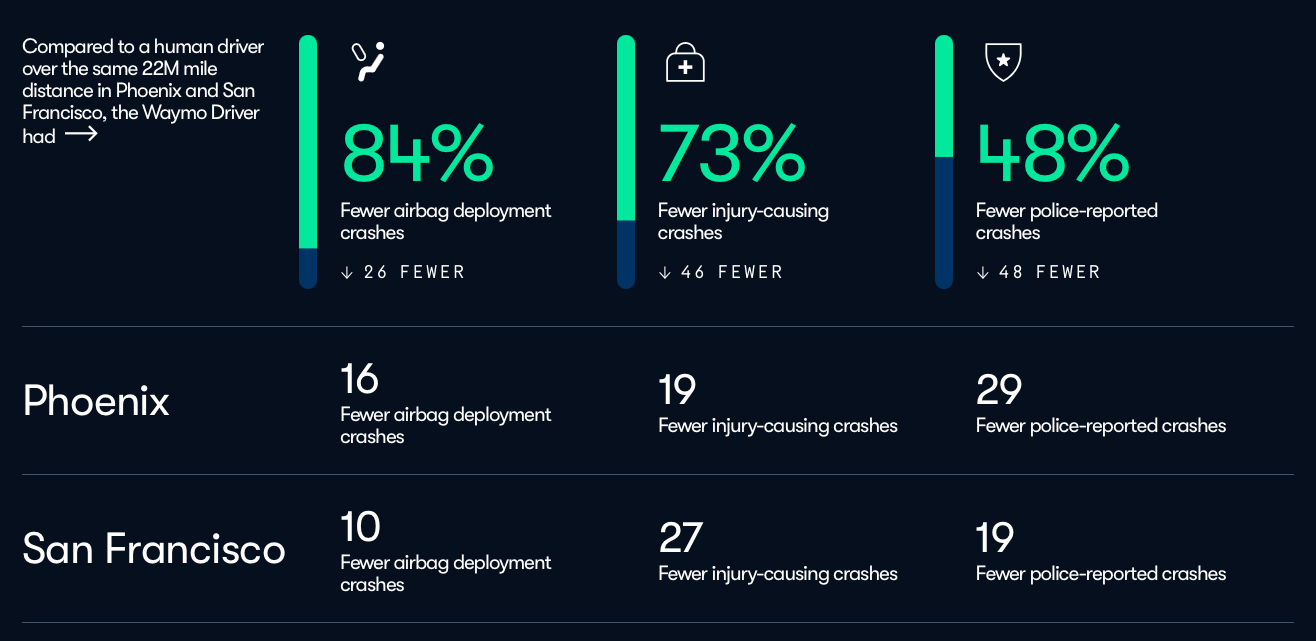
That said, there is an argument to be made that AVs are already safer than human-driven ones. Through to June 2024, Waymo had already logged over 22 million rider-only miles. And here is what it is now reporting in terms of airbag deployments, injury-causing crashes, and police-reported crashes:
All of them are lower than their respective benchmark crash rates.
A few days ago, Waymo announced (on X) that its robotaxis are now doing more than 50,000 paid trips every week across Phoenix, San Francisco, and Los Angeles.
This means that the company is getting an average of 300 bookings every hour or five bookings every minute. And if you add in Austin, where it’s currently offering a limited number of rides, the company has completed a total of over one million rider-only trips.
In the announcement, Waymo also went on to say that “fully autonomous ride-hailing is a reality and a preferred mobility option for people navigating their cities every day.” All of this is something.
But perhaps the most important takeaway, right now, is that the company continues to claim — by way of a study from Swiss Re — that its robotaxis are already significantly safer than human-driven vehicles.
I don’t personally know if this is true, but it’s not hard to believe. I mean, human drivers suck. And assuming it is true, we should all want more robotaxis on the road, because statistically, we would be significantly safer.
The problem, though, is that autonomous vehicles suffer from a perception bias. We’re all looking for them to fail. If a robotaxi gets into an accident, it’s news. But if a human driver gets into an accident, it’s standard operating procedure. It’ll be interesting to see how and when this flips.
Remember Wuhan? Well, it turns out that it is emerging as an important hub for driverless vehicles. Right now it is home to the largest fleet in the world:
In Wuhan, 500 robotaxis, mostly run by Baidu, China’s rival to Google, recorded more than 730,000 ride-hailing trips last year. That compares with combined orders of more than 700,000 last year in Phoenix, San Francisco and Los Angeles, according to Waymo, the self-driving car developer of Google’s parent company Alphabet. Waymo told the Financial Times that it had “a couple of hundred cars” in each of the three fully autonomous zones.
One of the things that is allegedly helping Chinese companies is that they have access to more data. The networks of cameras and other infrastructure that make Chinese cities the most surveilled in the world are, coincidentally, also good for training machine learning models.
This has some industry experts speculating that China could reach an autonomous vehicle “tipping point” sometime around 2027. Meaning, the technologies will be significantly safer than human drivers (at least 10x) and ready for mass adoption.
I don’t know if this is the right timeline. There have been many forecasts made over the years. But I do know that competition is good for progress and that having a rival can be an important motivator. And right now, this is yet another example of the US vs. China.
Last month, Waymo (Alphabet) and Uber announced a new multi-year partnership that will bring Waymo’s autonomous vehicles to Uber in the Phoenix area later this year. Already, Waymo operates across 180 square miles of the city, making it the largest fully autonomous service area in the world. But now, or I guess later this year, people will be able to order a Waymo AV through the Uber app.
Not a lot of people seem to care about autonomous vehicles anymore. For a while, every conference had people talking about how they were going to reshape our cities. But then the technology didn’t arrive quite as quickly as people were hoping, and so everyone lost interest and move on to other more exciting things. But clearly things are still happening. And this announcement strikes me as being an important one.
Benedict Evans just published a great post on his blog about “Tesla, software and disruption.” I recommend a full read. In it, he tries to answer whether Tesla is really “the new iPhone” and if it will be as disruptive to the car landscape as some/many people think.
In his line of thinking, electric (as opposed to an ICE vehicle) feels a lot more like a sustaining innovation, rather than a disruptive innovation. In other words, it something that incumbents will be able to incorporate. So it will not change the “basis of competition.”
The more critical aspect is instead autonomy. Here are two snippets from the piece:
All of this takes us to autonomy. Electric is compelling but will probably be a commodity, whereas Tesla’s improvements on top of electric may not be commodities but are not necessarily decisive. Autonomy changes the world in profound ways (I wrote about this here), and it’s a fundamentally new technology that doesn’t look at all like a commodity. And Tesla is doing this, too. Sort of.
In this competition, Tesla’s thesis is that the data it can collect from its cars will give it a crucial advantage. The only reason that anyone is interested in autonomy today is that the emergence of machine learning (ML) in the last 5 years probably gives us a way to make it work. Machine learning, in turn, is about extracting patterns from large amounts of data, and then matching things against those patterns. So how much data do you have?
But even if we are to all agree that autonomy is the “disruptive innovation”, it is not yet clear who will get there first. Maybe it is Tesla. Maybe it is Waymo. Regardless, many or most people seem to agree that it will arrive in 202x.
This is an interesting piece by Bloomberg summarizing the current state of autonomous vehicles and in particular the (supposed) dominance of Waymo (Alphabet’s self-driving vehicle arm). Many believe they will be the first real entrant into the market.
The company is currently running an “Early Rider” program in 25 cities. But its Phoenix trials are the furthest along, which isn’t at all surprising given the city’s car orientation and suburban fabric. Already Waymo has started offering passenger rides without a backup driver in the car.
Overall, the company has come forward with four main business priorities:
Ride hailing
Trucking
Personal vehicles
Public transit
But I still think that we’ll see a blurring of these priorities, if not outright cannibalization, as the cost per mile plummets. I mean, why own a personal vehicle if it is flat out easier and cheaper to just hail a robotaxi?
Here is an excerpt from the article talking about pricing:
Tasha Keeney, an analyst at ARK Invest, says that Waymo could choose to offer an autonomous ride-hailing service today at around 70 cents a mile—a quarter of the cost for Uber passengers in San Francisco. Over time, she says, robotaxis should get even cheaper—down to 35 cents a mile by 2020, especially if Waymo’s technology proves sturdy enough to need few human safety monitors overseeing the autonomous vehicles remotely. “You could see software-like margins,” Keeney says.
I can’t wait to be driven around for cents on the dollar. Click here to read the full article.