
Daily insights for city builders, delivered every morning at 6 AM ET. I’m Brandon Donnelly — a Toronto-based real estate developer and founder of Globizen. I’ve been writing here since 2013.

Tag: wayfinding

  • The TO360 wayfinding project

    Despite COVID-19, I am still going to work and going to the gym. (Zoom and Peleton are up 23% and 6%, respectively, from February 21 to March 5, presumably because there’s a belief we’re all going to start doing less of these two things.)

    On my walk home from the gym today I noticed that some new wayfinding had just been installed at the corner of Church and Wellington. I’m not sure how long it has been up, but I am fairly certain it is new. Here is a photo.

    The wayfinding is part of the City of Toronto’s TO360 project, which was launched in 2011 and includes everything from transit shelter maps to finger posts like the one you see here. (Don’t worry, I am confident that detailed shadow studies were conducted before this thing was erected.)

    The “Astral” street furniture that we still have kicking around this city can’t be removed fast enough and so wayfinding like this is a significant improvement. I like the designs.

    But I also think the project is important from a placemaking standpoint. Signage like this helps to brand the city and the places with in it. It also signals a certain degree of internationalism, because wayfinding is most useful for visitors.

    So I am happy to see more of these going up.
  • 3 real estate + tech startups

    image

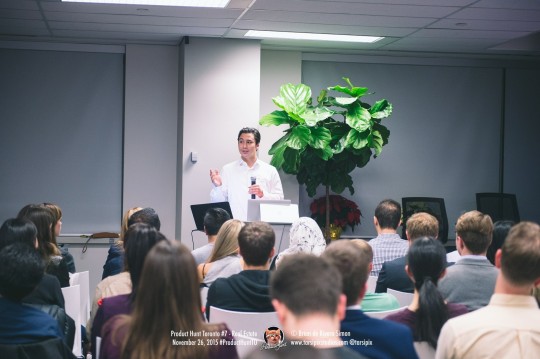
    On Thursday night I spoke at Product Hunt Toronto about the overlap between real estate and tech. My slide deck will be made available online and I’ll be sure to tweet it out and link to it in the comment section of this post.

    What was amazing to see was a room filled with 250 people coming together from almost two different worlds. I’m generalizing here, but you had the real estate people in suits and the tech people in t-shirts. But they were all mixing together to figure out how technology is going to disrupt the real estate industry. That is great to see.

    This was not the case 5+ years ago when I started obsessing about the overlap between these two spaces. I remember pitching at a Startup Weekend here in Toronto where I was pegged as the fringe outlier for wanting to work on a real estate idea. Now I can’t keep track of all the startups who are tackling this space.

    But this is a trend that is happening not only in real estate but in almost every other vertical. Here’s a quote from Fred Wilson that I used last night:

    “One of NYC’s great strengths is the diversity of its economy – finance, real estate, media & entertainment, retail, fashion, health care, education, and now tech. And the reason tech is growing so fast in NYC is that it is embedding itself in all of these other industries.”

    It’s an exciting time.

    In any event, for those of you weren’t able to attend, the 3 startups that presented were Evercondo, PiinPoint, and MappedIn.

    Evercondo is a condo communication and management tool for property managers and boards. PiinPoint is a data-driven tool that helps businesses find the best places to locate within a city. And MappedIn creates digital wayfinding solutions for (primarily) retail stores and venues.

    If you know of any other interesting startups tackling the real estate space, please share them in the comment section below. Early stage companies need all the support and exposure they can get.

  • What signage says about your city

    I woke up this morning in the City of London, Ontario, to a parking ticket. Apparently, I had committed an infraction by parking between the hours of 3:00 am – 5:00 am.

    Here’s what the sign looked like, directly in front of my car. There were no other signs nearby other than one at the end of the street telling me where the parking area stopped.

    image

    Perhaps I’m missing something, but based on the signage provided, there’s absolutely no way for me to know that parking is not permitted between the precise hours of 3:00 am and 5:00 am. And truthfully, this seems like an odd set of hours to want to enforce. 

    If there were some feasible way for me to fight this ticket, I would. But since cities make this purposely difficult, I’m just going to pay it. Even though I feel like fighting it out of principle.

    But this post isn’t for me to complain about a parking ticket.

    When I got the ticket this morning, it reminded me of a “theory” that someone once told me at an Urban Land Institute conference a few years back in Washington D.C. I actually can’t remember who it was, but the idea was that you can tell how global a city is by the quality of its signage and wayfinding signage.

    I’m intrigued by this proposition because, if you think about it, a city unaccustomed to receiving outsiders has less of a need for quality signage. As a local, you begin to create your own mental map of the city and you intuitively start to understand what’s allowed, such as where you can park. The importance of good signage somewhat diminishes.

    But outsiders are coming with no understanding. They’re looking for directions and instructions. So you should make sure that your city is giving it to them. However, at the same time, there are lots of big global cities, such as New York, which are or were notorious for bad signage. So signage quality is probably not perfectly correlated with globalization.

    Regardless, signage matters. It’s one of the ways in which a city talks at you and others. How clearly does your city communicate?