Daily insights for city builders, delivered every morning at 6 AM ET. I’m Brandon Donnelly — a Toronto-based real estate developer and founder of Globizen. I’ve been writing here since 2013.

Tag: wall street

  • The capital of Ethereum

    Few people in Toronto seem to be talking about the important role that this city has played and is playing when it comes to cryptocurrencies (specifically Ethereum). And if you believe, as I do, that Ethereum and other blockchain technologies have the ability to form the backbone for an entirely new kind of world, then this is kind of a big deal.

    The Financial Times recently published this article about “Wall Street’s crypto whisperer.” It is about a guy named Joseph Lubin who is the founder of a crypto company called ConsenSys and previously the co-founder of Ethereum. Lubin is from Toronto.

    If you read the article, you’ll see that Lubin is a pretty bright guy (and now a billionaire with his crypto assets). Born in Toronto, he ended up going to Princeton to study computer science. He worked on Wall Street for a bit (hence the whisperer moniker), but also did a bunch of other interesting stuff, including moving to Jamaica with a girlfriend and working on music production.

    In 2013, he was back in Toronto and went to a Bitcoin meetup in the city. The article says it was in a downtown warehouse (which makes it sound pretty cool and underground). And at this downtown warehouse meetup, he met a guy (actually a teenager) named Vitalik Buterin. Vitalik had just written a white paper on what would ultimately become Ethereum and he gave Lubin a copy. Lubin was so “blown away” when he read it that he decided to join the movement.

    The two (and presumably others) would then go on to live together in shared houses in Toronto, Miami, and Zug (Switzerland), and work on this new smart contract technology. Today, Ethereum has a market cap of nearly $400 billion (as of September 12, 2021).

    Even if you ignore for a second that we’re talking about crypto technologies, this is still a fascinating city building story. It is fascinating because it shows the value of in-person urban interactions (again, the two allegedly connected at a meetup in a downtown warehouse). And it is fascinating because the Toronto braintrust has been instrumental in advancing a technology that could arguably end up powering not only the future of the internet but perhaps the world.

    At the same time, it strikes me that we need to be much better at both celebrating and encouraging these kinds of new ideas locally. Are we out in the world telling this story to the best of our abilities? Have we properly positioned Toronto as one of the most important places for cryptocurrencies and innovation in general? Mayor Suarez of Miami has been a great promoter of his city in this regard.

    “Innovation” isn’t usually neat and tidy. It happens on the fringe and it is often not obvious at the outset. Imagine what an Ethereum pitch would have sounded like back in 2013. But this is how new ideas start. And Toronto has proven to be full of them.

    Photo by Narciso Arellano on Unsplash

  • And we’re back

    Welcome to 2019.

    I am currently in transit and catching up on some internet reading and email on my way back to Toronto.

    At this time of year it is, of course, common to reminisce (or lament) about what happened over the last year, as well prognosticate what may come.

    Over the last few years, I have done a bit of that on the blog. But I clearly didn’t do that this year while in Brazil (and away from any semblance of a workspace).

    So here’s what others have been writing and thinking about over the holidays:

    – 2018’s tech trends and tribulations in 14 charts. RecodeLink

    – 2018 was the year of the YIMBY. CityLab. Link

    – A cool girl’s guide to Toronto. Vogue. Link

    – Amazon’s annual Christmas press release. Link

    – Best travel posts of 2018. Design Milk. Link

    – Here’s (Almost) Everything Wall Street Expects in 2019. Bloomberg. Link

    – Here’s what to expect in cybersecurity in 2019. TechCrunch. Link

    – Naive to hope Toronto can change in 2019? That means we have work to do. Shawn Micallef. Link 

    – The 10 largest US venture rounds of 2019. TechCrunch. Link

    – What is going to happen in 2019. Fred Wilson. Link

    – Will a recession hit in 2019? Alan Murray. Link

    – Year in search 2018. Google. Link

  • Uber to go public in 2019

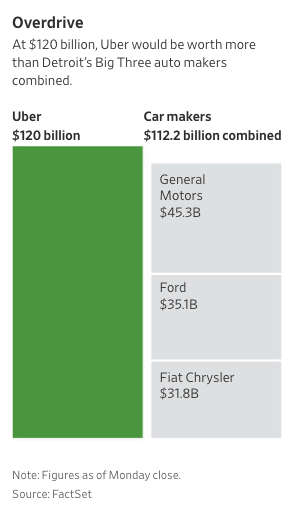
    Last week it was announced that Uber had confidentially filed for an IPO (right after Lyft did the same). It could go public as early as Q1 of next year. And supposedly, a valuation of $120 billion is being tossed around. The company last raised money in August of this year (from Toyota) at a $76 billion valuation.

    image

    Here are a few other interesting figures from a WSJ article published in the fall:

    – Uber has indicated that it doesn’t expect to be profitable for at least another 3 years. This year it is expected to hit between $10 and $11 billion in revenue, compared to $7.78 billion last year.

    – First Round Capital invested about $1.6 million in Uber’s first two fundraising rounds (2010 and 2011). If the company does in fact reach a valuation of $120 billion in the public markets, that early investment will be worth $5 billion. (First Round sold some of their shares to SoftBank in January and I’m not sure if the above figure accounts for that.)

    – Over 50 companies have invested in Uber since its founding, not including a slew of individual investments from people like Jeff Bezos of Amazon.

    On a related note, Fred Wilson, who is far more knowledgeable on this topic than I, recently published a post talking about the relationship between the private and public markets and what could happen to (tech) valuations in 2019. 

    It’s a good follow-on read to the above.

    Figure: WSJ

  • Would it be insider trading if Kylie Jenner traded on her tweets?

    Lately I have really gotten into Matt Levine’s daily newsletter about “Wall Street, finance, companies and other stuff.” Maybe that’s how I should describe this blog: Cities, real estate, design, and other stuff.

    If you aren’t familiar with Matt’s writing, here is an article that he wrote about Kylie Jenner’s recent tweet concerning Snapchat. You know, the one that wiped out $1.3 billion of market value because she revealed – using only 88 characters, I might add – that she was no longer using the app.

    https://platform.twitter.com/widgets.js

    The article was spurred on by this question:

    “Would it be insider trading for Kylie Jenner to buy short term out of money put options on Snap and tweet out that she’s no longer using Snap?”

    And this is the start of his answer:

    Insider trading, as I am constantly saying around here, is not about fairness; it is about theft. It is not illegal to trade on your own nonpublic knowledge of your own intentions. Warren Buffett can buy stocks before he announces that he’s bought them, even though that announcement will predictably make the stocks go up. 

    If I did describe this daily blog like Matt describes his daily newsletter, this post would clearly fall into the “other stuff” camp. But maybe you too will find it interesting. If you do, you can subscribe here

  • What happened (in tech) in 2017

    I am still catching up on reading after being mostly offline last week, minus short windows where I would go online to upload these daily blog posts.

    Here is a post that Fred Wilson wrote on new year’s eve about “what happened in 2017.” It has become a tradition of his to write a “what happened” post on the last day of the year and a “what is going to happen” post on the first day of the new year. He then uses these posts to keep track of how well he does on his predictions for the year.

    His three headlines for 2017 were: (1) crypto; (2) the beginning of the end of white male dominance; and (3) the tech backlash (i.e. tech is the new Wall Street). It is worth a read. Crypto was an obvious one, but he has been writing about it – and investing in the space – for years. Of particular interest in this post is how he positions it as the basis for Internet 3.0 (the decentralized internet).

    What is also clear from the post is just how ingrained tech has become in our everyday lives and how much it reaches beyond simply the tech industry. I have been saying this for years, which is why I spend a lot of time writing about it on this blog.

  • Turning data exhaust into gold

    Last year, social media company Foursquare predicted that Chipotle would see a ~30% drop in its Q1 2016 sales. It knew this because the geo-location data from people using its app (check-ins and passive visits) was also down. They had figured out the relationship between foot traffic and sales. I think I wrote about this in the first half of last of year.

    Not surprisingly, lots of companies – including those on Wall Street – are now starting to pay attention to data sets such as these. Matt Turck wrote a great blog post about it this morning, called: The New Gold Rush? Wall Street Wants your Data. Here’s an excerpt:

    That a social media company could be building a data asset of immense value to Wall Street is part of an accelerating trend known as “alternative data”. As just about everything in our lives is getting sensed and captured by technology, financial services firms have been turning their attention to startups, with the hope of mining their data to extract the type of gold nuggets that will enable them to beat the market.

    The opportunity is open to a wide range of startups.  Many tech companies these days generate an interesting “data exhaust” as a by-product of their core activity.  If your company offers a payment solution, you may have interesting data on what people buy. A mobile app may accumulate geo-location data on where people shop or how often they go to the movies.  A connected health device may know who gets sick when and where.  A commerce company may have data on trends and consumer preferences. A SaaS provider may know what corporations purchase, or how many employees they hire, in which region. And so on and so forth.

    We may be calling this alternative data right now, but it is almost certainly just a matter of time before it simply becomes: the data. 

    I like the term “data exhaust” that Matt uses, because it feels like it accurately captures what is going on right now. The new economy is producing a lot of byproduct. If you clean it up and package it in the right way, then you might be creating additional value. But if you don’t, then it’s probably just exhaust.