Daily insights for city builders, delivered every morning at 6 AM ET. I’m Brandon Donnelly — a Toronto-based real estate developer and founder of Globizen. I’ve been writing here since 2013.

Tag: venture capital

  • Contentment as vice

    “Contentment used to be a virtue. Now it’s a vice.”

    I came across this line on Brad Feld’s blog

    For those of you who aren’t familiar with Brad, he is a successful entrepreneur and early stage VC investor. He cofounded the Foundry Group, Mobius Venture Capital, Intensity Ventures and Techstars, and sold his first company back in 1993. 

    But Brad has also struggled with depression over the years and so you’ll find that a number of his blog posts are also quite contemplative.

    This particular post – where the above line comes from – is about a societal norm that I am sure many of you can relate to. I know I can. Here’s another snippet from the post:

    “We talked for a few minutes about the overall, dominant American culture of achievement. The endless striving. The need to feel busy, important, and successful. The deep cultural norms around ambition.”

    Whether it’s because we’re all deeply insecure or because we just need to fulfill our egos, this has become our modus operandi. It has become all about “the hustle” and about “crushing it 24/7.”

    Just this evening I was at a friend’s birthday party and I couldn’t tell you how many times I said “busy.”

    “Hey Brandon, how are things?”

    “Busy!”

    This is an absolutely terrible response. I know that. And I’ve started introducing other responses into my small talk repertoire. But busy is so ingrained in our culture. Being busy makes us feel important. It means we are in demand. We do things. We create value.

    But is the reverse – not being busy – now a vice?

    Regardless of your position on the appropriate balance between contentment (being ok with what you’ve got) and work (striving for more than what you’ve got), I think the first line of this post is an incredibly poignant commentary on the life that many of us live today.

  • From self-storage to urban logistics

    image

    I have long told myself that if I ever needed to rent self-storage space, it would mean that I own too much stuff and that I need to get rid of some of my shit. But I recognize that there are many reasons why someone might need extra storage and I recognize that the storage market in the United States alone is something to the tune of $30 billion a year.

    Here is an interesting case study about the storage company MakeSpace, which to-date has raised almost $60 million in equity funding. Their model is likely one that you’ve heard of or used before. Instead of you yourself going to the “self-storage” facility, they do the pickup and delivery. So they call themselves a logistics business, like Amazon, except that it works in reverse. Instead of you receiving deliveries, they take your stuff from your home back out to their warehouses.

    Because of the route management software that they’ve been building over the last 4.5 years and because there’s enough density in the areas that they service, their pick-up and drop-off routes are apparently profitable. You no doubt need a certain amount of scale for that to happen, but they seem to have it. By the end of this year, they expect their reoccurring revenues to be in the $10′s of millions. That’s coming from the volumes of green boxes you see at the top of this post.

    What’s particularly relevant for this audience are the built form and real estate implications. Because their customers aren’t physically visiting their facilities, they’ve been able to locate all of their distribution centers on the outskirts of the cities in which they operate. And because of this, their physical real estate costs are said to be less than 50% of traditional self-storage firms and they believe this number will trend to around 20% as volumes continue to grow.

    All of this has me thinking about some of the other implications of the on-demand economy on cities and on real estate.

    Image via Both Sides of the Table

  • Crane capital of America

    When people like Richard Florida talk about today’s “superstar cities”, the usual suspects include London and New York for finance, the San Francisco Bay Area for tech, Milan for fashion and design, and so on.

    And you can certainly find the data to back up these claims. For instance, if you look at venture capital dollars invested, many of these same cities reappear near the top: San Francisco, San Jose, New York, etc.

    One city that doesn’t often appear on these sorts of lists, though, is Seattle. 

    However, clearly something special is taking place in the city. For the second year in a row, Seattle has been named the construction crane capital of America. No other American city comes close right now. (However, Toronto is still #1 in North America.)

    At the same time, if you think about all of the companies that have come out of Seattle over the years, you start to realize that maybe VC dollars invested isn’t enough to tell the entire entrepreneurial story.

    Venture capitalist Fred Wilson once said on his blog that if you look at dollars in and dollars out, Seattle outperforms – by a lot. And that’s very interesting to me. Is this simply the lasting legacy of Microsoft? Or are there other – transferable – lessons to be learned here?

  • The “R” word

    Albert Wenger recently penned an interesting post about the “R” word.

    It’s about health insurance and why redistribution is a toxic word in U.S. politics, but also why much of what we do as a society – from public roads to insurance – is actually about redistribution. What I like about the post is that he cuts through a lot of the noise and gets right at the crux of things.

    Here’s part of his conclusion:

    So what should you take away from this? There always is some element of redistribution to insurance – at a minimum ex post and generally also ex ante. The “why should I (usually some healthy person) pay for x (usually some payment for someone from a different demographic)” objection to health insurance is about redistribution. We should acknowledge this openly and not pretend that it is otherwise, because then we can move forward and say “you should, because that is your contribution to how our society works.”

    The point of his post, which he reiterates in the comment section, is that “insurance is a commons more than it is a market.” Too much individual choice – for instance, rich people opting out because they don’t need it – actually weakens the system.

    But you should really read his entire post. It’s good.

    Photo by Jamie Street on Unsplash

  • Internet Trends 2017

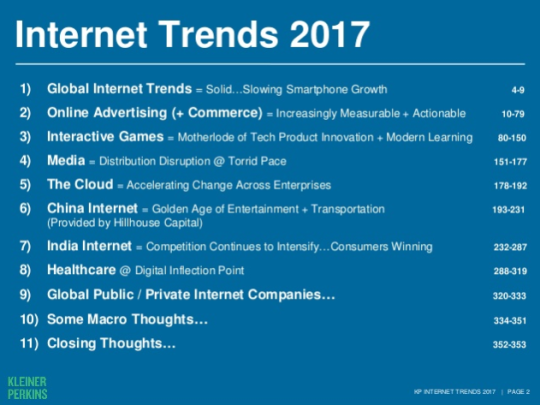
    Mary Meeker – who is a partner in the VC firm Kleiner Perkins – just recently released her annual Internet Trends report. 

    I’ve pasted the table of contents above so you can quickly decide if you’d like to spend your time going through it. The entire report is over 350 slides.

    If you can’t see the embedded slideshow below or if you’d like to access the reports from previous years, click here.

    [slideshare id=KGiWuuYFlhbQBC&w=595&h=485&fb=0&mw=0&mh=0&style=border:1px solid #CCC; border-width:1px; margin-bottom:5px; max-width: 100%;&sc=no]

  • New York, San Francisco, Toronto

    Yesterday it was announced (here, here, and here) that Toronto-based Top Hat has raised $22.5 million (USD) in Series-C funding. The round was led by New York-based Union Square Ventures.

    I am always excited to see Toronto-based startups doing well and I am particularly excited by this remark in USV’s blog announcement:

    “Also worth noting is that Toronto continues to impress us with its quality and diversity of companies. We now have five investments there, placing Toronto third as a location in the USV portfolio after New York and San Francisco.”

    Here is another quote from Fred Wilson’s blog:

    “Toronto is a great place for startups. In addition to five investments of ours that are HQ’d there, I know of at least one other USV portfolio company that has much of their engineering team in Toronto. The talent, mindset, and quality of the people in the Toronto/Waterloo tech/startup community is really top notch and we love investing there.”

    Go Toronto. 

    (Of course, Toronto really means Toronto-Waterloo. That’s the geography of the ecosystem.)

  • The Anti-Portfolio

    In the world of venture capital, it is not uncommon to make most of your money off only a small fraction of your investments. Here’s how Fred Wilson describes his firm’s “batting average”:

    “I’ve said many times on this blog that our target batting average is “1/3, 1/3, 1/3” which means that we expect to lose our entire investment on 1/3 of our investments, we expect to get our money back (or maybe make a small return) on 1/3 of our investments, and we expect to generate the bulk of our returns on 1/3 of our investments.”

    I’m guessing that this is one of the reasons why mistakes are more readily embraced – or even celebrated – in venture capital and in tech. It’s part of the DNA of the industry.

    A perfect example of this is something called the Anti-Portfolio. Venture capital firm, Bessemer Venture Partners, has a page up on their website dedicated to “honoring those we missed.” It is a list of phenomenally successful companies that for various reasons BVP decided not to invest in. That is, they had the opportunity but they decided to pass.

    Here’s a taste (copied verbatim from their site):

    • [Apple] BVP had the opportunity to invest in pre-IPO secondary stock in Apple at a $60M valuation. BVP’s Neill Brownstein called it “outrageously expensive.”
    • [Facebook] Jeremy Levine spent a weekend at a corporate retreat in the summer of 2004 dodging persistent Harvard undergrad Eduardo Saverin’s rabid pitch. Finally, cornered in a lunch line, Jeremy delivered some sage advice “Kid, haven’t you heard of Friendster? Move on. It’s over!”
    • [Google] Cowan’s college friend rented her garage to Sergey and Larry for their first year. In 1999 and 2000 she tried to introduce Cowan to “these two really smart Stanford students writing a search engine”. Students? A new search engine? In the most important moment ever for Bessemer’s anti-portfolio, Cowan asked her, “How can I get out of this house without going anywhere near your garage?”

    As I was going through BVP’s Anti-Portfolio, I immediately thought about how different this sensibility is compared to the real estate industry. I mean, could you imagine a developer celebrating all of the sites she or he passed on and all of the projects that lost or made no money?

    One of the reasons you do this is to learn from your mistakes. So perhaps we could all use some sort of “anti-portfolio.”

  • Turning data exhaust into gold

    Last year, social media company Foursquare predicted that Chipotle would see a ~30% drop in its Q1 2016 sales. It knew this because the geo-location data from people using its app (check-ins and passive visits) was also down. They had figured out the relationship between foot traffic and sales. I think I wrote about this in the first half of last of year.

    Not surprisingly, lots of companies – including those on Wall Street – are now starting to pay attention to data sets such as these. Matt Turck wrote a great blog post about it this morning, called: The New Gold Rush? Wall Street Wants your Data. Here’s an excerpt:

    That a social media company could be building a data asset of immense value to Wall Street is part of an accelerating trend known as “alternative data”. As just about everything in our lives is getting sensed and captured by technology, financial services firms have been turning their attention to startups, with the hope of mining their data to extract the type of gold nuggets that will enable them to beat the market.

    The opportunity is open to a wide range of startups.  Many tech companies these days generate an interesting “data exhaust” as a by-product of their core activity.  If your company offers a payment solution, you may have interesting data on what people buy. A mobile app may accumulate geo-location data on where people shop or how often they go to the movies.  A connected health device may know who gets sick when and where.  A commerce company may have data on trends and consumer preferences. A SaaS provider may know what corporations purchase, or how many employees they hire, in which region. And so on and so forth.

    We may be calling this alternative data right now, but it is almost certainly just a matter of time before it simply becomes: the data. 

    I like the term “data exhaust” that Matt uses, because it feels like it accurately captures what is going on right now. The new economy is producing a lot of byproduct. If you clean it up and package it in the right way, then you might be creating additional value. But if you don’t, then it’s probably just exhaust.

  • Coastal dilettantes and venture capital

    Chamath Palihapitiya – founder and CEO of a VC firm called Social Capital – recently penned an op-ed in The Information called: “The Sunk Cost Fallacy and the Future of Silicon Valley.”

    Chamath is one of the most outspoken voices in Silicon Valley and is openly critical about the way the industry generally functions today. Here are two excerpts from his op-ed piece:

    “Chronic diseases like obesity, diabetes and heart disease are ravaging much of the U.S. and the world. Automation is eliminating the jobs of millions of well-meaning, law-abiding men and women. Weather patterns are increasingly unpredictable, disrupting water and food supplies and displacing millions of people. But despite this trail of breadcrumbs of big problems and big markets, we still find it difficult to fund potentially big solutions. Instead, we keep doubling down on the easy things.”  

    “Easy short-term growth is now so highly valued in Silicon Valley that we often overlook technical innovation, sustainable long-term growth and meaningful progress in markets that matter. Every week adds to the corpus of press releases from companies with quick, fleeting growth overcapitalized beyond rationalization. And after too many years of this, Silicon Valley is now typecast as a monoculture of coastal dilettantes who float from one meaningless endeavor to another, tone deaf to real problems.”

    Social Capital was founded in response to these criticisms. Their mission is to improve society by using technology to solve big problems – problems like the ones mentioned above.

    Another firm with a similar mission is Obvious Ventures. They call what they do #worldpositive investing. Their goal is to only fund companies that deliver social and environmental benefits along with every dollar earned.

    It’s interesting to think about how capital gets allocated and whether or not it will result in meaningful benefits to the world. Because this is not just about venture capital. You could substitute venture capital for many other asset classes and ask similar questions.

  • Opendoor.com is so risky that it may just work

    image

    I have been writing about the startup Opendoor.com for over 2 years now. And I continue to believe that they are the most promising disruptor in the residential real estate space. 

    Here is the first post that I wrote back in July 2014 after they raised their first round of funding. Here is the second post that I wrote after they launched in Phoenix. And here is another post that I wrote 6 months ago where I argued, once again, that they are doing something worth paying attention to. (This last post explains how the platform works.)

    Well, about a week ago it was announced that they have raised another round of funding: a $210 million Series D. In all likelihood, the company’s valuation is now over $1 billion. Here’s the Techcrunch announcement where the message was: huge ass number; risky business model.

    In response to this, Ben Thompson wrote a terrific and widely shared blog post called, Opendoor: A Startup Worth Emulating. I love his post because he says what I have firmly believed and argued for many years: Zillow and Redfin are not disruptive real estate startups.

    This is what he says about Zillow:

    “And yet, the most successful real estate startup, Zillow (which acquired its largest competitor Trulia a couple of years ago), is little more than a glorified marketing tool: the company makes most of its revenue by getting real estate agents — the ones collecting 6% of fees, split between the buying and selling agents — to pay to advertise their houses on the site. Certainly a free tool that makes it easier to find houses in a more intuitive way is valuable — Zillow has acquired the sort of userbase that allow it to build an advertising business for a reason — but at the end of the day the company is a tax on a system that hasn’t really changed in decades.”

    And though very risky, he argues that Opendoor is far better positioned to shake up the status quo. 

    Here are two of his key points:

    “Sellers are uniquely disadvantaged under the current system, which is another way of saying they are an underserved market with unmet needs.” [Sellers are the side of the market that Opendoor is specifically targeting.]

    “Opendoor has a new business model: taking advantage of a theoretical arbitrage opportunity (earning fees on houses sold at a slight mark-up) by leveraging technology in pursuit of previously impossible scale that should, in theory, ameliorate risk.”

    And here’s what that could ultimately mean for the industry:

    “Opendoor has many more reasons why it might fail than Zillow or Redfin, but its potential upside is far greater as a result. First is the immediate opportunity: sellers who can’t wait. However, as Opendoor grows its seller base, especially geographically, its risk will start to decrease thanks to diversification and sheer size; that will allow it to lower its “market risk” charge which will lead to more sellers. More sellers means both less risk and an increasingly compelling product for buyers to access, first with a real estate agent and eventually directly. More buyers will mean lower marketing costs and faster sell-through, which will lower risk further and thus lower prices, pushing the cycle forward. It’s even possible to envision a future where Opendoor actually does uproot the anachronistic real estate agent system that is a relic of the pre-Internet era, and they will have done so with realtors not only not fighting them but, on the buying side, helping them.”

    I’m with Ben on this.