Daily insights for city builders, delivered every morning at 6 AM ET. I’m Brandon Donnelly — a Toronto-based real estate developer and founder of Globizen. I’ve been writing here since 2013.

Tag: vehicles

  • America’s most and least car-oriented cities

    My partner Kieran sent me this chart this morning:

    It is a summary of the average weekday miles traveled by adults in private vehicles, including taxis and ride-hailing vehicles, for the 50 largest metro areas in the US (data is from the fall of 2023). At the top of the list with the most miles traveled is Raleigh, and at the bottom of the list with the fewest miles traveled is, not surprisingly, New York.

    The other cities on the bottom of this list probably won’t surprise you either. But it’s a good reminder of how built form determines our mobility choices. If you look up which US cities have the highest population densities and the most compact built forms, I think you’ll generally find that it mirrors what you’re seeing here.

  • The post-combustion era

    Over the winter I visited BMW World, and its neighboring museum, in Munich, Germany.

    I loved seeing how the company got its start and how far it has come since it helped to invent the automobile at the beginning of the 20th century. I think their first product was actually an airplane engine.

    But you and I both know that the paradigm is changing. The internal combustion engine (ICE) is going away and pretty soon we won’t be driving, so much as being driven around by our cars.

    Bloomberg recently published an interesting article about this shift and about BMW. Here is an excerpt:

    The fact that both combustion engines and electric motors find themselves inside the same 18,000-person complex in Dingolfing, BMW’s largest in Europe, makes it a microcosm of a shift overtaking automakers the world over. A visitor can see that 625-horsepower engine—more than twice as powerful as the original from 1985, a luxury product relentlessly branded as “the ultimate driving machine”—then walk around the corner and see its puny electric replacement. You start thinking the better slogan might be “the ultimate combustion engine.” As in: last of its kind.

    Electric motors are a hell of a lot simpler to manufacture (and service) than gasoline engines. BMW estimates that they take about 30% less time to make. So the impacts of this transformation span everything from supply chain to human capital.

    Today, about 10% of the work that goes on in Dingolfing is related to electric vehicles.

  • A decentralizing or centralizing force?

    I was on two panel discussions over the last week and, as is the case with all real estate panels, the topic of parking invariably came up, as did the impact of autonomous vehicles.

    There seems to be a general consensus that the advent of driverless cars will result in less demand for parking. Every developer I know is trying to build as little parking as possible and is thinking about how – when the time comes – they might convert their parking into something more productive. I have yet to speak to anyone who is building excess parking in order to prepare for autonomy.

    Where there’s a split, however, is whether autonomous vehicles will represent a decentralizing or a centralizing force for our cities. Historically, new technologies have lowered transportation costs and encouraged decentralization. Before the advent of rail, the US population hugged the coasts, because it was cheaper to navigate across the Atlantic than it was to move inland.

    A similar phenomenon also played out with our streetcar suburbs and with our car-oriented suburbs. These new technologies made it possible for people to travel further distances in order to get to work and other places. So it is not at all surprising that many people today are inferring that autonomous vehicles will produce this same outcome.

    But there is a counterargument. 

    We know that the demand for transportation services is highly elastic. Uber and other ride sharing apps have demonstrated this to us. Lower fares translate into dramatic increases in demand. So the opposing argument is that as the cost per kilometer drops – autonomous electric vehicles are going to be much more cost effective to operate – we’re going to see boatloads of induced demand.

    This induced demand will then force us to look toward road pricing and other demand management tools in order to cope, which then begs the question: How much cheaper and more convenient will autonomous vehicles really be? 

    At the same time, it is important to acknowledge that autonomous vehicles should correct many of the inefficiencies currently caused by humans acting like humans. There is also the opportunity to operate these autonomous vehicles more like public transit than as personal vehicles. And that will have a profound impact on urban mobility.

    Still, it is not yet clear, at least for me, that autonomous vehicles will be the decentralizing force that many assume they will be.

  • Street-level intelligence and analytics

    I discovered a company yesterday called CARMERA, which just raised a $20 million Series B funding round. They call themselves a “real-time, street-level intelligence platform” and their flagship product, called Autonomous Map, provides HD maps and real-time navigation data to autonomous vehicles. That’s the way AVs work. They need maps like CARMERA’s to function. Here is an overview of what is supposedly the largest AV taxi service in the world. It is a partnership between CARMERA and Voyage.

    One of the interesting things about this product is that it is cleverly powered through another one of their products: a free fleet monitoring tool for commercial operators. So fleet managers use this service to keep track of their actual human drivers and, at the same time, CARMERA uses the vehicles to collect the data it needs for its Autonomous Map. They call it “pro-sourcing” the data (a play on crowdsourcing).

    It is perhaps a good example of “single user utility.” The product you’re making often has to be valuable to a single user before scale is reached. In this case, Autonomous Map would be a hard sell without a critical mass of pro-sourced data. It solves the perennial chicken-and-egg problem when creating new marketplaces.

    Finally, I think many of you will be interested to know that CARMERA has also announced a partnership with the New York City Department of Transportation. As part of this, the company will be handing over the data they have on pedestrian density analytics and real-time construction detection events. Part of their mission is to “automate cities” and better street analytics will certainly help to open up a new world of city building possibilities.

    Photo by Yeshi Kangrang on Unsplash

  • Minimum fleet

    Here is an interesting study by the MIT Senseable City Lab, which looks at: “the minimum number of vehicles needed to serve all the trips in New York without delaying passengers’ pick up times.” If you can’t see the embedded video below, click here.

    [youtube https://www.youtube.com/watch?v=nFo64kBGF6o&w=560&h=315]

    This is interesting because it begins to quantify the amount of waste running through the system today and the possible efficiencies brought about by autonomous vehicles. In this model, the current taxi fleet in NYC could be reduced by 40%.

    For more on the study, go here.

  • Singapore just capped vehicle growth at 0%

    When I was in New York a few weeks ago, my friend (a New Yorker) said to me that he couldn’t imagine owning a car (he used to but got rid of it with zero remorse). He then elaborated on all of the nuisances that driving in the city produces.

    There are parts of Toronto where you can feel similarly. I feel fortunate to live in one of those parts. Of course, there are other parts of this city where the exact opposite is true. It’s inconvenient not to have a car. These are typically areas where lower land costs have been exchanged for higher transportation costs.

    The City of Toronto has a land area of approximately 630 square kilometers. If that’s all the land we had (the metro area is almost 6,000 square kilometers), you can bet we would think about land use and transportation a bit differently.

    Take for instance, Singapore, a city-state with an area of approximately 719 square kilometers. The Land Transport Authority estimates that 12% of the republic’s total land area is taken up by roads.

    Because of this, they just announced that they have lowered their vehicle growth rate (for cars and motorcycles) from 0.25% per annum to 0% effective February 2018. They can do this through their Certificate of Entitlement (COE) quota. And it won’t be revisited until 2020.

    Put differently: No more cars and motorcycles until, maybe, 2020.

  • Downstream effects of electric and autonomous vehicles

    I speculate a lot on this blog about what electric and autonomous vehicles will mean for the future of our cities. The reason it’s speculation is because it’s phenomenally difficult to know with any sort of certainty what the downstream effects of these technologies will be.

    I’ve seen some people claim that a car is still a car. That is, all of the same rules will apply even if they’re powered completely by renewals and we manage to make drivers obsolete (5-10 years?). But I fundamentally disagree with this line of thinking. There will be both positive and negative consequences. They are just yet to be seen.

    Benedict Evans recently wrote a post where he started to think about where some of these changes might happen. And so I thought it might be valuable to throw a few of these into the discussion mix. Here are some of his ideas:

    • About half of car maintenance spending in the US goes to things directly related to the internal combustion engine. Electric takes that away.
    • There are about 150,000 gas stations in the US. They go, along with their associated convenience stores, which is where the margins are made. Interestingly enough, more than half of all US tobacco sales happen at gas stations. Where does that go?
    • It is estimated that electric vehicles will increase overall electricity demand by 10-20%. But this could disappear with the battery storage and off-peak power.
    • Globally, about 1 million people die every year from car accidents. In the US, something like 90% of all accidents are thought to be caused by human error and about 1/3 of fatal accidents involve alcohol. Autonomy has the potential to take most of this away. Personally, I think we’ll look back and think about how dangerous driving used to be and wonder how/why we all did it.
    • A complete rethink of parking. This obviously gets talked about a lot. ~14% of LA’s land is thought to be used for parking. My guess is that parking ratios/requirements go way down (we’re already in the 0 to 0.3 per residential unit territory here in Toronto) and parking garages transform into yards for AVs.
    • Autonomous vehicles once again rewrite the retail real estate landscape. Benedict believes they will create more billionaires in real estate and retail than in tech or manufacturing. I like how he describes big box retailing as an arbitrage of land costs, transportation costs, and people’s willingness to drive and park. This point is likely about AVs + e-commerce. See yesterday’s post about Amazon.
    • Finally, his last point is that autonomous vehicles could become a kind of mobile Panopticon. The Panopticon was an institutional building typology conceived of by Jeremy Bentham in the late 18th century. It was based on the idea that inmates could all be monitored by a single watchman, without any of the inmates knowing if they were, in fact, being watched. It was a way of trying to impose strict obedience in prisons, and so on. Since virtually all autonomous vehicles require some sort of computer vision, Benedict argues that they could become the 21st century watchmen. Move over CCTV.

    The other big question is about decentralization. New transportation technologies have consistently promoted greater suburbanization – think streetcar suburbs to car suburbs. The fact that you’ll be able to use your time more productively in an autonomous vehicle is continually floated as an argument for this trend to continue. But I haven’t made up my mind about this one.

    Do you have any other thoughts on the downstream effects of electric and autonomous vehicles?

  • Tesla is winning the arms race

    “If we have data, let’s look at data. If all we have are opinions, let’s go with mine.” – Jim Barksdale, former Netscape CEO

    Fred Wilson wrote a post yesterday about Tesla’s data advantage in this self-driving car arms race that we are currently living through. (I found the above quote in the comment section of the post.)

    In their Q3 2016 update, Tesla claims to have logged more than 1.3 billion miles on its vehicles equipped with Autopilot hardware. This is important because the more data it collects – across diverse road and weather conditions – the better the vehicles get at driving without human intervention. As Fred Wilson put it: “more data is better than more software engineers.” So that places Tesla ahead of Google, Uber, GM, et al.

    I spent a lot of time driving over the past week, certainly more than usual, and I couldn’t help but think about how much better it would have been to instead sit in the backseat and read a book (or mindlessly scroll through Instagram).

    I always try and use cruise control on long drives, but unless the road is fairly empty, I find it doesn’t work very well. Everyone is driving at different speeds and so I usually end up having to reset it / adjust it every so often.

    The big question in my mind is still: How does the world look when driving longer distances doesn’t suck so much? What changes when you can get into your / a car (important distinction) at bedtime, fall asleep, and then wake up in a new place?

    A lot, I think.

  • Full self-driving hardware

    Tesla has just announced “full self-driving hardware” on all of its cars, including the upcoming Model 3, in anticipation of a big software update to be released sometime around December 2016 (hopefully). 

    This will enable fully autonomous driving “in almost all circumstances” – they mention rain, fog, and dust, but no snow – at a level of safety that Tesla believes is already 2x better than the average human driver.

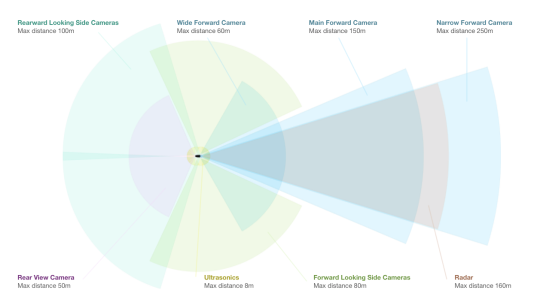
    This is being accomplished through a souped up onboard computer and by increasing the number of surround cameras from 4 to 8. Here’s a diagram (via Tesla) of how those cameras work and how they will capture a 360 degree view:

    image

    A couple of immediate thoughts / takeaways:

    The Smart Summon feature is obviously very cool. Summon on your smartphone and your car will come find you. Elon Musk has said that it will eventually find you even if you happen to be on the other side of the country. 

    But this assumes that there are solid metal snake chargers (or something else) to automatically charge your vehicle somewhere on route. It also suggests that the vehicles won’t be equipped to cross international borders by themselves.

    Elon Musk has said that (unfortunately) retrofitting older Tesla vehicles to full self-driving hardware will be very difficult and costly – the cost delta is greater than buying a new car. This reinforces my belief that leasing, rather than owning, is probably a wise strategy right now given how much change is happening in the auto space.

    Lastly, here’s some fine print from the Tesla Auto Pilot website:

    “Please note also that using a self-driving Tesla for car sharing and ride hailing for friends and family is fine, but doing so for revenue purposes will only be permissible on the Tesla Network, details of which will be released next year.”

    Uber vs. Tesla. Round 1. Fight.

    If you’d like to see a full self-driving Tesla in action, check out the video on their website.

  • How will self-driving vehicles change our cities and our habits?

    Last night
    I had a dream that I was driving around in a snowstorm and, for whatever
    reason, my tires had almost no tread on them. So I was all over the road.
    Strange. I have no idea what this means, if anything at all.

    But it did
    remind me that I can absolutely imagine a time when the thought of driving your
    own car (outside of it being maybe a hobby) will seem positively archaic. I
    mean, think about how messy our current system is. Roads are a chaotic and
    oftentimes dangerous place.

    The more
    interesting question for me though is: how will self-driving vehicles change
    our cities, our habits, and so on? In Elon Musk’s recently published Master
    Plan (Part Deux)
    he outlines 4 main goals for Tesla:

    1. Create stunning solar roofs with
      seamlessly integrated battery storage
    2. Expand the electric vehicle product
      line to address all major segments
    3. Develop a self-driving capability
      that is 10X safer than manual via massive fleet learning
    4. Enable your car to make money for
      you when you aren’t using it

    Let’s think
    about what these could mean.

    One
    translates into decentralized energy generation and storage. Now all of a
    sudden the cars on our roads will be roaming around our cities collecting and
    storing energy, eventually returning home at the end of the day to power our homes.
    I can already imagine fleets of sun worshipping cars chasing the light as it
    moves across our cities.

    Two is recognition
    that self-driving vehicles are going to have a meaningful impact on traditional
    public transit. (Elon reveals that Tesla is working on high passenger-density
    urban transport.)

    Three
    addresses the chaotic current state and the massive potential of networked
    cars.

    Four is particularly
    interesting to me. I wonder to what extent this income will simply subsidize
    car ownership or if it could actually transform cars into an investment (rather
    than purely an expense). Will people end up buying self-driving vehicles in the
    same way that people buy real estate for yield?

    Furthermore,
    how does this notion of a shared vehicle pool now completely change the way we
    think about parking requirements. For instance, today we think about parking in
    terms of individual usage. This tenant requires/wants X amount of parking. All
    2-bedroom apartments require Y amount of parking.

    But if we’re
    now all sharing our vehicles, parking requirements would then be based on some
    broader and collective demand curve. Parking would become less individualistic
    and instead become more of a yard where self-driving vehicles come to store
    themselves when not in use.

    Once again,
    we reach a point where utilization rates go up for each vehicle and overall
    parking demand goes down. Good thing we’re getting rid of parking minimums.

    What else could
    you see happening?