Daily insights for city builders, delivered every morning at 6 AM ET. I’m Brandon Donnelly — a Toronto-based real estate developer and founder of Globizen. I’ve been writing here since 2013.
My partner Kieran sent me this chart this morning:
It is a summary of the average weekday miles traveled by adults in private vehicles, including taxis and ride-hailing vehicles, for the 50 largest metro areas in the US (data is from the fall of 2023). At the top of the list with the most miles traveled is Raleigh, and at the bottom of the list with the fewest miles traveled is, not surprisingly, New York.
The other cities on the bottom of this list probably won’t surprise you either. But it’s a good reminder of how built form determines our mobility choices. If you look up which US cities have the highest population densities and the most compact built forms, I think you’ll generally find that it mirrors what you’re seeing here.
This data is from 2019, but I imagine that things would look pretty similar today and that it might even be a little more pronounced. The dataset from the above article looked at how many people have cars in a given area (a darker dot = fewer cars) and then plotted this against population density and income per capita.
Here’s what that looks like for the regions of New York, Boston, Los Angeles, and Houston (data from 2013 to 2017):
What is fascinating about these charts is that they show two different correlations. In dense and transit-rich cities such as New York and Boston, car usage is most closely linked with population density and not with income. The dark dots form a horizontal line near the top.
However, in the case of Los Angeles and Houston, car usage is instead most closely linked with income and not with population density. The dark dots form a vertical line near the left — the lowest income per capita.
So what does this tell us?
It tells us that if you design a city to broadly require a car, then you are likely to sort people based on those that can afford a lot of car and those that cannot. On the other hand, if you design a city around transit, then you are likely to instead create a place where both the rich and poor get around in similar ways.
There is also evidence that the latter is being increasingly viewed as more desirable. 2017 was the first year in the US where high-income young people (ages 26 to 33) drove less than low-income young people. Presumably these high-income people had choices, and so I tend to view this as a preference.
As a whole, this is surely a good thing for our cities. But now I think we need to be careful not to allow density and walkability to become the new luxury that only the rich can afford.
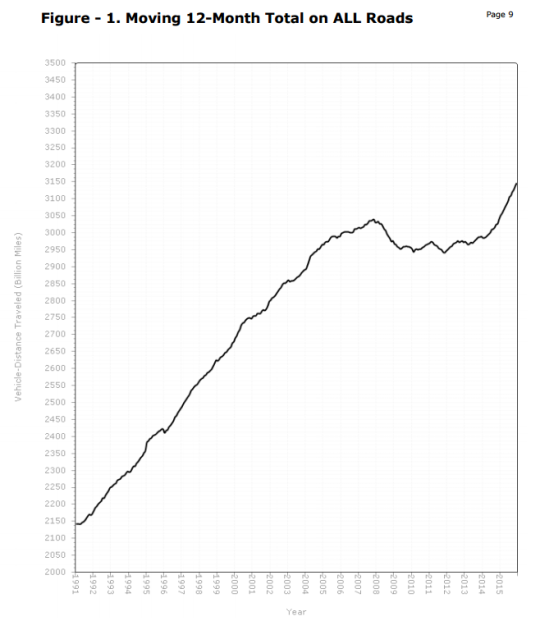
For a number of years now, urbanists – including myself – have been thinking about “peak car.” And that’s because if you looked at vehicle miles traveled (VMT) in the United States since about 2007, the trend line was more or less flat.
This had us wondering whether or it was simply an outcome of the recession or some sort of broader shift.
Well, if you look at the December 2015 numbers from the U.S. Department of Transportation, VMTs are once again growing. In fact, it’s now above the 2007 “peak.” Compared to December 2014, travel on all roads and streets in December 2015 was up by 4.2% or 10.6 billion vehicle miles traveled.
Here’s the chart:
A lot of this could be because of lower gas prices. But I would be curious to hear your thoughts in the comments about whether or not you think 2007 to 2014 was (1) a recessionary blip or (2) a longer term trend in the making.
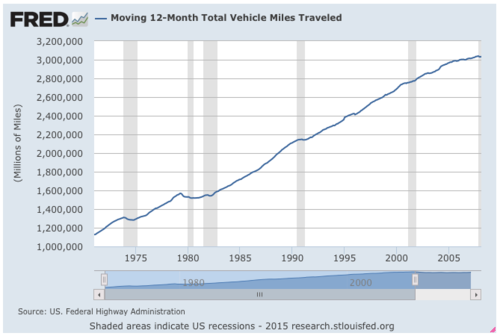
The total number of vehicle miles traveled in the US used to largely do only one thing: go up. This is made it fairly easy for the Federal Highway Administration (FWHA) to forecast how much more Americans were going to drive in the coming years – they just extended the trend line.
Below is what that looked like since the early 1970s (via FRED Economic Data). You’ll see that the total vehicle miles traveled went from somewhere around 1.1 trillion miles to around 3 trillion miles in and around the late 2000s. The shaded areas represent recessionary periods.
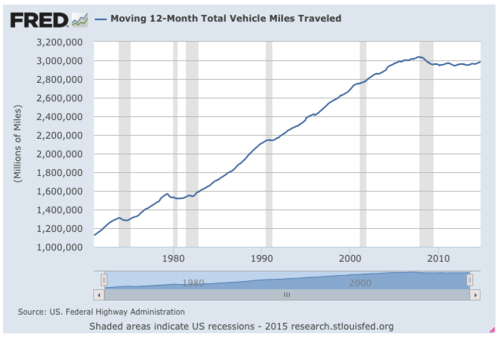
But then in 2007, something happened. Total vehicle miles traveled peaked, declined, and then flat lined at just under 3 trillion miles. Here’s what that looked like (the ending time period is October 2014):
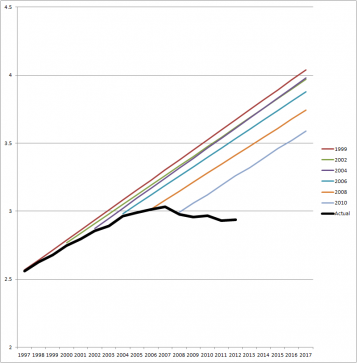
However, since this was new for the FHWA, they continued to believe that this would ultimately correct itself and that total VMTs would eventually continue on their linear ascent. So here’s what their projections looked like (via State Smart Transportation Initiative):
Clearly things didn’t go as planned.
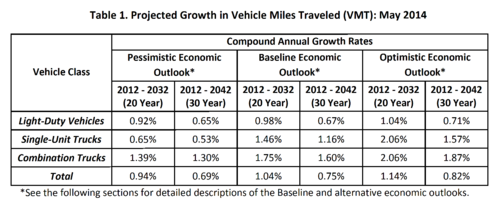
But then in May of last year (2014), the FHWA finally changed its tune and released this forecast, which had the following projections:
It outlined 3 economic scenarios: a pessimistic one, a baseline one, and an optimistic one. In their baseline outlook, they believed that the annual growth rate for total vehicle miles traveled in the US would be 0.75% over a 30 year period running from 2012 to 2042.
At the same time, they also stated that population growth would average about 0.7% per year through this same period. This means that the FHWA has more or less conceded that total vehicles traveled per person will likely remain flat, which is a significant change from previous forecasts.
Now, given their track record, I don’t think any of us should put a lot of faith in the accuracy of these numbers. Per capita driving could flat line. But it might also go down, which is what it has been doing over the past few years.
Either way, I do think it’s worth thinking about this shift. It’s a pretty big deal.
If you’ve been reading Architect This City since last winter, you might know that every year I go on one big snowboard trip with a group of guys I went to grad school with at Penn. Last year we went to Jackson Hole and Vail, and this year the plan is to go to Banff and Revelstoke.
We start planning it by the fall and so already we’ve been trying to sort out the details for this winter’s trip. But as we finalize the plans, one thing I’ve noticed is how I’ve automatically been trying to minimize the amount of driving that we’ll need to do. In fact, in a perfect world, we wouldn’t have to rent a car at all.
Now, small mountain towns aren’t usually the best for public transit, but there are often ways to get around that. When we were in Jackson, we took the public bus to get to the mountain every day, as did most people who lived or stayed in town.
This winter, the plan is to fly into Calgary and stay in Banff for the first leg of the trip. So I’ve been trying to figure out if there’s a train that can get us from Calgary to Banff and which hotels offer shuttle buses to the mountains. Because I’d rather not drive, and I know many of my friends feel the same way. It’s an added cost and it gets in the way of après ski.
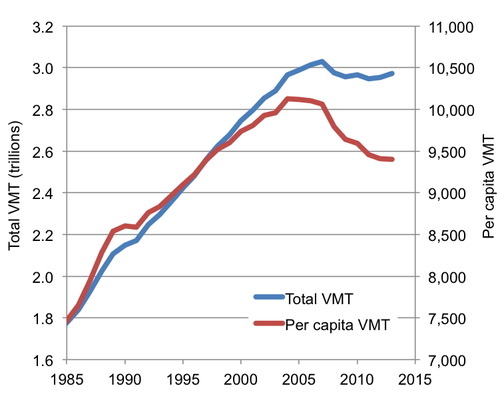
What’s interesting about this, is that not only do I try and minimize the amount of driving I do here in Toronto, but I do it when I travel as well. And if you’ve been following the macro trends, you might know that many other people feel the same way. That’s why total Vehicle Miles Traveled in the US has been in falling since about the mid-2000s:
People are falling out of love with driving, and many believe that this shift is permanent. Here’s a recent report from the US PIRG Education Fund talking about just that:
I also think this shift is permanent – until maybe the nature of driving changes and cars start driving themselves. But at that point, it won’t be called driving anymore and there will probably be many other changes. So on this rainy Wednesday morning, my big bold prediction is that future generations will no longer drive.