Daily insights for city builders, delivered every morning at 6 AM ET. I’m Brandon Donnelly — a Toronto-based real estate developer and founder of Globizen. I’ve been writing here since 2013.

Tag: vc

  • Winner take all

    We have talked a lot on this blog about the concentration of economic activity in global cities. Here is an old post about a paper called “winner-take-all-cities”, which documents the overrepresentation of talent, economic activity, innovation, and wealth creation in a select number of alpha cities.

    But this same phenomenon is playing out in a myriad of different ways. Aaron Renn calls this the “superstar effect” and has been writing about it for years. Another more recent example is this post by Richard Kerby called: Where did you go to school?

    Kerby looked at where venture capitalists in the US went to school and discovered that around 40% of them have gone to one of two schools: Stanford or Harvard. His argument is that not only is the venture capital industry lacking in gender and racial diversity, but it’s also lacking in cognitive diversity.

    My point with this post, though, is one of hyper-concentration. Tech is a dominant force in today’s economy. And in 2017, nearly 45% of all venture capital investment in the US went to companies located in the Bay Area – meaning San Francisco and San Jose.

    So here is an example of a select number of schools training a select number of minds that then go on to invest in a select number of cities. Fred Wilson, who is a venture capitalist, has a good response to this problem of diversity in the VC industry.

    But, of course, this is bigger than just the VC business.

  • Internet Trends 2017

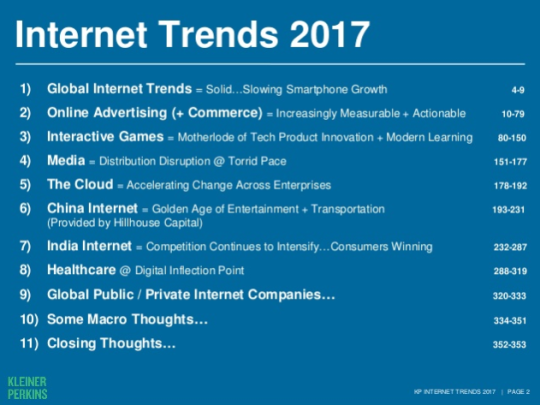
    Mary Meeker – who is a partner in the VC firm Kleiner Perkins – just recently released her annual Internet Trends report. 

    I’ve pasted the table of contents above so you can quickly decide if you’d like to spend your time going through it. The entire report is over 350 slides.

    If you can’t see the embedded slideshow below or if you’d like to access the reports from previous years, click here.

    [slideshare id=KGiWuuYFlhbQBC&w=595&h=485&fb=0&mw=0&mh=0&style=border:1px solid #CCC; border-width:1px; margin-bottom:5px; max-width: 100%;&sc=no]

  • Rinse and repeat

    image

    Venture capitalist Matt Turck has a post up on his blog that is packed full of information about the New York City tech ecosystem. (He has also written similar posts about Berlin and Paris.)

    His overall thesis is that New York – as a startup/tech hub – is only now starting to catch up to the hype of 4 or 5 years ago. He now refers to NYC as the de facto Number 2 after the Bay Area.

    If you’re interested in all of this, you can go read his full post. But I would like to pull out 2 points. The first is about the “rinse and repeat” cycle that happens over time that allows cities to become substantive startup hubs:

    As any student of emerging tech ecosystems knows, the key dynamic to success is the “rinse and repeat” cycle. You need several waves of successful tech companies to go through the whole cycle of founding, financing, scaling and significant exit.   Post-exit, the hope is that successful founders, employees and investors then contribute back both money and expertise to the next generation of tech startups, a few of which eventually become highly successful themselves and then provide money and expertise to the following generation.

    The trouble is, each successive cycle takes years, because the average successful startup takes 5 to 10 years to get to a large exit.

    One key reason the Silicon Valley has become such a powerful network is that this “rinse and repeat” cycle has been happening there for decades, at least since the 1940s and 1950s (Hewlett Packard), with a real acceleration in the 1970s and 1980s (Apple IPO, founding of Kleiner Perkins, etc).

    I’ve written about this idea before, but didn’t refer to it as “rinse and repeat.” I’m thinking about adopting that terminology going forward.

    The second is a list of New York-based startups. Matt uses it as an example of how entrepreneurial activity in New York is operating across a broad cross-section of different industries. That’s an important characteristic to identify.

    However, I also thought you might find it valuable to see what startups are out there, particularly if you happen to work in one of the below verticals/horizontals. I certainly went right to the real estate line.

    Fintech: Betterment, IEX, Fundera, Bond, Orchard, Bread
    Health: Oscar, Flatiron Health, ZocDoc, Hometeam, Recombine, Celmatix, BioDigital, ZipDrug
    Education: General Assembly, Schoology, Knewton, Skillshare, Flatiron School, Codecademy
    Real estate: WeWork, HighTower, VTS, Compass, Common, Reonomy
    Enterprise SaaS: InVision, NewsCred, Sprinklr, Namely, JustWorks, Greenhouse, Percolate, Mark43, Movable Ink
    Commerce infrastructure: Bluecore, Custora, Welcome Commerce
    Marketplaces: Kickstarter, Vroom, 1stdibs
    On Demand: Handy, Via, Managed by Q, Hello Alfred
    Food: Blue Apron, Plated, Maple
    IoT/Hardware: littleBits, Canary, Peloton, Shapeways, SOLS, Estimote, Dash, GoTenna, Raden, Ringly, Augury, Drone Racing League
    AR/VR/3D: Sketchfab, Floored

    I was happy to see my friends at Floored in the above list. They are under AR/VR/3D, but they service the real estate industry.

  • Is venture-based real estate development coming to the Bay Area?

    Golden Gate Bridge by Mariusz Blach on 500px.com

    https://500px.com/embed.js

    Chamath
    Palihapitiya
    is a Sri Lanka born, Canada educated, venture capitalist in
    Silicon Valley, who made a boatload of money as one of the early employees of
    Facebook. He now runs a VC firm called Social +
    Capital
     and owns part of the Golden State Warriors.

    The other
    night he was interviewed at a StrictlyVC event in San Francisco and I think
    that many of his comments would also be of real interest to the Architect This City
    community. He’s super passionate in interviews and always fun to listen to.

    Below is what
    he had to say about the San Francisco startup scene. It really speaks volumes
    about what people will put up with in order to live in an awesome place/city that they love. All of his responses below are from this
    TechCrunch article
    .

    “The city has to be doing more, around
    transportation, around housing… You have to get rid of the nimbyism and you
    need to quadruple, if not quintuple, the amount of housing. You need to tell
    that engineer from the University of Michigan that he can live here on a salary
    of $80,000.

    [In the meantime], we look at our startups, and
    the minute that they start to spend more than 15 percent of their burn – good
    money that we give them – on rent, a huge red flag goes up. When they, on a
    per-head-count basis, are spending so much, we start looking at the
    productivity of the technical team. And if it’s good but not great and they’re
    spending this insane amount of money [versus] a different team in Redwood City,
    we start to ask ourselves: “Are you so convinced that success is going to
    happen in this city at 1.5x the cost?”

    Because for every dollar that someone in
    Mountain View or Redwood City is raising, you [in San Francisco] have to raise
    one-and-a-half to two times that just to get to the same point. So you’re cutting
    your half life in half. To prove that you can take an Uber from some fuckin’
    shitty bar to another shitty bar? Like, I don’t understand.”

    And here he
    talks about the possibility of his venture firm also getting into the real
    estate development business. I couldn’t resist blogging about this.

    “We made a big
    decision with our last fund to build an organization that looks really
    different than a venture firm, and that organization is going to be this
    hybrid, bastard stepchild of Berkshire Hathaway and Blackstone and BlackRock.

    What I mean by this is
    that we want to have a large permanent capital base and we want to make really
    long, discontinuous bets on companies and sectors and trends.

    And one of the things
    we talked about was having a real estate fund …[because] we owe it to our
    companies to alleviate some of these problems when no one else is going to. If
    we went and built one million square feet somewhere of mixed use, where you
    work and live, and we rethink what it means to have a modular living environment
    for a millennial cohort that wants to work at companies and doesn’t necessarily
    have kids, we can do that in a way and give that back to our CEOs as a benefit
    of working with us.

    And you can probably
    make the economics work. Because we only really care about the equity of the
    company anyways. And the equity in the real estate will take care of itself if
    you take the 30-year view. So we’re at the point now where we’re like, wow, we
    should raise a few billion dollars and get into the real estate business and
    solve this problem systematically for our companies. And maybe in that, it
    becomes a blueprint for how others should do it. We’re just basically going to
    act as our own city-state and decide how to do it ourselves.”

    It’s
    interesting to think about what the economics might look like if your primary goal is
    simply to provide space to your portfolio companies (entrepreneurs) so that
    they get more (financial) runway and, therefore, have a greater chance of success. I’d love to see that pro forma.

  • Why brick-and-mortar stores should be scared of same hour delivery

    Venture capitalist Fred Wilson wrote a post on his blog today called, Same Day/Same Hour Delivery.

    The post is about why he believes that Walmart could get the “most disrupted by the Internet.” And it has to do with the rapid rise of same day and even same hour delivery from ecommerce companies. If you can order it online and receive it within an hour, why bother going to a brick-and-mortar store?

    His post reminded me of one I wrote towards the end of last year called, The threat to big box retailing. But since Fred is in the business of making bets on technology companies and he has accumulated a significant amount of wealth doing that, I thought you might like to also hear it from him.

  • How technology could completely change the real estate development industry

    If you’re involved in the built environment in any way, shape, or form – as a developer, architect, policy maker, and so on – I would highly recommend you watch the video below. My friend Candice Luck, who I went to Rotman with, sent it to me this morning with a link starting at the 24 minute mark. I haven’t yet watched the whole thing, but given how interesting this short section was, I plan to.

    The video is a talk by Steve Jurvetson, who is a venture capitalist with DFJ. He was one of the founding investors in Hotmail and currently sits on the board of companies like SpaceX and Tesla Motors. At the 24 minute mark he talks about a startup called Flux.io that hasn’t yet launched their product, but is working towards “reimagining building design”. They’re a spin-off from Google X and plan to officially launch in early 2015.

    Rather than try and describe the video here, I will just say that it’s an incredible example of how technology and digitization could completely change the real estate development industry. If you can’t see the video below, click here. The video starts at the Flux.io section.

    [youtube https://www.youtube.com/watch?v=IPgyb6euISs]

  • Your thoughts on the real estate marketplace, please

    If you know me at all, then you’ll know that I’m a big proponent of introducing more technology into the real estate space. I think the industry is one that has been incredibly slow to embrace technology, but that it’s only a matter of time before it does.

    Two months ago I wrote a post talking about how entrepreneur and venture capitalist Keith Rabois is working on a home buying startup codenamed Homerun — now called Opendoor. Here’s how he recently described the state of affairs:

    “My friend [PayPal and Palantir cofounder] Peter Thiel suggested that I come up with an idea to innovate in residential real estate,” Rabois told VentureBeat in April. “It’s the largest part of the economy unaffected by the Internet. And that was definitely true then, and even with things like Trulia and Zillow, it’s fundamentally true today. But the process of [selling a home] hasn’t been transformed by technology.”

    What Opendoor is trying to do is really interesting, but I have a different idea. It’s called Unlyst. And today I’d like to ask the ATC community for a small favor. I’ve created a short home buying and selling survey (embedded below) that will take you at most 2 minutes to complete.

    If you could please take the time to do that, I would greatly appreciate it. I’ve made the results public as well, so you’ll be able to see how buyers and sellers currently feel about the real estate marketplace. If you can’t see the survey below, please click here. Thanks for your help!

    [googleapps domain=”docs” dir=”forms/d/1bKvHYdSUfYH3AGX7LcLIK0_-i7nt7WIdTmHeaJ8P7pY/viewform” query=”embedded=true” width=”760″ height=”500″ /]

  • Airbnb for retail spaces raises $7.3 million

    Though it’s sometimes common to downplay “this for that” startups (that is, derivative startups that try and borrow a model and use it in another market), Storefront–which can be described as Airbnb for retail spaces–has just raised a $7.3 million Series A round.

    Storefront is a marketplace for short term retail space (think pop-up shops). People with space simply create a listing and decide how much they would like to charge per day, per week or per month. In doing so, Storefront “helps all sorts of brands, sellers, and merchants to create their first brick and mortar retail experience.”

    What I find interesting about Storefront, and other startups like Airbnb, is that they’re really rewriting the way real estate marketplaces work. Instead of large retail landlords (Storefront) and multinational hotel operators (Airbnb), technology is allowing individuals to now participate in these marketplaces. Supply is being decentralized and anyone with extra space can participate.

    You could argue that these sorts of informal and short term rentals are nothing new, but I don’t think there’s ever been the possibility of scaling up like there is today. I mean, just look at how much attention Airbnb has been getting in New York. These startups are having an impact on the way the larger market functions.

    Change is coming. And I think we’ll see a lot more of it in the real estate space.

  • Tech is now the second largest job sector in New York City

    According to a recent report called Building a Digital City, which I found via Fred Wilson’s blog, tech is now the second largest job sector in New York City behind financial services (which includes real estate). There are an estimated 262,000 tech workers in the city earning wages in excess of $30 billion.

    This is a really interesting stat that speaks to the diversity of New York’s economy and the ability for it to continually reinvent itself. But what I found particularly interesting, was the following comment by Fred Wilson:

    “And the reason tech is growing so fast in NYC is that it is embedding itself in all of these other industries. It’s not entirely clear to me whether Gilt is a tech company or a fashion/retail company, it is not clear to me whether ZocDoc is a tech company or a health care company, it is not clear to me whether Codecademy is a tech company or an education company.”

    This is very much the way I think about so called tech companies today. I recently had a Rotman colleague say to me that he felt the startup world was becoming saturated. Everyone is now seemingly working on some new app.

    But I like to think of it slightly differently. As Fred’s comment above suggests, a lot of startups today aren’t purely tech companies. They’re just out to solve a problem and it just so happens that technology and the internet are creating all sorts of opportunities for new solutions.

    I also read a blog called Platform Connected and the author put it like this:

    “In the future, every company will be a tech company. We already see this change around us as companies move to restructure their business models in a way that uses data to create value. We are moving from linear to networked business models, from dumb pipes to intelligent platforms. All businesses will need to move to this new model at some point, or risk being disrupted by platforms that do.”

    So there you have it. Software really is eating the world.

  • Every employee in a company depends on the CEO to make fast, high quality decisions. Often any decision, even the wrong decision, is better than no decision. These decisions are pulse of the organization. Sharing command almost guarantees that the CEO position will perform poorly in this dimension.

    Ben Horowitz