Daily insights for city builders, delivered every morning at 6 AM ET. I’m Brandon Donnelly — a Toronto-based real estate developer and founder of Globizen. I’ve been writing here since 2013.

Tag: vancouver

  • America really is building very few condominiums

    On my way back from Philadelphia
    this past weekend I wrote a post called, The
    Philadelphia (real estate) story
    . It was about how opposite the market is
    in Philly compared to Toronto.

    After writing that post and
    because of a discussion in the comment section, I started thinking about condo
    vs. rental apartment development across the US. Because unlike cities such as
    Toronto and Vancouver, it struck me that – outside of maybe New York and Miami
    – most U.S. cities are really not building a lot of for sale condos. And if
    you’re from Toronto or Vancouver, I bet that feels odd to you.

    But what exactly is that number?

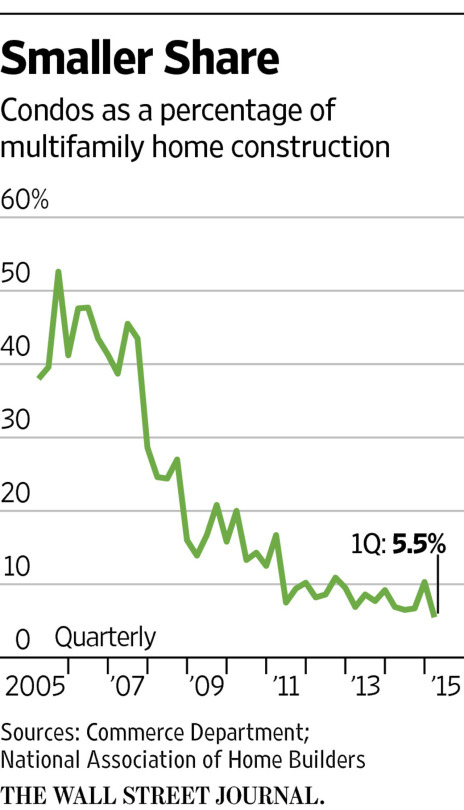
    As of the first quarter of 2015, condos as a percentage of all new
    multifamily (apartment) construction in the US was only 5.5%. That’s a tiny number and is down from
    over 50% before the Great Recession, which means most
    cities in the US really are building mostly rental. Last year the US built 264,000
    multifamily units across 11,000 buildings
    .

    So why is that happening?

    There appears to be a number of
    factors, according to a
    recent article in the Wall Street Journal
    .

    There’s a supply side
    constraint:

    Another obstacle cited by developers: construction loans. Matt
    Allen, chief
    operating officer of the Related Group, a developer based in Miami, said he can
    get a construction loan for roughly 75% of the cost of building an apartment
    complex. But lenders will cover only 50%, on average, of a condo complex’s cost
    because of the greater risk, he said.

    There’s a demand side
    constraint:

    As a result, the Federal Housing Administration, which
    backs mortgages made to low-wealth buyers, tightened its lending standards in a
    series of moves from 2008 to 2012. Under the new rules, in order for the FHA to
    insure mortgages in a given condo complex, at least half of the units must be
    owner-occupied and no more than half can be FHA-insured, among other
    requirements. For condo projects under development, at least 30% of units must
    be under contract for sale before the FHA will start backing mortgages there.
    Mortgage giants Fannie Mae and Freddie Mac tightened
    their standards as well.

    And there are macroeconomic
    factors:

    On the entry-level end, tepid job growth early in the
    recovery and the younger generation’s affinity for flexibility have fueled
    demand for rentals. Apartment rents are up nearly 16% since 2010, according to Reis Inc.

    Notwithstanding
    the above, could this be a post-recession policy pendulum that has swung
    too far in one direction?
  • The impact of laneway housing in Vancouver

    In 2009, Vancouver created policy and legalized laneway homes. (If you’re not up on laneway housing, click here. I’ve written too much about this topic.)

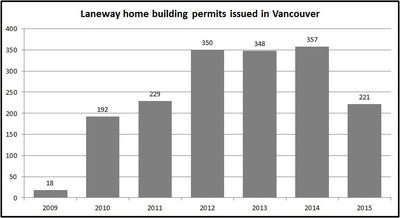
    Since then, the number of laneway homes built in Vancouver has steadily increased to the point where roughly 350 new homes are built every year. 

    Here’s a chart I found showing the number of laneway home building permits issued in Vancouver since 2009 (the year to date number for 2015 is up to and including June):

    image

    This is pretty interesting in its own right.

    But as soon as I saw this chart I started wondering how these numbers fit into the overall new home construction landscape. So I decided to dig up the City of Vancouver’s Statement of Building Permits Issued for June 2015.

    As the chart above shows, the number of laneway dwelling units built (well, permits issued) was 221 as of June 2015. But what’s really fascinating is that this numbers exceeds the number of building permits issued for single family dwellings, which was only 192!

    Also super interesting is the significant spread in building permit value. 

    For single family dwellings, the total value was $156,086,861 (or $812,952 per dwelling unit). On the other hand, for laneway dwellings the total value was $36,478,785 (or $165,062 per unit).

    Now to be fair, if you add single family dwellings with a secondary suite into the mix, you get a total count of 608 new dwelling units (as of June 2015). But at 221 new units, laneway dwellings still make up a meaningful portion of the new construction market.

    So while laneway houses might seem fringe for Toronto and other cities right now, they’re really not that fringe. In fact the numbers above start to show that they can be a viable source of new and relatively affordable single family housing.

    Eventually other cities will realize this too.

  • Build the Future – A CityAge Summit this October

    The View from CN Tower II by Roland Shainidze on 500px.com

    https://500px.com/embed.js

    This October 8th and 9th (2015) in Toronto, CityAge will be hosting a summit at the MaRS Discovery District called, Build the Future. The goal is to explore the future of Canada’s economic powerhouse.

    Here’s a little bit about CityAge:

    CityAge is a platform for ideas and business development, designed to enable new partnerships among the business, government and societal leaders who are shaping the 21st Century.

    Founded in 2012 in Vancouver, Canada, our events have taken place, or are scheduled, in New York City, Hong Kong, Toronto, London, Los Angeles, Seattle, Edmonton, Philadelphia, Kansas City, Ottawa, Vancouver and The Waterloo Region in Canada.

    To date more than 4,000 leaders in business, government and society have attended a CityAge event.

    I’ve seen the draft agenda and list of speakers for the event, and if you enjoy the content on this blog, I think you’ll also really enjoy this CityAge summit.

    But even better is the fact that if you’re a young professional (under 35) and a reader of Architect This City, you can use the code YOUNGPRO to attend for just C$195.

    You’re welcome. I hope to see you there 🙂

  • Vancouver isn’t immune to the urban-suburban divide

    https://500px.com/embed.js

    In the comment section of my post about Vancouver’s transit referendum, a reader suggested I take a look at an article by Peter McMartin called, The real Vancouver emerges (from the ruins of the plebiscite)

    McMartin’s argument is basically that Vancouverism – the name given to the city’s progressive architecture and planning approach – isn’t as widespread as it might seem. The reality is that Vancouver, much like Toronto and other cities, is divided.

    “Vancouverism might be a reality for two or three neighbourhoods huddling in the downtown, and that greener, more progressive ethos might hold sway in one or two more.

    But Vancouver — and I speak of it in the metro sense — is the sum of its parts, and most of its parts are suburban in their sensibilities, and that includes not just all of the suburbs but most of the neighbourhoods in the City of Vancouver proper.

    They’re resistant to change. They abhor densification. They’re conventional in their sensibilities and they’re highly dependent on the automobile. More importantly, they’re not just dependent on the automobile, they prefer it.”

    Here in Toronto, we know our city is divided. And many people see it as evidence that amalgamating the city in 1998 was a big mistake. The inner suburbs are holding back old Toronto and elitist old Toronto just doesn’t understand the priorities of the inner suburbs.

    But I’m not convinced that amalgamation is to blame.

    Most cities have long histories of amalgamating adjacent towns, villages, and cities, and I suspect that there was opposition all along the way. At what point is amalgamation acceptable and and what point is it problematic?

    The anti-amalgamation camp here in Toronto seems to believe that it would have allowed old Toronto to continue doing what it wants to do and allowed the inner suburbs to do what they want to do.

    But this to me feels parochial.

    Our cities need to think bigger than that. We need to think as cohesive urban regions. And as Vancouver demonstrated this past week, that’s not always easy. But I don’t think the answer is to just think smaller and ignore the people whose views don’t match our own.

    Interestingly enough, what a lot of this comes down to, I think, is built form. 

    Because different kinds of built form will encourage and often mandate different kinds of transportation choices. And how you get around a city will inform a big part of what you value and what you vote for.

    Over time though, I believe that we will see built form start to level out across our city regions through continued intensification. Many people won’t be happy about this change. But it is likely that it will end up creating more cohesive cities. 

    Built form is no small thing.

  • With Vancouver voting “no” to transit tax, could Hong Kong now serve as inspiration?

    https://500px.com/embed.js

    Earlier today it was announced that Metro Vancouver voted “no” to a 0.5% sales tax increase that would have been used to fund a $7.5 billion regional transportation plan. 

    Roughly 62% of respondents said “no”. And not surprisingly, the percentage of people who voted “no” increased as you moved outward towards the suburbs. But even the City of Vancouver itself sided slightly with “no” at 50.81%.

    Since I’m not that plugged into the Vancouver scene, I’m not going to comment on this issue. But hopefully you all will in the comments below. I know that a lot of you are incredibly passionate about this.

    Instead, I’d like to pose two questions. 

    Firstly, why is it that Asian transit operators seem to be so much better than North American transit operators at recovering their costs through fares? (Urban density and car ownership likely have something to do with it). And secondly, why hasn’t Hong Kong’s famous “rail plus property” transit model been exported to North America?

    For those of you unfamiliar with Hong Kong’s Mass Transit Railway Corporation, here’s how much money they make (via The Atlantic from 2013):

    The Mass Transit Railway (MTR) Corporation, which manages the subway and bus systems on Hong Kong Island and, since 2006, in the northern part of Kowloon, is considered the gold standard for transit management worldwide. In 2012, the MTR produced revenue of 36 billion Hong Kong Dollars (about U.S $5 billion)—turning a profit of $2 billion in the process. Most impressively, the farebox recovery ratio (the percentage of operational costs covered by fares) for the system was 185 percent, the world’s highest. Worldwide, these numbers are practically unheard of—the next highest urban ratio, Singapore, is a mere 125 percent.

    In addition to Hong Kong, the MTR Corporation runs individual subway lines in Beijing, Hangzhou, and Shenzhen in China, two lines in the London Underground, and the entire Melbourne and Stockholm systems. 

    And here’s how they do it (also via The Atlantic):

    Like no other system in the world, the MTR understands the monetary value of urban density—in other words, what economists call “agglomeration.” Hong Kong is one of the world’s densest cities, and businesses depend on the metro to ferry customers from one side of the territory to another. As a result, the MTR strikes a bargain with shop owners: In exchange for transporting customers, the transit agency receives a cut of the mall’s profit, signs a co-ownership agreement, or accepts a percentage of property development fees. In many cases, the MTR owns the entire mall itself. The Hong Kong metro essentially functions as part of a vertically integrated business that, through a "rail plus property” model,  controls both the means of transit and the places passengers visit upon departure.  Two of the tallest skyscrapers in Hong Kong are MTR properties, as are many of the offices, malls, and residences next to every transit station (some of which even have direct underground connections to the train). Not to mention, all of the retail within subway stations, which themselves double as large shopping complexes, is leased from MTR.

    I believe that we could do this too. So hopefully we can have a great discussion about it in the comment section below.

  • 11th Annual Land & Development Conference

    Today I spent the day at the 11th Annual Land & Development Conference here in Toronto. I found it particularly good this year, but it’s now late, I’m tired, and I want to go watch game 6 of the NBA finals. So I think this is going to be a fairly short post.

    Here’s a summary of some of my key takeaways from the day (a lot of it is Toronto-centric):

    • Increasingly, the commercial and residential sides of the real estate development business are converging. And it’s being largely driven by the focus on urban intensification and mixed-use.
    • This is leading to an “institutionalization” of the residential side, which has historically been the domain of smaller private/local companies and rich families.
    • Merger is creating complexity around asset valuations: Is it about the income (cap rates) and/or the future development potential?
    • Low rise house prices in Toronto continue to skyrocket. Supply is highly constrained. This has been the story for a number of years now.
    • High rise condo prices in Toronto continue to be more or less flat (modest increase). The industry is going to need to figure out how to work with and compliment the current surge in rental apartment development. There is an element of competition between the two asset classes.
    • According the RealNet’s new home price index, the spread between low-rise and high-rise housing in the Greater Toronto Area widened to $326,659 as of this past April (2015).
    • Rental Apartment Case Studies: Motion on Bay by Concert Properties (Bay and Dundas) was underwrote at $2.60-2.80 psf rents back in 2009. Rents are now in the $3 range. The Heathview by Morguard (Bathurst & St Clair) had $2.80-2.90 psf rents in its pro forma. It achieved and beat these numbers.
    • There’s a flood of Asian money coming into (1) Vancouver and then into (2) Toronto looking for development projects. There appears to be a lot of impatient and/or dumb capital out there. Challenge remains finding good development sites.

    I will end by saying that I found there to be greater transparency at today’s conference. There was a lot of talk about deal specifics and I don’t remember seeing this much detail at past conferences. 

    Maybe I just wasn’t paying attention closely enough before or maybe the industry is slowly becoming more transparent. I hope it’s the latter.

    If you were there today and I missed something groundbreaking, please share it in the comments below!

  • W57 — A new hybrid building typology

    image

    We’ve been talking about a lot of heavy topics here on Architect This City lately. Everything from the contentious Gardiner Expressway East to minimum population densities to density creep. 

    So today I thought we could talk about something a bit more fun: architecture.

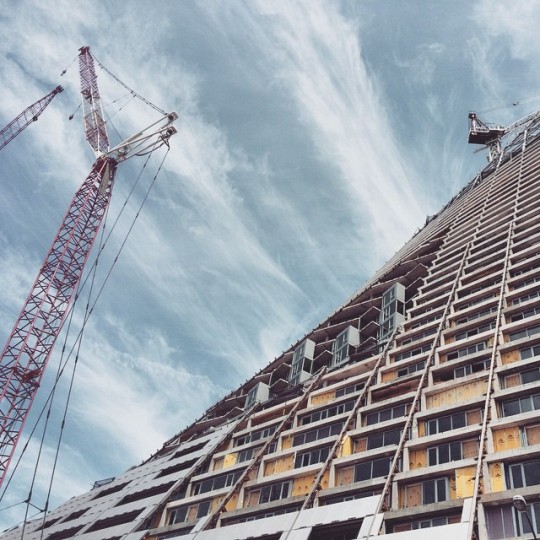
    When I was in New York last weekend, one of the buildings that was on my must-see list was the now under construction West 57th Street by Danish architect Bjarke Ingels. See photo above. (It also happens to be at the exact location where the West Side Highway transitions from elevated to surface boulevard.)

    This is supposedly the first North American project for Bjarke Ingels (he also has a project in Vancouver now). And if you’re a regular reader of this blog, you’ll know that I’m a fan of his work. His diagrams and storytelling ability were a big inspiration for me when I was in architecture school.

    The concept behind the project was to create a new hybrid building typology, one that is a cross between the typical European perimeter block building and the North American skyscraper. And the result is pretty wild.

    Here’s a video in case you aren’t familiar with the project. Click here if you can’t see it below.

    [youtube https://www.youtube.com/watch?v=_0JbTbOm_iQ?rel=0&w=560&h=315]

    I think it’s a really exciting project. What are your thoughts?

  • The cost of saying “no”

    https://500px.com/embed.js

    When you rezone a property to build something new, pretty much every city will ask you to provide reports and studies that assess the potential impacts of that something new. 

    They’ll ask you to look at the impact on traffic, the impact on storm water, the impact on shadows in the area, and the list goes. This, of course, is fair and reasonable. It makes sense to measure the impact of the proposed changes to see if it will work in the given context. 

    But those are not the only impacts to consider. I think that many of us underestimate the flip side, which is the impact of doing nothing, or in this case, building nothing. Here’s a recent quote from an excellent interview with urban economist Edward Glaeser:

    Personally, I believe there are always huge costs to saying “no” to people who want to create space for new families that want to live in the city; who want to make the city more affordable. There are always costs – I believe that very, very strongly – but, sure, there are also benefits to saying “no” at certain times.

    Glaeser is, of course, not saying that we should allow unfettered development. He is saying that there are costs (or impacts) to building and costs to not building. The challenge is that we assume, often incorrectly, that saying “no” simply means the status quo will prevail. And we do not consider the impacts.

    So what does that mean? Here’s an example.

    The Neptis Foundation, which is a nonpartisan and charitable urban research group, just published an interesting report called, Growing Pains: Understanding the new reality of population and dwelling patterns in the Toronto and Vancouver regions

    What the report did was compare growth and settlement patterns in both the Greater Toronto (and Hamilton) Area and Metro Vancouver between 2001 and 2011. And what they found was two different stories.

    Of the one million people that moved to the Toronto region between this period, roughly 80% of them settled in new greenfield housing subdivisions at the urban edge. And only 18% of people moved to areas that were well serviced by public transit.

    By contrast, only 31% of Metro Vancouver’s population growth went to greenfield areas and 69% went to urban intensification areas. Nearly half of these new residents ended up settling next to high frequency transit.

    From an environmental standpoint, Vancouver’s settlement pattern is obviously preferable. But it takes hard work to achieve that. The barriers to infill development are more formidable than the barriers to greenfield development. This is despite the fact that there are well documented social, economic, and environmental costs associated with urban sprawl.

    My point with this example is that growth and demand will find somewhere to settle. Some locations make more sense than others, but sometimes there’s no choice when we have decided to say “no.” So what we ought to be doing is measuring both the impact of building, as well as the impact of not building.

  • Art and apartments

    Photograph Vancouver by Marc M on 500px

    Image Source: Vancouver by Marc M on 500px

    According to a recent Bloomberg article, this is where the rich are putting their money today:

    “The two greatest stores of wealth internationally today is contemporary art….. and I don’t mean that as a joke, I mean that as a serious asset class,” said Fink. “And two, the other store of wealth today is apartments in Manhattan, apartments in Vancouver, in London.”

    In case you wondering, Laurence Fink is the founder and CEO of BlackRock Inc., which today is the largest asset manager in the world. They have over $4.77 trillion in assets under management according to their website. That’s a mind boggling number.

    And if you read the Bloomberg article cited above, you’ll see that this interest in both art and apartments represents a shift away from gold as the de facto safe haven.

    “Historically gold was a great instrument for storing of wealth,” the chairman of BlackRock Inc. said at a conference in Singapore on Tuesday. “Gold has lost its luster and there’s other mechanisms in which you can store wealth that are inflation-adjusted.”

    What’s interesting and probably most relevant to the Architect This City community though is this investment focus on apartments.

    When people talk about a possible housing bubble in Canada they often cite house prices to median household income as a key ratio. The question then becomes: How can house prices be such a high multiple relative to local incomes?

    That’s relevant, but it’s not the entire story for cities like New York, London, and Vancouver. That ratio alone assumes that real estate isn’t a global investment vehicle. And for some people people it is exactly that.

  • Westbank unveils #BloorAndBathurst before filing development application

    image

    Last night Westbank went public with their first design for the southwest corner of Bloor and Bathurst in Toronto (the Honest Ed’s site).

    There’s no name for the project yet and they haven’t even submitted a development application to the city, but I can tell you that there was a lot of excitement in the room last night. Over 500 people showed up at the Park Hyatt. And I think it only partially had to do with the fact that they were offering up free grilled cheese sandwiches.

    If you’d like to get a feel for last night’s open house, check out #BloorAndBathurst on Twitter. And if you’d like to learn more about the project, check out Alex Bozikovic’s piece in the Globe and Mail. It’s pretty exciting stuff. I’m not going to repeat all of the project details here because Alex has already eloquently done that. All of the developer’s information boards can also be found online, here.

    What I instead want to talk about is Westbank’s community engagement process. In Toronto, it’s quite rare to see this level of public consultation pre-application. And that’s because the city only requires it once a development application has been formally made.

    But I’m of the opinion that the status quo isn’t actually the optimal strategy for city building. In fact, I’ve argued before that public consultation is broken.

    And the reason I think that is because the typical process doesn’t allow for a critical mass of community feedback, both early on and throughout the process (think lean startup methodologies). In-person public meetings are too much friction for a lot people and getting feedback only once an application has been submitted means that a lot of work has already been done, which is the opposite of lean.

    In the case of #BloorAndBathurst, last night was part of an engagement process that began last year.

    Now, part of the reason that many developers don’t adopt this model is because of fear. There’s a belief that many communities just don’t like change, period. But is that really the public opinion? Or do we simply not have enough data and enough feedback loops built into the city building process?

    Time will tell how this approach works out for Westbank, but I have a pretty good feeling that they’ll do just fine.

    Image (Sketchup model + watercolor): Westbank via Globe and Mail