Daily insights for city builders, delivered every morning at 6 AM ET. I’m Brandon Donnelly — a Toronto-based real estate developer and founder of Globizen. I’ve been writing here since 2013.

Tag: value

  • Listed.fun (and something else)

    This is a fun little passion project by Airbnb-engineer Andrew Pariser and someone known as Potch. The way it works is that it shows you a picture of a recently sold property, and you have to guess what it sold for. You get a bunch of guesses, and after each one, you are given more information about the property and some feedback on how close you are. To win, you need to get within 1%.

    When I tried it out, my initial guess was way off (too high). Toronto has trained me well. I also wasn’t sure where Evansville, Indiana was, so that bit of information didn’t really help me. But the arrows telling me I was way too high, certainly did. The reality is that it’s pretty hard to guess the value of a home if you don’t know where it is, you can’t see interior photos, and you generally don’t have enough information.

    But what if you were from Evansville, Indiana and what if you did have enough information? I bet that the guestimates would actually be pretty accurate. This idea of crowd-sourcing market information and pulling wisdom from crowds has long interested me, because price discovery is a major pain point for real estate. Sure you can look at comparable sales and current listings, but that is not an exact science. Neither are algorithms.

    But what if there was a way to test the market and get pricing feedback before you actually list? Would you trust it more than Zillow’s algorithm? This is something that I’m working on testing right now through a passion project called Unlyst. Myself and a few others are working on a very simple product that will be released this fall. If you’d like to follow along, sign up here.

  • That emotional connection

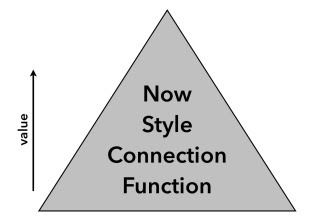
    Marketing guru Seth Godin recently published this value
    triangle on his blog
    :

    image

    No matter what business you’re in, it’s worth giving some thought to this. What do you offer?

    At the bottom of the triangle is function. A hotel room functions as a place
    to sleep. A smartphone functions as a device to make calls, send text messages,
    and download some apps. A condominium functions as a place to live, eat, sleep, have sex, and so on. But all functions being equal, most of us will buy whatever product is the cheapest.

    That is until there’s an emotional connection. I love the
    way Seth frames it: “Where do people like me do things like this?” It is about defining
    who you are. Am I the kind of person who buys A or am I the kind of person who buys
    B? If I care deeply about the environment and B promises to respect that, I am
    likely to buy B.

    But then, moving even further up the triangle, if two items offer the same function and the
    same emotional connection, many of us will go for the one that appears sexier, shinier (the new iPhone 7 is very shiny), and more
    stylish. It just deepens the connection.

    Finally, at the very top of the triangle is now. This is
    about scarcity. What’s hot right now?
    Think of that new restaurant that just opened downtown that you haven’t been
    able to get a table at. It’s now and you want to Instagram the food so badly so
    that you can show everyone you were there. You want to be now.

    The point of all of this is that we consume things for
    reasons that go well beyond simple function. That’s just the start of it all.
    One could argue that all of this is simply smoke and mirrors, but that’s a
    topic for another blog post. This is our reality.

    To relate this topic back to architecture and real estate, I
    am curious how many of you have made a housing decision that you believe went
    beyond function. How much of it was based on connection and style?

    Not surprisingly, for me, architecture and design matter a
    great deal.

    Earlier this summer I was driving around the city with my
    father and he was pointing out to me all of the new build single family homes
    that were sprouting up. He then asked me what I thought of them. I responded: “They’re
    shit.”

    What I was really saying with that glib remark was that
    those homes – no matter how expensive – didn’t reflect my own belief system
    about the world. Sure they served their function, but they didn’t offer the
    connection and style that “people like me” like to praise. To borrow once again
    from Seth: we are all part of a certain tribe.

    What tribe do you belong to? And does your housing choice
    reflect that?

  • Enemies of the High Line

    Despite not being the first example of infrastructural adaptive reuse, the High Line in New York has certainly kickstarted an urban trend. Cities all around the world now want their own “version of the High Line.”

    Philly is working on a new “rail park.” I toured the space last summer and it’s very similar to the High Line in terms of existing infrastructure. Rome and Toronto are both working on “under” spaces, which are beneath an old viaduct and elevated expressway, respectively. And the list goes on.

    But I think it’s worth remembering just how contentious the High Line was before it was built. For some people it was just an eyesore and a public safety hazard. Here’s a excerpt from a New York Times article dated 2002:

    “This is a terrific win for us,” said Michael Lefkowitz, a lawyer for Edison Properties, one of 19 businesses that own land beneath the High Line.

    Janel Patterson, a spokeswoman for the city’s Economic Development Corporation, said an agreement to share the $11 million cost of dismantling the High Line was being circulated among the property owners and the rail bed’s owner, CSX, of Richmond, Va. “It’s about eliminating a public safety hazard,” Ms. Patterson said, “but it’s also about enabling the city to move forward and better develop the area.”

    It’s also worth mentioning that former Mayor Giuliani supposedly favored demolition of the High Line. Former Mayor Bloomberg, however, did not:

    …Mr. Bloomberg said: "Today, on the West Side of Manhattan, we have an opportunity to create a great new public promenade on top of an out-of-use elevated rail viaduct called the High Line. This would provide much-needed green space for residents and visitors, and it would attract new businesses and residents, strengthening our economy. We know it can work … . I look forward to working with Friends of the High Line and other interested parties to develop a feasible reuse scenario.”

    The challenge with these sorts of things – that is, new ideas – is that we live in a world of proof and precedents. We want to see that it has been successfully done before, because, otherwise, we might be wrong. So now that New York has shown what is possible, it has cleared the way for other cities.

    Rethinking old infrastructure is a sound urban strategy. But we also shouldn’t forget that it’s less valuable to be right about something that every other city already believes to be true. The real value is created when you’re right about something that most other cities don’t yet believe.

  • The value of saying no

    If you’re somebody who has a lot of ideas, it can be pretty easy to get overwhelmed and/or distracted by all of the possibilities. It’s also worse when you’re an optimist and you believe it can all be done. I am definitely guilty of this. It is one of my weaknesses.

    We all have a finite amount of time to work with and so saying no to the stuff that isn’t core is critical. I believe I am getting better at this, but every now and then I find myself having to do some pruning. And once I do that, boy does it feel great.

    Seth Godin has a fantastic blog post on this topic that I love called, No is essential. Here it is in its entirety (it’s a short post):

    “If you believe that you must keep your promises, overdeliver and treat every commitment as though it’s an opportunity for a transformation, the only way you can do this is to turn down most opportunities.

    No I can’t meet with you, no I can’t sell it to you at this price, no I can’t do this job justice, no I can’t come to your party, no I can’t help you. I’m sorry, but no, I can’t. Not if I want to do the very things that people value my work for.

    No is the foundation that we can build our yes on.”

    To drive the point home even further, let’s shift gears and talk about wine. (For all of you fellow wine drinkers.)

    In viticulture, overall yield – usually measured in hectoliters per hectare of vineyard – is often seen as an important indicator of quality. The idea being that low yields produce better wines because the flavors get concentrated over fewer grapes. 

    Part of what drives this is the leaf to fruit ratio. Too much fruit and not enough leaves, means the grapes won’t ripen properly.

    The parallel to this conversation is that leaves are much like time. There’s only so much of it. And while many of us are constantly trying to maximum yield – I know I am – there are limits to the kind and quality of grapes we can produce when we do that. 

    I know this in principle. And more and more, I know this in practice. I am learning to say no.

    Image from Flickr

  • The value equation

    On Tuesday night I attended a great industry event that Quadrangle Architects organized about mid-rise buildings. 

    Mid-rise buildings (somewhere around 4-12 storeys) are all the rage in Toronto these days. But there are many challenges associated with this building typology and this was an event to talk about them and hopefully push things forward.

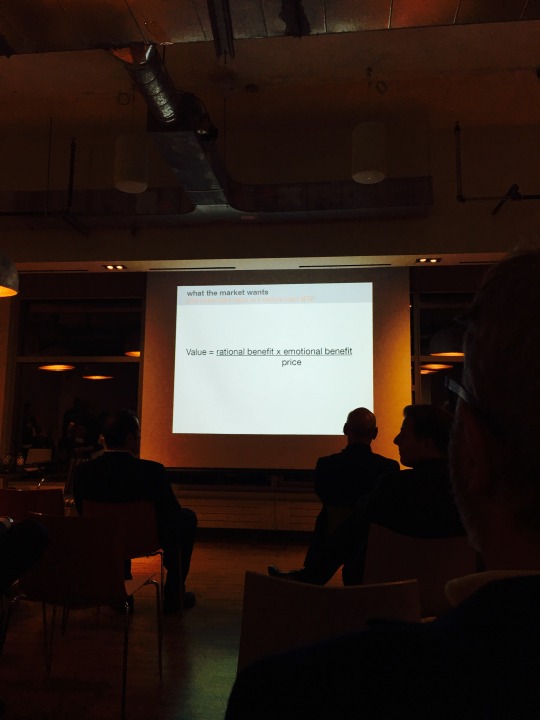
    One of the speakers at the event was Jeanhy Shim of Housing Lab Toronto. And I’d like to share one of her slides here:

    It reads:

    Value = (rational benefit x emotional benefit) / price

    I believe she admitted to taking it from someone at Bruce Mau Design. But that’s okay. That’s how ideas build. What I really like about it is that it attaches a value to the things that are difficult and sometimes impossible to measure: the emotional stuff.

    As I mentioned in this post over the weekend, we are all obsessed with the quantitative side of our businesses. In the case of development, we look at prices, per square foot prices, apartment sizes, and the list goes on. And we often reduce our “products” to these sorts of key metrics.

    But if you’re competing just on numbers, then you’re missing a big and important part of the equation. People consume things – and housing is no different – for a number of different reasons. We buy things because of how it makes us feel, how it reinforces our sense of self, how it improves or promises to improve our lives, and so on. These are all harder to measure than square footage. 

    But we are living in a data driven world and more and more of this type of information will become available for city building. If you and your business can get your head around it first, you’ll have a huge advantage. 

  • How wise are crowds?

    Earlier this week I wrote a post about a new build home under construction at 37 Canerouth Drive in the west end of Toronto. As part of that post, I asked people what they thought the home would be valued at when it was completed. There were just under 10 responses (many thanks!) and I thought it was really fascinating to see the ranges.

    A lot of you responded in the comment section of the post, but a bunch of the other estimates came in via Facebook, Twitter, and email. It isn’t a huge data set, but I’ve nonetheless consolidated the ones I could remember I received:

    $2,375,000
    $2,750,000
    $1,800,000
    $3,000,000
    $8,500,000
    $2,600,000
    $3,500,000
    $1,750,000

    If you average these estimates, you come to a value of $3.3M. However, the clear outlier is the $8.5M. So let’s take that one out and see how the number changes. If you do that, you then get an average estimate of $2.5M. A pretty big swing.

    Now, I don’t know offhand how accurate that number really is, but I’m fascinated by this idea of “the crowd” determining value. Particularly for markets such as housing where supply can be completely heterogeneous and there isn’t a lot of transaction volume to refer back to (compared to other types of markets).

    Because my strong belief is that under the right circumstances and with enough data points, this number could end up being hugely accurate. And, it could also be more forward looking since it’s capturing current market sentiment as opposed to being based on historical transaction prices.

    If you have any thoughts on this, I’d love to hear from you 🙂

  • Put your window to work and make $50 a month

    image

    I’m convinced that city building – like probably every other industry – is going to get a lot more data driven. Yesterday I wrote about how driverless cars are collecting exact replicas of our cities as a result of the 3D scanning that they do. And today I learned about an interesting new startup called Placemeter.

    Basically it works like this: If you have a window (at home, at the office, or wherever) that faces onto a lively street, Placemeter will pay you to setup a smartphone in that window as a “meter.” The going rate is up to $50 per month and they’ll even provide you with the necessary suction cups.

    Through video, your phone will then start collecting anonymous data about that street’s activity levels: the number of people, cars, and so on. Below is a video of what that output looks like. Notice that it’s even collecting the number of people that go into each of the stores. Click here if you can’t see the video below.

    //player.vimeo.com/video/69091237

    To make money, Placemeter plans to sell (or is already selling) this data. And their goal is to “make your city better” by specifically improving the way that pedestrian spaces are designed. There are of course lots of other use cases for data like this (such as seeing how busy that bar is across town), but their primary goal appears to be around city building. At least that’s the case right now.

    Not surprisingly, there are concerns about privacy. But I’m sure they’ll be able to work around that. All of the data they collect is anonymous and they don’t save any of the footage that they receive from the meters. Their system just extracts the relevant data points and then automatically deletes the video. 

    What’s also interesting to me about this startup, though, is that it’s yet another example of decentralized value creation. Just like Airbnb empowered anyone with a spare room to run their own bed and breakfast and YouTube empowered anyone with some talent (or a funny cat) to create engaging content, Placemeter is allowing anyone with a window and a view to connect and contribute to a network of urban sensors.

    And it works because the marginal cost of adding a new meter to their network is relatively low. Especially if you compare it to what it might cost for a municipality to setup and manage a similar – albeit centralized – system. It’s a totally different cost structure. So when we talk about smart cities and data driven city building, we’re really talking about networks and an environment of decentralized inputs.

    It’s a pattern that keeps coming up as a result of the internet. If you start watching for it, I’m sure you’ll see it.

    Image: Flickr