Daily insights for city builders, delivered every morning at 6 AM ET. I’m Brandon Donnelly — a Toronto-based real estate developer and founder of Globizen. I’ve been writing here since 2013.

Tag: value creation

  • Why construction productivity lags other sectors of the economy

    Construction is an essential sector of the economy, responsible for building and maintaining the physical infrastructure that underpins our society. However, it’s no secret that construction productivity lags behind other sectors of the economy, such as manufacturing and information technology. So why is this the case?

    One of the main reasons for the productivity gap is the unique nature of the construction industry. Unlike other sectors, construction projects are often one-off, bespoke endeavors, making it challenging to achieve the economies of scale that are typical of manufacturing or technology. Each project requires a different set of skills, tools, and materials, which can be costly and time-consuming to source and manage. This leads to a lack of standardization and efficiency, which can hinder productivity.

    Another factor that contributes to low productivity in construction is the reliance on manual labor. Despite the increasing use of technology and automation, much of the work in construction still relies on physical labor, which is subject to human limitations and the potential for errors. This can result in delays, rework, and additional costs, all of which impact productivity.

    Moreover, the construction industry faces challenges in terms of supply chain management and workforce development. The industry relies heavily on a complex network of suppliers, subcontractors, and laborers, all of whom must be coordinated and managed effectively. This can be difficult, particularly in light of the current labor shortage and skills gap in the industry.

    To address these challenges, the construction industry needs to embrace innovation and new technologies to improve efficiency, standardize processes, and reduce waste. There is also a need to invest in workforce development and training to upskill the existing workforce and attract new talent to the industry.

    In conclusion, the construction industry faces unique challenges that make it challenging to achieve the productivity gains that are typical of other sectors. However, with the right investments in technology, training, and process improvement, the industry can overcome these challenges and continue to build the infrastructure that our society relies on.


    Maybe you didn’t notice. But if the above doesn’t sound like me and my writing, it’s because today’s blog post is brought to you by ChatGPT (AI). The prompt I used was, “write a short blog post about why construction productivity lags other sectors of the economy.”

    On some level, it’s unsettling that AI can now, almost instantaneously, spit out a blog post like this. It would now be pretty easy to set up a daily blog, like this one here, and use ChatGPT to populate it each day.

    But of course, while that might be interesting initially, it would quickly become a banal baseline. Anyone and everyone could copy what you’re doing. AI is going to change a lot. But our jobs remain the same: find new ways to create value and be remarkable.

  • Value creation gap

    Here is a good follow-up to yesterday’s post about Ian Schrager and Edition Hotels. It’s a short post by Seth Godin that I’m going to reblog here in full:

    The gulf between “risky” and “feels risky” is huge. And it’s getting bigger.

    It turns out that value creation lives in this gap. The things that most people won’t do (because it feels risky) that are in fact not risky at all.

    If your compass for forward motion involves avoiding things that feel risky, it pays to get significantly better informed about what actually is risky.

    I like this distinction, a lot.

    I’m traveling for work right now, which is why you may be noticing shorter than usual posts. But stay tuned because I’ll be making a big announcement later this week on the blog.

  • That emotional connection

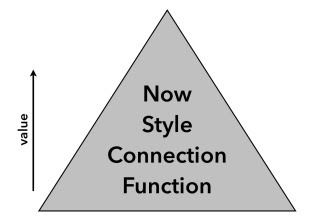
    Marketing guru Seth Godin recently published this value
    triangle on his blog
    :

    image

    No matter what business you’re in, it’s worth giving some thought to this. What do you offer?

    At the bottom of the triangle is function. A hotel room functions as a place
    to sleep. A smartphone functions as a device to make calls, send text messages,
    and download some apps. A condominium functions as a place to live, eat, sleep, have sex, and so on. But all functions being equal, most of us will buy whatever product is the cheapest.

    That is until there’s an emotional connection. I love the
    way Seth frames it: “Where do people like me do things like this?” It is about defining
    who you are. Am I the kind of person who buys A or am I the kind of person who buys
    B? If I care deeply about the environment and B promises to respect that, I am
    likely to buy B.

    But then, moving even further up the triangle, if two items offer the same function and the
    same emotional connection, many of us will go for the one that appears sexier, shinier (the new iPhone 7 is very shiny), and more
    stylish. It just deepens the connection.

    Finally, at the very top of the triangle is now. This is
    about scarcity. What’s hot right now?
    Think of that new restaurant that just opened downtown that you haven’t been
    able to get a table at. It’s now and you want to Instagram the food so badly so
    that you can show everyone you were there. You want to be now.

    The point of all of this is that we consume things for
    reasons that go well beyond simple function. That’s just the start of it all.
    One could argue that all of this is simply smoke and mirrors, but that’s a
    topic for another blog post. This is our reality.

    To relate this topic back to architecture and real estate, I
    am curious how many of you have made a housing decision that you believe went
    beyond function. How much of it was based on connection and style?

    Not surprisingly, for me, architecture and design matter a
    great deal.

    Earlier this summer I was driving around the city with my
    father and he was pointing out to me all of the new build single family homes
    that were sprouting up. He then asked me what I thought of them. I responded: “They’re
    shit.”

    What I was really saying with that glib remark was that
    those homes – no matter how expensive – didn’t reflect my own belief system
    about the world. Sure they served their function, but they didn’t offer the
    connection and style that “people like me” like to praise. To borrow once again
    from Seth: we are all part of a certain tribe.

    What tribe do you belong to? And does your housing choice
    reflect that?

  • Value creation, transparency, and authenticity

    https://500px.com/embed.js

    I started writing this blog a year and 10 months ago. 

    At that time, I had no real title for it (it was just called “Cities”) and I had no idea where it was going to take me. All I knew was that I enjoyed the discipline of writing every day and that I wanted to talk about cities and city building. It was a way for me to neatly organize all of my passions – which span everything from architecture and real estate to technology and transportation.

    Since that time, this blog got a name (Architect This City). It was named by the Guardian (UK) as one of the best city blogs in the world. I’ve met an incredible array of different people (send me an email if you like coffee and are doing cool things). I get invited to comment on city building issues on a regular basis. And an incredible community of almost 10,000 daily readers has emerged (you can email subscribe here).

    A big thank you to everyone who reads and contributes to ATC.

    But over the course of writing this blog, something else unexpected happen. I started getting referred to as a “brander, marketer, and content creator.” Now, I’ll admit that I’ve become increasingly interested in these fields over the years, but it was certainly not something I thought of or could have predicted at the outset.

    What really happened though is that I simply started riding a wave that arguably took hold sometime around the mid-2000s and then focused my attention on an industry that has historically been slow to change (real estate). And that wave is the shift towards inbound marketing (as opposed to outbound or interruption marketing).

    If you’re a marketer, this is old news. You already know this. But I think there’s still lots of room for this to take hold in the real estate industry. So let’s talk about it a bit.

    To give you an example from outside real estate, take a look at Five O’ Clock magazine by Harry’s. Harry’s is a shaving company out of New York that offers moderately priced well-designed shaving supplies for men. It’s simple model that works very well.

    Their positioning has been around the idea of “Own Your AM”, which makes sense given that they are a shaving company. And so what they often do in their Five O’ Clock magazine is profile the mornings of interesting people, such as professional skier Jimmy Chin (who happens to live in one of the best places on earth).

    But if you do a search for the word “shave” in that Chin article, you won’t find it. Because it’s not about just creating content so that you can plug your business at every opportunity; it’s about creating value for your customers and building a relationship.

    And that’s really fundamental to the change I’m talking about. 

    Today, the marginal cost of reaching your customers has dropped to almost zero (even if you’re reaching out to them on a one-on-one basis over, say, social media). And so the opportunity exists for companies, brands, and individuals to do things that simply weren’t feasible before.

    Because of this, it is now possible for everyone to easily establish their own personal brand. I think we’re going to see more, not less, of that. And it has changed how we message and communicate – whether it be via blogs, social media, or online magazines.

    In my view it comes down to 3 considerations: value creation, transparency, and authenticity. If you can create value for your target audience and be transparent and authentic, you’re going to naturally draw people in. I try and do all of that on this blog and hopefully it comes through.

  • Put your window to work and make $50 a month

    image

    I’m convinced that city building – like probably every other industry – is going to get a lot more data driven. Yesterday I wrote about how driverless cars are collecting exact replicas of our cities as a result of the 3D scanning that they do. And today I learned about an interesting new startup called Placemeter.

    Basically it works like this: If you have a window (at home, at the office, or wherever) that faces onto a lively street, Placemeter will pay you to setup a smartphone in that window as a “meter.” The going rate is up to $50 per month and they’ll even provide you with the necessary suction cups.

    Through video, your phone will then start collecting anonymous data about that street’s activity levels: the number of people, cars, and so on. Below is a video of what that output looks like. Notice that it’s even collecting the number of people that go into each of the stores. Click here if you can’t see the video below.

    //player.vimeo.com/video/69091237

    To make money, Placemeter plans to sell (or is already selling) this data. And their goal is to “make your city better” by specifically improving the way that pedestrian spaces are designed. There are of course lots of other use cases for data like this (such as seeing how busy that bar is across town), but their primary goal appears to be around city building. At least that’s the case right now.

    Not surprisingly, there are concerns about privacy. But I’m sure they’ll be able to work around that. All of the data they collect is anonymous and they don’t save any of the footage that they receive from the meters. Their system just extracts the relevant data points and then automatically deletes the video. 

    What’s also interesting to me about this startup, though, is that it’s yet another example of decentralized value creation. Just like Airbnb empowered anyone with a spare room to run their own bed and breakfast and YouTube empowered anyone with some talent (or a funny cat) to create engaging content, Placemeter is allowing anyone with a window and a view to connect and contribute to a network of urban sensors.

    And it works because the marginal cost of adding a new meter to their network is relatively low. Especially if you compare it to what it might cost for a municipality to setup and manage a similar – albeit centralized – system. It’s a totally different cost structure. So when we talk about smart cities and data driven city building, we’re really talking about networks and an environment of decentralized inputs.

    It’s a pattern that keeps coming up as a result of the internet. If you start watching for it, I’m sure you’ll see it.

    Image: Flickr