Daily insights for city builders, delivered every morning at 6 AM ET. I’m Brandon Donnelly — a Toronto-based real estate developer and founder of Globizen. I’ve been writing here since 2013.

Tag: vail

  • Western resort real estate is in very high demand

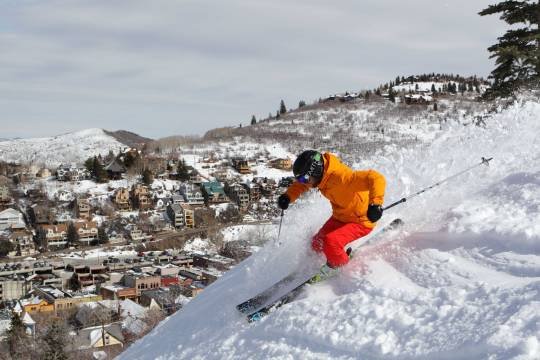
    People like ski and snowboard towns. Here’s an excerpt from a recent WSJ article talking about Park City:

    Prices continued to rise in most luxury ski towns this past year, but none grew as much as Park City, a former silver mining town 32 miles east of Salt Lake City. The average home sale price there grew 35% in 2023 from 2022, compared with a 9.4% increase at Vail and Beaver Creek and 3.2% at Aspen, according to the resort report by Summit Sotheby’s International Realty. 

    The main point of the article is this: Park City has gotten really expensive, and so people are now looking and buying homes further out in places like Heber City, Midway, and Kamas. Here’s how expensive expensive is:

    Over the last four years, Covid has stoked demand for western resort real estate. In Park City, single-family homes have sold for a median price of $4 million year-to-date, up from $1.996 million in 2019, according to Redfin, which averaged the monthly median sales prices weighted for the number of homes sold. One home was listed in September for $65 million, which could set a record for the state. It’s now under contract, according to listing agent Paul Benson of Engel & Völkers, who declined to disclose the sale price.

    This, of course, isn’t a novel phenomenon. It’s the whole “drive until you qualify” thing. But what’s interesting about this particular mountain example is that it’s not centered around access to a CBD or downtown; it’s centered around “how fast can I get to a ski and snowboard resort?”

    For example, Deer Valley has a new East Village that is expected to open up in 2025. This brings the cities mentioned above closer in. And buyers seem to be doing that math: “It’s a 25-minute drive today, but next year I’ll be able to get on a lift in 15 minutes. Score.”

    Given that Deer Valley also doesn’t allow snowboarders, it’s interesting to think about how these trends could be bifurcating the region between skiers and snowboarders. I don’t have any data on this, but I bet if you mapped it out, there would be some sort of clustering happen.

    The article also goes on to talk about transportation. Because you can’t talk about new development and real estate without talking about traffic. But I think Bill Ciraco (Park City Council) gets it exactly right in the article: This is a car problem, and less of a people problem.

    In my mind, the Wasatch Range is destined for something like this ONE Wasatch concept, which is/was a proposal to link seven resorts through a handful of new skiable connections. This is similar to what you’ll find in Europe, and it means less driving and more time on the mountain.

    That’s what everyone wants to be doing anyway.

    Photo by Lauren Pandolfi on Unsplash
  • Saying no to “Mountain Modern”

    Jackson, Wyoming is one of my favorite places on the planet. (Here is a ski/snowboard video that my friends and I made a few years ago in Jackson.)

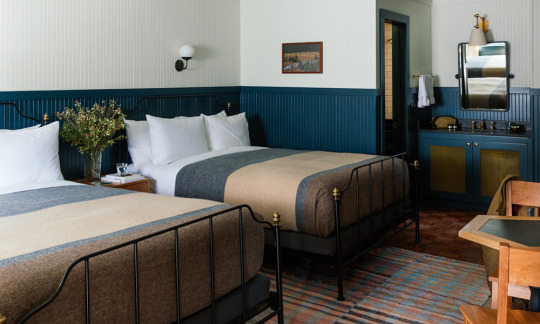
    Earlier this year, Eagle Point Hotel Partners and the Brooklyn-based design firm Studio Tack completed a renovation of the Anvil Motel in Jackson – it’s now the 49-room Anvil Hotel

    Apparently reclaimed motels are the new hospitality trend.

    What I appreciate about their approach, is the emphasis on creating something that feels local and contextual. Here are a couple of snippets from Surface Magazine:

    The designers wanted to avoid a rustic feel, or what Ruben Caldwell, one of Studio Tack’s four partners and an avid backcountry skier, calls “Mountain Modern,” referring to architecture, common in places like Vail, Colorado, and Lake Tahoe, California, that excessively uses reclaimed wood and Cor-Ten steel. “We knew we didn’t want to steer anywhere near that,” says Chou, a long-time snowboarder who more recently got into skiing. “It takes a bit of familiarity with ski towns to know what you don’t want to do.”

    The vibrancy of Jackson’s local culture impressed the design team—and Caldwell so much so that he moved there full-time last year. “As a design team,” Caldwell says, “we’re hyper-aware of the need for projects to be deeply embedded into the local scene.”

    It’s easier to copy and paste. But the results are always better when you take a bit of time to understand a place. 

    Image: Anvil Hotel

  • Off to the mountains

    image

    I am leaving this morning for my annual retreat to the mountains. This year we are going to Park City, Utah, which we decided to do about a year ago.

    The reason we chose this particular place is because Vail Resorts spent $50 million over the offseason to merge Park City Mountain Resort with the neighboring Canyons Resort. 

    There’s now a mountain-to-mountain gondola and 7,300 acres of skiable area across the two resorts, which makes it the largest ski resort in the United States. And that’s why, this month, the New York Times named it one of the 52 places you need to visit in 2016

    But it’s not all puppy dogs and ice cream. What kickstarted this transformation was that the previous operator of Park City, Powdr Corporation, actually forgot to renew its sweetheart land lease.

    So if you’re at all interested in skiing, snowboarding, real estate, and/or lawsuits, you might be interested in what happened here. Curbed did a summary of the battle last year. It was big news in the ski world.

    Image via the New York Times

  • Avoiding driving

    If you’ve been reading Architect This City since last winter, you might know that every year I go on one big snowboard trip with a group of guys I went to grad school with at Penn. Last year we went to Jackson Hole and Vail, and this year the plan is to go to Banff and Revelstoke.

    We start planning it by the fall and so already we’ve been trying to sort out the details for this winter’s trip. But as we finalize the plans, one thing I’ve noticed is how I’ve automatically been trying to minimize the amount of driving that we’ll need to do. In fact, in a perfect world, we wouldn’t have to rent a car at all.

    Now, small mountain towns aren’t usually the best for public transit, but there are often ways to get around that. When we were in Jackson, we took the public bus to get to the mountain every day, as did most people who lived or stayed in town.

    This winter, the plan is to fly into Calgary and stay in Banff for the first leg of the trip. So I’ve been trying to figure out if there’s a train that can get us from Calgary to Banff and which hotels offer shuttle buses to the mountains. Because I’d rather not drive, and I know many of my friends feel the same way. It’s an added cost and it gets in the way of après ski.

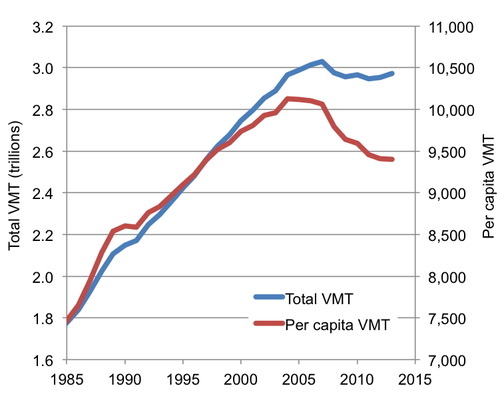
    What’s interesting about this, is that not only do I try and minimize the amount of driving I do here in Toronto, but I do it when I travel as well. And if you’ve been following the macro trends, you might know that many other people feel the same way. That’s why total Vehicle Miles Traveled in the US has been in falling since about the mid-2000s:

    image

    People are falling out of love with driving, and many believe that this shift is permanent. Here’s a recent report from the US PIRG Education Fund talking about just that:

    //platform.twitter.com/widgets.js

    I also think this shift is permanent – until maybe the nature of driving changes and cars start driving themselves. But at that point, it won’t be called driving anymore and there will probably be many other changes. So on this rainy Wednesday morning, my big bold prediction is that future generations will no longer drive.

    What do you think?