
Daily insights for city builders, delivered every morning at 6 AM ET. I’m Brandon Donnelly — a Toronto-based real estate developer and founder of Globizen. I’ve been writing here since 2013.

Tag: usv

  • Homeschooling is one of the fastest growing trends in education

    Earlier this week, Union Square Ventures announced that it was leading a Series A investment in an online education marketplace targeted at K-12 students. The platform is called Outschool, and you can think of it as a form of homeschooling.

    Today, there about 55 million K-12 students in the US, with around 9% enrolled in private schools. Charter schooling is on the rise (somewhere around 3 million students), but so is homeschooling (similarly around 2.5 million students). Data here.

    Homeschooling, at least in the US, largely started within religious groups. But that is starting to change and it is becoming more widely adopted. USV has made a bet that this trend will continue.

    If you look at Outschool’s model, you’ll see that it shares a lot of similarities with other successful internet marketplaces. It is direct-to-consumer (the internet has a way of getting rid of intermediaries). The courses are significantly cheaper than traditional classroom schooling ($10-15 per course). And the supply-side of the marketplace (the teachers) is far more open and accessible to non-traditional participants.

    USV gives the example of a human rights lawyer who is teaching on the platform and now earning more than $10,000 per month in additional income. I’ve never enjoyed online classes, but now that we have reliable video chat, maybe that starts to change.

    In any event, where my mind goes with all of this is the impact on our built environment. We are heading toward more flexible spaces and we are doing a lot more from home.

  • Motivation and coordination

    Albert Wenger of Union Square Ventures recently gave a talk at the 2017 Blockstack Summit about “Decentralization and the Knowledge Age.”

    He starts by talking about motivation and coordination.

    The state, he argues, is good at coordination, but not so good at motivation. The market, on the other hand, is good at motivation, but not so good at coordination. Money and self-interest are powerful incentives.

    He then talks about how networks have improved the market, the firm, and the state. When the cost of sharing information drops, everything gets better.

    But there are downsides to networks. For one, they form monopolies. Consider Facebook in social. Google in search. Amazon in ecommerce.

    They also create environments ripe for censorship and “algorithmic abuse.” Everything you see in your feeds is optimized to make you respond and/or feel a certain way. The line between delivering you relevant content and deliberate manipulation is perhaps a fine one.

    So what’s the solution? Decentralized blockchain networks are one exciting possibility. But they also have their own limits and drawbacks. Albert touches on those in his talk.

    The video is about 24 minutes. If you can’t see it below, click here.

    [youtube https://www.youtube.com/watch?v=LgQT874KHuw?rel=0&w=560&h=315]

  • The “R” word

    Albert Wenger recently penned an interesting post about the “R” word.

    It’s about health insurance and why redistribution is a toxic word in U.S. politics, but also why much of what we do as a society – from public roads to insurance – is actually about redistribution. What I like about the post is that he cuts through a lot of the noise and gets right at the crux of things.

    Here’s part of his conclusion:

    So what should you take away from this? There always is some element of redistribution to insurance – at a minimum ex post and generally also ex ante. The “why should I (usually some healthy person) pay for x (usually some payment for someone from a different demographic)” objection to health insurance is about redistribution. We should acknowledge this openly and not pretend that it is otherwise, because then we can move forward and say “you should, because that is your contribution to how our society works.”

    The point of his post, which he reiterates in the comment section, is that “insurance is a commons more than it is a market.” Too much individual choice – for instance, rich people opting out because they don’t need it – actually weakens the system.

    But you should really read his entire post. It’s good.

    Photo by Jamie Street on Unsplash

  • Conversational investing

    I’ve been spending my mornings this weekend, listening, watching, and reading things. I’m always reading to find content for this blog, but I’ve allocating more time to consumption this weekend. So you might be noticing a slightly different varietal of posts over the past few days.

    This morning it’s a podcast called Dorm Room Tycoon. It’s an interview with Andy Weissman, who is a partner with the New York venture capital firm, Union Square Ventures. The topic is “how we invest” and I’m enjoying the discussion.

    Andy describes their firm as being boutique and thesis-driven. Meaning they have theses and they look for companies that dovetail with them. But in addition, he also labels their approach as “conversational investing.”

    What does that mean?

    It means they listen, watch, and read. They blog (all the partners write their own personal blog). They engage and discuss. They put themselves and the firm “out there”. And they don’t pretend to have all the answers or to be able to predict the future. Instead they let their conversations – both internal and with the broader market – help them make their investing decisions.

    So why do I bring this up?

    Because in my own small way, I am trying to do the same with real estate development, architecture, and city building. I write every day to learn and because I am infinitely curious. If you want to know what I’m thinking about, read this blog.

    It’s for this reason that my favorite blog posts are the ones in which there’s lots of discussion in the comment section. It’s the market talking back, telling me whether I’m out to lunch or not. Ultimately, this idea of “conversational investing” is really about iterative decision making.

    Here’s the podcast embed in case you would also like to listen:

    [soundcloud url=”https://api.soundcloud.com/tracks/266734055″ params=”auto_play=false&hide_related=false&show_comments=true&show_user=true&show_reposts=false&visual=true” width=”100%” height=”450″ iframe=”true” /]

    Regardless, the Dorm Room Tycoon is worth checking out. They have other interviews with people like Malcolm Gladwell and Simon Sinek.

  • The benefits of sharing — what real estate could learn from tech

    One of the reasons I decided to start blogging was because I saw how open the tech community had become – with respect to sharing their ideas and experiences – and I thought that the same thing could and should be done in real estate, as well as in city building more broadly.

    But in many ways, the real estate industry is the antithesis of the tech industry. We are slow moving and secretive of our ideas. Now, some of this is driven by fundamental differences in terms of how these two sectors operate. It’s a lot easier to test and iterate on your ideas in tech than it is with actual bricks-and-mortar. But I still think about ways in which we, in real estate, could be pushing the envelope.

    As one example of what I’m talking about, take Union Square Ventures in New York. They call themselves a “thesis-driven venture capital firm”, which means they come up with a framework and core set of ideas, and then use those to drive their investment decisions.

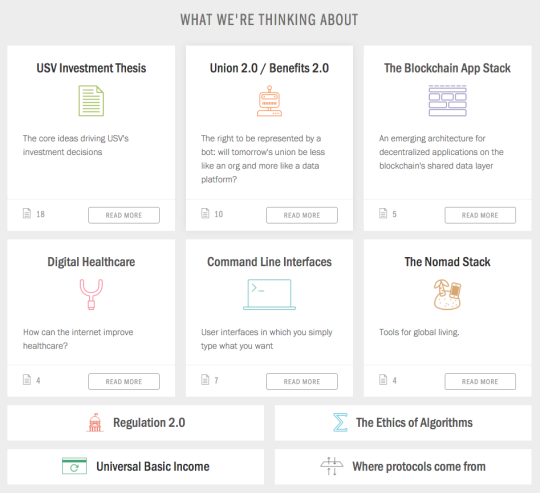
    You would think that these frameworks and ideas would be pretty sensitive. I mean, they are the core drivers of their business. But their entire website is actually set up around sharing and collaborating – with the public – on these ideas. Here’s a screenshot:

    image

    Each topic is something they are “thinking about” and something they want to make an investment in (or already have). Fascinating.

    Many of you, I’m sure, would argue that there are risks to doing this. But there are also benefits, some of which are driven by collective intelligence. By sharing their ideas and hypotheses with the public, it helps to evolve their thinking. After all, their investment thesis is not a static thing. It grows over time.

    But in addition to this, it also makes it abundantly clear to their customers (entrepreneurs) what they believe in and what they look for. And I am sure this helps them with deal flow. More and more customers aren’t just “buying” a product, they are also “buying” a philosophical underpinning and belief system.

    Can you imagine a real estate firm doing something like this? I can. But it’s not happening yet, as far as I know.

  • Wrapping my head around Bitcoin

    There’s been a lot of talk about Bitcoin over the past year, particularly as of late when the value of one bitcoin peaked at over USD $1,200.

    Truthfully, it’s only been over the past few months that I’ve really started to wrap my head around how Bitcoin works and what the implications of it might be. But the more I learn about it, the more it strikes me as something enormous in the making.

    If you’re not yet familiar with Bitcoin, you can check out this video (simple version) or this video (complicated geek version).

    Essentially though, it’s a decentralized and open source digital currency that’s managed using networked computers, as opposed to any one government. And functionally, it works as a distributed public ledger that logs every single bitcoin transaction. What this means is that when you buy or sell something using bitcoin, no exchange of bitcoin actually takes place. Instead, the distributed public ledger (called a block chain) gets updated to show who owns which coins both today and previously. 

    This is potentially a big deal for 2 reasons.

    The first is that many people view Bitcoin as the first internet native currency. The decentralized architecture of Bitcoin matches the decentralized architecture of the internet. And so it has the possibility of becoming the transactional protocol for the internet and global commerce.

    The second reason (and this is where your mind will really get blown) is that transactions can be logged in the block chain/ledger with additional information embedded into each bitcoin. What this means is that you can use Bitcoin to create contracts, such as deposits, escrows, loans and so on. And since Bitcoin is designed to function in low trust environments (ie. where nobody knows each other), there’s an opportunity to really optimize the way we buy and sell almost anything.

    In fact, if you dig deeper into what’s being contemplated with Bitcoin, you’ll find things like “smart property.”

    “Smart property is property whose ownership is controlled via the Bitcoin block chain, using contracts. Examples could include physical property such as cars, phones or houses.”

    Of course, it’s still early days for Bitcoin. But if it truly does become the transactional protocol for the internet, then I certainly do think we’ll see dramatic changes in the way we buy things like cars and real estate.

  • Capitalism and the future of the world

    Last night I watched an interesting presentation by Fred Wilson (New York VC) where he talks (at LeWeb in Paris) about the big 3 technology trends shaping our world. In his view, they are 1) non-hierarchical networks (think Twitter vs. newspapers); 2) unbundling; and 3) smartphones (the most obvious of the 3). It’s a great talk even if you’re not interested in technology per se, because these trends are impacting virtually every industry, from banking to education.

    This morning Fred wrote a post on his blog called “The Limits of Capitalism.” And I think it’s an excellent follow-up to his talk on the future. I would also classify myself as a capitalist, but I also think that unfettered capitalism will eventually break down. And in the context of the changes outlined in his presentation, I think we need to think long and hard about how we’re going to—not stop them from happening, because they’re inevitable—but best cope with them.

    Because already we’re seeing rising income inequality and a complete “bifurcation of the labor market into high-skill and low-skill jobs.” And that in turn is impacting our cities. In fact, that bifurcation is what largely got Rob Ford elected here in Toronto.

  • Starting from the bottom in real estate and healthcare

    Earlier this week when I responded to a Globe and Mail article that was arguing condo rents were on the decline in Toronto, I talked about how imperfect and opaque I feel the real estate market is. Today I’d like expand on that.

    The reason I call the real estate industry imperfect is because of 2 main reasons: first, there’s a lot of friction when it comes to buying and selling as a result of high transaction costs (amongst other things); and, second, there are massive information asymmetries between marketplace participants. This could be buyers and sellers, purchasers and developers, clients and real estate agents, and so on.

    But it’s only a matter of time before these issues get resolved. And I think it’ll happen through better access to data and more transparency in the marketplace. The question, however, is: Where is this big data going to come from?

    I was reading Fred Wilson’s post this morning on Large Networks, Big Data, and Healthcare, and I was struck by a parallel. Here’s what stood out for me:

    “The question is who will control the input of the patient data, the aggregated data sets, and the results the data science produces. If the answer is the current healthcare system; the insurance companies, the hospitals, and the doctors, then we will have missed a big opportunity to reshape healthcare. If, on the other hand, the data is entered by patients, controlled by patients, and benefits patients, then we would have something new, different, and disruptive.”

    In both healthcare and real estate, we have large bureaucratic institutions and bodies that control the industry. And in both instances, we’ve seen that they’ve been slow to adapt to the changing times. Therefore, I think the billion dollar opportunity is the same in both: the data is going to have to come from the ground up via patients and real estate consumers. Only then will we have something truly innovative.

  • Why I decided to start blogging

    New York VC Fred Wilson wrote a blog post yesterday called “Writing It Down.” In it he talks about why he blogs everyday. It’s worth reading. If you’re into tech, you should also read his linked post on Twitter.

    After reading it, I thought I should come clean about something: He’s one of the main reasons I decided to start blogging. I saw what he was doing and I felt inspired. The other reason is that I started blogging for Dirt and really enjoyed it. I’m trying to also do it daily, but so far I haven’t made any public promises on that front. I’d rather under promise and over deliver.

    I’ve been an avid reader of Fred’s blog for awhile now. What I find really powerful is that it has become a mechanism for him to get his thoughts out and into the world and to get feedback on them. Sometimes his posts can be a definitive how-to (such as his MBA Monday lessons) and in other cases it’s clear that he himself isn’t sure of the answer, but that he wants to put it out there for discussion. And I think that’s a great way to be. There’s wisdom in crowds.

    At the same time, when I decided to start blogging personally, I told myself that even if nobody reads my stuff that I’d still be getting value out of it. That’s because writing forces you to think about things to a greater extent than if you, well, just sat and thought about them. I like that.

    However, I do hope that my blog will end up getting read by others because I’m interested in happenstance. I’m interested in the chance that like-minded individuals will read one of my posts about cities and reach out to me, or introduce me to somebody I should meet. 

    When you put yourself out there, I think you also open yourself up to opportunities.