Daily insights for city builders, delivered every morning at 6 AM ET. I’m Brandon Donnelly — a Toronto-based real estate developer and founder of Globizen. I’ve been writing here since 2013.

Tag: urbanization

  • Shaping Cities in an Urban Age

    Shaping Cities in an Urban Age is the third book to come out of the London School of Economic’s Urban Age project. It was published last fall. The first two titles were, Living in the Endless City (2011) and The Endless City (2007).

    If you’re familiar with the first two publications, you’ll know that these books are heavily illustrated. Lots of maps, charts, and diagrams. So they make great coffee table books. But they’re also filled with insightful essays — this one has 37 of them.

    In this particular book the focus is on the following:

    “It identifies current trends that are making cities more fragmented, less equitable and environmentally more damaging, and argues powerfully for a more integrated social, environmental and spatial approach that can inform and inspire city-makers that are shaping an increasingly urban world.”

    I am sharing this with all of you today because I have always really enjoyed these books. They have a way of quickly putting things into perspective globally.

    Around 2.5 billion more people are expected to live in an urban agglomeration by 2050. And 90% of this growth is expected to happen in just two places: Asia and Africa. This is an unprecedented shift that will obviously create many challenges and many opportunities.

    This book is about that.

    Image: Phaidon
  • The next 15 megacities

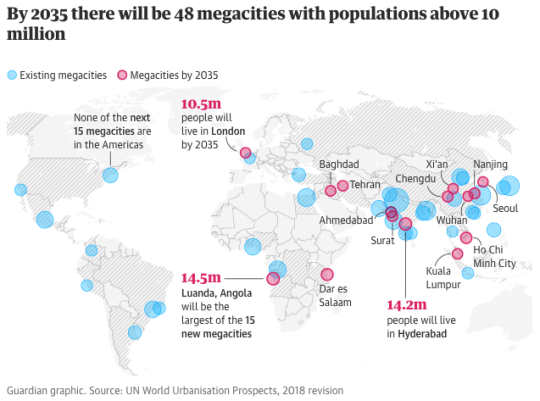
    The Guardian is running a series right now called: The next 15 megacities. A megacity is typically (but loosely) defined as a city (or metropolitan area) with a population of at least 10 million people. 

    By 2035, another 15 cities are expected to become megacities according to the United Nations. Hence the above series. None of these new entrants will be in the Americas. And only one – London – is anticipated to be in the West.

    The first city in their series is Baghdad. The second is Dar es Salaam. And the third, and latest, is Tehran. They are such interesting reads.

    I have said this before on the blog, but the pace of growth in many of these cities is astounding. Dar es Salaam – one of the fastest growing cities in the world – is adding about half a million people ever year.

    For the full megacities series, click here.

  • China has a lot of people

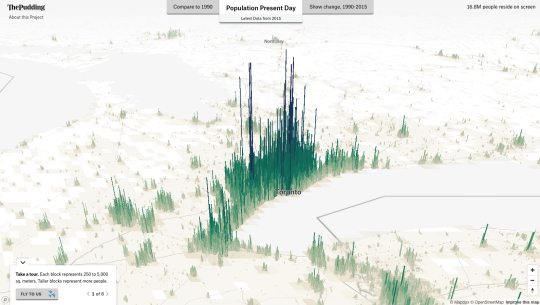
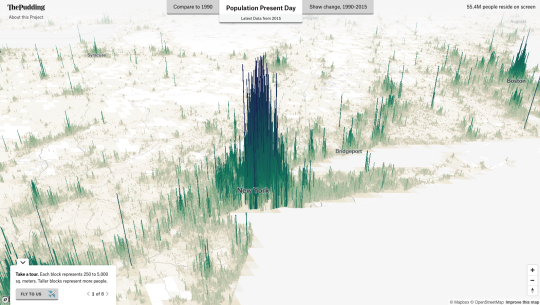
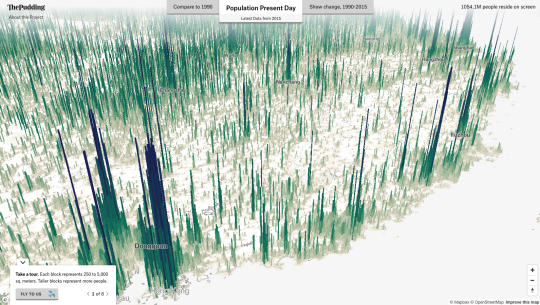
    Matt Daniels over at The Pudding recently visualized the world’s population in this spiky 3D map. You need to take a look. Better on desktop.

    The data is from 2015, but you can also compare it to and show the change from 1990.

    Here is the Greater Toronto and Hamilton region (16.8 million people reside in this screen grab):

    Here is the New York City region (55.4 million people reside in this screen grab):

    And here is China (1.054 billion people reside in this screen grab):

    I tried to capture both Shanghai and Hong Kong in this image. Guangzhou, Hong Kong, and Shenzhen are currently in the mist of forming a 40 million-person megalopolis.

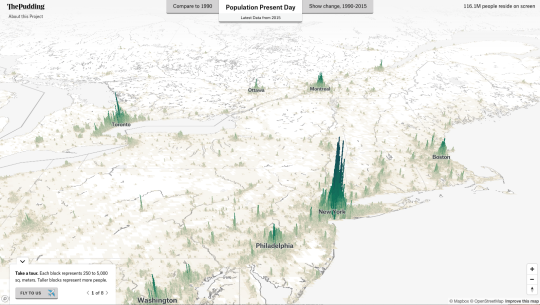
    If we pan back over to the northeastern United States and Central Canada – keeping the same scale as the above image from China – it looks like this:

    These last two images say a lot. 

  • The Oklahoma Land Rush of 1889

    One of our partners sent me a terrific article last week by Sam Anderson on the founding of Oklahoma City

    I have said this before on the blog, but I am deeply fascinated by the origins of cities because, oftentimes, the story isn’t all that lucid. Why right here? As Anderson points out in his article, usually cities “creep into existence.” 

    But not Oklahoma City:

    Oklahoma City was born in an event called, with extreme dramatic understatement, the Land Run. The Land Run should be called something like “Chaos Explosion Apocalypse Town” or “Reckoning of the DoomSettlers: Clusterfuck on the Prairie.” It should be one of the major events in American history. Dramatizations of it should be projected onto IMAX screens with 3-D explosions, in endless loops, forever. Every time you walk into a mall, you should be accosted by fuzzy-headed Land Run characters shouting, “What is America?!” “What does America even mean?!” Because the Land Run was, even by the standards of this very weird nation, absurd. It was a very bad idea, executed very badly. It would be hard to think of a worse way to start a city. Harper’s Weekly, which had a reporter on the ground, called it “one of the most bizarre and chaotic episodes of town founding in world history.” A century later, the scholar John William Reps reviewed the evidence and concurred. The founding of Oklahoma City, he wrote, was “the most disorderly episode of urban settlement this country, and perhaps the world, has ever witnessed.”

    To learn how Oklahoma City went from a population of 0 to 10,000 in about half a day, check out the full article.

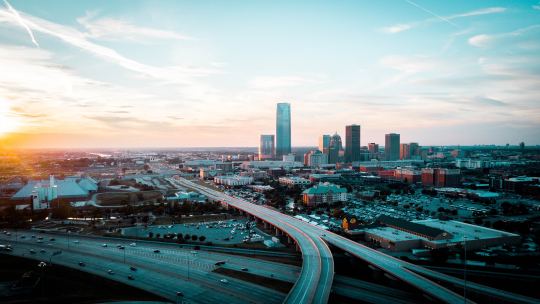
    Photo by Gerson Repreza on Unsplash

  • How large metro areas are driving the global economy

    “The concentration of economic growth and prosperity in large metro areas defines the modern global economy, creating both opportunities and challenges in an era in which national political, economic, and societal trends are increasingly influenced by subnational dynamics.” -Brookings Institute

    The Metropolitan Policy Program at the Brookings Institute has a new report out for 2018 called the Global Metro Monitor.

    Here are some of the highlights (data is from 2014 to 2016):

    – The 300 largest metro areas in the world accounted for 36% of employment growth and 67% of GDP growth.

    – Metro areas in China and the Asia-Pacific region outperformed, whereas Latin American cities, and in particular the largest Brazilian cities, were weaker performers.

    – The majority of large metro areas had growth rates that exceeded that of their respective regions. So again, cities are the driver.

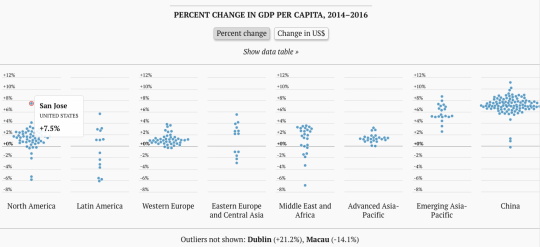
    And here is an interesting interactive chart (better to click through) that shows the % change in GDP per capita. 

    image

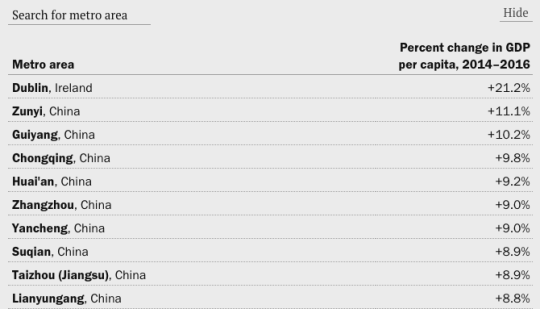
    Look at how much of an outlier San Jose is. Though, check out Dublin in the footnote. And if you look at the actual data table, it is all China, except for Dublin at the top.

    image

    For the rest of the charts, click here. And to download the full Global Metro Monitor report, click here.

  • City building reading list (and an event)

    Today’s post is going to be about a handful of things that have caught my attention.

    – Gary Hack, who is the former dean of the University of Pennsylvania School of Design, recently published a book called Site Planning: International Practice. It is a textbookish guide to planning processes, new technologies, and sustainability, with an emphasis on rapidly urbanizing countries. Thank you to my friend Michael Geller for bringing this to my attention.

    – Sidewalk Labs Toronto is opening a new experimental workspace here in Toronto at 307 Lake Shore Boulevard East (Queens Quay & Parliament) on Saturday, June 16th from 12 – 6pm. It’s an old fish processing plant that they have turned into their office. The team will work there during the week and on the weekends they will open to the public to showcase what they’re up to. Register for the June 16th event, here. I just did.

    – Alexandra Lange has a recent piece in the New Yorker called, The Hidden Women of Architecture and Design. It’s about the important role that women have played in the “design of childhood”, which is the title of a book by Lange. There’s also a short but interesting story about Detroit’s Lafayette Park (Mies van der Rohe) at the beginning of the article.

    – Finally, here is a blog post by Witold Rybczynski where he talks about the shortcomings of architectural education. Obscure theories. Technical or made-up jargon. And no concern for budgets and schedules. I have always shared a similar view and have long felt that there needs to be more business school in architecture school.

    Hopefully there’s something in here that is of interest to you.

  • The challenges of the metropolis beyond Habitat III

    This morning I woke up to an email from the Urban Ecology Agency of Barcelona. They are a public consortium dedicated to urban sustainability and made up of the City Council of Barcelona, the Municipal Council and Metropolitan Area of Barcelona, and the Barcelona Provincial Council. The email was about this upcoming “urban congress” taking place in Barcelona from May 22-24:

    Sadly, I have no plans to be in Barcelona next month. But if any of you are based or traveling there, the conference is all about the future challenges that cities will face and about contributing to the new urban agenda. The main topics are: sustainability, city planning, social cohesion, and competitiveness. 

    Habitat III – which is in the title of the conference – was a United Nations conference on housing and sustainable urbanization. It took place in Quito, Ecuador in October 2016. However, it forms part of a much larger framework around sustainable global development. More info here.

    Barcelona is also one of my favorite cities, so I am happy to share this one with all of you. If you’d like to register for Post-Habitat III, head over here.

  • The 100 million city

    The Guardian recently published this reminder that the real population growth in the world today is happening in Asia and Africa. The article is called, “The 100 million city: is 21st century urbanisation out of control?” Much of the data is from this 2016 paper by Daniel Hoornweg and Kevin Pope, which projected the populations of the world’s biggest cities by 2100.

    The standout example is that of Lagos, Nigeria, which went from under 200,000 people in the 1960s to an estimated 20 million people today. Though, I would imagine that the ubiquity of informal settlements makes it difficult to come up with an accurate number.

    Still, it is one of the world’s top 10 largest cities and, by 2100, it may be the largest city in the world. The Guardian described the population as young, fertile, and increasingly urban. The median age in Nigeria is 18 and the fertility rate for the content is 4.4 births per woman.

    I am mentioning all of this today because I think it grants some perspective. This is an immense city building challenge, not only because of the unprecedented growth rate, but also because it remains largely poor. Lagos, a city, may add more than 2.2x the population of Canada, a country, during the balance of this century.

  • Third Coast Atlas: Prelude to a Plan

    Daniel Ibañez, Clare Lyster, Charles Waldheim, and Mason White have just published a book analyzing the Great Lakes and the Saint Lawrence River. It’s called, Third Coast Atlas: Prelude to a Plan.

    The Great Lakes represent the world’s largest collection of freshwater; a feature that is likely to become

    only

    more valuable. Their coastline is longer than the Atlantic and the Pacific coastlines of the US, combined. Hence the name “Third Coast.”

    The reason the book is called a “prelude to a plan” is that it doesn’t propose a plan or a path forward. Instead, it is focused on analyzing the current state. Here is an excerpt about the book taken from the Daniels Faculty:

    Third Coast Atlas: Prelude to a Plan describes the conditions for urbanization across the Great Lakes region. It assembles a multi-layered, empirical description of urbanization processes within the drainage basins of the five Great Lakes and the Saint Lawrence River. This thick description encompasses a range of representational forms including maps, plans, diagrams, timelines, and photographs, as well as speculative design research projects and critical texts.

    I find this topic fascinating and I suspect that many of you might as well. It’s also an important one. So I wanted to get it on your radar. If you happen to be in Toronto next week, the launch/book signing is happening this Tuesday, October 24, 2017.

  • The suburbanization of America continues

    FiveThirtyEight (Jed Kolko) published a post last month called, “Americans’ Shift To The Suburbs Sped Up Last year.” 

    What Kolko did was take recent population estimates from the US Census Bureau and group them into 6 categories based on the size of the metro and its population density. 

    By doing this he discovered something that runs counter to the narrative that we are living through an urban renaissance: lower-density suburbs grew faster than urban counties. The former grew at ~1.3% in 2016. And in the south and west, the lower-density suburbs of large metro areas topped over 2% growth.

    What gives? 

    Well, this urban renaissance is lopsided. Here’s an excerpt from the article:

    That revival is real, but it has mostly been for rich, educated people in particular hyperurban neighborhoods rather than a broad-based return to city living. To be sure, college-educated millennials — at least those without school-age kids — took to the city, and better-paying jobs have shifted there, too. But other groups — older adults, families with kids in school, and people of all ages with lower incomes — either can’t afford or don’t want an urban address.

    Richard Florida is calling this phenomenon: The New Urban Crisis.