Daily insights for city builders, delivered every morning at 6 AM ET. I’m Brandon Donnelly — a Toronto-based real estate developer and founder of Globizen. I’ve been writing here since 2013.

Tag: urbanism

  • All streetcars are not created equal

    With Toronto preparing to deploy the first batch of its new streetcars this summer, there’s been a lot of talk about streetcars in general. Rob Ford has said he wants to get rid of them all together and I hear a lot of other people expressing similar frustrations: Streetcars are rolling stop signs. Streetcars block 2 lanes of traffic. Why don’t we just use more buses? Streetcars cause traffic. And so on.

    So what should we do?

    First, let me start by saying that buses suck. I’m a huge proponent of public transportation in cities, but there’s nothing quite like a rush hour bus ride to have you question your economic status in life. Bus routes have also been shown to have little economic development value, where as fixed rail lines (such as streetcar, LRT and subway) generally increase surrounding property values and spur investment.

    Second, my view is that streetcars themselves as a transportation technology aren’t the problem. It’s our execution. I’ve touched on this topic before on ATC, but I’d like to reiterate a few points here. 

    The value of light rail is that it’s a relatively inexpensive way (compared to subway) of efficiently moving a lot of people. But in order to do that, you need deploy it in a sensible way. In my mind, that primarily involves 3 things: giving streetcars their own dedicated lanes (grade separation), having a reasonable number of required stops, and streamlining the onboarding and off boarding process. Today, we don’t do a great job at most of these things (although our new streetcars will use a proof of payment model).

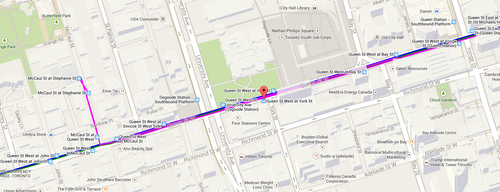
    Take a look at this comparison between Dublin’s Luas light rail system and Toronto’s streetcar system. Both images are at the same scale. Notice the dramatically different stop spacing. Much of the Luas system also runs on its own dedicated lanes.

    Dublin:
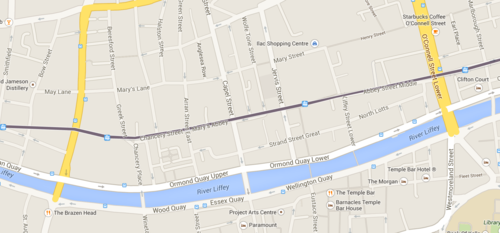
    image

    Toronto:

    image

    Every time a Toronto streetcar stops it generates waste. Cars are forced to stop behind it. Everyone on the streetcar has to sit and wait while somebody fumbles through their change looking for a token. But there are other ways to do this. There are ways to make light rail more subway-like, despite the fact that it may be above ground.  And so I don’t think we should be so quick to write off all streetcars.
  • Culture in our society and economy

    Last week I was reading the blog of James S. Russell, who used to be the architecture critic for Bloomberg News. He’s no longer the architecture critic, because Bloomberg got rid of his column:

    My column, along with almost all cultural coverage, was eliminated at Bloomberg late last year in favor of a yet-to-be completed revamping that focuses on luxury and lifestyle. 

    Obviously, the decision saddens me personally, but it’s also a regrettably powerful signal that culture doesn’t matter in our society and economy.

    As someone who spent a great deal of time studying art, architecture and design, his post really resonated with me. This is a depressing thought. It may be hard to measure the ROI of the arts, but that doesn’t mean there isn’t a return.

    Ironically, Bloomberg–the former mayor of New York–understood this:

    As Mayor of New York, Michael Bloomberg, the company’s founder, championed arts as valuable to the vibrancy of the city and as a powerful force for economic development. The city has seen unprecedented growth in arts facilities, thanks both to his administration’s efforts and his personal philanthropy. His post-mayoral activities are intended to nurture cities as fields of wealth creation by helping them become cauldrons of innovation, which he recognizes is entwined with vibrant cultural and lifestyle trends.

    That sounds about right.

  • What do venture capitalists have to do with cities?

    This morning I woke up to a tweet from somebody asking me why–despite my obvious love of cities and real estate–do I seem more influenced by venture capitalists on my blog. He wondered if it was because of a lack of public/online real estate thought leaders.

    I responded by saying yes; that’s part of the reason. I honestly can’t think of one real estate developer that hosts a personal and regular blog. (If you know of any, please pass them along.) Whereas I can’t think of a major VC who doesn’t blog.

    Sure there are other real estate professionals who blog, but a lot of those sites just feel like giant lead generation tools and those aren’t enjoyable to read. I’m trying not to create that kind of blog. The trust of readers is more important to me than trying to promote my businesses.

    But the other reason I often cite venture capitalists and “tech” centric topics is because I believe in cross pollinating industries. I don’t believe the world operates neatly under silos and neither should our minds and businesses. I’ve also argued many times before that with software eating the world, nobody should be ignoring technology.

    At the same time, the consumer web feels to me like this profound social force changing the way people live and interact with each, which, if you think about it, is what cities have always been about. And so I see all kinds of interesting overlaps.

    Of course, I also look to planners, designers and other urbanists for inspiration. But I don’t like to do so exclusively. Industries, like anything else, can quickly become insular–whether tech or urban planning. My interest–and the focus of this blog–is cities. And I will continue to incorporate ideas and viewpoints from any discipline that I think touches them.

  • Is Chicago’s zoning code broken?

    This may sound crazy, but I’ve never been to Chicago. It’s on my list, but I just haven’t gotten around to it and I’ve never had a specific reason to go. Hopefully I can make it this summer.

    Lately though, I’ve found myself reading more and more about the city. Given that it’s also a Great Lakes city and it’s of comparable size, Chicago is an interesting case study for Toronto. But one thing that seems to keep coming up, is the need for zoning reform.

    About a month ago I wrote a post called “The tale of 2 Chicagos”, which was inspired by the blogging of Aaron Renn (The Urbanophile) and Daniel Hertz (City Notes). The discussion was around the prevalence of single-family zoning in most parts of Chicago and how it’s creating a supply constrained market (driving up prices).

    But there’s another outcome. Here’s what Daniel Hertz recently argued:

    When places in and around downtown become more desirable, developers build more housing, and more people get to live there. But when non-downtown neighborhoods become more desirable, developers can’t build more housing: it’s against the law. So instead, they profit by tearing down old two-flats and building mansions in their place. And as a result, fewer people get to live in those neighborhoods, even as more and more people want to.

    Effectively, his argument is that gentrification leads to a loss of housing units. Developers can’t build more housing, so they replace housing. And it all stems from a restrictive zoning code that aims to maintain the character and scale of established neighborhoods. I get that, but you could easily argue that it exacerbates the negatives of gentrification.

    It strikes me that Toronto and Chicago are in somewhat similar places in terms of their growth. Without any real natural barriers, both cities had the luxury of being able to develop through horizontal sprawl when they were younger.

    But with people now returning to city centers, we’re faced with a series of difficult decisions: How do we balance preservation and growth? How do we balance low-density with high-density? How do we maintain the character of what people love while still creating an inclusive city?

    It absolutely can be done, but it’s going to mean embracing a certain amount of change. And that’s not always an easy sell. 

  • The hard thing about urban debt

    I’m in the midst of reading Ben Horowitz’s new book called “The Hard Thing About Hard Things.” You may have noticed all of the random quotes I’m posting over on my tumblog. It’s good stuff.

    At one point, he talks about two types of metaphorical debt: technical debt and management debt. Technical debt is when you write shitty (computer) code that addresses the short-term, but eventually needs to be rewritten in the future. Similarly, management debt is when you make bad and short-term management decisions that don’t serve you well in the longer term. In both cases, the debt compounds and, when you eventually pay for it, it’s got a lot of interest on it.

    This got me thinking: Is there an equivalent for cities? Is there such a thing as urban debt? I figured there must be since we’re an impatient society obsessed with instant gratification.

    I then remembered a great quote that I saw either on Twitter or Tumblr that I think can be credited to Lewis Mumford:

    Adding highway lanes to deal with traffic congestion is like loosening your belt to cure obesity.

    Neither solution is sustainable and eventually you’re going to have to pay the consequences. In the case of cities, I think the answer is transit.

    And transit (disinvestment) is actually a really good example of what might be considered urban debt, because it requires long term planning—something that often conflicts with our political system. Politicians want quick wins.

    But I think it’s important to keep in mind that when we fail to make the hard decisions today, they only become more costly to deal with tomorrow. Quick wins might make for good politics, but they often don’t make for great city building. 

  • Recommendation to remove the elevated Gardiner Expressway

    I’ve written a lot lately about the Gardiner Expressway East. First to argue that I think it should be torn down and, second, to provide a counter argument as to why some people think North America’s urban freeways are here to stay. I wanted to avoid confirmation bias.

    Well a recommendation has been made to City Council and it is, indeed, to remove the eastern portion of the Gardiner Expressway. They are now asking Council to approve it. The item will first go to the Public Works and Infrastructure Committee on March 4, 2014 and, subject to the results of that meeting, will then go to City Council on April 1, 2014. 

    The recommendation to Council identified the following 4 key features of the preferred “remove” option:

    1. Widening of Lake Shore Boulevard east of Jarvis Street by two lanes into an eight-lane landscaped at-grade boulevard;
    2. The lowest overall public investment at $240 million net present value (NPV) because of significantly lower lifecycle costs despite a higher upfront capital cost than Maintain;
    3. Public land disposition proceeds of approximately $80 to 90 million NPV from the release of about 4 hectares of land (which could support 260,000 square metres of development)
    4. Highest compatibility with Official Plan and Central Waterfront Secondary Plan principles and objectives as well as approved plans, such as the Don Mouth Naturalization and Flood Protection EA, Lower Don Lands Framework Plan, Keating Channel Precinct Plan and the Port Lands Acceleration Initiative.

    If you’d like to read more about what’s going to Public Works and City Council, click here.

    One thing I didn’t mention in my previous posts is the land disposition piece (item #3 above). By removing the Gardiner East, roughly 10 acres of public land will be freed up which, according to their estimates, could allow for 2.8 million square feet of new development. That’s roughly the size of our 72-storey First Canadian Place.

    I’ve been crystal clear about my position on the Gardiner East and so I’m delighted to see it seemingly move forward in that direction. I know a lot of people are concerned that the removal option could result in some commute times being 5 to 10 minutes longer by 2031, but I think we’ll have even bigger problems by 2031 if we continue with the status quo.

    Urban theorist Richard Florida has argued many times before that when cities get to around 5-6 million people they come to a point where they have to make tough decisions about the way they’re going to continue to grow and prosper. Toronto is at that moment. Our car dependent ways are already crippling productivity levels.

    What kind of city do we want to be by 2031? I don’t think that we can afford to just “maintain.”

  • Is laneway housing a good idea or a bad idea?

    As a follow up to my recent post called “Disrupting everything”, I thought I would share this talk by venture capitalist Chris Dixon at Y Combinator’s Startup School. In it, he talks about why good ideas often seem like bad ideas at first.

    Chris frames the discussion by saying that when you have a good idea—that everyone else thinks is a bad idea—you effectively know a secret. But by a secret, it’s really that you believe something that nobody else believes to be true. So much so that when you try and tell everyone else about your secret, they all think you’re crazy, which is frustrating because it seems so obvious to you.

    He then provides a number of characteristics that can help you identity good ideas that seem like bad ideas:

    • Powerful people dismiss them as toys.
    • They unbundle the functions done by others.
    • Did it originate as a hobby?
    • Do they challenge social norms?

    Now, he’s obviously talking about startups, but I think the framework can apply outside of the technology world. I think it can apply to cities. 

    To give you one example, let’s consider laneway housing. If you’re a regular reader of this blog, you’ll know that I’m a big supporter of laneway housing in Toronto. But that it’s something the city generally does not support.

    However, there are laneway houses being built and they’re being built by architects and progressive urbanists. Some might even call it a hobby, because it remains a pretty tough business model at the moment.

    Personally, I think one of the main reasons the city is unwilling to formally allow laneway housing is because it challenges social norms. I’ve read the staff reports and the meeting minutes: people think it’s weird to live off a laneway. In fact, in one case somebody asserted that since laneways are generally undesirable urban spaces, anybody who would want to live off one is almost surely a social degenerate.

    But there’s absolutely nothing inherent to human beings that says we can’t live off a 5m wide street or that we can’t have a “house located behind another house.” Those are simply constructs we’ve created for ourselves.

    So the next time you hear about an idea that you think seems like a bad idea, ask yourself: Is it really a bad idea or does it just make me feel uncomfortable because it contravenes the norm? Taking yourself out of your comfort zone is a good thing. It’s how we grow.

  • Disrupting everything

    Last year when I started working on Dirt—which was really my first startup—I had a number of people say things to me like: “Wow, that’s quite a change, going from real estate into tech.” But that’s not the way I saw and see it.

    I don’t think you can silo industries like that anymore. Technology is touching everything. Some would even go so far as to say that every company in the world is, or will be, a software and technology company.

    The way I looked at it was that I was starting a technology-enabled real estate company. I was hoping to leverage the internet to improve the way things are done in an existing industry. Of course, by improve I really mean disrupt—which is arguably the biggest buzzword in the tech community today:

    “Disruption is not so much a trend as an especially lucrative world philosophy favored by technophilic entrepreneurs. It’s the only path towards progress. If you’re not disrupting something you might as well go collect kindling and roast raccoon meat in the hills of Cupertino.”

    A good example of how disruptive innovation is reaching all sectors of the economy, including government, is the New Haven-based startup called SeeClickFix (which I discovered via This Big City). What it does is allow citizens to report non-emergencies (like potholes) to their local government. Governments can then respond and manage these tasks. (Sorry Rob Ford. Now you don’t need to return all those phone calls.)

    But moreover, I think it shows that technology is not only going to disrupt business and industry, it’s going to disrupt the way cities function and the way we live. I don’t know what that’s ultimately going to look like, but I can already feel it underway.

    Albert Wenger, of venture capital firm Union Square Ventures, recently argued—in a talk at DLD—that we are still in the midst of a transition from the Industrial Age to the Information Age. And I buy that. With every new disruption, we’re one step closer to completely making that transition. But we’re not quite there yet.

    The Industrial Age drove people out of cities. It made cities dirty and undesirable. But in the Information Age, cities are damn important and it’s where people want to be. Look at all the people rushing back to urban centers.

    So if technology has the power to disrupt business, industry, and cities, I suggest we stop just thinking about technology in isolation and remember the powerful words of Marshall McLuhan: “The medium is the message.” Don’t just focus on the obvious or you’ll miss a tidal wave of change happening beneath the surface.

  • Car as prosthetic

    I spent a lot of time in the suburbs over the holidays and it got me thinking.

    For all the talk about intensification here in Toronto, adapting our car dependent suburbs to become, well, less car dependent is going to be an enormous challenge. Once you’ve built out an area around the car, it’s almost impossible to go back. 

    One of the biggest challenges is going to be figuring out how to turn the suburbs from inward to outward. If you think about it, the suburbs are an incredibly inward type of development pattern.

    Retail plazas typically have their entrances—not off main streets—but off internal parking lots. And residential areas often have backyards facing the main streets because nobody wants a house fronting on a major thoroughfare. These are the design principles we’ve used to create our suburbs.

    But the result is that we’ve created environments that are inhospitable to pedestrians. What enjoyment would you get out of walking along a street where everything has its back turned to you? This is the anthesis of animated street life. And in this case, Margaret Thatcher would probably be right: I would feel like a failure taking the bus.

    To compensate for this kind of environment, we’ve made it virtually mandatory to have a car. It’s the only reasonable way to get around. Writer Rebecca Solnit put it best when she said:

    “In a sense the car has become a prosthetic, and though prosthetics are usually for injured or missing limbs, the auto-prosthetic is for a conceptually impaired body or a body impaired by the creation of a world that is no longer human in scale.”

    And that’s precisely it. We built around the car and not around people. And in doing so, we made ourselves dependent. I don’t know about you, but there’s something liberating about being able to walk to all the things I commonly want—food, money, coffee and so on. But maybe that’s just me.

  • Urbanization in the developing world

    A few days ago I asked a reader of this blog if there was anything, in particular, that she’d like to see more of on here. She responded by saying that she’d love to learn more about how other cities—outside of Toronto—are managing urbanization, as well as how we shape cities and cities shape us.

    It’s an interesting and important question because, frankly, the challenges are greater outside of Toronto. One of the stats that often gets cited here in the media is how the Greater Toronto Area gets approximately 100,000 new immigrants every year. This doesn’t include domestic migration though, so I would assume that our total number is even greater.

    But if we stick with 100,000 for now, it means the GTA receives about 11.4 new immigrants every hour (100,000 people / 8,765 hours in a year). Lagos, Nigeria, on the other hand, receives between 50-60 new people every hour. In fact, it’s predicted to be 7th fastest growing city in the world between now and 2020. 

    If you take a look at the complete list of the world’s fastest growing cities (all estimates, of course), you’ll likely notice that the vast majority of the cities are in the developing world. And that’s really the challenge. The world is rapidly urbanizing and becoming the most urban it’s ever been, but the changes are the greatest outside of developed nations. This poses entirely unique challenges.

    Of the kinds of cities I’m talking about, I’m most familiar with Dhaka, Bangladesh. In my last year at Penn, I was part of a studio led by KieranTimberlake Architects that focused on water and housing issues in that city. It was a partnership with the University of Dhaka. We spent roughly 2 weeks there and it was an eye opening experience.

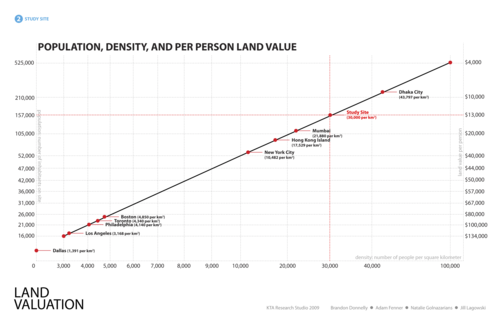
    Here’s a telling slide from our final presentation:

    image

    What we were trying to do with this chart was compare population and per person land value for our development site according to various city types. In other words, we were essentially asking: If we were to build out our proposed site in the same way, as say, Dallas, Los Angeles, Hong Kong, or what is typical for Dhaka, how many people could we fit and what would be the resulting per person land value?

    I don’t remember where we got the land value figures from, but we were trying to be cognizant of the fact that every city requires a unique solution. Using the same per person land values in Dhaka as in Dallas would be unimaginable because Dhaka has over 40,000 people per square kilometre (top right on the diagonal line above) and Dallas has under 1,400 per square kilometre (bottom left on the diagonal line above).

    The challenges of urbanization in the developing world are profound, particularly in places like Dhaka where most of the city is subject to severe annual floods. By some estimates, 18% of the city’s land area gets flooded every year—talk about adding another layer of city building complexity.

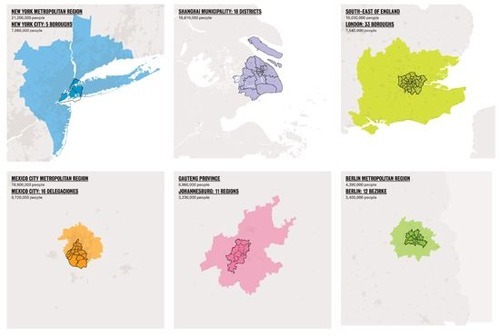
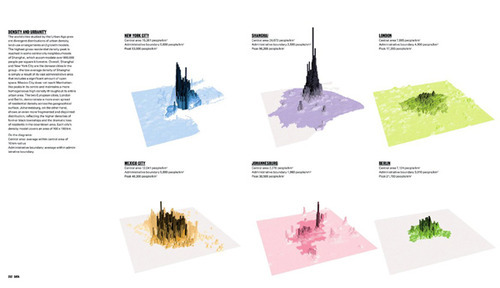
    We didn’t solve all of the problems in that studio and we’re not going to do it here, but I do think it’s important to fully understand the problem. One of my favorite books on cities is called “The Endless City.” It examines New York, Shanghai, London, Mexico City, Johannesburg and Berlin, and has a ton of great data and diagrams.

    Here are a two that outline densities and land use patterns for the above 6 cities (same order starting on the top left):

    image

    image

    If you’re interested in cities, it’s definitely worth having it on your coffee table. And fitting to @PhatNancy’s tweet, ”The Endless City doesn’t just show how cities are changing but also how they are changing us.