Daily insights for city builders, delivered every morning at 6 AM ET. I’m Brandon Donnelly — a Toronto-based real estate developer and founder of Globizen. I’ve been writing here since 2013.

Tag: urbanism

  • Where will we live?

    image

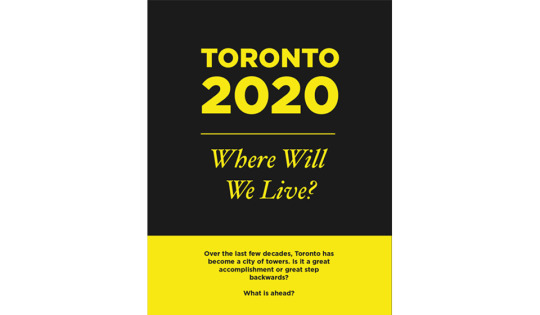
    This evening I participated in a roundtable discussion at WORKshop here in Toronto. It was part of an exhibition that they currently have on called, Toronto 2020: Where Will We Live? They are located in the concourse level of 80 Bloor Street West, so go check them out.

    The discussion this evening was all about the dramatic change in Toronto’s urban form over the last decade. In other words, the condo boom. We covered everything from the life cycle of buildings and urban design to demographics and policy. It was a lot of fun and I am certain the group could have continued talking all night.

    But one thing that I was reminded of this evening is how important it is for great city building to be cross-disciplinary.

    Take, for example, architects and (real estate) developers. 

    The stereotypical developer is greedy and only concerned with money. They don’t care about the impact that their buildings have on the built environment. On the other hand, the stereotypical architect is only concerned with design and not with the economic feasibility of projects. (I’m exaggerating here for effect.)

    The point is that neither of these participants in isolation could build a great city. A beautiful design doesn’t have much value if it can’t be financed and built. And a highly financeable project could end up contributing nothing to the city. In some cases it could actually detract from the built environment.

    So if we really want to build truly great cities, I believe it needs to be a collaborative effort. We need to bridge the divides in thinking and leverage each other’s strengths. 

    I have felt very strongly about this since I first started studying architecture as an undergraduate student, which is how I ended up taking business and real estate classes. I felt and continue to feel that the greatest opportunities exist at the intersection of different ways of thinking.

  • Towards a post privacy world — what the Ashley Madison hack could mean for cities

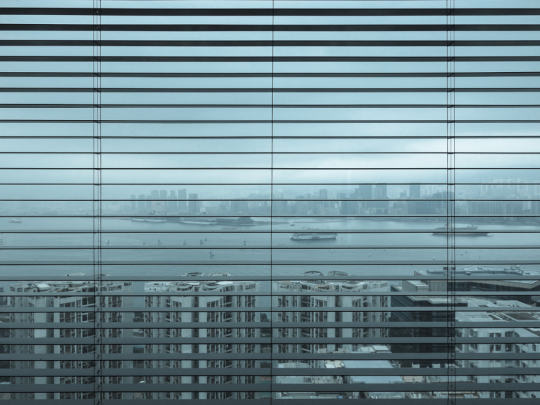
    Blinded View by Markus Jentes on 500px.com

    https://500px.com/embed.js

    Ashley Madison is a website that helps married people have affairs. 

    Recently the website was hacked and over 33 million accounts were exposed. This included full names, email addresses, mailing addresses, and so on. Not surprisingly, this has gotten a lot of press. The site was/is marketed as being private and secure. And clearly that is not what it is right now.

    But there are people in the tech community, such as venture capitalist Albert Wenger, who believe that is merely a glimpse into the future – a “post privacy future.” He even argues on his blog that we as a society should be more accepting of the leak and that the release of this data could lead to a “more measured view of affairs.” (There are many who argue that humans are not intended to be monogamous.)

    For many, or probably most of you, I’m sure this position seems pretty radical. After all, this leak will likely destroy many marriages.

    But Wenger’s position on privacy is a fascinating one and he’s written a lot on the topic. The tension he sees is one between individual privacy vs. collective intelligence. In this part of the world, our society values the former over the latter. But he believes that we are headed towards a world where almost everything, yes everything, will eventually become public. Again, radical position. But consider how much we publicly share about our personal lives today versus 10 or even 5 years ago.

    What’s perhaps more relevant to the Architect This City audience though is what this could mean for many other industries beyond tech.

    I often think about what a “post privacy future” could mean for city building. Imagine if every architect, real estate developer, engineer, and other participant made public all of their work. This would mean that all designs, financial models, sales data, and so on were made widely available to anyone who wanted to see them.

    The thought probably scares many of you in the industry, but consider what it would mean for our collective intelligence. There’s a strong argument to be made that we would all be better off and that the process of building would become far more efficient. In fact, if truly everything were public, it could in theory eliminate most of the market’s concerns about overbuilding, a condo bubble, and all the other stuff that gets talked about.

    The reason people speculate on these market factors is because we don’t have all the data. We don’t actually know what’s going to happen. We have no idea. I know I certainly can’t predict the real estate market.

    So why aren’t we quickly becoming more public?

    Wenger raises the game theory principle known as the prisoner’s dilemma:

    “So one way to think about secrecy is that it leads to lots of prisoner’s dilemma style situations. Individuals (or companies) would be worse off if they were the only ones disclosing, but if everyone disclosed (or at least the majority), then everyone would be much better off. In the language of game theory, we are in a bad equilibrium.”

    In other words, if only one real estate developer disclosed her project’s financial information to the public, then she would probably be worse off against her competitors. But if every developer in the city did it, then the market as a whole would be better off because everyone would then benefit from collective intelligence.

    Using the example of infidelity, if one person is caught having an affair, then that person is more than likely worse off. But if over 33 million people are caught having an affair and it reinforces the statistic that between 30-60% of married people in the United States will have an affair at one point in their lives, then maybe it forces us as a society to rethink what marriage means today. And maybe that makes us all better off.

    This is a pretty far out there argument, though the city building example is probably more palatable than the Ashley Madison one. Regardless, I would love to hear your thoughts in the comment section below. 

    Are we heading towards a post privacy world?

  • Interview with Brad Keast of Osmington

    image

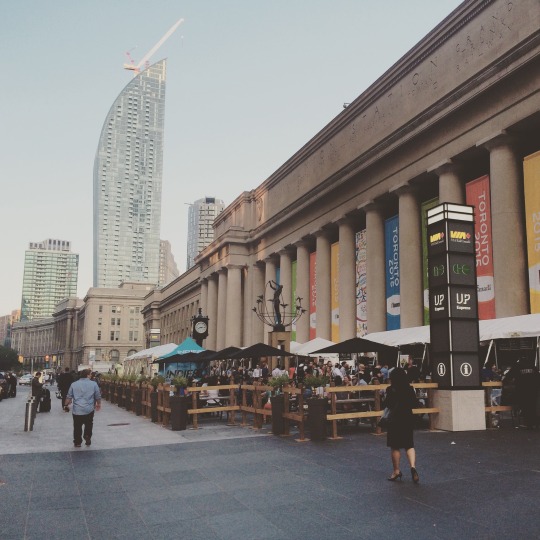
    Given yesterday’s post about Times Square in New York, the timing is perfect to talk about the revitalization of Union Station here in Toronto, its new public spaces, and the programming that’s now happening in and around the station.

    Perhaps the most noticeable is something called Front Street Foods @ Union Summer, which is an outdoor food market set up along Front Street. It’s on this summer from July 6th to September 27th, 2015. 

    However, Front Street Foods is only one part – the food part – of a larger events and programming strategy known as Union Summer. I recently had a quick chat with Brad Keast of Osmington, who is involved in a lot of what’s happening right now at Union Station.

    I found it interesting to learn about how organic the process was. And I thought you all might find it interesting as well.

    ————————————–

    Tell us a little bit about you and your company’s involvement with Union Station. 

    I’ve been with Osmington for over 4 years now and Union Station is a major focus of my waking life. 

    The company won a public RFP with the City of Toronto in 2009 to be the City’s retail partner in the redevelopment. What this means is that while the City owns the building and is doing base building construction, we are overseeing all the retail, advertising, and special events and programming. We are finding all the tenants, doing a bit of overshell work and then turning it over for fit-up.  

    We think the real special part of the project comes in through the special events and programming. We really want to make the station a destination in itself and you’re starting to see that with some of the programming we’ve done this year, be it a contemporary art event like Villa Toronto or something more community-focused like Union Summer – the current animation of the area in front of the station.

    How did the idea for Union Summer come about? 

    This really was a collaborative internal effort. We started by thinking ‘hey, let’s put a bunch of tables and chairs on the new plaza in front of the station and see what happens.’ Then we added in the idea of food. We knew it had to be accessible but didn’t want traditional food trucks, rather something less mobile but still not permanent. 

    That’s when we reached out to Toronto Market Company and they started rounding up the vendors. Then we layered on entertainment – daily music be it live or DJs, as well as a movie night with the Toronto International Film Festival (TIFF). We even have some kids programming on the weekends. Then we worked with the Farmers’ Market being displaced from Nathan Phillips Square due to Pan Am this year to have them here on Wednesdays.

    What was involved in making Union Summer a reality? What was the biggest surprise and/or hurdle that needed to be overcome? 

    There was a tremendous amount of coordination needed. First we weren’t sure when the construction was even going to be finished, all that was certain was it would be before Pan Am started. 

    Then the infrastructure required for the event itself was an exercise in creativity – power, water, and grey water disposal in particular. There was a lot of meetings with City officials for things like building permits, fire code, council approval to apply for a liquor permit, and health and food safety measures. Operationally things like loading in, coordinating with the installation of the Pan Am banners between the columns, interim furniture when our original order didn’t make it onto a ship in Antwerp, and then the first week was so busy that some vendors started losing staff because they were burnt out. 

    Like all things with this project we have to be mindful that this is an operating train station. In fact it’s the busiest building in the country with over 250,000 people per day passing through so we can’t impede those operations. We’ve done our best and have learned some lessons along the way and the reception has been overwhelming. 

    One of the best things about having that many entrepreneurs in close proximity is that some vendors have been pairing up to try experiments. Frozen custard-stuffed churro?

    Toronto is getting much better at designing and programming its public spaces. Given your experience with Union Summer, is there something the city could and should be doing to encourage more of these kinds of urban activations?

    Well, first of all, our contacts at the City, in particular Denise Gendron and Scott Barrett in Real Estate Services have been incredibly supportive of our efforts and we couldn’t have done it without them. If I could make one recommendation it would be to build in the supportive infrastructure for services. Of course that’s only beneficial if there is someone to take charge of the space and program it appropriately. It’s not a part time job.

    What’s next for Union Station?

    Right now the focus is on getting the first retailers open on GO’s new York Concourse. On the programming side we will host art for Nuit Blanche (October 3rd, 2015). That promises to be exciting. And then opening November 30th, 2015 is the Holiday Market. It was a huge success last year so we’re bringing it back for 3 weeks this time.

  • Fun Friday: ATC subscriber map

    When I was very young I went a Montessori school here in
    Toronto. If you’re not familiar with Montessori education, it’s basically a
    very open ended and independent form of learning. Students choose
    what they want to do.

    Because of this, many have argued that a Montessori
    education is actually great training to be an entrepreneur
    . Instead of being
    told what to do, you as a student need to figure it out on your own. See the
    parallel? Both Google founders went to Montessori school.

    When I was there (< grade 4), my absolute favorite thing
    to do was draw maps. I remember them having these large scale maps of the world where you could
    physically remove each country so that you could then trace it and create your
    own maps. I spent a lot of time doing exactly that.

    To this day, I still really love maps. And I remember many
    of my friends in architecture school being the same way. So perhaps it comes
    with the territory.

    In any case, I recently started playing around with a product
    called cartoDB. And one of the things you can easily do with it is connect it
    to Mailchimp (the service that manages the ATC email newsletter) and anonymously
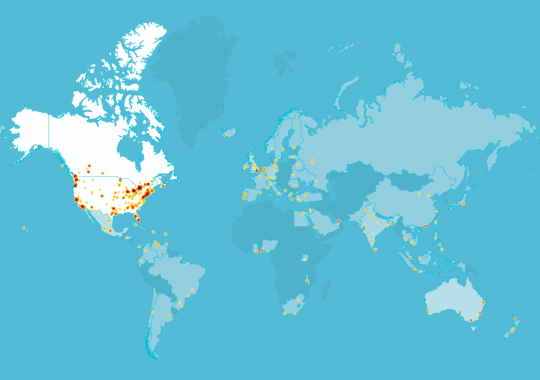
    map the location of each subscriber. I couldn’t resist giving it a try.

    Below is what that looks like. Not surprisingly, the highest
    concentrations of subscribers to this blog are in Canada and the US.

    image

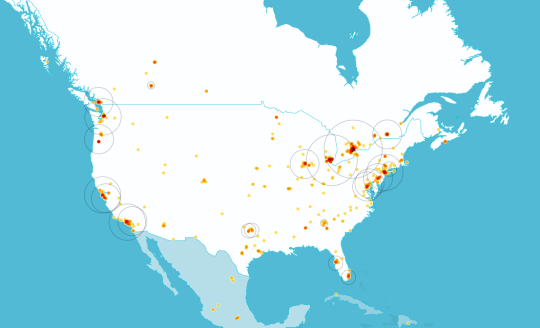
    So here’s a zoomed in version:

    image

    I’ve been trying to branch out from talking about Toronto
    all the time. And that seems to be working somewhat. But I could still do a better
    job of creating more global content. I’ll try harder.

  • Photos of the built environment

    image

    One of my absolute favorite things to do is travel to cities, explore, and take lots of pictures. When I’m in a new place, I can’t help but examine everything about the built environment. That’s the architect in me and it’ll never go away.

    When I was in undergrad I had a refurbished digital SLR camera that I used to use. But now I just use my iPhone. As the saying goes: the best camera is the one you have on you.

    Seeing how I was just in Philadelphia, I’ve been posting a lot of new city related photos to my Instagram. And since about 10x more people follow this blog than follow my Instagram, I’m going to plug it here: follow me on Instagram 🙂

  • The global pyramid of wealth

    Every year the London-based property consultancy Knight Frank publishes something called The Wealth Report. And it’s one of those reports that I could go through for hours. 

    It includes a ton of really fascinating stats that speak volumes about where in the world wealth is being created and how it’s moving around. And of course there are a lot of connections between wealth, real estate, and city building.

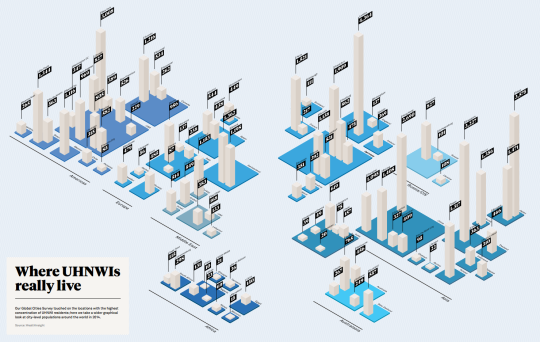
    Below are 3 diagrams that really stood out for me in the 2015 version. 

    The first diagram shows which cities have the most Ultra High Net Worth Individuals (UHNWIs). An UHNWI is defined as an individual with assets exceeding US$30 million, but excluding personal assets and property (such as one’s principal residence). Click here to see the full size image (I know the numbers are small).

    image

    Not surprisingly, London (4,364), Tokyo (3,575), Singapore (3,227), New York (3,008), and Hong Kong (2,690) are at the top of the list. But I was a little surprised – albeit happily surprised – to see Toronto (1,216) come in at #2 in North America, beating out Mexico City (1,116), Los Angeles (969), and Chicago (827). 

    The second diagram shows you how many square meters of luxury property (apartment) you can buy for US$1 million in a bunch of different cities around the world. 

    In Monaco (top end), that’ll buy you 17 square meters (183 square feet) and in Cape Town (bottom end), that’ll buy you 208 square meters (2,196 square feet).

    image

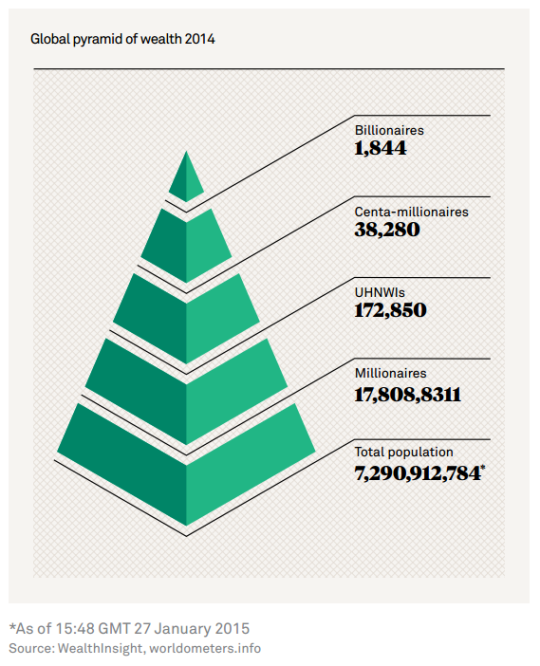
    The third and last diagram is what they call the global pyramid of wealth. It’s a pyramid of everyone in the world and then the number of millionaires, UHNWIs (see above), centa-millionaires, and billionaires. And if you do the math, the top of this pyramid comes nowhere close to 1% of the global population.

    image

    It’s fascinating (and exciting) to see where and how global wealth is concentrating. But it should also make you think about rising income inequality. I know it does for me.

  • Brian Curtner – 1951 – 2015

    image

    The world cannot find a cure for cancer soon enough. Earlier today Quadrangle Architects here in Toronto published the following news release. For those of you not from Toronto, Quadrangle is one of the most important architecture firms in the city.

    It is with great sadness that we share with you that Brian Curtner, our co-founder, colleague and friend, passed away from cancer on August 15, 2015 at the age of 64.

    As an architect, Brian has been widely recognized for exemplary designs that include the award-winning BMW showroom at the foot of the Don Valley Parkway, Corus Entertainment’s state-of-the-art headquarters on Toronto’s waterfront and 130 Bloor Street West in Yorkville – all innovative responses to complex urban challenges. Equally important to his projects was Brian’s unique ability to build long-term working relationships and turn them into friendships that spanned decades.

    Balancing entrepreneurship and commitments to family and friends, Brian was instrumental in creating a highly successful architecture practice, combining business acumen with design excellence, technical expertise and client service which continue to define Quadrangle today.

    Together with his family, we will honour Brian’s life and achievements with a memorial celebration in the near future. We will communicate more details as soon as arrangements have been finalized. In the meantime, Brian’s family welcomes donations to either the Temmy Latner Centre for Palliative Care at Mount Sinai Hospital or Sunnybrook Hospital’s Odette Cancer Centre, in his memory.

    In the coming days, please visit our website for additional information. Details will also be available regarding a website being created in memory of Brian.

    For any inquiries please connect with Elle Fitzpatrick.

    image

    Top image from Quadrangle’s Instagram; bottom image from here.

  • 10 reasons to visit Philadelphia right now

    image

    Today’s ATC post – which happens to be a guest post – is coming to you live from on board the UP Express train that runs from Union Station in downtown Toronto to Pearson Airport. (Everywhere should have free wifi.)

    I’m on my way to Philadelphia and I’ve been wanting to try this train since it opened earlier this summer. It feels great to finally ride it. It’s everything I could have hoped for. It even has that new car smell 🙂

    Last month I wrote a post called, 10 reasons to visit Toronto right now. It was in honor of my good friend Alex Feldman’s visit. Well now it’s my turn to visit Philadelphia and he has decided to return the favor and do a Philly version of that same post. 

    Alex is to Philadelphia what I am to Toronto. He grew up in Philly. He was educated in Philly (we went to Penn together). And he’s super passionate about the future of Philly. And I think that’s how everyone should be about their city.

    So I hope you enjoy his list of 10 reasons to visit Philadelphia right now. It’s basically my to-do list for this weekend.

    ———————————————

    10. World Heritage City: Philadelphia is on track to become the first World Heritage City in the United States. This UNESCO designation will underscore the city’s historic importance as the birthplace of American Democracy as well as the historic urban fabric which gives the city it’s walkable, urbane character.

    9. Shopping: Philadelphia has come a long way as a shopping destination. Conde Nast Traveler recently ranked the city as number 2 out of the best shopping destinations in the world. 3rd Street in Old City has become a hotbed for independent boutiques while Rittenhouse Square has attracted new chains such as Uniqlo, Theory, and Vince. More is on the way with a complete re-make of the Gallery shopping mall slated to start soon and the new East Market complex under construction. 

    8. The Pope is Coming:  In case you haven’t heard, Pope Francis will make his first visit to the United States – with a 3 day visit to Philadelphia in late September. The visit will coincide with the World Meeting of Families gathering. A crazy number of visitors (2 million?) are expected to descend on the city – causing Philadelphians to panic, complain, and attempt to rent their houses for ridiculous amounts of money. But this important visit will help raise the profile of the city on the international stage.

    7. Building Boom: There is probably more development happening in Philadelphia right now then any other time in recent history. The skyline is growing with additions by Norman Foster, Cesar Pelli , and Kohn Pedersen Fox. New apartment buildings, condos, and rowhouses are under construction across the city (rental vacancy rates are less than 2%). In addition the Barnes Foundation and the new Singh Center for Nanotechnology mark impressive additions to the city’s architectural landscape.

    6. Public Spaces: Philly’s public realm has seen massive investment over the last several years. A complete remake of the landscape outside of City Hall has become the new Dilworth Park. The designers of NYC’s highline have added two public spaces to the city (Race Street Pier and the new Central Green in the Navy Yard). And Schulkill Banks recently added a new boardwalk which the New York Times raved about when they ranked Philly as the number 3 city to visit in 2015. More is on the way with the first phase of the Reading Viaduct Rail Park expected to start soon.

    5. Waterfront: Philadelphia’s Delaware River waterfront has long been cut off from the city by interstate 95. Things have started to change recently, with new trails and pier parks recently added to the working waterfront. Even Penn’s Landing, the city’s much maligned waterfront attraction is seeing improvements – including the tremendously popular Spruce Street Harbor Park – a pop-up park featuring floating beer barges, shipping container food stands, and tons of hammocks.

    4. Food: Philly is one of the best food cities in the United States. So much is happening right now in the city’s dining scene, it’s hard to keep track of the latest restaurant openings. Neighborhoods such as Fishtown and East Passyunk have emerged as hot dining districts with BYOB chef driven restaurants. More can be gleaned from the Washington Post which recently summarized the dining scene better than I can.

    3. Pop-up Gardens: One of the best reasons to visit Philly in the summer is the opening of the Pennsylvania Horticultural Society Pop-Up gardens. The wildly popular beer gardens, began several years ago as an initiative to remake underused or vacant lots into useful public spaces. This summer, 2 gardens – one on 15th and South and one at 9th and Wharton have been transformed into vibrant spaces for eating, drinking, and hanging out.

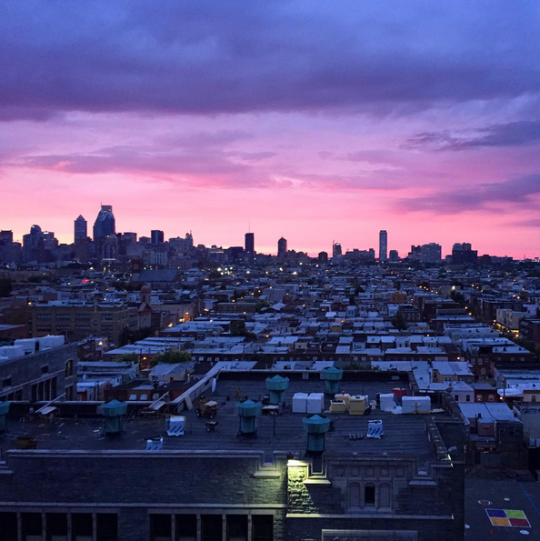
    2. Le Bok Fin: Speaking of temporary uses, the most recent addition to Philly’s pop-up (or iterative placemaking) scene is a rooftop bar called Le Bok Fin. Situated on the 8th floor of an old vocational high school in South Philly (and named after the school’s restaurant – which in turn is a play on one of Philly’s most famous French restaurants). This is the first iteration of development at what is planned to become an amazing new center for creatives inside the old school – being led by Lindsey Scannapieco and her team at Scout LTD. Check out Le Bok Fin for incredible views of the city skyline (especially at sunset).

    1. Bike Share: While a little late to the party, Philly recently launched it’s own bike share program – which is proving to be a huge success. Dubbed Indego, the new bike share is easy to use, has 60 stations, more than 600 bikes and is becoming one of the best ways to hop around town. Check one out and go explore Philly!

    Image: Alex Feldman

  • The impact of laneway housing in Vancouver

    In 2009, Vancouver created policy and legalized laneway homes. (If you’re not up on laneway housing, click here. I’ve written too much about this topic.)

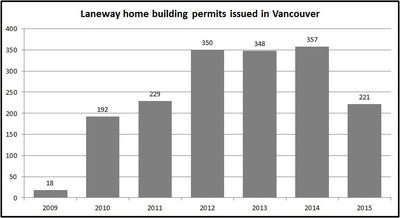
    Since then, the number of laneway homes built in Vancouver has steadily increased to the point where roughly 350 new homes are built every year. 

    Here’s a chart I found showing the number of laneway home building permits issued in Vancouver since 2009 (the year to date number for 2015 is up to and including June):

    image

    This is pretty interesting in its own right.

    But as soon as I saw this chart I started wondering how these numbers fit into the overall new home construction landscape. So I decided to dig up the City of Vancouver’s Statement of Building Permits Issued for June 2015.

    As the chart above shows, the number of laneway dwelling units built (well, permits issued) was 221 as of June 2015. But what’s really fascinating is that this numbers exceeds the number of building permits issued for single family dwellings, which was only 192!

    Also super interesting is the significant spread in building permit value. 

    For single family dwellings, the total value was $156,086,861 (or $812,952 per dwelling unit). On the other hand, for laneway dwellings the total value was $36,478,785 (or $165,062 per unit).

    Now to be fair, if you add single family dwellings with a secondary suite into the mix, you get a total count of 608 new dwelling units (as of June 2015). But at 221 new units, laneway dwellings still make up a meaningful portion of the new construction market.

    So while laneway houses might seem fringe for Toronto and other cities right now, they’re really not that fringe. In fact the numbers above start to show that they can be a viable source of new and relatively affordable single family housing.

    Eventually other cities will realize this too.

  • The world in 2050

    The United Nations recently released its 2015 version of World Population Prospects. It looks as if they put out and revise this report every 5 years.

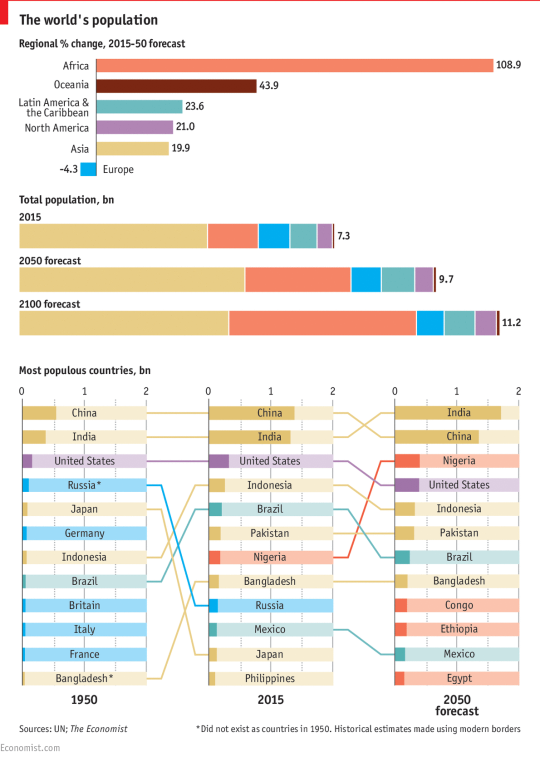
    The Economist then took some of their data and assembled it into the following charts:

    image

    It’s obviously extremely difficult to predict what will happen in the world by 2100, but to the extent that forecasting is possible, the world’s population is expected to reach somewhere around 11.2 billion people. Today it’s 7.3 billion.

    The bulk of this growth is expected to happen first in Africa, and then in Asia. By 2100, Africa’s share of the global population is expected to grow to 39% and Asia’s share is expected to decline to 44%.

    If you’ve been following population trends, most of this shouldn’t come as a surprise to you. The meaningful population growth happening in the world today is happening in the developing world. 

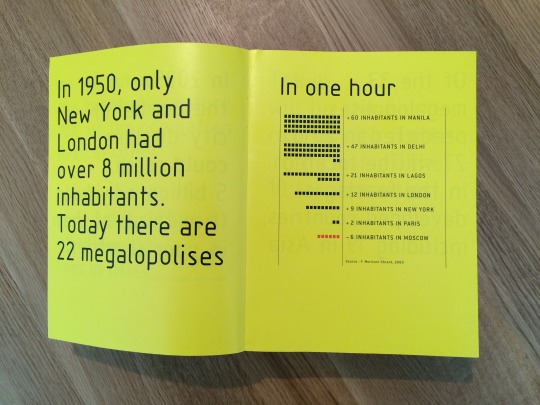
    That’s why architects, such as Rem Koolhaas, have been studying cities like Lagos (Nigeria) since the late 1990s and early 2000s. Below is a photo from a book/research project that I love called Mutations (2000). I pulled it from my bookshelf this morning.

    image

    It’s interesting to think about what all of this will mean for the global economy and for global governance. 

    The United States is about to be alone when it comes to advanced economies with a globally competitive population. Europe is shrinking, which leads me to believe that a strong EU is likely important. And we now have lots of megalopolises with big populations, but with very low income levels.

    Nigeria is the largest economy in Africa, but per capita income is somewhere around $3,000.