Daily insights for city builders, delivered every morning at 6 AM ET. I’m Brandon Donnelly — a Toronto-based real estate developer and founder of Globizen. I’ve been writing here since 2013.

Tag: urbanism

  • Uberpooling your way to cheap rides

    This morning on my way into the office I ran into a friend who lives in my building (downtown). She works in midtown and so I asked her how she gets into the office. She told me that she either takes the subway or an Uber, but that increasingly she has been taking Uber, particularly on the way home.

    We then started talking costs and she told me that what she does is carpool with a friend from work using UberPOOL. They live nearby and so what they do is leave from the same place at night (the office) and then select a midpoint location between their homes for the drop-off. After splitting their portion of the fare, the ride costs her about $3.25.

    As she was telling me this, I couldn’t help but think to myself: Wow, this is massively disruptive to transit. That is the same cost as taking the subway. So why take transit? With the subway, there may be a speed argument in certain instances, but that certainly wouldn’t be the case with some of Toronto’s streetcar lines (such as the King line). It’s faster to walk.

    However, there are obviously geographic limits to how far you can go in an UberPOOL before your costs greatly exceed taking transit. But as Uber and other similar services continue to bring down the price of a ride (eventually the labor cost component will disappear), how big does that area get?

    All of this – including my own mobility patterns – has got me thinking yet again about the role of transit in the city of tomorrow. 

    One segment that continues to be underserved is the regional scale. Here in the Greater Toronto Area, we are working on that by transforming our commuter rail service into a two-way all-day Regional Express Rail service. Today that strikes me as being hugely valuable. And unless driverless vehicles somehow solve our traffic problem, it will likely remain that way.

    I would love to get your thoughts in the comments below.
  • The yellowbelt

    We talk a lot about the greenbelt here in Toronto. Some argue that it’s squeezing the housing market and driving up prices.

    But what about the yellowbelt? (Credit to Gil Meslin for the term.)

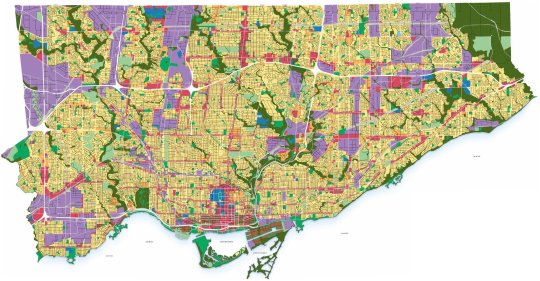
    Here is a land use map of Toronto:

    The yellow areas are “neighborhoods.” They, along with parks, ravines, watercourses, and valleys, make up ¾ of the city’s land area. The Official Plan describes these areas as being “stable” – meaning they will see little physical change. Supply cannot adjust to demand.

    I get why this is the way it is and I understand how difficult it would be change something like this. But let’s not ignore the impact that this land use constraint has and will continue to have on the housing market. 

    It’s the yellowbelt. Thank you Gil for letting me to steal the name.

  • Some thoughts on how we plan cities

    I came across this discussion on Twitter yesterday about how so many of the spaces we love in cities would not conform to today’s modern city planning practices:

    //platform.twitter.com/widgets.js

    This is a topic I’ve been thinking about lately and so it’s a timely discussion. In fact, I’ll often come across spaces in Toronto where I’ll think to myself: This is a really great space. But it’s highly unlikely that it could be built this way today. Naturally the question then becomes: What does this say about modern city planning?

    City planning is obviously important. But at the same time, we are almost certainly making mistakes and doing things that we will later regret. I say this not because I’m particularly critical of planning today, but because cities are enormously complex entities and it’s difficult to believe that we’ve figured everything out at this point.

    One thing I wonder about is if we aren’t over-planning and being too prescriptive about our cities. Some of you will probably argue the exact opposite. But hear me out.

    Vancouver is a city that has long been considered to be the gold standard in modern city planning. We talk about its podium + tower building typology. We talk about its “gentle density.” And we talk about its great public and recreational spaces, among many other things.

    But when I was there last month having dinner with a friend of mine, she said something to me that stood out. She said: “Brandon, Vancouver is a boring city. If it weren’t for my family being here, I would happily move to Toronto, New York, or somewhere else.”

    Cities are amazing places because they unleash human ingenuity. They allow new and unforeseen things to emerge. The challenge, I think, is to not sterilize that away when we plan and build. And all of us involved in the building of cities are probably guilty of doing that to an extent.

  • The New Urban Crisis

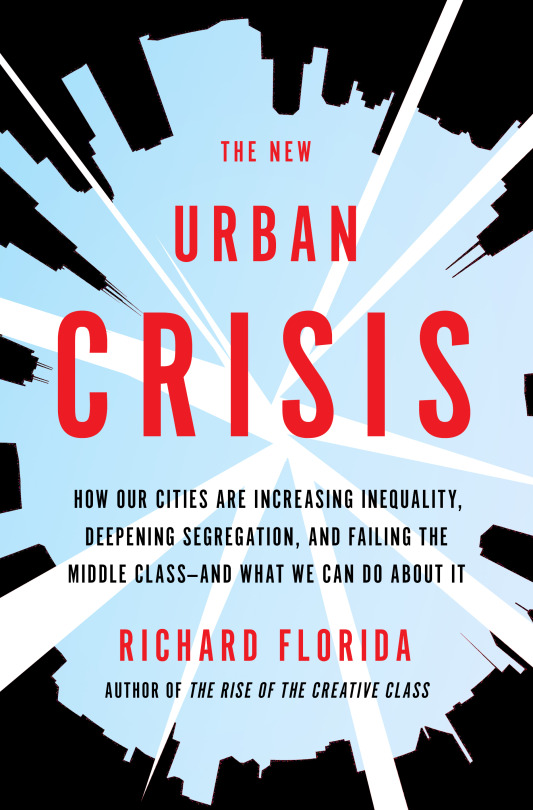
    Richard Florida has a new book coming out in the spring called, The New Urban Crisis

    Noteworthy about the book is that he has changed his tune with respect to the potential of the “creative class” to form the new middle class. Here’s a quote from the Houston Chronicle:

    “I got wrong that the creative class could magically restore our cities, become a new middle class like my father’s, and we were going to live happily forever after,” he said. “I could not have anticipated among all this urban growth and revival that there was a dark side to the urban creative revolution, a very deep dark side.”  -Richard Florida

    Regardless of what you think of the work of Richard Florida, I’m sure this book will be bedside for most urbanists. The focus is on creating a new kind of inclusive urbanism, which is top of mind for so many of us today.

    If you’d like to pre-order it, you can do that here.

  • Has there been a “great inversion?”

    Urbanist Richard Florida has spoken a lot about a “great inversion.” This is about poverty moving to the suburbs and the core of cities becoming a kind of “gated suburb.” (i.e. wealthy)

    In response to this narrative, City Observatory recently published a post where they call this a new mythology. Joe Cortright argues that it is simply an exaggeration that sounds good in media headlines. And indeed, if you look at some accounts of poverty, the swings haven’t been that dramatic.

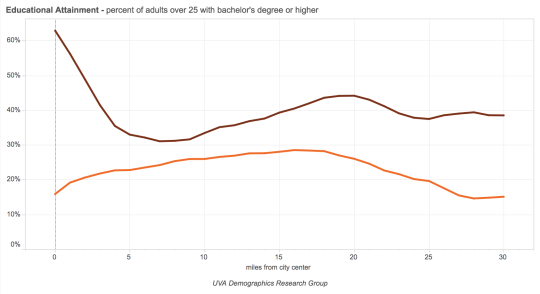
    However, if you dig into this study by Luke Juday at the University of Virginia (cited in the City Observatory article), there have been some interesting changes. 

    Below is a chart that shows the percentage of adults (over 25) with a bachelor’s degree (or higher) sorted by distance from the city center. This particular chart is a composite of 7 northeastern (US) cities. The brown line is 2012 and the orange line is 1990.

    As you can see, there has been a huge spike in educated people living in city centers – at least in the northeast.

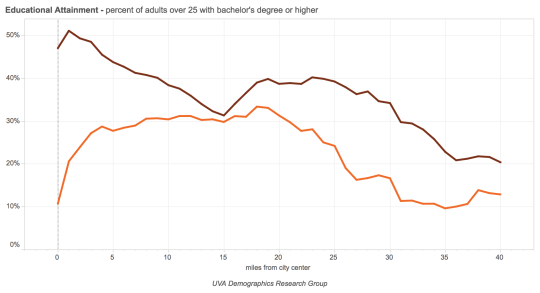
    Here is that same chart for Atlanta:

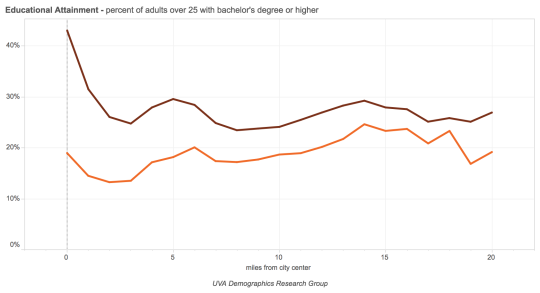
    New York:

    In the case of New York, it looks like the entire city just became more educated.

    Miami:

    Educational attainment is often the single biggest determinant of income. So there is something to be said about highly educated people concentrating themselves in city centers. We may not want to call it an inversion of great proportions, but it’s a meaningful shift.

  • Big, bold, and global

    I love the way that urban planner Joe Berridge thinks about Toronto and city building. He is constantly considering our position on the global stage and urging us to fight for a top position by executing on real and meaningful projects. 

    Here is a recent article from the Toronto Star which lists some of those projects. They include everything from a new convention center to creating a fourth university (in addition to the University of Toronto, York, and Ryerson).

    Here’s a snippet:

    We could get “lost in domesticity — very nice, but that’s not enough,” he says, drawing on his experience leading urban renewal projects around the world.

    Toronto’s social cohesion is enough to attract 125,000 new people each year to the region. But they won’t stay if we can’t employ them and provide opportunities. And that requires global thinking.

    Berridge says it is the city’s “moral obligation” to use its taxing power, its wealth, its status as Canada’s only global city and the historical advantages of public education, public health and public services to propel Toronto into super city status.

    Cities will often talk in nebulous terms about being “world class.” That isn’t all that helpful. Let’s be specific and also acknowledge that great things cost money. Are we a top tourist destination? Are we a top convention destination? Are we attracting the smartest people in the world with the best schools? Do we have the best transit and health care systems in the world?

    Toronto is a great city and so it’s perhaps easy to become complacent. But past performance is not an indicator of future outcomes. We need to think in global terms. We need to keep in mind that this is an international competition. And every day all of us step onto that field.

    Thank you Joe for constantly reminding us of that.

  • 6 things about cities from Richard Florida

    Last week Richard Florida headlined an “Urban Lab” panel at the NYU Schack Institute of Real Estate. It was moderated by Sam Chandan, who is dean of the Shack Institute. 

    Here are 6 takeaways from the discussion, with a few of my own thoughts attached:

    1. Suburban brain drain. This is happening. Florida states that (real estate) development is the key to rebuilding the suburbs. It will challenging to reorient the suburbs away from the car (though suburbs vary greatly), but I do agree that many suburban areas need a refresh to keep them relevant against this brain drain.

    2. Decline in home ownership. Florida believes we will see owning vs. renting drop to about 50-50. This would be a pretty big change given that US homeownership is currently hovering in the low 60s and this is already at historic lows. However, the trend is towards urban and that often means more renting.

    3. New city characteristics. Access to urban amenities, cultural capital, and transportation is critical and should drive new development. Transit and rail infrastructure can “open up” new areas and combat issue #4, below.

    4. Housing affordability. Florida reiterates “the great inversion.” Poverty moving to the suburbs; cities now housing the rich. He also isn’t sure that capitalism alone will solve this problem. Gives example of Manhattan where market is focused on high-end luxury residential.

    5. Florida argues that planning and real estate knowledge need to come together to overcome some of the information-asymmetries inherent in the development industry. I’ve written about similar ideas before. I try and apply this sort of multi-disciplinary thinking to urban issues.

    6. Micro-living is not a silver bullet for “chronic poverty.” I think it serves a segment of the housing market.

  • PHLEGM video

    This past summer I wrote about the 8 storey mural (by street artist PHLEGM) that was about to go up on the side of a Slate building at the corner of Yonge + St. Clair in midtown Toronto.

    Well, that mural is now complete. It’s been in the news a bunch over the past couple of months, both locally and internationally. designboom (they’re allergic to capital letters) wrote about it last month.

    In case you missed all that press and/or you’d like to learn more about the process, here is a video that the STEPS Initiative published last week. It’s 5 minutes. If you can’t see the video below, click here.

    [vimeo 185861345 w=640 h=360]

    The STEPS philosophy of creating public art in unlikely urban spaces is a hugely interesting one. It’s really the antithesis of the white-walled art gallery.

  • Urban change through rapid prototyping

    image

    The Market Street Prototyping Festival is just finishing up in San Francisco. The festival, which is now in its 3rd year, is centered around urban interventions that can be rapidly prototyped and tested. The goal is to discover new ideas that could be used to transform and improve Market Street – the city’s civic spine. It is a joint effort of both the San Francisco Planning Department and the Yerba Buena Center for the Arts.

    Here is a list of all the prototypes. You can “like” projects, but I wish they would have made it easier to filter and see which ones are the most popular.

    One project that I liked is Vote With Your Feet. It consists of two doorways and a single crowdsourced YES/NO question above it. You vote by choosing a doorway. Once you walk through, you are then shown the results. Here’s a Boomerang video of it in action. I like it because it provides a frictionless way to acquire lots of ground-up feedback. Imagine placing something like this at the exit of a busy train station or transforming the existing doors.

    Tactical urbanism can be a great mechanism for investigating and instigating positive change. This is hugely important considering how slow moving and bureaucratic city building can be. It’s not the same format, but NXT City here in Toronto has similar ambitions. They source new ideas for our public spaces from young people. I am thrilled that both of these initiatives exist.

  • Building crap

    Last night I participated in an excellent dinner discussion with a group of planners, architects, city officials, and politicians from Amsterdam. They were visiting Toronto to see first hand what rapid intensification has done to this city. And I very much appreciated the invite. Thank you.

    My message was that intensification has created a far more vibrant and exciting city compared to 15 or so years ago. It’s hard to know what exactly could be correlated with intensification, but we have certainly seen an explosion of culture, innovation, and pride in this city – among many other things. (It could be all Drake’s doing.)

    However, the counter argument at the dinner table was that Toronto is letting unfettered development produce unremarkable architecture. We are simply building glass tower after glass tower. And I know that, for many of you, this will ring true. I hear it all the time, including in the comments of this blog.

    Now, I will be the first to admit that there has been a lot of shit built in this city. No argument there. Some people have no taste. But at the same time, I think it’s myopic to assume that it’s strictly because of profit-motivated developers. 

    Oftentimes the perception is that development projects are awash in cash. There’s tons of money in which to do the right thing. Developers just need to stop being so greedy and start being more creative.

    The reality is that developers operate within a market. There are real limits to what people will pay for new space. And when, for instance, land prices go through the roof (an input), municipal fees jump (cost of doing business), and approvals drag (time value of money), guess where everyone starts looking for savings? In the build.

    I say this not to justify building crap. If I had it my way, everything would be beautiful. I champion design whenever possible. I say it simply to shed light on the process. Because when we all understand the factors at a play, I believe we all become more effective at finding solutions.