Daily insights for city builders, delivered every morning at 6 AM ET. I’m Brandon Donnelly — a Toronto-based real estate developer and founder of Globizen. I’ve been writing here since 2013.

Tag: urbanism

  • First 3D printed home in America

    The video below is a good follow-up to my recent post about the 100 million city and the rapid population growth that we are seeing in some parts of the developing world.

    If you can’t see the embedded video below, click here.

    [youtube https://www.youtube.com/watch?v=SvM7jFZGAec?rel=0&w=560&h=315]

    It’s a video about what is allegedly the “first permitted, 3D-printed home in America” – an 800 square foot home that was built/printed in Austin during SXSW in about 24 hours.

    The project is a partnership between New Story (a non-profit) and ICON (a construction technologies company), and the goal is to pioneer a fast and cheap housing model for the developing world.

    The cost for the above home is said to be about $4,000.
  • Vancouver’s Empty Homes Tax

    In an effort to curb the much talked-about and much debated empty home situation in Vancouver (supposedly the number is ~20k vacant homes), the city, as many of you know, implemented an Empty Homes Tax.

    To enforce this, the City of Vancouver now requires that every year, every owner of residential property must file a status declaration. If you don’t file this by the deadline, the property is automatically deemed vacant and the tax (1% of assessed taxable value) and a penalty ($250) are applied.

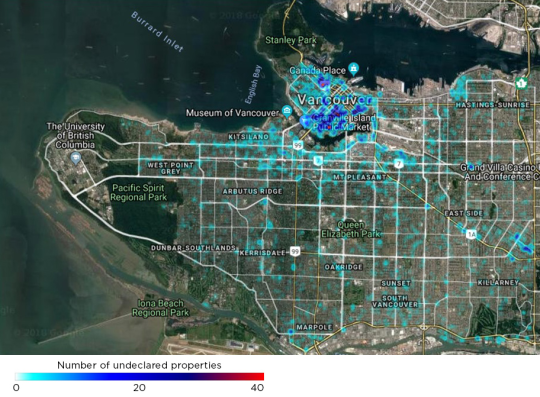
    Last month, 11 days before the 2017 deadline, the city published the below heat map showing the concentration of Vancouver property owners who hadn’t yet made their declaration. There were just under 4,000 undeclared properties.

    image

    But as Jens von Bergmann points out on his blog, Mountain Doodles (great data-driven blog), this was really just a map of where people live. Because if you also create a map of residential properties subject to the tax, which he did, it looks pretty similar to above.

  • New high-rise home prices up 39.5% year-over-year

    February data (2018) for the new home market in the Greater Toronto Area was released this past week by BILD and Altus. I seem to have gotten into the habit of writing about this every month.

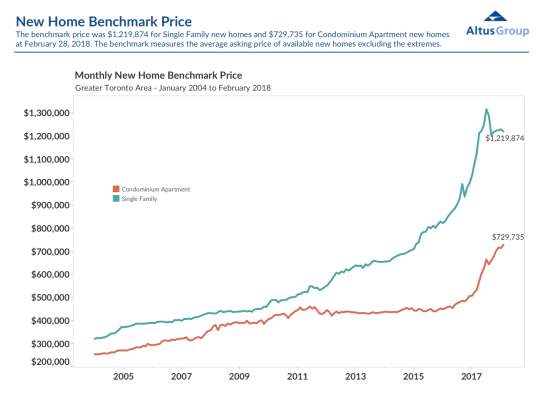
    The benchmark price for new low-rise single-family housing was down slightly from January to $1,219,874, but still up 12.8% from a year prior.

    The benchmark price for new high-rise housing was up a whopping 39.5% year-over-year to $729,735. But part of this is being driven by an equally dramatic increase in average unit sizes.

    Here is the relevant graph:

    image

    The story continues to be about tight supply, historically low developer inventories, and a lack of affordable low-rise product. 

    As I have argued many times before on this blog, I believe these factors — and in particular the last one — are, at least partly, driving this recent pop in high-rise pricing. People are priced out and now searching for substitutes.

    So my prediction continues to be that we will see a convergence (i.e. diminishing spread) between new low-rise and high-rise pricing.

    That will also bring about design and product changes on the high-rise side.

  • The most popular building amenities (according to a small subset of people)

    Here are the results from my primitive multi-unit building amenities survey:

    Gym is number 1. No surprise there. 46% of respondents said it was in their top 3. 

    Rooftop outdoor space at number 2 was perhaps a bit surprising. But then again, who doesn’t love a good rooftop patio?

    As for concierge service, I tend to think this was driven by package delivery. That’s certainly the biggest value add for me.

    One standout near the top, for me at least, is co-working space. Andrew LeFleur made mention of this on Twitter and I think he’s right: The changing nature of work is making these spaces more valuable in multi-family dwellings.

    And now some color on the above results.

    436 amenity selections were made as part of this survey. 

    About half of the respondents were from the Greater Toronto Area, followed by Calgary, San Francisco, Ottawa, Boston, New York City, Denver, Los Angeles, Paris, Miami, and many other cities. Shoutout to whoever responded from Kuala Lumpur and Porto Alegre.

    In terms of “Other” amenities, there were suggestions for a band rehearsal space, a vending machine, a grassy area for sports, and programming the helps you meet your neighbors.

    In terms of this one last, it can be tricky for condo buildings. Developers only provide the space. It’s then up to management. But I’ve seen it done very well in rental buildings.

    Are you surprised by any of the results from this survey?

  • My new gig…

    image

    So this is interesting.

    Earlier this month, Travis Kalanick – co-founder of Uber and its former CEO – formed a new venture fund called 10100. According to the WSJ, it was funded with his own money after he sold 30% of his position in Uber for a cool $1.4 billion. 

    Ten-one-hundred’s spartan website explains that the goal of the fund is “large-scale job creation, with investments in real estate, ecommerce, and emerging innovation in China and India.” On the non-profit side, the initial focus will be on “education and the future of cities.”

    Then this week, Travis tweeted out “My new gig…” and disclosed that 10100 had entered into an agreement to buy a controlling interest in a real estate holding company called City Storage Systems (CSS) for $150 million. 

    He also announced that he would become CEO.

    The focus of CSS is on the redevelopment of distressed real estate, particularly parking, retail, and industrial assets. He goes on to say: “There are over $10 trillion in these real estate assets that will need to be repurposed for the digital era in the coming years.”

    This whole series of events is a big bet on some significant changes in the real estate space.

    Photo by Martin Reisch on Unsplash

  • What are the most important condo and rental building amenities?

    Last night I casually asked the

    Twittersphere

    what the most important condo amenity is, besides a gym. 

    That tweet got quite a few responses – everything from rock climbing to a proper facility for realtor lock boxes.

    Given the response, I thought it would be worthwhile to be a bit more rigorous in this analysis. So I have created an online survey that you can very quickly fill out by clicking here

    Here’s how this is going to work:

    – You have to enter your email address. Sorry, some friction. I figured that would make the data a bit more reliable. Don’t worry your email is safe.

    – You can select a maximum of 3 amenities. One of them can be “Other”, in which case you would then enter in an amenity not already found on the list.

    – The order of the amenities in the survey is being randomized so as to avoid any possible it’s-near-the-top-and-I’m-too-lazy-to-scroll bias.

    – You’ll be able to see the results of the survey after you’ve responded. I’ll also post the results to this blog so that it’s public and people learn things. Individual emails will, of course, never be published.

    Developers should be building what people actually want and will use. Now is your chance to tell us what that is. Click here for the survey.

  • It Will Never Work

    On March 31, RIBA North (Royal Institute of British Architects North) in Liverpool will be opening the doors on a new exhibition that explores 25 years of award winning work by the developer and self-described “regenerator”, Urban Splash. I love the name of the exhibition. It’s called: “It Will Never Work.”

    Here is a short description of the exhibition:

    Urban Splash profess to have started without a plan, purposefully ignoring advice and routinely rejecting accepted development processes. At every step ‘it will never work’ has been a call to action rather than a discouragement.

    The company’s maverick presence on the development landscape of the North has changed the way we live, work and play in our cities, and their continued success as ‘established innovators’ is helping to shape urban futures.

    If you aren’t familiar with the work of Urban Splash, I would encourage you to check them out. When I was first starting out in development and scouring the world for developers that actually cared about design and cities, these guys were on my shortlist.

    So I have been a longtime follower and I have developer friends here in Toronto who I know also admire their work. Sadly, I have no plans to be in Liverpool anytime soon. But maybe some of you do.

  • Crypto networks and top-down urban planning

    Taylor Pearson recently compared crypto networks to cities and argued that the best crypto networks, much like the best cities, are formed from the bottom up. 

    The example he gives is that of Paris (bottom-up) vs. Brasilia (top-down). Paris is the hugely successful city and Brasilia is the failure of high-modernism.

    I appreciate the argument he’s making and I do agree with him on the potential of decentralization, but I couldn’t help but dig into his city example a bit further.

    The Paris we all know and love today is the result of an enormous centrally planned urban renewal exercise. Baron Haussmann carved, among many other things, long straight boulevards through Paris’ medieval fabric in order to modernize and rationalize the city.

    What makes this top-down exercise different from that of Brasilia’s? Is it simply that Haussmann was constrained by Paris’ existing and decidedly urban fabric?

    Because then we could turn our attention to New York City’s gridiron plan of 1811, which laid out – before the island of Manhattan had even fully developed – a relentless and orthogonal street network from Houston Street all the way up to 155th Street.

    Is the difference that Brasilia was planned with suburban sensibilities in mind and Manhattan was not? Or was it the restrictive Euclidean zoning that did it in for Brasilia? 

    Whatever the case may be, history suggests that some top-down planning exercises may have worked out just fine. Though to be fair, each of them was not without their share of critics.

    Photo by Rafael Leão on Unsplash

  • Neighborhood depopulation

    Recently we’ve been talking about California’s Proposition 13 and how it may be creating a disincentive for longtime homeowners to move. They’re enjoying below market property taxes, and so they stay put, even if they may have too much house.

    But this concept of “overhousing” isn’t unique to California. The Globe and Mail just ran a piece talking about how Toronto’s designated “Neighborhoods” are losing people as the nests empty out, seniors remain put, and the broader city booms.

    The rate of depopulation that created the spare bedrooms in Toronto’s low-rise neighbourhoods is stark: “Since 2001, about 52 per cent of the land mass of Toronto has reduced in density of population by about 201,000 people,” Mr. Smetanin says. “Other parts of Toronto have grown by 492,000.”

    The irony of this phenomenon is that the city’s Official Plan considers these Neighborhoods to be “physically stable”, as well as “one of the keys to Toronto’s success.” However, things are clearly changing behind that physical stability.

    Photo by Verne Ho on Unsplash

  • The City as a Place for People

    The City of London Corporation recently published a report called “The City as a Place for People”, which talks primarily about itself and how great London is as a magnet for talent. 

    But as self-serving as it may be – the report is timed to be ahead of this year’s MIPIM – there appears to be some data and interviews backing up the claims.

    58% of “institutional investors” said that London is the best European city for business. Dublin was next at 22%. 

    A separate survey of 2,568 “corporate decision makers” in Europe revealed that 21% of respondents felt that London was the best European city for business, followed by Paris (13%) and Frankfurt (7%). When asked which city had the best talent pool, the responses were fairly similar.

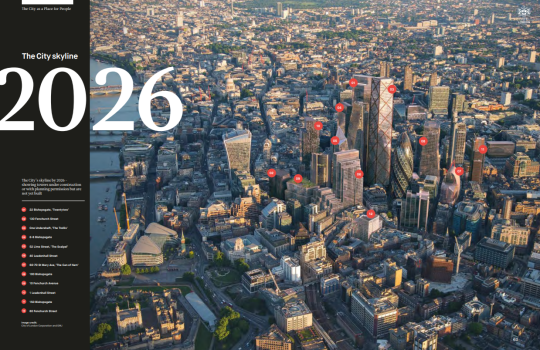
    Also included in the report is a rendering of the City’s skyline by 2026. These are always fun to see. Here is a screen grab:

    image

    It is showing all towers under construction and all towers with their planning permissions in place. If you’d like to download the full report, you can do that here.