Daily insights for city builders, delivered every morning at 6 AM ET. I’m Brandon Donnelly — a Toronto-based real estate developer and founder of Globizen. I’ve been writing here since 2013.

Tag: urbanation

  • Cost-plus pricing

    Today, Urbanation released its Q4-2018 market highlights report for the Greater Toronto Area. 

    The general media will pick up these numbers and tell you that there’s been a precipitous decline in the number of new condominium sales. But the reality is that 20,028 units were sold in 2018, which is actually in-line with 10-year averages for this region. 2017 was a particularly frenetic, and unsustainable, year.

    The average pre-construction sold price for a new condominium in the former City of Toronto (the core) was $1,117 psf last year, and $921 psf across the broader region. These numbers represent significant double digit increases from the year prior. But again, what I don’t think many people appreciate is that the cost environment has also changed dramatically over the last few years.

    Construction costs are way up, as are development charges and a myriad of other pro forma line items. The above numbers are simply a result of cost-plus pricing. Here’s where costs are at and here’s where we need to be to make the project feasible. Margins haven’t increased; in fact, they’ve probably been squeezed for many developers.

    I think this is an important topic that deserves more transparency and visibility. So I’m hoping to work with a developer friend of mine and publish something more substantial in the coming months.
  • Average price of a new condo in Toronto is now above $1,000 psf

    Urbanation released its Q3-2018 condo market results for the Greater Toronto Area earlier this month. 

    Here are a few highlights:

    – The unsold inventory of new condos in development is currently 33% below the 10-year average of 14,806 units.

    – Year-to-date sales of new condominiums decreased to 14,055 units from 25,839 units (same period last year). 2017 was a record year.

    – The average price per square foot for new project launches in Q3-2018 was $1,044 psf. This is the first time the average has broken the $1,000 psf mark. 

    – This is a significant price increase from last year and it is being driven by low supply, stable demand, and rising development/construction costs (my opinion).

    – The average unit size for project launches in Q3-2018 was 714 sf.

    – The average opening quarter absorption rate remains above 55%. It has been this way since Q1-2016.

    For the full press release, click here.

  • Reintroducing Junction House

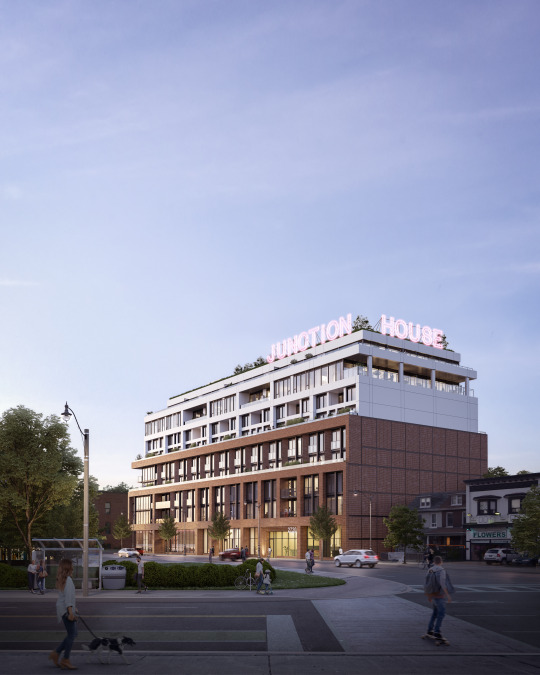
    Today we released the above rendering for Junction House and announced that sales will begin this fall.

    144 condominium homes. A mix of 1, 2 and 3 bedroom suites, including our Two-Storey House Collection and our Laneway House Collection. Prices starting in the $400s.

    One of our partners also happened to serendipitously send me this Globe & Mail article today talking about the increasing demand for and shortage of mid-rise housing:

    “The market is substantially undersupplied in mid-rise,” said Mr. Hildebrand, who notes that mid-rise projects in the GTA [Greater Toronto Area] were just 31 of 2017’s new launches, accounting for 3,833 units (12 per cent of the total).

    Stephen Price, CEO of Graywood Developments, went on to say this in the article:

    “There’s a huge appetite for medium density in Toronto. Many don’t want to live in the downtown core, this buyer is more interested in being in a community and there is a greater propensity to buy larger more livable units.”

    Given the huge influx of inquiries we received today after the above announcement was made, I would say that feels right. And our focus at Junction House is very much on “larger and more livable.”

    If you’re at all interested in a new home at Junction House, I would encourage you to get on our priority list, here.

  • Condo rents in Toronto are up 11.2% from last year

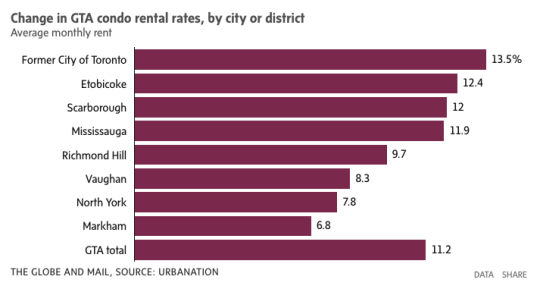
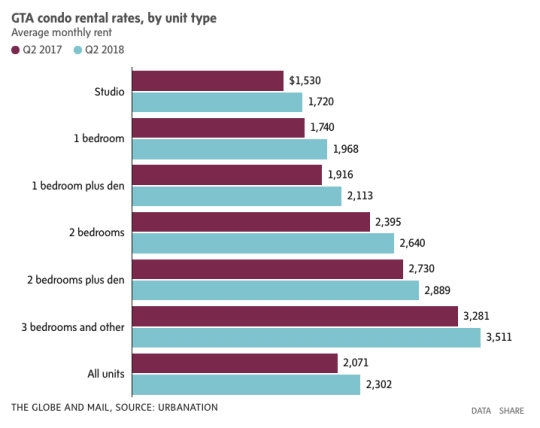
    Yesterday Urbanation released its Q2-2018 rental report for the Greater Toronto Area. It tracks both purpose-built rentals and condominium rentals, the latter being condominium units that are listed for rent on MLS. The average condo rent, for all unit types across the GTA, is up 11.2% year-over-year to a face rent of $2,302 per month.

    Here is a chart from the Globe and Mail:

    The former City of Toronto, which includes downtown, is actually up 13.5%:

    But here are the stats that I really wanted to draw your attention to today (figures from the Globe).

    According to Urbanation, there were some 384,000 condo apartments in the Greater Toronto Area in 2017 and nearly 1/3 of them were rented out. Given that the Canada Mortgage and Housing Corporation pegs the total number of rental apartments in the GTA at approximately 311,596, condo apartments represent about 40% of all our rental housing stock.

    So condo buildings are actually doing quite a bit of heavy lifting when it comes to providing rental housing in this region.

  • Half of Toronto condos completed last year became new rental housing

    image

    Shaun Hildebrand (Urbanation) and Benjamin Tal (CIBC) published a report today called, “A Window Into the World of Condo Investors.” In it they revealed that last year (2017 data) no less than 48% of the Greater Toronto Area’s newly completed condo units were closed on by “rental investors.” In other words, almost half of the units became new rental supply.

    This stat was not surprisingly turned into clickbait-y type headlines like, “Half of Toronto condos bought last year were by investors”; whereas an alternate headline might read: “Half of Toronto condos completed last year became new rental housing.” Not as jarring, I know.

    In any event, there are a bunch of other interesting stats in the reports. Here are a few of them:

    – 80% of all new home sales in the GTA last year were condo.

    – Average resale condo prices (per square foot) increased by 26% last year and rents grew by 9%.

    – Over 20% of condo investors purchased their property with no mortgage.

    – Average down payment made by investors was 20%; non-investors were closer to 15%, likely because of mortgage insurance and other factors.

    – Out of the condo investors who took possession in 2017 with a mortgage, no less than 44% are in a negative cash flow position – meaning their rental income isn’t covering their carrying costs. 

    – The returns, which the report calls exceptional, have been coming in the form of price appreciation.

    – As a stress test for the market – what if all these negative cash flow investors suddenly sold their condos? – the report also estimates that if you took all of the rental investors who closed in 2017 with a mortgage and who are in a negative cash flow position greater than $500 per month, it would represent only 3.4% of the total annual supply of condos (both new and resale product).

    If you would like to check out the full report, you can do that over here.

    Photo by Scott Webb on Unsplash