
When I was
a kid growing up in the suburbs of Toronto, I never played in the backyard. I
played in the streets. That’s where all the kids came together.
We would
play baseball in somebody’s driveway, using one of the garage door “squares” as
the strike zone. We would play football on corner lots, where it was tackle on
the grass and “two-hand touch” on the street. And we would wax our curbs so
that we could skateboard them.
None of these
spaces were ever really intended for baseball, football, or skateboarding, but
we kids repurposed them.
As people,
including families, continue to move into urban centers around the world, I
have no doubt that the next generation of children will once again repurpose
spaces for play. But that doesn’t mean that we don’t have work to do when it
comes to properly preparing our communities for people of all shapes and sizes.
One of the
most interesting design challenges facing us today has to do with our towers.
Architects
have long been obsessed with the idea of vertical villages. Le Corbusier’s Unité
d’habitation in Marseille had two shopping streets embedded within the tower
that were intended to act as public spines. I don’t know how well they did, but
it was a highly progressive idea for the time.
Following
on this idea, I was recently watching a
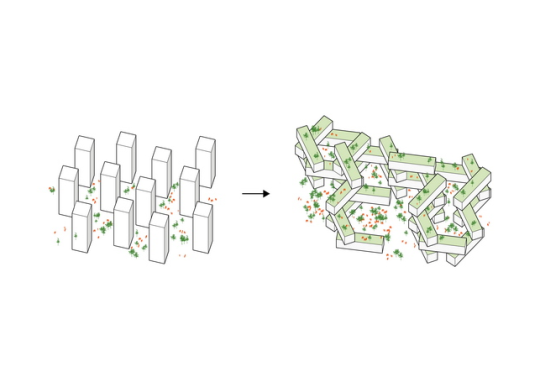
TED talk with architect Ole Scheeren (thanks Mariane) and I was fascinated
by his obsession with breaking down the raw verticality of towers.
His belief
was that, yes, cities are and will continue to become more dense through tall
buildings, but that most towers isolate rather than connect people. His work strives to do the opposite.
And this
one of the big trends that I think we will see more of in our cites. We will see
new forms of urban connectedness and a blurring of private, public, and
semi-public spaces. Screw Euclidean zoning.
On that
note, I am reminded that I owe the ATC community a post on my predictions for
2016. I hope to get that out shortly.
Diagram via Büro Ole Scheeren