Daily insights for city builders, delivered every morning at 6 AM ET. I’m Brandon Donnelly — a Toronto-based real estate developer and founder of Globizen. I’ve been writing here since 2013.

Tag: urban migration

  • Where renters want to move

    Every quarter, Apartment List publishes something that they call their Rental Migration Report. What they do is use search data from their website to determine where their (registered) users are hoping to move to and from. Their first report of 2020 is now out and below is their list of the most attractive US metros. It is based on search data from June to December, 2019.

    Now, it’s important to note that this is really only a form of intent — taken from one particular website. This list may not, and probably doesn’t, accurately mirror how and where people are actually migrating within the US. But it is still interesting to see what is top of mind for Apartment List’s users. (If there were multiple search inquiries during a visit to the site, they counted the first metro area.)

    Beautiful mountains. Great snowboarding/skiing. And a burgeoning tech ecosystem. I am not at all surprised to see Denver at the top of this list.

    Images: Apartment List
  • Young, rich, childless, and white

    Whenever I’m not sure what to write about, I just read. That’s one of the big benefits of daily blogging – it forces me to do that.

    This morning I stumbled upon the blog of Jed Kolko. Jed is an economist and, up until 2015, he was Chief Economist and VP of Analytics at Trulia.

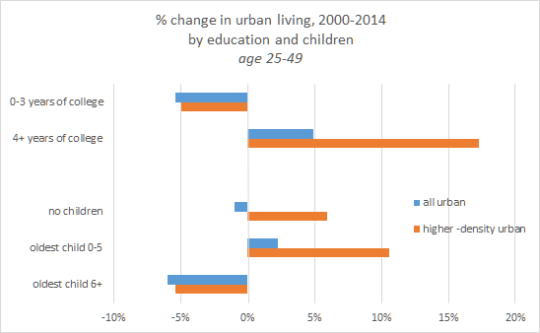
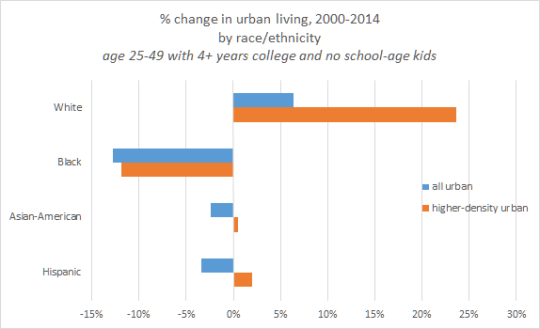
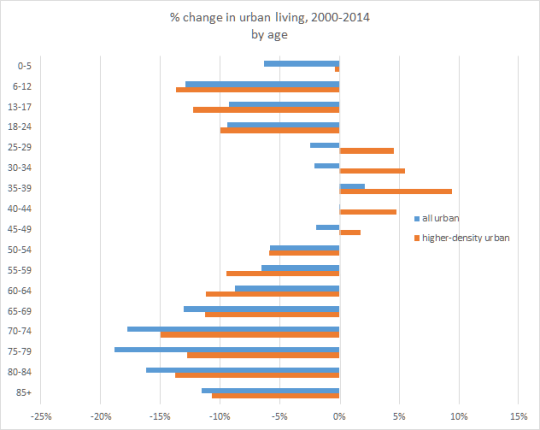
    His most recent post argues – naturally with lots of data and charts – that for all of our talk of (re)urbanization, it’s actually a specific subset of the population that is far more likely to be have urbanized between 2000 and 2014: the young, rich, childless, and white. (Note: His post is talking specifically about U.S. cities.) 

    Below are a few of his charts. 

    In all cases, the x-axis represents % change in urban living between 2000 and 2014. All of the data is from Public Use Microdata Samples (PUMS) – 2000 decennial Census and from the 2014 one-year American Community Survey (ACS).

    Here is age:

    image

    Household income:

    image

    Education and children:

    image

    And here is race/ethnicity:

    image