
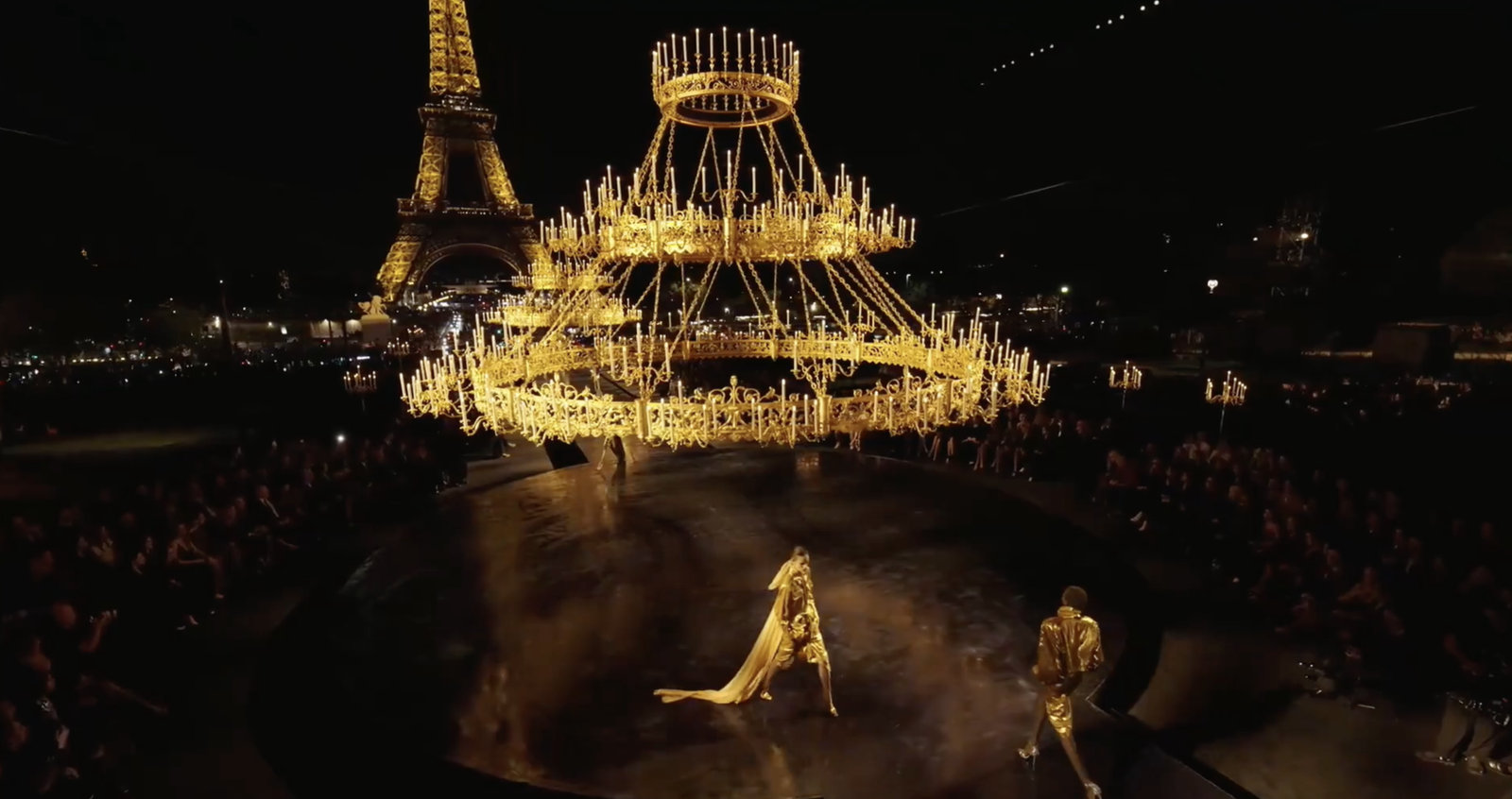
This week at Paris Fashion Week, Saint Laurent’s creative director Anthony Vaccarello presented an open-air show in front of the Eiffel Tower that is widely rumoured to be his last show at the fashion house. (Too bad.) The set was opulent cinema. Everything was gilded — in an elegant way, not the gaudy Trump way — including the clothes themselves.
The overall set was intended to pay homage to the historic ballroom of the Hôtel InterContinental, where Yves Saint Laurent himself used to famously present his collections. And suspended above the runway was an enormous gold chandelier that effectively created an “urban ceiling” for the space. Here’s the full show if this at all interests you.
But this is not a post about fashion.
One of the things that stood out to me was the obvious relationship between the glittering Eiffel Tower and the enormous gold chandelier. It’s a good example of how you don’t necessarily need walls to frame an urban space. The hanging chandelier was all that was needed to turn a public plaza into a private salon.
At the same time, I was struck by how sexy and glamorous Paris always manages to make what is effectively a piece of raw industrial architecture. The Eiffel Tower was immediately popular with the general public at the 1889 Exposition Universelle because of its awe-inspiring stature, but elites derided it for its lack of Parisian taste. So how then did it become so synonymous with French high culture?
One theory is that it’s because the tower is generally useless.
In 1964, French theorist Roland Barthes wrote an essay where he argued that the Eiffel Tower became the ultimate global symbol precisely because it means basically nothing in itself, which is why it can be so easily imbued with other symbolic meaning. The Louvre is art. The Arc de Triomphe commemorates a military victory. And Notre-Dame is religion.
The Eiffel Tower, by contrast, is empty. It’s more or less a hollow skeleton of iron. Barthes called this an “empty signifier.” In other words, it’s a blank canvas — one that has come to symbolize everything from 19th-century industrial progress to 21st-century luxury fashion. Its greatest strength may be its uselessness.
It can be hard to predict when something might resonate in the way that the Eiffel Tower has. The so-called cultural elites certainly didn’t get it at the time. But cities desperately need these urban symbols, and what they come to mean ultimately depends on the urban context and positioning we choose to create. It’s malleable.
Take, for instance, the CN Tower in Toronto. There is nothing inherent to its concrete form that prevents it from symbolizing high design or civic sophistication in the way the Eiffel Tower does. The difference is in the curation: at its base, we put an aquarium; Paris brings out gilded Saint Laurent.
Saint Laurent’s show this week was equal parts marketing for the fashion house and for the city.