
Daily insights for city builders, delivered every morning at 6 AM ET. I’m Brandon Donnelly — a Toronto-based real estate developer and founder of Globizen. I’ve been writing here since 2013.

Tag: urban expansion

  • Sprawling, but affordable

    The Wall Street Journal recently published an interesting article that ties in nicely with two of my recent posts. My post about North American population growth and my post about the San Francisco pro-development group known as BARF.

    The WSJ article is about the growing divide between affordable and expensive cities in the US. And the argument is that expansionist, or sprawling, cities are better at suppressing home values and maintaining affordability:

    “The developed residential area in Atlanta, for example, grew by 208% from 1980 to 2010 and real home values grew by 14%. In contrast, in the San Francisco-San Jose area, developed residential land grew by just 30%, while homes values grew by 188%.”

    Now, here’s a chart saying that same thing:
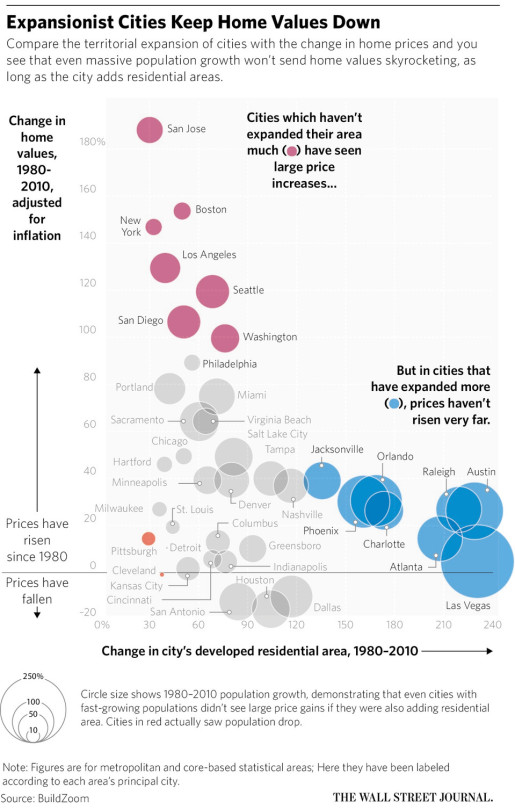
    The reality is that greenfield development (suburban sprawl) generally has far fewer barriers to development than urban infill development. So I’m not surprised to see cities like Las Vegas, Atlanta, and Phoenix clustered towards the bottom right.

    At the same time though, I’m obviously not convinced that sprawl is an optimal outcome. I think there are other costs not reflected in the chart above. So what’s the best solution here, assuming we want to build inclusive mixed-income cities?

  • Mega-cities vs. networked cities

    Morning fog by Yijiang Wu on 500px.com

    https://500px.com/embed.js

    Ed Glaeser, Giacomo Ponzetto, and Yimei Zou recently published a new academic paper called, Urban Networks: Spreading the Flow of Goods, People and Ideas

    The paper looks at whether it’s more advantageous to build huge and consolidated mega-cities or build connected networks of smaller urban centers (perhaps connected by high speed rail). As countries like China rapidly urbanize, this is something that many people are thinking about.

    In China, there is a lively urban planning debate
    about whether to facilitate the increased expansion of the vast agglomerations of Beijing and
    Shanghai or whether to focus on creating networks of cities that are smaller, albeit still much
    larger than almost all of the cities of Western Europe. The current government policy favors
    networks, in the hope that connected smaller cities may be free of the extreme downsides of
    mass agglomeration, such as extreme congestion, pollution and high housing costs.

    Like most things, there are real trade-offs. 

    In the paper, they assume that larger cities lead to more urban amenities, which in turn serves as an important magnet for skilled workers. However, for unskilled workers who may not care/benefit from the same urban amenities, it is possible for them to dislike the bigger cities. In this case, the benefits do not outweigh the negatives of urban expansion and an urban divide is created (rich/poor).

    One of the potential negatives is housing.

    The attraction of denser, not larger, mega-cities is determined also by the elasticity of
    housing supply. When it is easy to add extra homes on a narrow plot of land, as in Texas,
    then density becomes more attractive. European urban networks may well be the right
    answer because history and regulation makes it so hard to build in Europe’s older cities.
    Even though China has usually been quite friendly towards skyscrapers, the sheer scale of
    the Chinese population may still make the case for urban networks.

    If you’re interested in this topic, there’s a section (#2) in the paper on the history of urban networks that you might like.