Daily insights for city builders, delivered every morning at 6 AM ET. I’m Brandon Donnelly — a Toronto-based real estate developer and founder of Globizen. I’ve been writing here since 2013.

Tag: urban economics

  • Doom loop or boom loop?

    One of the interesting things about return-to-office trends is that there’s a meaningful difference between smaller and larger cities. In smaller cities, most people have returned to working in their offices. But in larger cities, this hasn’t been the case. This makes intuitive sense. Larger cities tend to have more expensive real estate (which forces people to decentralize) and, in turn, longer and more punishing commutes. So in a larger city, the individual benefits of WFH (i.e. having zero commute costs) tend to be far greater.

    However, in-person interactions are critical to what are known as agglomeration economies. This is why we have things like financial districts — because there are real economic benefits to even competing firms locating proximate to each other. WFH arguably reduces these benefits. And in this recent report called, Doom Loop or Boom Loop: Work from Home and the Challenges Facing America’s Big Cities, the authors, Richard Voith, David Stanek, and Hyojin Lee, have tried to estimate what these agglomeration losses might be for cities like New York, San Francisco, and Philadelphia.

    Here’s New York City:

    If you agree with their assumptions, then you might also agree with their policy recommendations. Among other things, the report argues that larger cities, like New York City, should be focused on promoting themselves to industries/jobs that benefit the most from in-person interactions, recognizing that WFH isn’t going away. At the same time, cities should understand that reducing the cost and increasing the pace of housing production also helps to reduce agglomeration losses. It keeps more people centralizing around a particular place.

    To download the full report, click here. It’s an interesting read.

  • Housing follows money

    One argument that you might be able to make is that home prices follow urban density. New York City, for example, is dense. And homes in New York City tend to be more expensive than those in, oh I don’t know, rural Canada. So with this, you might conclude that development and density are bad — it makes housing more expensive. But then there’s places like San Jose, California. It’s not very dense, and yet it has some of if not the most expensive housing in the US.

    Well, it turns out that housing density and median housing values don’t actually exhibit a particularly strong correlation. A better and much stronger relationship can be found in what Kasey Klimes explains, here, in this excellent post, which is that home prices more accurately follow incomes. In other words, the more high paying jobs that exist in a market, the more likely that housing will be expensive.

    Here is what that looks like for US metros over 1 million people:

    The above chart compares median home value to aggregate income per unit of housing. And here, Kasey discovers an r-value of 0.9, which suggests that “over 81% of median home values in large metros can be attributed to aggregate income per unit of housing.” This explains why San Jose, and San Francisco, are such outliers. They have very high incomes for every unit of available housing, despite the former being not all that dense.

    Okay, so now that we know this, how do we make housing more affordable? One option is to just make people poorer. If you reduce incomes per unit of housing, then home prices will, almost certainly, go down. And this is why poorer cities tend to have more affordable housing. But this is obviously suboptimal. The better option is to keep people wealthy and simply increase the denominator in “aggregate income per unit of housing.”

    Meaning: build more housing!

    Chart: Kasey Klimes

  • Ownership and participation — what cities share with Web3

    Here’s a cogent argument by Dror Poleg about how urban economics can be used to explain the evolution of Web3, and also why it’s all a bit of a ponzi scheme, but that when it works, it works.

    His argument revolves around ownership and participation. If you own real estate in a city, you could say that you are both a part owner of said city and a participant. You participate by virtue of living and/or doing other things there, but beyond that you also have a vested interest in the city doing well. Because if the city continues to do well and grow, there should be more demand for real estate, including yours, and that likely means your wealth will increase over time.

    This same force could be said to apply when existing property owners oppose new development. It restricts supply and increases the value of people’s existing “ownership” in a city. It’s kind of like being a company and not issuing new shares so as to not dilute your existing shareholders.

    This connection between ownership and participation is similarly a hallmark of Web3. In the world of crypto, users buy tokens (some fungible and some non-fungible) and those tokens provide access and rights to various things.

    For example, owning tokens might allow you to vote on key decisions affecting the overall organization. And if the organization does well and continues to grow, all token holders should, in theory at least, see their wealth increase. More people will want those same tokens. Ownership and participation.

    Web2 companies, on the other hand, do not typically offer this automatic connection between ownership and participation. That is, of course, unless you’re a shareholder. If you’re just a regular user of a platform like Instagram (which I am), but you don’t own any shares in Meta (I do not), then you’re only a participant.

    If you happen to be a widely followed influencer then you can certainly benefit indirectly from the platform, but you do not benefit from any sort of direct ownership in the organization. Pretty much everything accrues to the house.

    In fact, you also don’t own your followers, from which you derive your indirect benefit. Not to pick on Meta, but if Meta decided that your content was suddenly inappropriate for the platform, perhaps too salacious, then it could choose to close you down and your indirect benefits.

    This, of course, is one of the great promises of crypto and Web3. If you’re a part owner and you have some say in the way things are being run, you can maybe avoid this kind of outcome. And if things really aren’t working out, one should have the flexibility to take their followers and be extra salacious somewhere else.

    We shall see if this is ultimately how Web3 plays out, but the connection between ownership and participation is an interesting one and, if things do end up working out as planned, maybe it can be harnessed to improve our cities. Because we know the problems: inequality, housing supply and affordability, and many others. The system is clearly far from perfect.

    Photo by Adrian Schwarz on Unsplash

  • The vertical city

    We often talk about agglomeration economies in terms of their horizontal clustering within cities. But a new paper in the Journal of Urban Economics – summarized here by Richard Florida – has looked at the other dimension: the vertical clustering of economic activity within tall buildings. 

    Here is an excerpt from Florida’s piece in CityLab:

    Economic activity is also sorted vertically, with higher-profile and more profitable firms occupying higher building floors. Law offices are disproportionately represented on the highest floors, taking up more than a third of floor space above the 40th floor, compared to 12 percent of floor space between the second and 40th floors. Finance, insurance, and real estate take up roughly 20 percent of floor space above the 40th floor, compared to 23 percent between the second and 40th floors. Business services, engineering, and miscellaneous other industries are also more likely to take up more space below the 40th floor.

    The other takeaway is that there appears to be a greater rent premium attached to higher floors (vertical movement) than for being located closer to the central business district (horizontal movement). This surprised me. But I also don’t have access to the full paper. Is the dataset just US cities?

    Nevertheless, the idea of a vertical city interests me a lot. And I agree with the authors of the report that, for perhaps obvious reasons, it is far less studied compared to horizontal development patterns.

  • What’s happening in Melbourne?

    image

    I’ve never been to Australia, so take everything I’m about to say in this post for what it’s worth. I also don’t know much about Sydney and Melbourne, other than the fact that I’ve studied the latter’s laneways and the tremendous impact they’ve had on revitalizing the CBD.

    However, recently I’ve had a few close friends visit these cities for the first time and, since then, I have started noticing a trend. All of them come back and tell me the same thing, that they prefer Melbourne to Sydney. They say: “Yeah, Sydney is nice and beautiful and all, but it’s not all that exciting. Melbourne feels way more dynamic. Oh, and have you seen their laneways? You would love them.” That’s what they tell me.

    So that’s what I have in my head when I read that Melbourne is now the fastest growing city in Australia; that it’s one of the most liveable cities in the world; and that by as early as 2031 it could take Sydney’s place as the biggest city in the country. Below is a chart from The Australian. If you can’t see it, click here.

    //platform.twitter.com/widgets.js

    Some argue that this is happening because housing is cheaper in Melbourne (median dwelling price of ~$700,000 versus ~$1 million). And some argue it’s because the jobs are there and the city has become a cultural and sporting destination. Whatever the case may be, net migration is estimated to be somewhere around 100,000 people per year.

    My own view – and I’ve made this argument before on the blog – is that we shouldn’t underestimate the importance of cool shit when it comes to cities. People vote with their feet more than ever today. And for a growing segment of the population, cities are a consumer good.

    Indeed, in 2001, Edward Glaeser, Jed Kolko, and Albert Saiz penned a research paper called the Consumer city, where they argued precisely that. The premise was that historically we have tended to think of cities as being centers of production, but we should also be thinking about them as places of consumption.

    Here’s an excerpt:

    “But we believe that too little attention has been paid to the role of cities as centers of consumption. In the next century, as human beings continue to get richer, quality of life will become increasingly critical in determining the attractiveness of particular areas. After all, choosing a pleasant place to live is among the most natural ways to spend one’s money.”

    This is why those coffee shops and cool laneways matter. Some cities have unfair natural advantages. Los Angeles has weather. Vancouver has mountains. Montreal has poutine. But for the rest of us, the amenities typically form part of the built environment. They are a product of our choices.

  • Knowledge is more important than space

    I don’t always agree with economist Edward Glaeser, but I really enjoyed the talk that he gave at the Vancouver Urban Forum back in 2012 (at least part 2 of it). I came across it on Twitter today and, since it only has about 300 views, I figured that some of you also haven’t seen it.

    The argument he makes is that knowledge and education are the bedrock of cities. And since we continue to cluster in cities, despite all of our technological advances, knowledge is clearly more important than space. One of the ways he defines cities is by their lack of space and the closeness of the people.

    Of course, this isn’t anything new. If you’ve read his book Triumph of the City, you’ve heard all of this before. But that didn’t stop me from enjoying his talk. It’s a great overview of declining transportation costs, locational advantages, agglomeration economies, the importance of urban density, the impact of small and large firms in a city, and so on.

    I also really liked this idea that knowledge is worth more than space. So if you have 20 minutes and you want to get geared up about cities, have a watch.

    Click here if you can’t see the video below.

    [youtube https://www.youtube.com/watch?v=zg7aITkTNe8?rel=0&w=560&h=315]

  • The economic benefits of a winning sports team

    Jays Game 2 by Charles Bodi on 500px.com

    https://500px.com/embed.js

    I was having round 1 of (Canadian) Thanksgiving dinner with my father on Saturday night and we inevitably started talking about the Blue Jays.

    As I write this post, the Blue Jays are down 2-0 in the ALDS, but by the time you read this email in your inbox (assuming you subscribe), game 3 will have already happened. Either the Jays will be on their way to a great comeback or the season will be over. I am remaining fiercely optimistic.

    But in addition to the regular sports chatter, we also started talking about the possible economic benefits of the Blue Jays winning and being in the playoffs for the first time in decades. 

    We assumed that 50,000 people buying tickets, heading downtown, and spending money on food, alcohol, parking, transit, taxis, and hotels, would be a great benefit to the local economy. And immediately I thought to myself: this would make a great blog post.

    But it turns out that the local benefits of professional sports aren’t so clear cut.

    There’s been a lot of research on public funding for sports stadiums and a lot of the research suggests that it may not be in the best interest of taxpayers. A considerable amount of the spending does not get retained by the local economy and instead gets siphoned off to the respective league and to concentrated private interests.

    But Toronto already has the SkyDome, I mean, Rogers Centre. It’s a sunk cost. So looking forward, there must be some incremental benefits.

    Well, a recent article in the Chicago Tribune asked this same question in light of the Cubs heading to the playoffs. And it turns out that it’s also not so clear cut.

    Part of the problem is something called the “substitution effect.” When a sports team starts winning (and people jump on the bandwagon), money is simply redirected away from other forms of entertainment towards sports entertainment. In other words, instead of going to see a movie or going to the museum, people go to the game.

    In fact, a 2001 study by Dennis Coates and Brad R. Humphreys called, “The Economic Consequences of Professional Sports Strikes and Lockouts”, found that during sports stoppages, 37 metro areas with professional sports franchises actually experienced no negative financial impact. And in many cases they performed better.

    Interesting.

    Having said all this, there’s a powerful sense of solidarity that takes over a city when everyone is rooting for the same team to win. And that’s hard to attach a value to.

  • How immigration shaped Toronto and New York

    One of the things that Joe Berridge reminded me of in his talk yesterday, is that the story of Toronto is really the story of immigration. 

    In his words, Toronto has become the success story that it is precisely because we are good at taking in lots of immigrants and making them economically productive. 

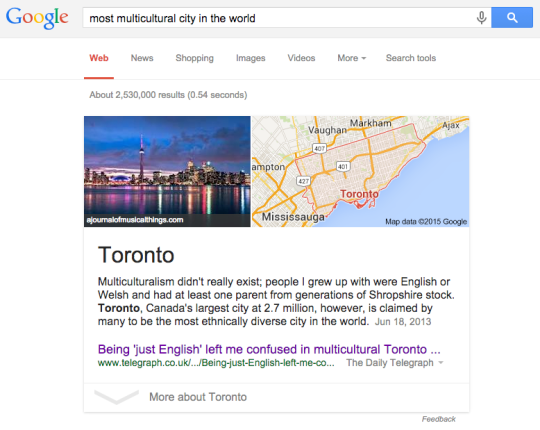
    Sure, there are many things that we could be doing better, but you don’t get to be the most multicultural city on the planet without doing a lot of things right. More than half of this city is now foreign born. The term “visible minority” is quickly expiring.

    image

    And more than anything else, this accomplishment is arguably what has allowed us to become the global city that we are. Click here for a fascinating chart from the Toronto Star that allows you to see the number and source of immigrants that have come to this city over the last half century.

    But of course, Toronto is not alone in this accomplishment.

    Urban economist Edward Glaeser wrote a great essay back in 2005 called Urban Colossus: Why is New York America’s Largest City? It’s an incredibly interesting read for those of you interested in cities and so I definitely recommend it.

    But the crux of his argument is that New York is the largest and most dominant city in America because of geography – specifically its deep harbor – and because of its success in manufacturing.

    What this meant is that New York became the center of shipping in the country and the point of entry for the majority of immigrants coming into the United States. But since transportation costs were still relatively high at the time, most immigrants arrived in New York and stayed in New York.

    Luckily, New York had a robust manufacturing economy – notably because of sugar refining, publishing and printing, and the garment industry. This allowed the waves of immigrants flooding into New York to become economically productive.

    From 1850 to 1920, the population of the New York grew about 800% from roughly 700,000 people to over 5.6 million people.

    So the moral of the story is simply that immigration has and will continue to play a pivotal role in the shaping of our cities. Canada has a sub-replacement fertility rate somewhere around 1.61 births per woman (2012). This is lower than that of United States, which is around 1.88 births per woman.

    That means that without immigration, we do not grow. We shrink. And that’s usually not a great thing for economies.

  • Top 10 (US) cities for young smart people

    image

    I’m always on the lookout for great websites and communities dedicated to cities. And today, thanks to a friend of mine, I found a new one called City Observatory. It’s my new favorite site for city geeks.

    They describe themselves as a “data-driven platform for sharing, analyzing and discussing the success of cities.” As soon as I read that, I immediately subscribed. I’m a big believer in using data to elevate the discussions happening around our cities and to cut through the bullshit.

    I’m looking forward to digging into more of their articles, but I did already take a look at the first report they published, which is called: “The Young and Restless and the Nation’s Cities”. Click here to download the PDF.

    What the report talks about is a demographic group that they refer to as “Young and Restless”, and which they define as being 25-34 years old and having a 4-year degree. And they focus on this group because they see it as critical to driving local economic development.

    They’re the next generation who are going to start those companies and drive growth and innovation. And since the data shows that as people age, they become less willing to relocate (which intuitively makes sense), cities today are quickly realizing that they need to capture this group of smart people while they’re still restless (i.e. mobile).

    So if this is important, which cities (in the US) are winning right now? Here are the top 10 cities via City Observatory:

    1. Washington D.C. 8.1%
    2. San Francisco 7.6%
    3. Boston/Cambridge 7.6%
    4. San Jose 7.5%
    5. Denver 7.5%
    6. Austin 7.0%
    7. New York 6.6%
    8. Minneapolis 6.6%
    9. Raleigh 6.5%
    10. Seattle 6.1%

    The percentage represents the portion of the population that’s 25-34 years old and has a 4-year degree. I’ve just listed the cities here, but in reality they reference the entire metro areas.

    Do any of the cities on this list surprise you? None are surprises for me. It’s more or less what I would have expected to see, except maybe for the absence of Chicago (it’s 12th according to this ranking).

    Is your city doing enough to capture this group?

    Image: Flickr

  • Stuck in condoland?

    Toronto Life recently published an interesting article called Stuck in Condoland. A lot of people have mentioned it to me, so there seems to be a lot of interest in the topic. It basically profiles the lives of a few young families who live downtown and are trying to raise young children in relatively small condos (think 700 square feet).

    I thought it was interesting because I like the idea of small and efficient living. The average post-war bungalow in Toronto was probably less than 1,000 square feet. And so this modern notion that you need a big house in order to properly raise a family is a relatively recent phenomenon. Although we’re a richer city today and that’s what happens when people become wealthier: they consume more.

    But the article also makes it seem that developers only want to build small condos and that larger condos and single-family homes just aren’t profitable enough. Thus the reason all these families are being forced to into tiny shoeboxes in the sky. But that’s not really true.

    Look, just like every other for-profit business on the planet, developers are concerned with making money. And so they will always look for ways to increase efficiency, drive down costs, and so on. But there are certain realities of the market that developers don’t have control over.

    First, developers aren’t building new single family homes in the city (at any sort of meaningful scale) because there’s no land to do so. And because the land use policies in place and the current thinking around how we can more sustainably build our cities for the future dictate that we should be building more intensely. In other words, building up. So it’s not a question of developers not wanting to build single family homes; it’s a question of not being able to.

    Second, trust me when I say that if the market wanted large 3 bedroom family units, developers would build them. Mandating them is a useless exercise if people don’t want them or are unable to afford them.

    The challenge we face is that a reinforced concrete condo tower is more expensive to build than a wood-framed single family house. So until land values get to a point where single family homes become the more expensive option (compared to condos), I don’t think we’ll see a huge rush towards 3+ bedroom suites.

    This is my hypothesis at least. Because when you buy house, you’re really buying two things: the house itself and the land. If the house itself (wood) is cheaper to build on a per square foot basis than a condo (concrete), then the variable that will make a difference is the land. And as people like to say: “buy land, they ain’t making any more of it.”

    So what I’m saying is that I just don’t think the situation is as simple as: “developers are bad, all they want to do is build tiny condos and make lots of money.” It’s more complicated than that. But I do believe the question of how families are going to live in the city is an important one.