Daily insights for city builders, delivered every morning at 6 AM ET. I’m Brandon Donnelly — a Toronto-based real estate developer and founder of Globizen. I’ve been writing here since 2013.

Tag: up express

  • Two-way, all-day regional rail

    Neat B and I had a very good friend’s 40th birthday dinner in the Junction this evening.

    So naturally, we walked over to the UP Express station from our offices in the Financial District and took the train one stop to Bloor Street. When we got off — along with everyone else who uses our airport link as a regional express train — we then walked the West Toronto Railpath up to the restaurant on Dupont Street. All in all, it took us about 35 minutes. We hopped on the 5:30PM train and we arrived at Lucia around 5:50PM.

    I know that a lot of people use this particular train to get to and from work, but I’m always so happy whenever I do it. I will take this over being stuck in traffic every day of the week. And for me, it is a powerful reminder of just how critical “two-way, all-day regional rail service” is to this urban region. We can talk all we want about better traffic signals, ramping up enforcement, or whatever, but the real solution to solving traffic congestion is getting people moving in other ways.

    Anyway, I digress. Here’s a photo of the delicious pasta we had:

    Happy birthday Philip!

  • New York City rolls out contactless fare payment at every single subway station

    I’m late to the party here, but I was reading this morning about how New York City recently completed the rollout of its One Metro New York (OMNY) fare payment system. What this does is allow you to use contactless payment systems, like Apple Pay, to get on the subway. ONMY is now available across the five boroughs on every bus and at all 472 subway stations (feel free to impress your friends at virtual parties with this stat).

    Metrolinx here in Toronto is similarly piloting contactless payments on the Union Pearson Express. You now have the option of tapping a credit card, a phone, or a watch. Maybe this doesn’t seem like such a big deal, but I still remember when the PRESTO payment card was first rolled out — it felt late to me. Apple added near-field communication (NFC) to iPhone in 2014, and at that point I think it was fairly obvious that standalone payment cards wouldn’t be around much longer.

    That time has arrived for New York City and will be hopefully arriving shortly for Toronto. And I think it will be particularly useful for tourists who may not have a Metrocard (NYC) or PRESTO card (Toronto) and just want to jump on a train. I’ve only taken the subway a handful of times during this pandemic, but I’ll be back at it once the world fully resumes. And I definitely can’t wait to take the UP Express to the airport again (and to the Junction).

  • The 50 coolest neighborhoods in the world

    There’s a stretch of restaurants and bars on the south side of King Street, west of John Street, here in Toronto, that I generally try and avoid. I won’t name names, but if you’re from Toronto, you know what I’m talking about. With all due respect to the business owners, I think of this stretch as tourist row. All cities have them. Usually the identifying marker is a human on the street with a menu trying to entice you to come inside and eat. And there’s nothing wrong with that. I can appreciate good street hustle.

    But whenever I’m traveling and trying to find a place to eat, I’ll often think to myself, “Oh man, is this the (insert city name here) equivalent of tourist row? I see people on the street with menus in their hands. Could be.” This is one of the reasons why I like Time Out’s recent “definitive list of the planet’s cultural and culinary hotspots.” They surveyed over 27,000 city dwellers in order to figure out where locals actually want to hang out. The result is the 50 coolest neighborhoods in the world.

    I am somewhat embarrassed to say that, I think, I’ve only been to 6 of them. I have work to do. But Toronto does make the list — once — and it is none other than the Junction. Their recommendations, here. However, one thing they did miss was the Union Pearson Express. That is the way to get to the Junction from Union Station and it is, clearly, still under the radar for most. The number one spot on their list goes to Arroios in Lisbon, which is actually beside where I stayed when I was there this summer. Damn that city is cool.

    For the full list of neighborhoods, click here.

    Full disclosure: I am not a neutral observer. We are developing in the Junction. And I am moving to the Junction (and trying to pretend to be cool).

  • 10 reasons to visit Philadelphia right now

    image

    Today’s ATC post – which happens to be a guest post – is coming to you live from on board the UP Express train that runs from Union Station in downtown Toronto to Pearson Airport. (Everywhere should have free wifi.)

    I’m on my way to Philadelphia and I’ve been wanting to try this train since it opened earlier this summer. It feels great to finally ride it. It’s everything I could have hoped for. It even has that new car smell 🙂

    Last month I wrote a post called, 10 reasons to visit Toronto right now. It was in honor of my good friend Alex Feldman’s visit. Well now it’s my turn to visit Philadelphia and he has decided to return the favor and do a Philly version of that same post. 

    Alex is to Philadelphia what I am to Toronto. He grew up in Philly. He was educated in Philly (we went to Penn together). And he’s super passionate about the future of Philly. And I think that’s how everyone should be about their city.

    So I hope you enjoy his list of 10 reasons to visit Philadelphia right now. It’s basically my to-do list for this weekend.

    ———————————————

    10. World Heritage City: Philadelphia is on track to become the first World Heritage City in the United States. This UNESCO designation will underscore the city’s historic importance as the birthplace of American Democracy as well as the historic urban fabric which gives the city it’s walkable, urbane character.

    9. Shopping: Philadelphia has come a long way as a shopping destination. Conde Nast Traveler recently ranked the city as number 2 out of the best shopping destinations in the world. 3rd Street in Old City has become a hotbed for independent boutiques while Rittenhouse Square has attracted new chains such as Uniqlo, Theory, and Vince. More is on the way with a complete re-make of the Gallery shopping mall slated to start soon and the new East Market complex under construction. 

    8. The Pope is Coming:  In case you haven’t heard, Pope Francis will make his first visit to the United States – with a 3 day visit to Philadelphia in late September. The visit will coincide with the World Meeting of Families gathering. A crazy number of visitors (2 million?) are expected to descend on the city – causing Philadelphians to panic, complain, and attempt to rent their houses for ridiculous amounts of money. But this important visit will help raise the profile of the city on the international stage.

    7. Building Boom: There is probably more development happening in Philadelphia right now then any other time in recent history. The skyline is growing with additions by Norman Foster, Cesar Pelli , and Kohn Pedersen Fox. New apartment buildings, condos, and rowhouses are under construction across the city (rental vacancy rates are less than 2%). In addition the Barnes Foundation and the new Singh Center for Nanotechnology mark impressive additions to the city’s architectural landscape.

    6. Public Spaces: Philly’s public realm has seen massive investment over the last several years. A complete remake of the landscape outside of City Hall has become the new Dilworth Park. The designers of NYC’s highline have added two public spaces to the city (Race Street Pier and the new Central Green in the Navy Yard). And Schulkill Banks recently added a new boardwalk which the New York Times raved about when they ranked Philly as the number 3 city to visit in 2015. More is on the way with the first phase of the Reading Viaduct Rail Park expected to start soon.

    5. Waterfront: Philadelphia’s Delaware River waterfront has long been cut off from the city by interstate 95. Things have started to change recently, with new trails and pier parks recently added to the working waterfront. Even Penn’s Landing, the city’s much maligned waterfront attraction is seeing improvements – including the tremendously popular Spruce Street Harbor Park – a pop-up park featuring floating beer barges, shipping container food stands, and tons of hammocks.

    4. Food: Philly is one of the best food cities in the United States. So much is happening right now in the city’s dining scene, it’s hard to keep track of the latest restaurant openings. Neighborhoods such as Fishtown and East Passyunk have emerged as hot dining districts with BYOB chef driven restaurants. More can be gleaned from the Washington Post which recently summarized the dining scene better than I can.

    3. Pop-up Gardens: One of the best reasons to visit Philly in the summer is the opening of the Pennsylvania Horticultural Society Pop-Up gardens. The wildly popular beer gardens, began several years ago as an initiative to remake underused or vacant lots into useful public spaces. This summer, 2 gardens – one on 15th and South and one at 9th and Wharton have been transformed into vibrant spaces for eating, drinking, and hanging out.

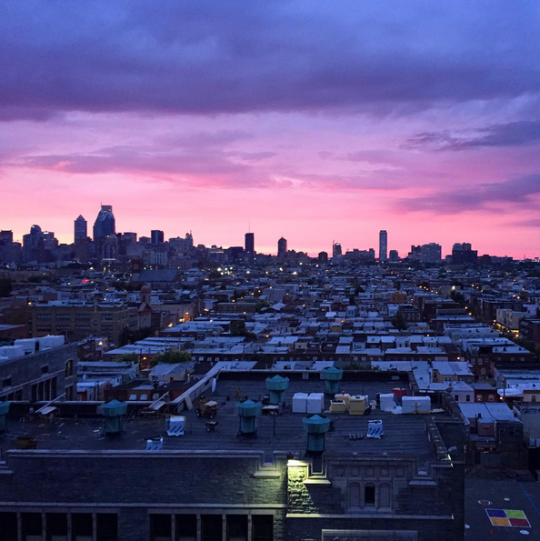
    2. Le Bok Fin: Speaking of temporary uses, the most recent addition to Philly’s pop-up (or iterative placemaking) scene is a rooftop bar called Le Bok Fin. Situated on the 8th floor of an old vocational high school in South Philly (and named after the school’s restaurant – which in turn is a play on one of Philly’s most famous French restaurants). This is the first iteration of development at what is planned to become an amazing new center for creatives inside the old school – being led by Lindsey Scannapieco and her team at Scout LTD. Check out Le Bok Fin for incredible views of the city skyline (especially at sunset).

    1. Bike Share: While a little late to the party, Philly recently launched it’s own bike share program – which is proving to be a huge success. Dubbed Indego, the new bike share is easy to use, has 60 stations, more than 600 bikes and is becoming one of the best ways to hop around town. Check one out and go explore Philly!

    Image: Alex Feldman

  • 10 reasons to visit Toronto right now

    https://500px.com/embed.js

    Next weekend a good friend of mine from architecture school will be visiting Toronto from Philadelphia. And I’m really excited to show him the city. (Next month it’s my turn to go to Philadelphia.)

    He’s a fellow city geek. He hasn’t been to Toronto in a number of years. And I haven’t seen him since our trip to Detroit 2 years ago.

    For those of us living and working in Toronto, there’s a lot to celebrate. Sure the Gardiner Expressway East decision didn’t go as I – as well as many other urbanists, including our Chief City Planner – had hoped. But there’s no shortage of other things to brag about.

    So here are 10 reasons to visit Toronto right now:

    1. We’ve created an entirely new business district south of Union Station called South Core. Now the region’s primary mobility hub is in the middle of the country’s most important business district, as opposed to on the edge of it. It’s a better use of infrastructure.

    2. We now have a dedicated train (the Union Pearson Express) that takes you from the country’s busiest airport directly to downtown in 25 minutes. You’ll find local retailers at the stations and a brand created by the brain behind Monocle Magazine. You can even use a smart card to ride it and our local transit system.

    3. We didn’t shut down Uber. Instead our mayor wants to create new policy that will allow these services to coexist with conventional taxi services. We don’t yet know how this will turn out, but I believe it’s a step in the right direction. It’s Toronto taking a leadership approach to innovation as opposed to trying to stomp it out.

    4. We are about to host the largest sporting event in Canadian history. The 17th Pan American Games will have double the number of athletes competing as the 2010 Winter Olympics in Vancouver.

    5. We created an entire neighborhood from scratch in order to house all of these athletes (Canary District). And I think it’s destined to become one of Toronto’s great neighborhoods. I’m saving my first visit for next weekend, so expect a follow-up post on this.

    6. We are dramatically rethinking this city’s public realm. From the plaza out front of Union Station to the new Queens Quay Boulevard along the waterfront, we are prioritizing people and creating more complete streets. It has given Toronto an entirely new urban feel.

    7. We are slowly starting to embrace our forgotten laneways and alleys through the help of organizations like The Laneway Project. And this is going to eventually lead to a further rethink of our pubic spaces and urban fabric.

    8. We continue to be one of the fastest growing cities in the world (certainly in the developed world). As a result, we are building some really exciting buildings by some of the top architects in the world. This includes everyone from Norman Foster to Frank Gehry.

    9. According to a recent report coming out of the Martin Prosperity Institute, Canada is one of the most creative and globally competitive countries in the world, as well as the most open to “ethnic and religious minorities and gay and lesbian people.”

    10. The ATC community is in the process of identifying a new, quintessentially Toronto food dish. But since we have every type of imaginable cuisine here, we’re struggling to pick just one. When you visit, you can help us identify the best and most Toronto dish.

    So there’s a lot to be excited about. I for one can’t wait for us to host the Pan Am Games, starting tomorrow. It’s a chance to show off this great city. 

    So if you’re also in town next weekend and want to geek out about cities, drop me a line.

  • Where should Toronto’s relief subway line go?

    Those of you from Toronto might be aware that the city is currently assessing the possibility of a “relief subway line” that would connect the downtown core back up to the Bloor-Danforth subway line in the form of a stretched out “U”.

    The reason this line is being called a “relief line” is that – in addition to providing local service all across downtown and its “shoulders” – it would also relieve much of the pressure that the Yonge-Bloor interchange is facing today. Instead of always having to connect at that location, passengers coming from the east and west would be able to do so sooner as a result of this new subway line (bypassing Yonge-Bloor).

    For those of you who are regular readers of ATC, you might know that I’m a big supporter of this relief line. I believe it should be our number one transit priority. It’s going to cut through areas of the city that have some of the highest population and employment densities, and so it’s an area where I think subway makes sense. The ridership would be there.

    Many people at the city also seem to agree:

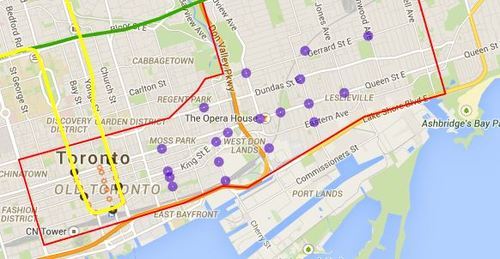
    Given that an assessment is currently underway, the city is looking for feedback from the public. One of the ways you can do that is by clicking here. The site will allow you to comment on the potential station locations (shown below using purple circles). I did it this morning and I would encourage you to do the same if you’re from Toronto.

    For clarity, this current study is only for the eastern portion of the relief line (study area is outlined in red below).

    image

    Once you’ve given this some thought, I’d love to have a discussion in the comments about where you think the relief subway line should go (or if you even think it’s a good idea in the first place).

    My initial thought is that it should connect into King station, run along King Street East, merge with Queen Street East near the Don Valley, go through Riverside and Leslieville, and then start making its way north to Danforth Avenue.

    My reasons are as follows:

    • King Street East is the most vibrant pedestrian street on the east side of downtown. There isn’t enough commercial activity further south.
    • King Street would allow it to eventually cut right through the Financial District when it heads westward.
    • The connection to Union station (for GO Transit, VIA Rail, and the Union-Pearson Express Train) would be manageable from King Street. Plus, SmartTrack may feed directly into Union.
    • King Street is roughly the midpoint between Queen Street and Lakeshore Boulevard. And if you place it too far south, it would take away from the proposed Queen’s Quay LRT line.
    • Having it merge into Queen Street near the Don Valley would allow it to service both Regent Park to the north, as well as the West Don Lands neighborhood to the south. It would also allow for a connection to a Cherry Street LRT line servicing the future Portlands neighborhood.
    • Queen & Broadview is emerging as a major node with a significant amount of density in the pipeline. And further north, Dundas & Carlaw is similarly seeing a lot of intensification.

    But I may have missed a few things. These are just my thoughts. What are yours?

  • To drive or not to drive

    I’m writing this post from some lounge called Apropos at Toronto’s Pearson Airport. I’m waiting to board my flight to Denver and kick-off the 5th Penn Annual. Technically, the Annual is being held in Jackson Hole this year, but 2 of us are jamming in a few extra days in Vail beforehand. I like to make the most of these trips.

    As I was arriving at the airport, I made sure to check up on the status of the new Union Pearson (UP) Express station that’s currently under construction and slated to open in spring 2015. Once the line is complete, Union Station and Pearson Airport (Canada’s two busiest transportation hubs) will be connected by a 25 minute express train operating every 15 minutes. I’m pretty excited about this.

    One of reasons I’m excited is because I think that really great cities should be easily navigable without a car. I’m not saying that cars shouldn’t be allowed or that we should make life purposely difficult for drivers; I’m saying that the decision of whether or not to use a car should be entirely personal. Some parts of Toronto meet this criteria, but other parts most certainly do not.

    One of the parts that doesn’t is the trip to Pearson. Today, getting from downtown to Pearson on public transit is a terrible experience. I don’t recommend it. And so you’re basically forced to drive, get a ride or take a taxi. That’s fine, but it’s not ideal—particularly for non-residents.

    I like to think of visitors to a city as customers of that city. From the moment they land in the airport, they’re now using your product or service. And for most people, the first thing they’re thinking about is how they’re going to get to where they need to go. How are you going to help them?

    If you can put them onto an express train, and quickly and comfortably bring them into the city, then you’re already impressing them. Unfortunately though, we often don’t think of visitors in this way—unless you’re hosting some major event like, say, the Pan American Games. Then you really start to think about customer experience.

    Either way, the Toronto experience is about to get a whole lot better next year. And I’m excited about that.