Daily insights for city builders, delivered every morning at 6 AM ET. I’m Brandon Donnelly — a Toronto-based real estate developer and founder of Globizen. I’ve been writing here since 2013.

Tag: university

  • Dendrochronology of U.S. immigration

    I can’t remember where I found it, but I recently stumbled upon this video simulating the dendrochronology of U.S. immigration from 1830 to 2015. 

    It is part of an ongoing project by Pedro Cruz, John Wihbey, Avni Ghael, and Felipe Shibuya, and is supported by Northeastern University.

    As its name suggests, the video (and broader study) uses the metaphor of a tree (and its growth rings) to explain historical immigration to the U.S. 

    If you can’t see the video below, click here.

    [vimeo 276140430 w=640 h=280]

  • Winner take all

    We have talked a lot on this blog about the concentration of economic activity in global cities. Here is an old post about a paper called “winner-take-all-cities”, which documents the overrepresentation of talent, economic activity, innovation, and wealth creation in a select number of alpha cities.

    But this same phenomenon is playing out in a myriad of different ways. Aaron Renn calls this the “superstar effect” and has been writing about it for years. Another more recent example is this post by Richard Kerby called: Where did you go to school?

    Kerby looked at where venture capitalists in the US went to school and discovered that around 40% of them have gone to one of two schools: Stanford or Harvard. His argument is that not only is the venture capital industry lacking in gender and racial diversity, but it’s also lacking in cognitive diversity.

    My point with this post, though, is one of hyper-concentration. Tech is a dominant force in today’s economy. And in 2017, nearly 45% of all venture capital investment in the US went to companies located in the Bay Area – meaning San Francisco and San Jose.

    So here is an example of a select number of schools training a select number of minds that then go on to invest in a select number of cities. Fred Wilson, who is a venture capitalist, has a good response to this problem of diversity in the VC industry.

    But, of course, this is bigger than just the VC business.

  • Apple and the humanities

    image

    This morning I came across two news item that are interesting in their own right, but also have a noteworthy relationship.

    $AAPL now has a market cap that exceeds $1 trillion. And not surprisingly, everyone, from the New York Times to Bloomberg (photo essay), is talking about it.

    But the one thing that continues to stand out for me about this story is what Steve Jobs said back in 2011 when he unveiled iPad 2.

    He said that fundamental to Apple’s DNA is its ability to marry technology with the liberal arts and the humanities. Its secret sauce is not technology alone.

    Now let’s move on to the second piece of news that caught my attention.

    As of 2017, less than 5% of college and university students in the US were studying one of the big four humanities majors – a sharp cliff-like drop from 2011 according to this data.

    That’s almost certainly because business degrees and STEM degrees are thought to be more valuable and in demand in the labor market. And I’m sure they are right out of school.

    But perhaps we shouldn’t forget Apple’s trillion dollar lesson. And I think this goes for both the tech space and the real estate industry, as well as others.

  • New School of Cities

    The University of Toronto just announced a new School of Cities. It will begin operations on July 1 of this year (2018) and bring together researchers from various disciplines to address the world’s most critical urban challenges. 

    Insert stat here about the percentage of the population that will live in an urban area by 2050.

    There are more than 220 faculty members across 40 different academic divisions at the University of Toronto who are doing urban-focused work. The School of Cities is intended to bring those minds together.

    So far there are plans for a “global cities summit” and an “urban lab” that will also bring students, faculty, industry, and government together. The intent is for the School to act as a city builder both locally (Greater Toronto Area) and globally.

    This once again goes to show just how important we are all taking urban issues today. But I am sure this blog audience didn’t need to be reminded of that.

    If you would like to sign up for updates from the School of Cities, you can do that here.

    Photo by Jorge Vasconez on Unsplash

  • Assortative mating at elite colleges

    When demographers talk about how educated a city or place is, they often refer to the percentage of the population with a 4-year college degree. This may seem crude, but so far it has been found to be one of the best predictors of higher income levels and overall urban prosperity.

    When you add in the fact that people tend to marry people that are similar to themselves – often called assortative mating – you get a driver for income inequality. People with high incomes are marrying other people with high incomes.

    In this recent New York Times article they dive into the sorting that can happen even within colleges, including elite colleges. 

    According to data from the Equality of Opportunity Project, if you were born between 1980 and 1984, went to Princeton, and came from a family with a household income in the top 20%, you had a 56% chance of being married by the time you hit 32-34 years old.

    However, if you came from a family with a household income in the bottom 20%, you only had a 34% of being married by the time you hit the same age bracket. One possible explanation is that if you’re from a lower income family, you simply aren’t privy to the same “clubs”, where people mate, even though you still got into Princeton.

    To reinforce this point even further, the above data suggests that only about 1.3% of Princeton students that come from a poor family will ultimately end up a rich adult. About 72% of Princeton students come from a household in the top 20 percent.

    When I look at the numbers for Penn, my alma mater, the marriage spread isn’t quite as dramatic. The marriage rates are 55% and 48%, respectively, for the top and bottom 20%. Maybe that makes it more egalitarian. Or maybe not.

  • Visualizing the origins of MIT’s international students

    “Like the United States, and thanks to the United States, MIT gains tremendous strength by being a magnet for talent from around the world. Faculty, students, post-docs and staff from 134 other nations join us here because they love our mission, our values and our community.” -L.Rafael Reif, MIT President

    The MIT Senseable City Lab recently analyzed nearly 20 years of ethnographic student data in order to visualize the origins of its international faculty, students, and researchers from 1999 to the present.

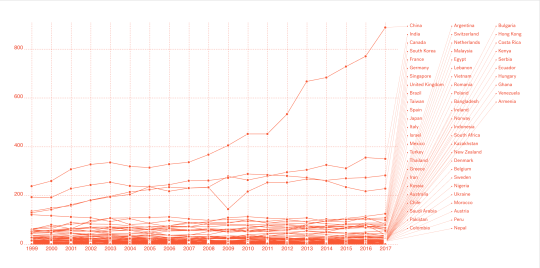
    The above chart may be a bit small (larger version here), but it shows all students (undergraduate, graduate, and visiting/others) by country. The top 5 countries are China, India, Canada, South Korea, and France.

    To give you some sense of the math, there are 3,808 international students at MIT as of 2017. 888 of them alone are from China – mostly at the graduate level (688 out of the 888). So China represents almost ¼ of MIT’s international student population.

    Another thing that stood out for me was the drop off in Canadians in 2009. You can see that “V” roughly in the middle of the chart. Canada went from 233 to 144 students. I wonder if this had something to do with the economic climate at the time. Not sure.

    Click here to see all of the visualizations. 

    Note that you can toggle by region and country, as well as by “Trump’s EO Countries.” That feature, as well as the quote at the beginning of this post, should give you an immediate appreciation for some of the motivations behind this exercise.

    Images: MIT Senseable City Lab

  • A sneak peek of One Spadina Crescent

    Earlier this week I got a sneak peek of One Spadina Crescent – the new building for the Daniels Faculty of Architecture, Landscape, and Design at the University of Toronto. 

    The renovation and addition was designed by the Boston-based firm NADAAA. And let me tell you, it’s absolutely spectacular.

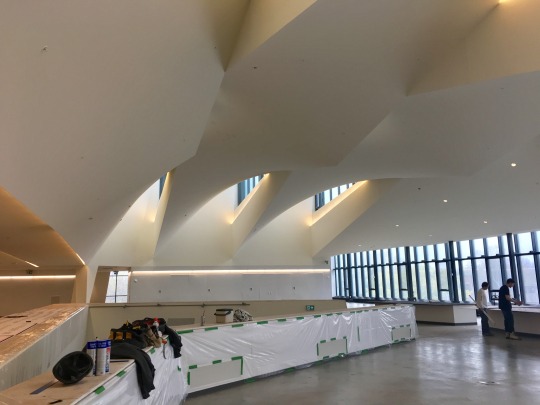
    I was in a rush at the time and I didn’t have my real camera on me, but I managed to quickly grab this snap:

    It’s of the third floor. 

    What you see in the middle are steps leading down to an “open bleacher space” that functions as a crit space and as an oculus that brings light into the core of the building. In the middle of the building is a large flex space.

    Because the building effectively sits in the middle of Spadina Avenue, the windows on the right side (above) look directly up the street, as if you were standing in the middle of it. I wish I had betters photos to share with you all.

    When you’re an architecture student, you spend almost all of your waking time in studio. I can certainly think of worse buildings to be cooped up in. I’m excited to see it in full swing come September.

    Click here if you’d like to see renderings of the building.

  • My identity crisis

    If you’re a regular reader of Architect This City, there are many things that you might know about me

    You might know that I was initially trained as an architect, but that I immediately transitioned into real estate development after grad school (where I studied both architecture and real estate).

    After becoming a real estate developer, you might know that I completed an MBA with a focus on innovation and entrepreneurship (which happened by default as a result of the electives I ended up being interested in).

    And finally, you might know, given the content of this blog and my startup history, that I have a significant interest in technology. More specifically though, you might know that my interest is in figuring out how technology will continue to infiltrate and impact “non-tech” industries such as real estate.

    But what you might not know is how I even ended up in architecture and real estate in the first place. Unlike a lot of people who seem to have grown up wanting to be an architect – perhaps because they had a relative who was one – I didn’t decide to study architecture until a bit later on.

    Growing up my primary interests were: art and computers.

    During high school, my art teachers used to tell my parents that I was going to be an artist. And my computer teachers used to tell my parents that I was going to be a computer geek – or maybe they said computer scientist.

    Maybe it had to do with timing and the emergence of the commercial internet in the 1990s, but computers sort of won out during that point in my life. I spent a lot of time building them from scratch, playing with software, and asking my mom not to pick up the phone because I was literally dialed-in to the internet.

    So when it came time to enrol in university, I fairly effortlessly decided on computer science. It just seemed to make sense. But after about a year I realized that it wasn’t for me. I didn’t love programming like my classmates did and the thought of doing it for a living scared me.

    At the same time, I felt like I needed to feed the artist in me. I wanted something both artistic and technical. So I decided to drop out of computer science and give architecture a try. It just seemed like the perfect marriage of my interests.

    I immediately fell in love with architecture. And I spent the next 7 years studying it across 2 degrees.

    But during that time, two things hit me. First, I came to the realization that real estate developers are the ones who really have the most say in terms of how our cities are built. And second, that technology was having a massive impact on business and life.

    This told me that design alone wasn’t going to be enough. I also needed to engross myself in real estate, finance, business, and technology. So that’s what I set out to do. And I really enjoyed it. On the technology side, it felt like I was coming full circle in a way.

    But today, I feel a bit like a 3 legged stool. There’s the design leg. The real estate/business leg. And the technology leg. And oftentimes I feel like life would be a lot simpler if I could just balance on one of those legs – instead of trying to stand on all three. But that’s simply not me.

    These are my passions and I need all of them to stand-up.

  • Education is what drives urban economic success

    The following chart is from City Observatory. It compares per capita income against the college attainment rate for the largest US metropolitan areas. If you hover over a circle it’ll tell you the metro area and what the precise numbers are. If you can’t see the chart below, click here.

    https://public.tableausoftware.com/javascripts/api/viz_v1.js

    What they found from this data set is that educational attainment – the percentage of the population with a 4-year college degree – is the single most important factor when it comes to urban economic success. In fact, according to City Observatory, it accounts for 60% of the variation in per capita income across the metro areas listed above. That’s huge.

    So even though people like Peter Thiel might be encouraging kids to drop out of College and start a company, having a well-educated population is a really important thing for cities. Actually, it’s the most important thing.

  • MBA

    image

    Today was my MBA convocation at the University of Toronto’s Rotman School. Though I actually finished my degree last year (with a bit of fast-tracking), I had to wait until today in order to formally graduate with the rest of my cohort. I did what’s called the 3-year morning MBA. What that means is that I took most of my classes at 7am.

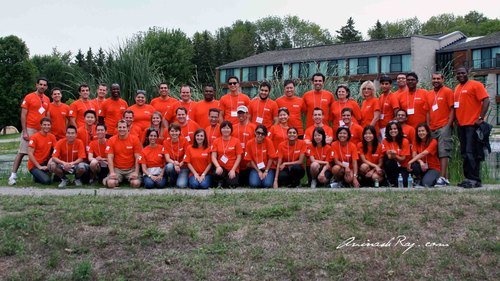
    The picture above is from our weekend retreat right before we started the program (I’m in the back row in the middle). It was taken in the summer of 2011. That feels like eons ago. It has been a tough slog.

    So today I’m taking the day off from writing about cities. Instead, I’m just going to enjoy the day off and the closing of this chapter in my life. An MBA is something I had been planning on doing even while I was in architecture school–so it’s nice to be able to check it off. But as I told my parents today after convocation: you ain’t seen nothing yet.