Daily insights for city builders, delivered every morning at 6 AM ET. I’m Brandon Donnelly — a Toronto-based real estate developer and founder of Globizen. I’ve been writing here since 2013.

Tag: university of waterloo

  • An Ethereum story

    We’ve spoken about Vitalik Buterin before.

    He is the inventor of the Ethereum blockchain, and its most prominent figure. He also happens to have grown up in Toronto. He went to the University of Waterloo. So when I wrote this post back in 2021, I asked: Why the hell is nobody talking about this? Why are we not celebrating the fact that our great city helped birth one of the most important technologies of our time? You couldn’t ask for a better economic development story. Well, I guess the answer is twofold. Crypto isn’t mainstream. Even back in 2021 when things were frothy it wasn’t. And, we’re awful at promoting and driving a global brand for our city. Both of these things need to change. So if you’re interested in learning more about Vitalik and Ethereum, you should check out this new movie (trailer) called Vitalik: An Ethereum Story. To watch it, go to ethereumfilm.xyz and mint the NFT for $20. You’ll then be able to stream it. I haven’t done this yet, but I’ll be doing it very soon. All of the proceeds from the NFT sales will go toward getting a more mainstream distribution deal.

    So by watching, you’re helping.

    Update: I watched it. It’s great.

  • Quietly booming tech town

    We have all seen these headlines before, so it’s not so under the radar for us. But the New York Times just published this article about Toronto calling it a “quietly booming tech town.” Depending on how you want to measure things, Toronto is now the third largest tech hub in North America after Silicon Valley and New York City (or at least that’s what the NY Times is telling me). The article touches on some of the ingredients for this success, but let me be a bit more explicit in this post because I think it is particularly relevant right now.

    Canada is a “Western” country. What does that mean? It means that we’re a democracy, we have the rule of law, we respect individuals (including private property), and we allow for pluralism of opinion, along with many other freedoms. These are all wonderful and magical things that are sometimes taken for granted. But I couldn’t imagine living in a place that doesn’t allow for such freedoms, nor would I want to.

    On top of this foundation, we have two other important ingredients: extraordinary universities, like the ones mentioned in the article (University of Toronto and University of Waterloo), and some of the most liberal immigration policies in the world. Our borders are open for the smartest and most ambitious. With just these handful of things — freedom, rules, education, and talent — we can screw up a lot of other stuff and still accomplish some pretty great things. I may be oversimplifying, but probably not by much.

    Humans are wonderfully talented. Let people be and they’ll show you. Because history has shown us time and time again that the above recipe works remarkably well. (Related post: Do the best cities have a lot of immigrants?)

  • Planning dinner, smart cities, and privacy

    image

    This evening I attended the 27th Annual Toronto Planning Dinner. It’s an annual dinner for people in planning and development, put on by the University of Waterloo Planning Alumni of Toronto. Thank you Wood Bull LLP for the invite.

    The keynote speaker was Dr. Anthony Townsend. He is the author of SMART CITIES: Big Data, Civic Hackers, and the Quest for a New Utopia. I haven’t read it (yet), but his talk offered a preview of it and I think it would be of interest to all of you.

    It deals with many of the topics that we discuss on this blog, one of which is the interrelationship between our physical environment and the networks and software layers that we are now building on top of it.

    These layers have the potential to augment and enhance our cities (maybe make them smarter), but they also have the potential to do us harm. One important issue that Townsend brought up is that of privacy.

    Cities used to enable anonymity. 

    When essayist and art critic Charles Baudelaire wrote about “modernity” in 19th century industrializing Paris, it referred to an ephemeral and fleeting kind of urban environment. Pass someone on the street and you may never see them again. That must have felt sad at the time.

    Today we live in a fish bowl. 

    Networks connect us, check us in, ping us when we are nearby people we know, and help us find people to meet and date. And we already have devices, like Alexa, that spy on us in our homes so that companies can serve us targeted ads. (This is deplorable by the way.)

    Will the city of the future endeavour to do the same as we equip it with more “smarts”?

    I guess that’s why Townsend believes that privacy will define a big part of 21st century urbanism. There’s no doubt that it will be very important.

  • Moving to the big city

    When I was 18 years old, I
    moved from the suburbs of Toronto to Waterloo, Ontario, which is about an hour
    west of the city.

    I largely did this for two reasons.

    Firstly, I had started
    visiting friends at both Wilfrid Laurier University and the University of
    Waterloo while I was in high school, and I thought that I wanted
    that kind of University town experience.

    Secondly,
    I started University as a Computer Science student and I figured that Waterloo
    was a pretty good place to study that. Research In Motion (later renamed to
    Blackberry) was an important company at the time and interesting things were happening.

    Though
    to be clear, I was a student at Laurier and not at the University of Waterloo – the better of the two schools for Computer Science – because I didn’t have
    the grades for the latter.

    But a
    funny thing ended up happening. I hated living in Waterloo. I felt so out of
    place. So much so that I spent every weekend back in Toronto visiting my
    friends who had instead decided to go to the University of Toronto.

    And I
    remember vividly how I felt during those weekends. I would stand in my friend’s
    apartments – most of which had dens and solariums that were hacked into
    bedrooms so that they could afford to live there – and I would look across the skyline and
    think to myself: why the hell do I not live here?

    So I
    transferred to the University of Toronto. And that solved that.

    The
    reason I bring up this story today is that I was reminded of it while reading a recent CityLab article by Richard Florida called, The
    Self-Confident City
    .

    The three
    main arguments in the article are:

    (1) Where
    we choose to live has a massive impact on our life outcomes.

    (2) Self-confident
    people – according to a recent study – seem to be drawn to big cities.

    (3)
    Self-confidence can also be a self-fulfilling prophecy
    for people in big cities.

    Now,
    I don’t know if it was really self-confidence and youthful hubris that told me I needed to live in a bigger city than Waterloo. (It was probably part of it.) All I know is that I
    wanted to live in a super dynamic place that felt bigger than me. I wanted to
    feel like I was a small fish in a big pond trying to make some sort of
    meaningful dent.

    That
    was true for me when I was 18. And it remains true for me today at 32.

  • Why Toronto-Waterloo needs all-day two-way urban rail service

    image

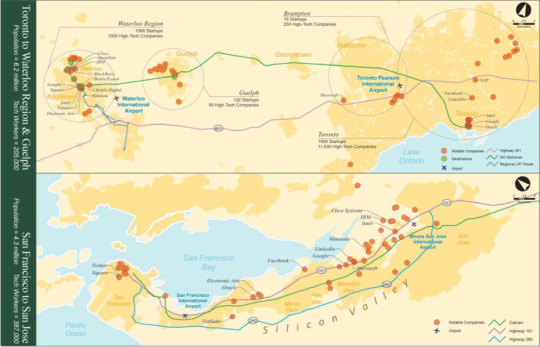
    This morning I stumbled upon an interesting Medium article talking about the need for an all-day two-way urban rail service between Toronto and Waterloo. 

    The argument is that along this corridor sits a technology ecosystem that is second in size only to San Francisco-Silicon Valley and that current connectivity levels represent a missed opportunity of epic proportions. Presently this rail service will feed you into Toronto during the morning rush hour and take you back out in the evening rush hour. But that’s it.

    According to this report prepared by the City of Kitchener (which is beside Waterloo), efficient train service would stitch together an ecosystem of approximately 12,800 technology companies, 2,800 startups, and 205,000 technology employees. It would also connect 6 universities and 4 colleges, many of which are ranked top in the world.

    There’s an argument here that this is exactly the sort of thing that governments should be doing to encourage innovation and entrepreneurship. Rather than trying to be heavily involved in actual startups, they should be creating an environment that maximizes output and then getting out of the way. 

    I think this makes a lot of sense. Don’t you?

    Image: The Innovation Express