Daily insights for city builders, delivered every morning at 6 AM ET. I’m Brandon Donnelly — a Toronto-based real estate developer and founder of Globizen. I’ve been writing here since 2013.

Tag: university of toronto

  • Carleton University’s Certificate of Real Estate Development

    Next Tuesday, January 19, I am helping to teach the introductory class of a Certificate of Real Estate Development program that is jointly offered by Carleton University’s Sprott School of Business and Azrieli School of Architecture & Urbanism. Here is a full list of the instructors and key note speakers that will be participating in the program. Obviously it is all being done online this time around.

    One of the great things about this program is that it’s a partnership between their school of architecture and their school of business. As you might expect given my background, I am biased in my view that this is a great way to teach real estate development. And it’s one of the reasons why I enjoyed my time so much at the University of Pennsylvania. I was free to take classes at whatever “school” I wanted to.

    When I later went on to study at the Rotman School, I actually tried to advocate for a better real estate development curriculum and for increased collaboration across the business and architecture schools (both alma maters). The response I got, at least back then, was that Rotman already had a real estate major and that it was fine just the way it was. Cool.

    For more information or to register for Carleton’s Certificate of Real Estate Development program, click here. I think there are only a few spots remaining.

  • Barton Myers’ California estate is on the market for $8.2 million

    Architect Barton Myers has his home in Montecito, California on the market right now for $8.2 million. In addition to his own residence, the 38-acre site also houses his studio and a guesthouse, all of which have roll-up garage doors so that you can enjoy that perfectly benign California climate. The estate is quintessentially Myers and it’s obviously awesome. Here is the listing from Sothebys. (I tried to street view the address but was only successful at locating what I think is its mailbox. What a natural setting.)

    For those of you who may be unfamiliar with the work of Myers, he is considered one of Toronto’s most influential architects. After graduating from the University of Pennsylvania and working with architect Louis Kahn for a few years, he moved to Toronto in the late 1960s to take up a teaching position at the University of Toronto. He then started his own architecture practice with Jack Diamond (also an alumnus of the University of Pennsylvania) and remained a principal of Diamond and Myers until 1975.

    Myers moved on to start his own firm — Barton Myers Associates — that same year and became known for notable projects such as 19 Berryman Street in Yorkville (Myers’ own residence) and the Wolf House at 51 Roxborough Drive, which was Architectural Record’s House of the Year in 1977. Probably the most distinguishing characteristic of his work is his use of exposed industrial materials, which is, of course, something that is on display in Montecito. But he managed to deploy these materials in a way that made them feel high-brow. His homes also feel very California to me.

    In 1984, he opened up an office in Los Angeles and eventually his practice in Toronto was shutdown. But not before leaving a lasting legacy in Toronto. For a map of all the firm’s North American projects, click here.

    Photo: BMA

  • Malcolm Gladwell on the world after COVID19

    [facebook url=”https://www.facebook.com/munkdebates/videos/785234722004262/” /]

    I am a huge fan of Malcolm Gladwell (and not just because he is Canadian and also went to the University of Toronto). Last week he kicked off a new Munk Dialogues series focused on the world after COVID19. (The next Munk Dialogue will be with Fareed Zakaria on Wednesday, April 15 from 8 PM to 9PM Toronto time.)

    In case you’re not familiar with the Munk Debates, they are normally a biannual event held here in Toronto. Their mission is to help people rediscover the “art of public debate” and they do that by convening some of the world’s brightest and most creative thinkers. Right now they are doing that online.

    In this Q&A with Gladwell, they touch on a lot of the topics that we are all debating right now on Zoom calls with our colleagues and friends. When will we get back to “normal?” What will change forever? Is working from home the new normal? Will people still want to go for Mandarin buffet? I won’t spoil it for all of you, but I did want to mention three points that I found myself agreeing with (I guess that is partially spoiling it).

    The first is his analogy to weak link sports such as soccer. Here you’re only as good as your weakest player. This is in contrast to strong link sports such as basketball. In this case, you’re only as good as your best player. If you want to win a championship, you get someone like Kawhi Leonard. Gladwell argues that this pandemic has further exposed us as a complex weak link society. We don’t even have the basic PPE and testing in place to fight this virus.

    The second is about whether this will create a more permanent shift to working from home. I have said before on the blog that I think it’s easy to overreach at a time like this. We might think that everything will change, but we also have short memories. Gladwell takes it a step further and argues that the exact opposite will happen. This pandemic will actually set working from home back a generation. We are going to be so sick of isolating that we will race back to what we had before.

    Finally, I like the point that right now is an opportunity for experimentation. This is true of all crises. It’s a lot easier to question the status quo when the status quo has already been disrupted. And we are seeing this happen at all scales, from people experimenting and learning new things at home to new companies being formed. Hopefully there will also be lasting benefits to our public health systems.

    Anyway, I would encourage to watch the video. If you can’t see it embedded at the top of this post, click here.

  • The ride-hailing red herring

    There’s a lot of data/speculation out there about the impact of ride-hailing apps. Many dense urban centers are claiming that they have increased traffic (slowed average speeds) and pulled people away from public transit. The University of Toronto published this study last year. And the WSJ recently published this chart for Chicago:

    To be honest, I’m not sure how much of the above is a result of ride-hailing apps, overall urban growth, e-commerce deliveries, public transit disinvestment, or other factors. But what is clear is that ride-hailing is pretty convenient and most (if not all) cities are seeing massive growth in this space.

    But all of this feels to me like a bit of a red herring. People will obviously choose what is most convenient and relatively affordable. And congestion was a problem well before people started using these apps (demand > road supply). The only solution I have seen work is to price congestion/roads.

  • Ride hailing in Toronto

    Earlier this year, the University of Toronto Transportation Research Institute (UTTRI) published this report on the impacts of ride hailing services in the City of Toronto.

    And then today, the Ryerson City Building Institute leveraged it to opine on how “on-demand tech” might improve transit going forward. That’s how I discovered it.

    What is clear from the report is that ride-hailing services — which they refer to as Private Transportation Companies (PTC) — are driven by two dominant use cases: 1) going out at night and 2) commuting to and from work.

    Friday and Saturday nights are by far the busiest periods for PTC travel, with the peak usually happening around midnight on Sunday morning. About 13,100 trips per hour, mostly concentrated in the core.

    Overall, it is estimated that Toronto does about 176,000 daily PTC trips (as of March 2019). That places it behind New York and Chicago in terms of the size of the market. But Toronto also didn’t complete its first PTC until 2014. Here’s a comparison chart:

    Another diagram that I found interesting was the proportion of shared ride trips by neighborhood. It shows that much of the inner suburbs are hailing shared rides — sometimes as high as 45% of all trips. This is interesting because it is people effectively gaming the system.

    Because the population densities are lower in the suburbs than in the core, you’re a lot less likely to get paired with other riders when you select that option. So what tends to happen is that you end up getting a private ride for the price of shared ride. I know I’ve played the odds before.

    If you’d like to download a full copy of the report, click here.

  • Facebook announces new cryptocurrency called Libra

    A new Facebook-supported blockchain and cryptocurrency, called Libra, was announced today. The goal: a new global currency. But unlike other cryptocurrencies, this one will be backed by a basket of government-issued securities and other investments.

    A new governing body called the Libra Association has also been formed, with its 28 founding members (see above image) contributing both capital (at least $10 million) and expertise. Going forward, they will help shape the network. It’s important to note that Facebook will have the same status as all other members of the Association.

    Here’s an excerpt from today’s WSJ:

    Facebook said Tuesday the network underpinning the new cryptocurrency would be governed by the Libra Association, an independent, not-for-profit organization based in Geneva. Facebook named more than two-dozen founding partners in that association, including Uber, Visa Inc. and a handful of venture-capital firms and blockchain companies like Coinbase.

    The other thing that differentiates Libra from other cryptocurrencies is that when it launches next year (2020), it will do so inside some of the most widely used consumer apps on the internet, including Facebook Messenger and WhatsApp. That translates into somewhere around 2.4 billion active users.

    Many within in the industry are already speculating that this could be what finally brings the crypto ecosystem into the mainstream, which is, I guess, why companies such as Visa and Mastercard have already signed on to the project. I am also thrilled to see the Creative Destruction Lab listed above. They are a seed-stage program based out of the University of Toronto.

    If you’d like to learn more about Libra, here’s the official website and here’s a good solid overview by TechCrunch.

    Image: Libra

  • The scale and scope of urban tech

    “Cities have become the basic platforms for global innovation and economic growth, supplanting the corporation as the fundamental organizing unit of the contemporary economy.” -Richard Florida

    Richard Florida and Patrick Adler of the Martin Prosperity Institute here in Toronto have been doing some research on what they are calling “urban tech.” They define it as encompassing the following industry sectors: co-living and co-working; mobility; delivery; smart cities; construction tech; and real estate tech.

    Here are the largest urban tech startups based on the amount of VC investment they have received:

    Below is how the space breaks down by sector. Mobility / ride hailing is the behemoth, receiving 61% of all VC investment. Food delivery is next. And “proptech” is at the bottom.

    Finally, here are the top “urban tech” cities. Beijing is right up there with San Francisco.

    For more information on the study, click here.

    Tables: CityLab

  • The compound effect

    This evening I was at my alma mater, the Rotman School, for a conversation between Roger Martin (the former dean of the school) and Canadian-Jamaican billionaire, Michael Lee-Chin. Michael is one of the most disciplined, consistent, and charismatic people I have never met. (The soothing Jamaican accent probably doesn’t hurt.)

    One of his points this evening was about compounding. Not just compound interest, which is what many of you are probably thinking, but compounding in life. The thing about compounding is that the real benefits come later on. That’s why personal finance people will tell you that the key to financial freedom is to start saving and investing early on.

    The problem with this is that, well, the real benefits come later on. And it can be frustrating when the rewards don’t seem to match the efforts. That’s why grit is so important and why some have suggested that it is a far better predictor of future success than things like IQ or a GPA score. There’s no substitute for hard work.

    In the development business, projects tend to take a long time. We started working on Junction House back in 2016 and here we are now in 2019 planning for construction. So I thought this evening was a good reminder that there’s lots of value in long-term goals and that more of us (including companies) should be thinking along these lines.

  • The geography of gyms

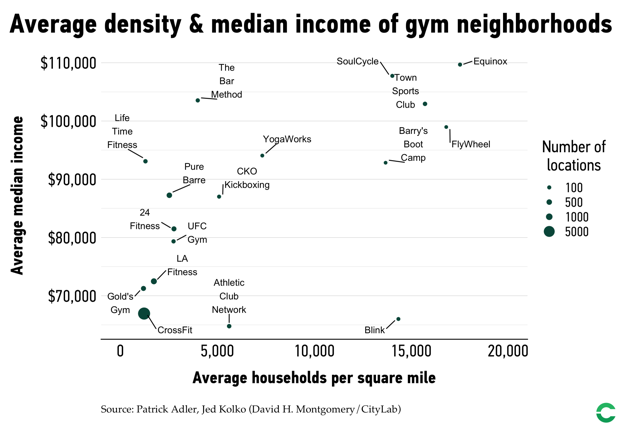
    Richard Florida and Patrick Adler recently looked at the geography of gyms across the United States. They analyzed 17 different fitness chains, over 10,000 gyms, and nearly 5,000 zip codes. Full article over here at CityLab.

    image

    The findings probably won’t surprise you, but it’s still interesting to see some of the data. Gyms and fitness studios tend to concentrate themselves in affluent neighborhoods with a high number of college graduates.

    The median household income of the average zip code with a gym or fitness studio is $72,720. This is compared to $56,694 for all zip codes. And when it comes to zip codes with an Equinox, SoulCycle, The Bar Method, or Town Sports Clubs, the median income jumps to over $100,000.

    Above is from the second post in the two part series they are doing on “the geography of fitness.” For the first one, click here.

  • Director, Real Estate

    The University of Toronto is looking for a Director, Real Estate to manage their tri-campus portfolio of income producing real estate, as well as the development opportunities that they have on and adjacent to their three campuses. The downtown campus alone is over 120 buildings across 130 acres.

    A good friend of mine is helping with this search; I went to the University of Toronto (twice); and I believe that institutions, such as U of T, play an important city building function. So I’m sharing this opportunity with all of you today. For more on the University’s development strategy, click here.

    They are looking for someone with 10+ years of experience. The salary will be competitive and commensurate with this level of experience. And you would be reporting directly to the Chief of University Planning, Design & Construction. 

    If you’re interested, you can apply here. You have until January 25, 2019 to do that. I hope the position gets filled with a star. Also, sorry if this post isn’t relevant to you. Regularly scheduled programming will resume tomorrow.