Daily insights for city builders, delivered every morning at 6 AM ET. I’m Brandon Donnelly — a Toronto-based real estate developer and founder of Globizen. I’ve been writing here since 2013.

Tag: ultra high net worth individuals

  • What rich people plan to do with their money in 2023

    Each year in March, Knight Frank publishes something called, The Wealth Report, which typically includes things like its Prime International Residential Index (PIRI) and a general overview of what ultra high-net-worth individuals (UHNWIs) are up to with their money.

    (An UHNWI is typically defined as someone with a net worth greater than $30 million. And as of last year, there were nearly 400,000 of them around the world, with Hong Kong being the city with the most.)

    In anticipation of this year’s report, Knight Frank has just published the key findings of an “Attitudes Survey.” This is them talking with and surveying private bankers, wealth advisors and family offices about some of the key themes for 2023.

    Here are a few of my takeaways:

    • Globally, about 1/3 of UHNWI wealth is allocated to primary and secondary homes. This is expected. Generally the richer you become, the more your net worth gets diversified away from your primary residence. It is also worth noting that of this 1/3 allocation, more than a quarter is being held outside of their country of residence. This outside-of-country-of-residence percentage is highest for UHNWIs in the Middle East (41%).
    • The average UHNWI owns 4.2 homes around the world, with UHNWIs in Asia owning the most: an average of five homes. This is the kind of stat that might provide motivation for a foreign buyer ban, but I continue to believe that there are other bigger drivers impacting housing affordability/supply across our global cities.
    • About 15% of UHNWIs said that they want to purchase a residential property this year (2023). This is down from 21% last year. Inline with bullet point number one, the greatest appetite/stated intent is coming from the Middle East. (Related article: The new Gulf sovereign wealth fund boom)
    • Real estate was identified as the top investment opportunity. About 1/3 of UHNWIs want to invest in real estate — either directly or indirectly — in 2023. And the top asset classes are: healthcare, logistics/industrial, office, multi-family rental apartments, and hotels. It is interesting to see office in the top three. A positive sign that it is maybe being viewed as an oversold opportunity.
    • Finally, environmental sustainability is being increasingly considered by UHNWIs when it comes to investment properties: 57% are considering energy source(s), 33% are considering opportunities for refurbishment, and 30% are considering the materials used/the embodied carbon footprint inherent to the asset.

    For the full findings, click here.

  • London super prime and the City Trifecta Index

    The latest (15th) edition of Knight Frank’s annual The Wealth Report was published last month. I find these interesting because they give you a global view of how and where capital is flowing into real estate (specifically prime real estate). London, for example, did rather well last year despite the pandemic. Buyers from the around the world spent nearly $4 billion on what is commonly referred to as “super-prime properties.” This is real estate with a sale price of US$10 million or more. London saw 201 super-prime properties trade hands last year, with an average price of $18.6 million and with 31 of these transactions being at or above $25 million. This is an increase compared to the year prior (2019), which I suppose is something given that the UK’s housing market was more or less frozen between March and May of last year. These figures put London at the top, ahead of New York and Hong Kong, when it comes to super-prime real estate sales in 2020. (London figures via the Financial Times.)

    Another interesting thing that you’ll find in the report is a city ranking that Knight Frank calls their City Trifecta. What this index does is take Knight Frank’s City Wealth Index (which considers where wealth is currently concentrated) and then adds in two other dimensions: innovation and wellbeing. The idea here is that innovation should drive future economic growth and wealth, and that wellbeing (quality of life) is pretty important when it comes to the future competitiveness of our global cities. When you look at the world’s top cities through this lens, the ranking starts to differ from what you may be used to seeing with cities like London, New York, and Hong Kong at the top (see above chart). Now you have Munich taking the number one spot; Boston and Toronto in 5th and 6th position, respectively; and cities like Zurich jumping up ahead of cities like Hong Kong. These kind of rankings always need to be looked at with a critical eye, but they can be interesting nonetheless.

    Image: Knight Frank

  • The global pyramid of wealth

    Every year the London-based property consultancy Knight Frank publishes something called The Wealth Report. And it’s one of those reports that I could go through for hours. 

    It includes a ton of really fascinating stats that speak volumes about where in the world wealth is being created and how it’s moving around. And of course there are a lot of connections between wealth, real estate, and city building.

    Below are 3 diagrams that really stood out for me in the 2015 version. 

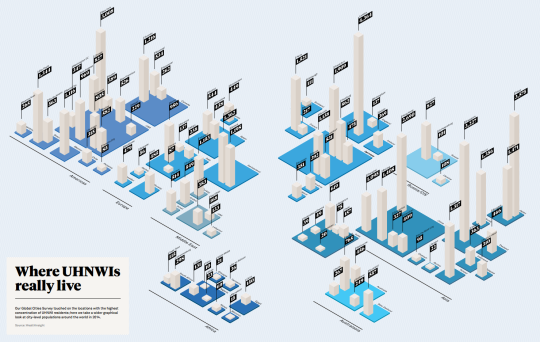
    The first diagram shows which cities have the most Ultra High Net Worth Individuals (UHNWIs). An UHNWI is defined as an individual with assets exceeding US$30 million, but excluding personal assets and property (such as one’s principal residence). Click here to see the full size image (I know the numbers are small).

    image

    Not surprisingly, London (4,364), Tokyo (3,575), Singapore (3,227), New York (3,008), and Hong Kong (2,690) are at the top of the list. But I was a little surprised – albeit happily surprised – to see Toronto (1,216) come in at #2 in North America, beating out Mexico City (1,116), Los Angeles (969), and Chicago (827). 

    The second diagram shows you how many square meters of luxury property (apartment) you can buy for US$1 million in a bunch of different cities around the world. 

    In Monaco (top end), that’ll buy you 17 square meters (183 square feet) and in Cape Town (bottom end), that’ll buy you 208 square meters (2,196 square feet).

    image

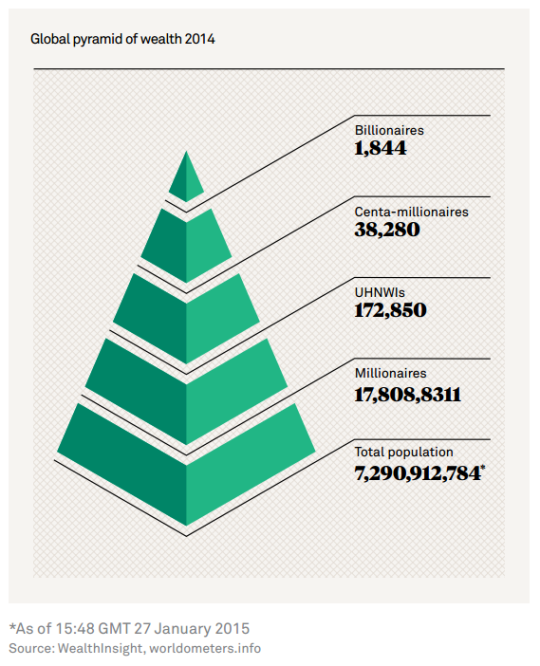
    The third and last diagram is what they call the global pyramid of wealth. It’s a pyramid of everyone in the world and then the number of millionaires, UHNWIs (see above), centa-millionaires, and billionaires. And if you do the math, the top of this pyramid comes nowhere close to 1% of the global population.

    image

    It’s fascinating (and exciting) to see where and how global wealth is concentrating. But it should also make you think about rising income inequality. I know it does for me.

  • Where the ultra rich buy real estate

    image

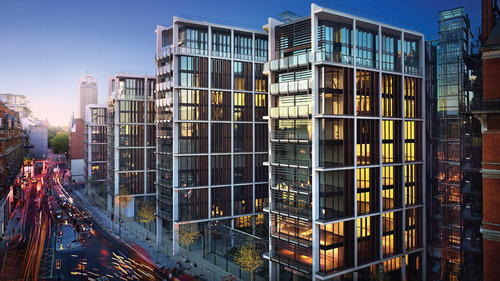
    Yesterday evening I was reading the Spring Summer Candy GPS Report put out by London-based property developer Candy & Candy. If you’ve never heard of Candy & Candy, then I guess you haven’t been in the market for a £60m apartment. Candy & Candy are the developers behind One Hyde Park in London, which is said to be the world’s most expensive residential development.

    But what is interesting about a project like One Hyde Park is that it’s really only possible in a global city, like London, that attracts a massive amount of foreign investment. A project like One Hyde Park is a possibility of globalization, not a result of local employment numbers.

    Which is why if you take a look at the Candy GPS report, you’ll see that their interest is in tracking the habits of ultra-high-net-worth-individuals (UHNWIs)–those with wealth exceeding US$30 million. Last year, the world was estimated to contain almost 200,000 of them, with a combined wealth of almost $28 trillion. This number is expected to rise to $40 trillion by 2020.

    Now, you may not be in the market for the most expensive apartment in the world, but I thought it would be interesting to talk about where this money is coming from and which cities it’s going into–at least when it comes to real estate.

    The top 3 countries for UHNWIs investing in real estate are Germany, Japan and the United States, respectively. The US has the most ultra rich people, but they have a lower propensity to invest in real estate compared to Germany. Nonetheless, these are the countries that dominate.

    But who are the recipients of this money?

    Well, first of all, it’s going into cities. But it’s flowing into a small number of them. Cities representing 5% of the world’s population are said to attract over 50% of the real estate investments made by the richest people on the plant. 

    According to Candy GPS, the top cities are Hong Kong, London, Moscow, Singapore and New York, respectively. Hong Kong sits at the top, largely because of money flowing in from mainland China, but London is said to have the broadest investment reach.

    So there you have it, a quick overview of where the ultra rich buy real estate.