Daily insights for city builders, delivered every morning at 6 AM ET. I’m Brandon Donnelly — a Toronto-based real estate developer and founder of Globizen. I’ve been writing here since 2013.

Tag: ucla

  • Informal settlements are the desire lines of housing

    Toronto’s new garden suite (accessory dwelling unit) policies are headed to Planning and Housing Committee this week for approval. If you’d like to leave a supportive comment, you can do that over here by clicking “submit comments” at the top of the page. I just finished doing exactly that.

    Given that this is happening, I figured I would share this related article from the New York Times talking about ADUs and informal housing in Los Angeles. I discovered it through this Strong Towns article by Jay Strange. And I love how he refers to informal structures as the “desire paths” of housing.

    Desire paths, for those of you who may be unfamiliar, are the naturally formed paths and lines that get created when people just walk where they want to walk. Usually these are the shortest and/or most logical routes and, by definition, they don’t align with any designed paths or walkways.

    Jay’s point with informal housing is that it is similarly what people actually want to do, but maybe can’t, usually because of restrictive zoning and/or building codes.

    The New York Times gives the example of a family that illegally built an accessory dwelling unit at the back of their house in the 1990s. It was rented to friends and family, and it helped them get through some difficult financial times. But again, it wasn’t lawful.

    According to some researchers at UCLA, Los Angeles County is estimated to have some 200,000 informal units. Many are forced into demolition, but many, like the above example, manage to sneak under the radar because lots of other people are building them and nobody in the community wants to disrupt things.

    Of course, Los Angeles now allows backyard cottages. And so what was once illegal is now not only permitted, but encouraged. Funny, isn’t it? I don’t know if it was the “desire housing” that ultimately made it happen. But it is clear that many people wanted it and they were voting with their actions.
  • The real reason people oppose new development

    image

    A good friend of mine just sent me this fascinating research paper called: Opposition to Development or Opposition to Developers? Survey Evidence from Los Angeles County on Attitudes towards New Housing. It is a study out of UCLA that was published earlier this year by Paavo Monkkonen and Michael Manville.

    For the paper, they conducted a survey-framing experiment with over 1,300 people in Los Angeles County to test how strongly they felt about a number of common anti-housing sentiments; arguments such as traffic congestion, neighborhood character, and strain on local services. 

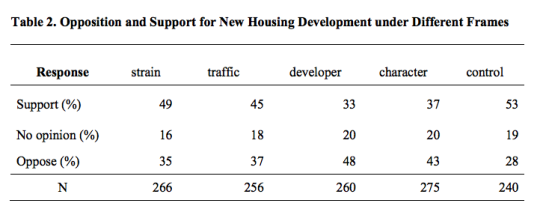
    However, they also introduced another argument: large developer profits. And interestingly enough, they discovered that respondents were 20 percentage points more likely to oppose a new hypothetical housing development when the survey was framed around the developer making a lot of money.

    Here is a table from the paper showing the various frames, as well as the percentage of people who supported, had no opinion, and who opposed. Note that under the “developer” frame, the opposition number is 48%.

    image

    So their “takeaway for practice” is as follows: “Housing opposition is often framed as a form of risk aversion. Our findings, however, suggest that at least some opposition to housing might be motivated not by residents’ fears of their own losses, but resentment of others’ gains.”

    Photo by Cameron Stow on Unsplash

  • Last-mile electric scooters — will they work?

    I’ve been hearing a lot about Bird recently. Perhaps it has something to do with the $15 million Series A round they raised last month (February 2018) and the $100 million Series B round they announced earlier today.

    A “Bird” is small electric scooters that look like this and can be rented from your phone for short haul trips. They are currently available in Santa Monica, Venice, UCLA, Westwood, and San Diego, and they are intended to be ridden in existing bike lanes.

    What may be particularly interesting to this blog audience is the fact that Bird is calling itself a “last-mile electric vehicle sharing company.” The pitch: 40% of car trips (in the US?) are less than 2 miles long. Let’s replace those using electric scooters.

    One of the first things that came to my mind is that this feels more accessible than cycling. Cycling to work can be a commitment. You have to think about your attire and the sweat factor, among other things.

    Would you agree?

  • Solutions to NIMBYism

    Earlier today Richard Florida published a piece in CityLab called: Anatomy of a NIMBY. The article cites a recent paper by Paavo Monkkonen (of UCLA) that focuses on the relationship between NIMBYism and housing affordability – a much talked about subject these days.

    More specifically, the paper identifies “four different strains of NIMBYism” and then offers up some possible solutions, which include things like a more inclusive process and better data. I’ve publicly supported these kinds of approaches on this blog many times before.

    But in addition to the above, I wanted to point out two other ideas from the paper and Florida’s article.

    The first is about shifting land use decisions up to the regional level, and maybe even the state level. This one is particularly timely given that there’s a lot of discussion in Toronto right now about shifting land use decisions in the exact opposite direction – from province (OMB) to city.

    The second is a suggestion from Yale professor David Schleicher that he refers to as “tax increment local transfers.” Essentially, the idea is to somehow allow current residents to participate in the future tax revenues generated from new development in their neighborhood.

    There’s lots of interesting reading buried in the above links.

  • The cost of parking minimums

    Access Magazine has a good piece on parking minimums and the cost they create for our cities. The article is by Donald Shoup, who is Professor of Urban Planning at UCLA. He is also the author of The High Cost of Free Parking.

    Here is his argument:

    “Minimum parking requirements create especially severe problems. In The High Cost of Free Parking, I argued that parking requirements subsidize cars, increase traffic congestion and carbon emissions, pollute the air and water, encourage sprawl, raise housing costs, degrade urban design, reduce walkability, damage the economy, and exclude poor people. To my knowledge, no city planner has argued that parking requirements do not have these harmful effects. Instead, a flood of recent research has shown they do have these effects. We are poisoning our cities with too much parking.”

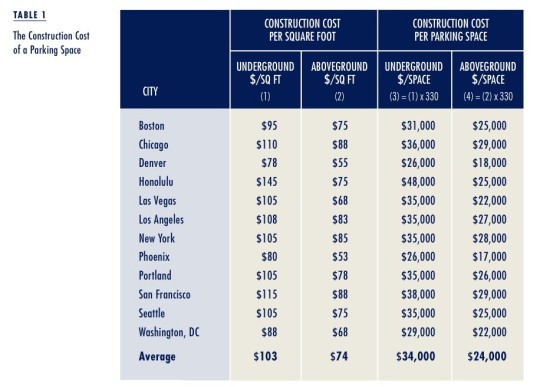
    And here’s his summary of what it costs to build a parking stall in various US cities (both underground and aboveground):

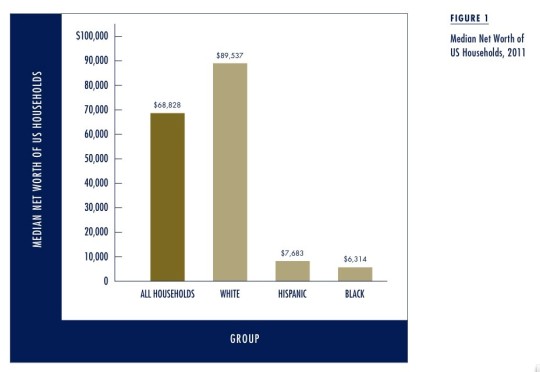
    To put these numbers into perspective, he also looks at the median net worth of US households (2011) to show just how expensive this parking is for some groups. 

    Because remember, these parking costs get embedded into the cost of housing, retail stores, and so on.