Daily insights for city builders, delivered every morning at 6 AM ET. I’m Brandon Donnelly — a Toronto-based real estate developer and founder of Globizen. I’ve been writing here since 2013.

Tag: uberx

  • The enduring allure of private vehicles

    Uber’s recent investor day presentation (link here) is interesting if you’re an investor or thinking about becoming an investor, but it’s also interesting from an urbanism standpoint. Part of the promise of Uber was that it was going to help lure people away from owning cars. Looking at the data though (see below), ridesharing penetration is still pretty low in even Uber’s largest markets: 3.9% for the US and 3.3% for Canada. Brazil is a leader here, which you might think is because of a lower cost per mile, but Australia isn’t far behind.

    At the end of the day, the vast majority of mobility trips are still being done through personal vehicles. This is certainly the case in the US with 6.6 billion weekly trips in personal vehicles versus 191 million on public transit and 22.6 million with UberX (all 2019 data). And for those taking Ubers, about 90% of riders are using some form of UberX — that being a solo, on-demand, point-to-point trip with a 4-door car. So sharing a car with strangers and using different/multiple modes of transport hasn’t really caught on here.

  • Should Uber be shut down?

    image

    Last week Travis Kalanick – the cofounder who built Uber into the most highly valued privately held startup in the world – stepped down as chief executive at the request of his investors. This was the culmination of months of controversy related to the company’s toxic corporate culture.

    So what’s next? 

    Benjamin Edelman, associate professor at Harvard Business School, recently argued that this is it for the company: Uber Can’t be Fixed – It’s Time for Regulators to Shut It Down. I discovered the article through a good friend of mine who has felt similarly since the beginning. Uber’s business model is predicated on illegality and that should not be misconstrued as “innovation”.

    I have a few thoughts on this.

    But let me start by saying that this post is not a comment on the company’s corporate culture or its internal practices related to lobbying governments. I have not really been following what’s going on internally and I’ll leave other, more informed, people to comment on those matters.

    With that said, here are 3 thoughts.

    One, shutting down the company feels like an extreme case of throwing out the baby with the bathwater. Lots of companies go through restructuring, assuming that’s needed, without completely capitulating.

    Two, before Uber came along it was still challenging to pay for a taxi in Toronto with a credit card. More often than not the driver would tell you that the machine was broken or ask that you instead pay with cash. At that point, I would have accepted a clunky payment machine mounted to the rear of the front seats as an innovation.

    To say that Uber’s technological innovations were all banal things that its competitors were already about to introduce is downplaying so much of what the company has done outside of its beneficial cost structure. 

    We got perfect information: Where is my car right now? We got full pricing transparency before even accepting a ride: Should I take an Uber or transit or should I drive? We got the ability to get in and out of a taxi without pulling out our wallets: I’ll quickly jump out at this red light. We got dynamic ride pooling and cost sharing: Let’s split this ride 3 ways to bring the fare down. And we got clean cars that didn’t smell.

    Why weren’t any of the incumbent taxi companies do this?

    Three, I fully agree that Uber (unfairly?) benefited from a meaningful cost advantage by operating in the unregulated side of the market. This was a huge boon for the company because, as the data suggests, the demand for taxis is highly elastic.

    But I also believe that the incumbent taxi companies were perpetuating a marketplace that was anything but free enterprise. It ensured that the status quo was maintained and that those who historically benefited from the system continued to benefit from the system.

    Because of this, I’m not sure that we would have seen the innovation that we saw without a company like Uber deciding to operate within a gray area and not ask for permission. Protectionism may have stomped it out. This may be why Hailo – which operated in the regulated side of the taxi marketplace here in Toronto – ultimately wasn’t able to survive.

    Though I suppose you could argue that Hailo’s failure (at least here in Toronto) strengthens the argument that Uber was only able to thrive because of its illegal cost structure. 

    However, it’s important to remember that Uber got its start by actually charging more than traditional taxis. At the outset it didn’t have enough liquidity in its marketplace to compete based on speed and/or price, and so it decided to offer a premium experience. 

    UberX didn’t introduce steep discounts until later on and even today many people will gladly accept surge pricing at multiples of a regular taxi fare. Clearly customers are deriving some other benefits from the app.

    Edelman ends his piece by referencing Napster as an example of another startup that defied legality and was ultimately forced to shut down. Again, shutting Uber down seems extreme to me, but I do agree with his conclusion. Regardless of what happens, the lawful innovations that Uber introduced are here to stay.

    Photo by Carl Joseph on Unsplash

  • Should you buy a car or just take Uber?

    Urban dawn by Raymond  on 500px.com

    https://500px.com/embed.js

    My friend Evgeny published a great blog post today called, On Car Ownership And The Future Of Transportation

    And in it he made the argument that instead of buying a car and an expensive downtown Toronto parking spot (average price: $40,000 – 60,000), most of us urbanites would be better of just taking a taxi or Uber.

    This got me thinking: At what point does it really make sense to completely forgo owning a car? (Full disclosure: I own both a car and a downtown parking spot.) So I decided to dig into the numbers a bit more and compare 4 mobility options:

    • Owning a car ($25,000 upfront) + downtown parking spot ($40,000 upfront) and driving yourself everywhere
    • Taking a regular taxi exclusively ($3.25 base + $1.75 per km)
    • Taking an UberX exclusively ($2.50 base + $1 per km)
    • Or, taking a futuristic driverless car everywhere (here I assumed $1.50 base + $0.25 per km)

    With the above numbers, I then assumed 15,000 km traveled per year and an average trip length of 15 km (so 1,000 trips per year). The trip length and number of trips per year matter because of the “base fare” that is charged when you take a taxi or Uber.

    I also assumed that the cost of owning a car is $0.60 per km (estimated from this Globe and Mail article) and that there is an opportunity cost to NOT renting out your downtown parking spot ($200/month). That is, every month that you spend driving yourself around and parking your car, you are forfeiting parking revenue.

    Finally, I looked at a 10 year time horizon and then “discounted” all the costs back to today’s dollars so that I could compare each mobility option.

    So what did I find?

    image

    What this says is that if you’re driving 15,000 km per year (average trip length 15km), then you’re better off taking UberX everywhere, as opposed to going out, buying a car and parking spot, and driving yourself around.

    But does this hold true at different travel distances?

    Based on my model, once you hit around 18,000 km per year, then you’re better of with option 1 (owning a car). That’s because the per km savings associated with driving yourself around are enough to offset the upfront costs of the car and parking spot.

    On the flip side, when you drop below 7,500 km traveled per year, even a regular taxi starts to make sense. That’s because you’re simply not traveling enough to reap the benefits of owning a car/parking spot. Again, high upfront costs; lower per km operating costs.

    Of course, there are a number of things I didn’t consider in my model. For one, most people finance their car and parking spot (it is bundled into their home mortgage). So I’m sure there are ways that you could change the above outcomes using leverage.

    At the same time, I didn’t account for the fact that when you’re being driven around (as opposed to driving around) you have the flexibility of doing work, responding to emails, and so on. If you want to attach a value to your time, then the scale would tip back in favor of taxis and Uber.

    But all of this was really just to make one point: look how cheap it could be to ride around in a driverless car. When that becomes the reality in our cities, which it will, it’s going to completely transform our current beliefs around cars, parking, and many other things.

    I guess that’s why General Motors just invested $500 million in the peer-to-peer ridesharing company, Lyft. They know the shit is coming.

  • Protect me from what I want

    The title of this post is a line from one of the works of Jenny Holzer. It feels appropriate right now.

    On Wednesday, Toronto saw a large scale anti-Uber protest involving as many as 2,000 taxis. It involved a bunch of taxis driving real slow around downtown, some altercations, and lots of people who want to see Uber completely shut down.

    This, of course, isn’t a new thing for cities. 

    Many cities around the world have seen similar kinds of protests. But many of you will probably also agree that this is not the most effective response from the taxi industry. It casts a negative light on them at a time when people are already switching to Uber for better service. It also ignores the fact that – in my view – Uber ain’t going anywhere.

    I’ve been a vocal supporter of Uber on this blog and I continue to believe that it will continue to prove to be a good thing for both consumers and for cities. In fact, famed startup investor Paul Graham once tweeted that because Uber is so clearly a good thing, you can tell how corrupt a city is by how hard it fights against it. This has become the truism among today’s urbanites.

    At the same time though, I am trying to take a balanced view on this issue, which is what got me thinking about the work of Jenny Holzer. Protect me from what I want. Today, I want Uber. But I am trying to think of where that want might lead me.

    Like a lot of private companies, the goal of Uber is monopoly profits. They would love to control the market. And that’s not a knock against them. It is just business. But I am imagining a market where only Uber exists.

    When I was in Miami last week I switched back and forth between UberX and regular taxis. Because Art Basel was going on, Uber was frequently in surge pricing. Sometimes as high as 4x. So in those cases, I just hailed a regular cab. Thankfully the cabs there are pretty reasonably priced and easily to hail. The driver didn’t ask me if I liked the electronic music playing on the satellite radio, but that’s not a big deal.

    But what if I didn’t have the option of hailing a regular cab? What if Uber was my only option and I had to put up or shut up when prices were 4x? That would be suboptimal in my books.

    So what does this all mean? 

    I am an Uber customer. I do not want and I do not believe it will go away. But I also believe that our public policy should encourage competition in the taxi marketplace. Competition holds people and companies accountable. It means that if you stop creating value, you will go out of business.

    It’s for that reason that I think the taxi lobby is wrong in trying to force Uber to shut down. And it’s for that reason that cities are going to have to work very hard at crafting the right kind of public policy. I am optimistic that Toronto will make that happen. But as we’ve seen today, there will be bumps along the way.

  • “Project Snowball” cracks down on UberX drivers in Toronto

    https://500px.com/embed.js

    This afternoon I saw on Twitter that Toronto Police are now starting to crackdown on UberX drivers in the city. The investigation is called “Project Snowball” and they have already charged at least 11 people. The fines are anywhere from $200 to $20,000.

    My response on Twitter was the following:

    I get that Uber is a highly disruptive company. I’ve written about it many times before. But at the end of the day, this is not just about Uber. This is about a larger shift in the economy.

    The buzz term is “sharing economy.” But one of the ways I like to think about it is like so: Facebook doesn’t produce any of its own content, and yet you could define it as a media company. Airbnb doesn’t own any rooms, and yet it is disrupting hotels. Uber doesn’t own any cars or plates, and yet it is disrupting the taxi industry.

    What’s happening is that the internet and mobile phones are allowing for peer-to-peer connectivity and more decentralized forms of marketplace supply.

    What does that mean?

    It means that instead of having a fleet of cars or a centralized hotel building, anyone with an extra car or an extra room (and an internet connection) can plug themselves into the market. And that represents an entirely different cost structure for businesses.

    It’s worth noting that prior to Uber, Travis Kalanick founded a peer-to-peer music sharing company called Scour (1998). Its closest equivalent would have been Napster. Remember Napster? This is not a new trend.

    That said, I still think we’re at the early stages of this shift. I predict that many other industries will see disruptors similar to Airbnb and Uber. And so when I look at it in this context, I have a hard time believing that fining UberX drivers is the most enlightened way forward.

    I believe we should instead be taking a leadership position and trying to figure out how to adapt our rules and regulations to this changing economy. Toronto is not alone in this battle. But we could certainly be the one to lead the way out.

  • How Uber is driving down the cost of transportation

    A few days ago, Bill Gurley – who is an investor in Uber – wrote a really fascinating blog post called, Uber’s New BHAG (Big Hairy Audacious Goal): UberPool. Bill doesn’t update his blog very often, but when he does it’s incredible stuff.

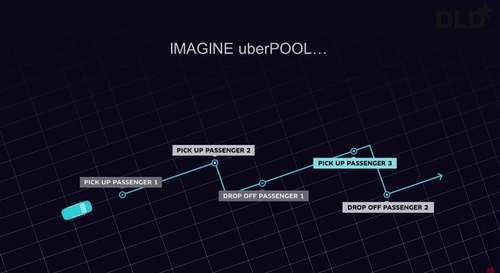
    I’ve touched on UberPool briefly before. But basically it’s a true “ride sharing” service where people with overlapping routes can easily share the same car – much like people do today informally. The obvious advantage of this is cost. It’s cheaper to share.

    image

    What’s most fascinating about this service though is how it fits into Uber’s larger mission to drive transportation costs down. And there’s a specific reason for that (via Bill Gurley):

    When Uber launched its low-cost UberX offering in the summer of 2012, the company quickly realized that the demand for its transportation services is HIGHLY elastic. As the company achieved lower and lower per-ride price points, the demand for rides increased dramatically. A lower price point delivered a much better value proposition to the consumer, yet still remained a great business decision due to the remarkable increase in demand.

    So what Uber quickly figured out was that if they could increase the utilization rate for drivers (the time actually spent with passengers), they could charge consumers lower prices while at the same time maintaining driver salaries. Prices went down, but volume went up.

    One way to do that is to obviously decrease driver downtime by improving liquidity on the marketplace. But another way is to simply increase the number of passengers being transported at one time. Hence the creation of UberPool.

    But it doesn’t stop there.

    Because of all the transportation data that Uber now has (the company has a data group called the “math department”), they can fairly accurately predict what a price cut will do to their ridership levels. This allows them to “forward invest” their capital in new services – such as UberPool – before they even have the revenue from the anticipated increase in ridership.

    So what does this all mean?

    It means that Uber is going to get cheaper and cheaper and cheaper. Uber is trying to get to what they call “The Perpetual Ride”, which basically means that drivers will always have customers (100% utilization). That’s quite a goal, but it would mean the absolute lowest prices for consumers (barring any other changes to their cost structure). 

    Dirt cheap transportation is a pretty compelling value proposition, which is why I continue to believe that cities should be hard at work trying to figure out how to harness this transportation shift.

    If you’re interested in this topic, I would encourage you to give Bill Gurley’s blog post a read.

  • Where Uber operates and where it’s banned

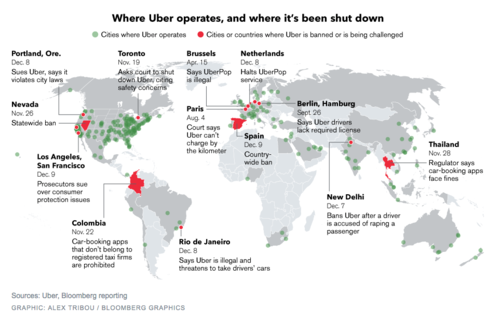
    Earlier this month, Bloomberg published this map showing where Uber operates and where it’s been banned (or is being challenged). You can click on the map for a larger version.

    image

    Uber operates in about 250 cities across the world. But it’s being challenged in a lot of them, including Portland, San Francisco, Los Angeles, Toronto, Rio de Janeiro, Paris, Berlin, as well as others.

    I don’t want to dismiss any of the safety concerns that have arisen lately, because those are very serious and they need to be addressed. Life safety is paramount. But I continue to believe that banning a service that many people clearly want to use isn’t the right solution.

    On top of that, I think it could lull many of the local taxi communities into a false sense of security about the future. Uber is moving incredibly quickly. UberX launched in Toronto in September of this year. And UberPOOL – their new carpool service – is likely next.

    With these releases, Uber is working towards a specific vision for the future: Their goal is to eliminate the need for private vehicle ownership. Should they be successful, this will not only impact taxis, but also car manufacturers and urban mobility in its entirety.

    So as difficult as it might seem right now, I think urban leaders would be better served trying to figure out how to harness these innovations. Cities have been trying for decades to get people out of their cars. Uber wants to do the same.

  • Toronto seeks injunction to stop Uber

    image

    One evening this past spring I was leaving a Rotman School event at Liberty Grand on the west side of Toronto. There aren’t a lot of taxis coming through this part of the city, so I figured I was going to have to wait while I hailed one from my phone. But as luck would have it, one happened to be pulling up just as I walked out of the hall.

    As he drove up and rolled down the window, I told him that I was going to the St. Lawrence Market area and that I needed to pay by credit card (I was trying to be a nice guy and avoid the inevitable fight when he was dropping me off). He responded by saying, “My machine is broken. Can’t you pay with cash?” I told him, “No, unfortunately I don’t have any cash on me. I need to pay with credit card.” He then rolled up his window and drove up closer to the entrance of the hall.

    Faced with this scenario, I did what most people would probably do nowadays: I pulled out my phone so that I could hail either an Uber or a Hailo cab (I’m sad that Hailo has since left the North American market). I decided on Hailo (it was cheaper until UberX came along) and ordered a car.

    But within a few minutes, the same taxi with the broken credit card machine circled back around, rolled down his window, and told me that his machine was now working and he would take me to the St. Lawrence Market. Knowing exactly what had happened, I said to him, “Wooooow, that’s funny that within the span of a few minutes your machine has magically started working again.” He wasn’t happy with that response.

    Now, we all know why he didn’t want to take my credit card. He didn’t want to pay the fees and he wanted the cold hard cash. And who can really blame him for wanting to maximize his profits. But for the end user, this experience sucks. When it’s 2 in the morning and all you want to do is go home to bed, you don’t care about the few dollars he’s trying to save. You just, want, to go, home.

    And that’s one of the reasons why Uber (and previously Hailo) is having such a huge impact on the market. Even before UberX arrived (the cheaper alternative), lots of people were more than willing to pay the Uber premium. And they continue to pay their controversial surge prices. But that’s because the experience is so much better than what’s offered today.

    We all know that Uber is under a lot of fire for what they do, but Toronto mayor Tory is 100% right in saying that ridesharing and peer-to-peer taxis are here to stay. Toronto may be seeking a court injunction to stop the service in this city, but I would agree that it’s likely going to be a big waste of money. The cat is already out of the bag.

    What’s happening here is no dissimilar to what happened with Napster. A court order may have forced the company to shut down, but it didn’t maintain the status quo for the music industry. That industry went, and continues to go through, a lot of change. So a better option, would be for everyone to sit down together and figure out what the future of the taxi industry is going to look like. Because I can guarantee you that it’ll continue to change.

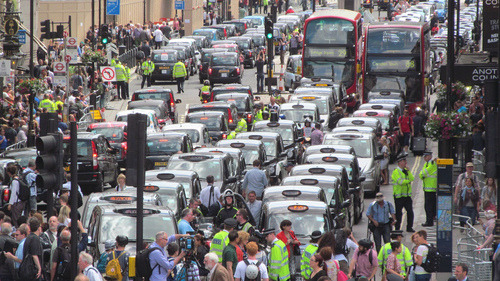
    Image: Anti-Uber protest in London (Flickr)

  • Comparing taxis to ride sharing services

    This morning I woke up to a post from venture capitalist Fred Wilson talking about the cost of loyalty when it comes to local transportation markets. More simply, it was a cost comparison between regular city taxis and ride sharing services such as a UberX, Lyft, and Sidecar in San Francisco, Los Angeles, and New York.

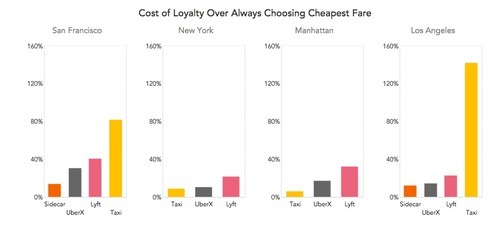
    The data was sourced from whatsthefare.com and looks like this:

    The way to understand this chart is to think about it as the answer to this question (from whatsthefare.com): If I were to take 1,000 rides over my lifetime with one individual service, how much more would I pay than if I compared prices and always picked the cheapest option?

    What you should immediately see is that regular taxis are far more expensive in San Francisco and Los Angeles compared to all of the ride sharing services. In the words of Fred Wilson: “That is crazy. They are going to go out of business in those markets with that pricing.”

    In my words: They are fucked.

    I wonder where Toronto would place against these cities. My gut tells me that we would be closer to San Francisco than New York. And if that is the case, I think you can figure out what that means.

    I thought this would be an interesting post given yesterday’s point about our cities being multi-modal. We urbanites have many more options at our disposal than we did only a few years ago. And if they’re cheaper and more convenient, we’re going to use them. I think that’s a good thing.

  • Taxis just got 40% cheaper in Toronto

    UberX officially launched in Toronto today. Which means that Toronto’s taxi and limousine industry is about to get a lot more grouchy. For those of you who may not be familiar, uberX is Uber’s low-cost car service. Just like the regular version, you hail a car using your mobile phone. But this option will cost you 40% less than a regular taxi!

    Here are sample rates from the Financial District to Yonge & Eglinton (midtown):

    And from the Financial District to Pearson International Airport:

    image

    This is pretty exciting. Because as much as I think it’s great to use Hailo or Uber to hail and then pay for a car, the big problem in my mind has always been that cabs in Toronto are just far too expensive. The meter starts at $4.25 and shoots up faster than you can take a selfie in the backseat.

    But obviously there’s an entrenched industry here that is not going to be happy about a startup eating into their fares. So I wouldn’t be surprised if we see a lot more backlash here in Toronto – as has been the case in many other cities. However I don’t think that’s a viable long term solution for the incumbents.

    Uber is thought to be worth $18.2 billion right now. It’s probably not going to go away.

    So instead of protesting and trying to ban it, we should be figuring out how to adjust to this changing reality. For the incumbents, this might mean lowering fares or figuring out a better way to differentiate themselves. A 40% discount is a pretty compelling value proposition. For me personally, I don’t know why I would ever pay more for a regular taxi, unless there was no other option.

    On a side note, it’s worth pointing out that an uberX trip from downtown to Pearson is estimated to cost around $33 – roughly the same as what some people think the Union Pearson Express train will cost. That’s further evidence that charging a lot and targeting business travelers may not be the best strategy.