Daily insights for city builders, delivered every morning at 6 AM ET. I’m Brandon Donnelly — a Toronto-based real estate developer and founder of Globizen. I’ve been writing here since 2013.

Tag: ubc

  • Margolese National Design for Living Prize

    This landed in my inbox earlier in the week. And since I think it’s important to support Canadian talent and I think it’s important for us to continually nurture a Canadian cultural identity, I’m sharing this design prize with all of you today.

    Hosted by the University of British Columbia’s School of Architecture + Landscape Architecture (SALA), the Margolese Prize is intended to recognize early to mid-career Canadians who are doing outstanding work related to the built environment. This could be in fields like architecture and planning or it could be in adjacent fields.

    Nominations are open until April 10, 2022 and you can both nominate yourself and nominate others. The winner will be announced this September and, in addition to a ceremony and presumably a trophy of sorts, the committee will be giving out $50,000. If you’d like to nominate yourself/someone, click here.

  • Ecodesign for cities and suburbs

    Larry Beasley and Jonathan Barnett are about to start teaching a free online course through the University of British Columbia edX called: Ecodesign for Cities and Suburbs. It starts April 4, 2017 and runs for 6 weeks.

    Here’s what you’ll learn (taken verbatim from edx.org):

    • The principles of ecodesign and why it is important as a response to the current disorganized urban growth model
    • Ways to adapt to a changing climate, and ways to mitigate climate change locally
    • Policies to balance auto and airplane transportation with walking, cycling, transit and high-speed rail
    • Ways of designing urban and suburban regulations to make cities more livable and environmentally compatible
    • Strategies for designing and managing the public realm, plus innovative arrangements and processes for implementing ecodesign

    The course is geared toward urbanists from all over the world and so the case studies will be global in nature. You can also participate as actively or passively as you’d like. Though, if you’d like to get a certificate, then you need to fully participate.

    What immediately stood out for me was the focus on both cities and suburbs. In many ways the suburbs are a more challenging problem to solve. So I hope there’s a good amount of focus on that context.

    Beasley was formerly co-director of planning at the City of Vancouver and Barnett is a professor of city and regional planning at the University of Pennsylvania (my alma mater). It should be an interesting course.

  • Mass timber tower time lapse

    Over the past few years there’s been growing interest in using mass timber for high-rise buildings (now colloquially referred to as “plyscrapers”).

    One project that got a lot of attention last year is Brock Commons (student residence) at the University of British Columbia. It is an 18-storey hybrid mass timber tower.

    The first and second floor (slab) and the two cores are poured-in-place concrete. After that, the other 16 floors of the tower consist of 5-ply cross laminated timber (CLT) panels and glue laminated timber (glulam) columns running every 10 feet. The roof is steel and metal decking.

    Below is a great time lapse video of the building under construction once it had switched over to timber. The wood construction portion started on June 6, 2016 and finished on August 10, 2016. So 2 floors per week.

    The video is well-annotated so that you know what week of construction it is, how many wood installers are on-site, which structural members are going in (along with their dimensions), and so on. The CLT panels are only 169mm thick.

    Click here if you can’t see the video below.

    [youtube https://www.youtube.com/watch?v=GHtdnY_gnmE?rel=0&w=560&h=315]

  • A look at net migration by age group in Vancouver

    I’ve written quite a few posts about family formation and, more specifically, about where Millennials will move once they start having kids

    Many seem to believe that – despite the current Millennial love affair with urban centers – much of this cohort is destined to repeat the pattern of the previous generation. Meaning, once the kids come along, they’re headed to the suburbs in search of bigger and more affordable housing.

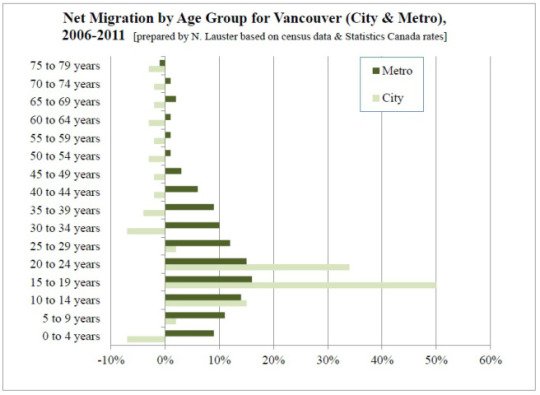
    If you look at the data, there’s a lot to support this prediction. Below is an interesting chart from Nathanael Lauster (Professor in Sociology at the University of British Columbia) that looks at net migration by age group for the City of Vancouver and the metro area.

    image

    What this chart shows is a flood of people in their late teens and early 20s migrating into the city (many of which are likely students), but then a fairly dramatic net loss of people leaving the city as they enter their 30s. The metro area, however, continues to grow – almost certainly because of people looking for more suitable family housing.

    But this data is from 2006-2011. We don’t yet have the 2016 census data. And I suspect that we will start to see an increase in the number of people opting to remain in the city across many different urban centers. 

    There are some very real economic pressures that successful cities today have to contend with. But I believe that the desire to remain in the city is there for a lot of young people.

  • Necessary city

    I’ve spoken about global cities, such as New York and London, many times before on Architect This City. I’ve also talked about the rise of consumer cities. That is, cities with a high “urban amenity premium”, which could be great outdoor amenities or great restaurants, theatre and so on. These are places of consumption.

    Sometimes global cities and consumer cities are one and the same. But there are also cities–such as Vancouver–where I view the urban amenity premium as outweighing their status as a global city. Vancouver, quite simply, is an awesome place to live and enjoy life. I almost went to UBC for grad school because of Whistler Blackcomb and the city itself.

    Today, I’d like to introduce another type of city into the discussion mix: the necessary city. I heard about it here and, although it seems somewhat intuitive, I think it’s an important reminder that, even though a city may not be an alpha global city, it may be fulfilling a specific function for a particular industry or aspect of the global economy. It may still be a necessary city for your corporate headquarters.

    For example, Houston is the city for energy companies. If that’s your business, you likely need a presence there. For fashion and luxury, it’s Paris. And if you’re in the auto industry:

    The major global equipment manufacturers are widely dispersed, but when you look at leading global parts suppliers, they virtually all have their North American headquarters in Detroit – including the German, Japanese and Korean ones. Among them are companies like Robert Bosch, Denso, Yazaki and Hyundai Mobis. If you’re in the auto industry in America, you have to deal with Detroit. Unsurprisingly, Detroit boasts several nonstop flights to key Asian destinations.

    In essence, we’re talking about cities making themselves necessary by becoming niche experts. And what I think is interesting about this concept is that it’s likely much more attainable for a lot of cities. Most cities will never become New York. And most cities will never be able to transform themselves into the next Silicon Valley.

    But maybe those are the wrong economic development goals. It’s not about becoming the next, whatever; it’s about finding and owning a particular niche and making yourself absolutely necessary to the global economy.