
Daily insights for city builders, delivered every morning at 6 AM ET. I’m Brandon Donnelly — a Toronto-based real estate developer and founder of Globizen. I’ve been writing here since 2013.

Tag: tunnel

  • A fixed transport link between Great Britain and Northern Ireland

    Here is a report that was just published looking at the feasibility of a fixed transport link between Great Britain and Northern Ireland across the Irish Sea. It is part of a study known as the Union Connectivity Review, but according to the report, this idea has been floating around since at least the middle of the 1800’s. This recent report claims to be the most rigorous of the bunch though.

    What they discovered is that it would be — you guessed it — super expensive. Somewhere in the range of £209 billion for a tunnel crossing and £335 billion for a bridge crossing. And it would take some 30 years before something like this could be operational when you consider planning, design, construction, and the various legal processes that something like this would require.

    So the recommendation was to stop and do nothing. But if any of you are curious about what it would take to build across the Irish Sea, here’s your chance.

  • Norway’s $47 billion coastal highway

    The E39 highway in Norway runs along the west coast of the country and connects Kristiansand in the south to Trondheim in the north. There’s also a ferry connection to Denmark that forms part of the route. The entire highway (excluding the ferry south to Denmark) is about 1,100 km. But it takes about 21 hours to drive it because Norway’s dramatic fjords (see above photo) mean that there are seven ferry crossings along E39. The Norwegian government wants to transform the route into a ferry-free highway, which would dramatically reduce travel times. But this presents a number of extremely difficult engineering challenges — some of which haven’t been solved yet. You can learn about a number of them in the below video from The B1M. If you can’t see it below, click here. It’s a fascinating video.

    Photo by Christiann Koepke on Unsplash

  • Boring Company ran a Tesla through its test tunnel

    This week Elon Musk’s Boring Company ran a Tesla through its 1.14 mile-long test tunnel in Hawthorne, California. This was accomplished by using a set of tracking wheels that Elon said, “turns a car into a rail-guided train & back again.” Apparently it is safe up to 150 miles per hour. Here is a video from yesterday’s unveiling (click here if you can’t see it below):

    [youtube https://www.youtube.com/watch?v=WQn-D-i5lyM&w=560&h=315]

    Some, or perhaps many, are skeptical of how this could work at scale in a dense urban environment. The company is imagining a world where every house or office building has one of these lifts (shown in the video) in their garage or basement. But there’s no question it is very cool and apparently this test tunnel only cost about $10 million per mile to dig. That’s progress in and of itself.

  • Bringing public transit into the 21st century

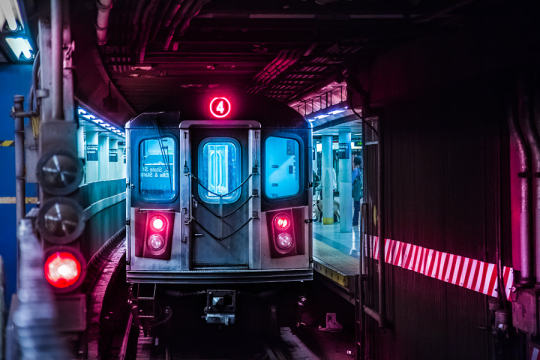
    New York Subway by Lok Yiu Cheung on 500px.com

    https://500px.com/embed.js

    I think we’ve hit peak millennial.

    Last Friday the Governor of New York, Andrew Cuomo, and the Metropolitan Transit Authority, announced that 30 subway stations will be redesigned and that “millennial-friendly amenities” would be added throughout the system

    As you might guess, this includes adding phone chargers in train cars and buses and wifi throughout all the stations (by the end 2016). They will also be replacing the MetroCard with an all digital fare system that will include mobile payments.

    But the reality is that this isn’t about being millennial-friendly. This is about joining the 21st century.

    Here in Toronto, we finally have our PRESTO card working on all streetcars and in almost 40% of the city’s subway stations. This is a huge improvement over our laughable and antiquated token system, but it’s not enough. I really hope the next rollout is a mobile app that will allow everyone to pay with just their phone.

    We also have wifi in about 30% of our subway stations, but again this is not enough. By the time you get authenticated (do you need to have Twitter now?), your train is usually arriving and then you enter a tunnel where no wifi exists. We need to be looking at the entire tunnel network. (Related topic: LinkNYC

    I say all this because I am a big supporter of public transit. Despite all the positive things I write about Uber, ridesharing, and driverless cars, I do not believe that they will eradicate the need for a strong transit backbone. This is fundamental to our city building efforts. 

    So let’s do our best to delight people when they take transit.