Daily insights for city builders, delivered every morning at 6 AM ET. I’m Brandon Donnelly — a Toronto-based real estate developer and founder of Globizen. I’ve been writing here since 2013.

Tag: travel

  • A visit to BMW World

    Today we visited BMW Welt (World) and the BMW Museum in Munich.

    BMW Welt was designed by COOP HIMMELB(L)AU out of Vienna. It is the result of a design competition that the BMW Group held in 2001. Construction of the ~73,000 square meter facility was completed in 2007.

    The project is centered around a great hall and an elevated vehicle delivery area known as Premiere. It was designed — and this includes the HVAC system — to handle 40 car deliveries per hour, or 250 per day. I guess they don’t work a full 8 hours.

    Below are two photos that I took of the delivery area. The circles you see on the floor in the second picture are rotating platforms. This is where you want to pick up your new car.

    And here is a plan of the entire Welt space via COOP HIMMELB(L)AU:

    I also really enjoyed the BMW Museum, which is housed in a separate building adjacent to the BMW Tower (the one that looks like engine cylinders).

    The “art cars” were a lot of fun. I’m sure that many of you will be able to guess the artist behind this one:

    But what I enjoyed most were the classics like this one here:

    The least interesting cars for me were the ones that weren’t old enough to be “classic”, but also weren’t new and shiny. This can happen with architectural styles as well. Designs sometime need time to settle in.

    For more photos of BMW Welt and the BMW Museum, follow me on Instagram.

    Drawings/Isometrics: COOP HIMMELB(L)AU
  • A beautiful destination: Rio de Janeiro

    Below is a breathtaking video of Rio de Janeiro by Beautiful Destinations. If you haven’t heard of them before, they run a great YouTube channel profiling places and experiences from around the world. I think they also post a new video every week. If you can’t see the video of Rio below, click here.

    [youtube https://www.youtube.com/watch?v=gYy1RITRN9s&w=560&h=315]

  • To invest or not invest

    We used Uber to get pretty much everywhere when we were in Rio de Janeiro. For reasons of convenience, cost, and safety, it just made the most sense. I can tell you that it felt a lot more valuable in place where you don’t speak the language and you’re acutely aware of being in the wrong place at the wrong time.

    And since Uber is going public later this year (along with Lyft), it got me thinking about whether or not it is a stock that I would want to own. Are they destined for monopoly profits? Do they have a defensible business model? How powerful are their network effects? Having first-mover advantage doesn’t guarantee anything.

    My initial thoughts are that the network effects for their core offering – single rides – don’t feel that strong. Sure you need a critical mass of drivers so you’re not waiting around too long, but at a certain point the response time is likely good enough. Rides are a commodity.

    This arguably changes as you get into services like Uber Pool and Uber Commute, because more users on the network in close proximity to you can mean lower costs and higher service levels. But is there any sort of lock-in effect?

    Many passengers and drivers seem to “multi-tenant.” In other words, many (or maybe most) people have multiple ridesharing apps installed on their phone and they will switch back and forth when it makes sense to do so. I do that when prices are surging. And drivers appear to be doing the same based on the Uber and Lyft emblems in their cars.

    For a long time, Uber was the only show in town here in Toronto. Hailo only lasted about two years or so. But as soon as Lyft entered the market, both companies moved to aggressively discount their rates, and that is still going on to this day. This suggests certain things to me.

    Among other things, it is a reminder that the demand for (commoditized) transportation services is highly elastic. We are price sensitive. We will use whatever is cheaper. So one way to win is to obviously create a cost structure advantage. Hence the current autonomous vehicles “arms race.” 

    Lyft is also trying to establish itself as a multimodal transportation solution. (When are scooters coming to Toronto?) Perhaps that will make them less of a commodity. But again, how defensible is that approach? I suppose the market will tell us what it thinks later this year.

  • And we’re back

    Welcome to 2019.

    I am currently in transit and catching up on some internet reading and email on my way back to Toronto.

    At this time of year it is, of course, common to reminisce (or lament) about what happened over the last year, as well prognosticate what may come.

    Over the last few years, I have done a bit of that on the blog. But I clearly didn’t do that this year while in Brazil (and away from any semblance of a workspace).

    So here’s what others have been writing and thinking about over the holidays:

    – 2018’s tech trends and tribulations in 14 charts. RecodeLink

    – 2018 was the year of the YIMBY. CityLab. Link

    – A cool girl’s guide to Toronto. Vogue. Link

    – Amazon’s annual Christmas press release. Link

    – Best travel posts of 2018. Design Milk. Link

    – Here’s (Almost) Everything Wall Street Expects in 2019. Bloomberg. Link

    – Here’s what to expect in cybersecurity in 2019. TechCrunch. Link

    – Naive to hope Toronto can change in 2019? That means we have work to do. Shawn Micallef. Link 

    – The 10 largest US venture rounds of 2019. TechCrunch. Link

    – What is going to happen in 2019. Fred Wilson. Link

    – Will a recession hit in 2019? Alan Murray. Link

    – Year in search 2018. Google. Link

  • Oi Rio

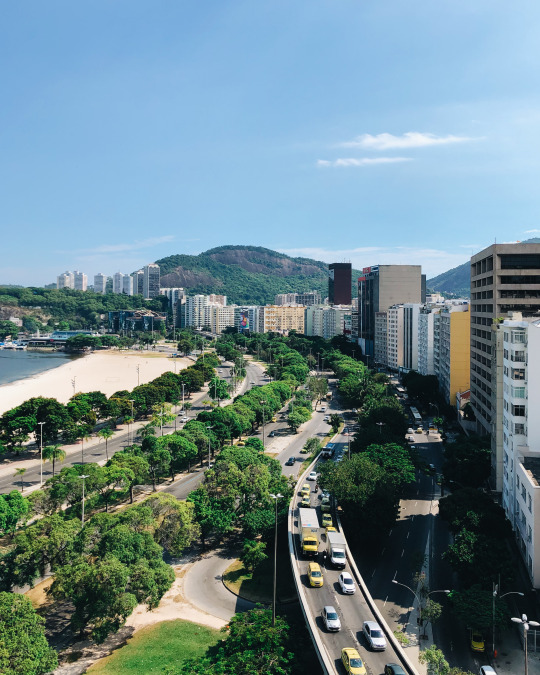
    I just arrived in Rio de Janeiro, which is where I’ll be for the next ten days. Here is a photo looking south from the rooftop of our hotel (more photos to follow on Instagram):

    image

    Today was a fairly relaxed day after many hours of travel. But tomorrow the architecture and design tour begins. 

    I am still trying to get a feel for the city. The first thing people tell you after you arrive is to be careful. Don’t go out at night. And take Ubers. 

    Uber is a significant advantage in a place like Rio where few people seem to speak English and you may be concerned about somebody taking you for a ride.

    Not only was the Uber from GIG about R$80 less expensive than a taxi (I was probably quoted the gringo rate), but you also get perfect information in terms of where you are going.

    This emphasis on safety and security is, of course, highly evident as you walk around the city. Lots of gates and lots of cameras.

    It’s perhaps a bit ironic to see so many places sealed off from the outside when you consider how great the climate is and how friendly the people are.

  • Flights per day

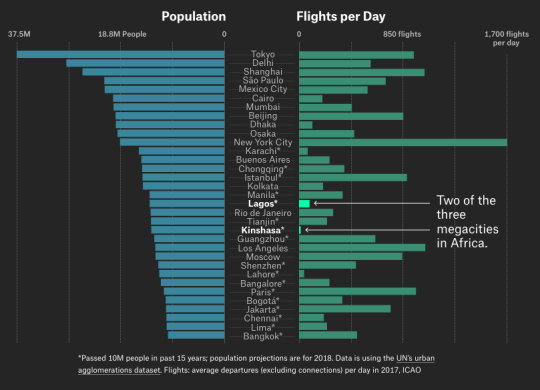
    I recently wrote about this visual essay – showing the world’s population – from The Pudding.

    They have some great essays. So I went exploring today. 

    Here is one that looks at the phenomenon of “poor-country urbanization” by way of the number of flights per day from a city.

    The argument is that a low number of daily flights means that the city, despite perhaps having a large number of people, is actually quite disconnected from the global economy.

    Typically, people moving from rural areas to urban areas has tended to translate into rising incomes. It has lifted people out of poverty.

    But today we’re seeing examples of poor urbanization, where the migration is less about opportunity and more about necessity.

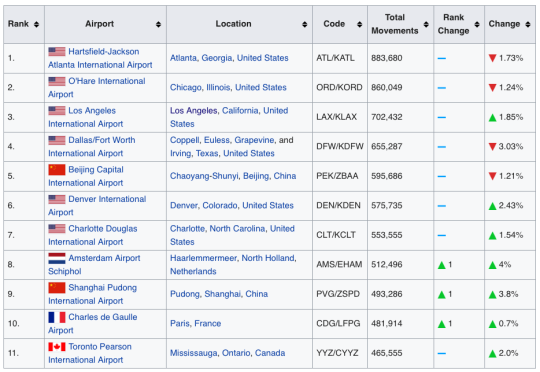
    While maybe crude, this measuring stick of flights per day piqued my curiosity. So here are some preliminary figures from the Airports Council International for 2017:

    The primary example mentioned in the essay is that of Kinshasa, which is the capital of the DRC. 

    It has a population of around 13 million people, but only 13 departing flights per day. (I’m assuming its “total movements” would be higher.)

    Based on the above list, ATL has ~2,461 total movements per day (defined as an aircraft either landing or taking-off). And YYZ has ~1,275 movements per day.

  • A picture of dynamic road pricing

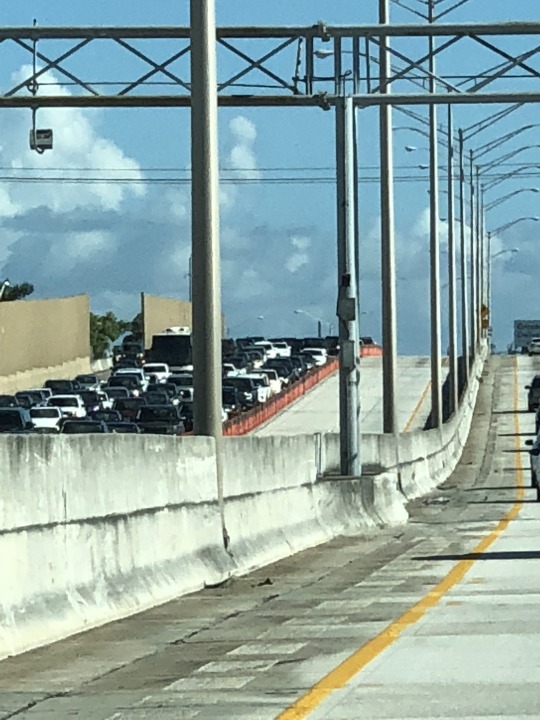
    Below is a photo of Interstate 95 near Miami, which, for the record, I myself did not take while driving.

    image

    The two empty lanes that you see are the “Express Lanes.” The price for using these lanes varies based on demand.

    During periods of low demand, the toll could be around $0.20 per mile. 

    During periods of high demand, such as during rush hour, it might be $1 per mile. 

    And during unusually heavy periods, like when there’s an accident, it could be more.

    We used these lanes while driving around the Miami area on this trip. The pricing always seemed reasonable and the lanes were never congested.

    I think the above picture is a good demonstration of how dynamic road pricing can be used alleviate traffic congestion.

    That’s why many cities, such as Portland, are exploring it as a solution. I wish Toronto would do the same.

  • Melting lollipops

    I’m out of office for the next week and so I’m going to try a bit of photoblogging. Here is a photo that I took this afternoon at Elena Bulatova Fine Art Gallery on St. Armand’s Circle. I really liked the art, and especially the melting lollipops and popsicles. They certainly felt climate appropriate.

  • Guide to hotels, inns, and hideaways

    Monocle has a new guidebook out that is dedicated to hotels, inns, and hideaways. It also has a particular emphasis on the “honest, charming, quirky and independent.” So forget the conventional 5-star hotels. Hotels are fascinating places, even in today’s world of Airbnb. If you’re planning a trip or planning to start a hotel, this may be a useful handbook for you. Pick one up, here.

  • Tropical Tobermory

    image

    I am in Tobermory at the tip of the Bruce Peninsula right now. 

    Above is a photo of the shoreline along Little Dunks Bay that I took with my Fuji. The water looks positively tropical, but it’s probably about 4 degrees celsius. It was perfect for chilling our ciders after a 2 hour hike through the woods.

    Sadly, I forgot the charger for my MacBook Pro back in the city, and so this – some photography – is all you’re going to get from me until I am back at my desk on Sunday evening.